
Which of the following is considered a default-risk-free instrument?
A) a three-month commercial paper issued by GE
B) a share of stock issued by Google
C) a three-month Treasury bill
D) a ten-year bond issued by Intel
Answer:
On August 15, 1971, the United States
A) returned to the gold standard.
B) suspended the convertibility of dollars into gold.
C) provided unlimited dollar reserves to the German central bank to help end a
speculative attack on the mark.
D) provided unlimited dollar reserves to the Bank of England to help end a speculative
attack on the pound.
Answer:
Short-term loans between banks are called

A) federal funds.
B) repurchase agreements.
C) repos.
D) discount loans.
Answer:
Mean reversion refers to the tendency for
A) futures prices to revert to the prices of the underlying securities.
B) the long-run mean return on stocks to equal the long-run mean return on bonds.
C) stocks with high returns today to experience low returns in the future and for stocks
with low returns today to experience high returns in the future.
D) financial analysts whose stock picks have earned above-normal returns in the past to
be unable to pick stocks that will perform as well in the future.
Answer:
How were open market operations conducted prior to 1935?
A) They were carried out by the Federal Open Market Committee.

B) They were carried out under the direction of the Secretary of the Treasury.
C) They were carried out by the district Federal Reserve banks.
D) They were carried out by the Banking Committee of the House of Representatives.
Answer:
Behavioral economics can best be described as
A) the study of situations in which people’s choices do not appear to be economically
rational.
B) the study of human economic behavior.
C) the basis for efficient markets.
D) the study of how the economy affects human behavior.
Answer:
The yield to maturity is equal to
A) the interest rate at which the present value of an asset’s returns is equal to its price
today.
B) the face value or par value of a coupon bond.

C) any payments received from an asset at the date the asset matures.
D) interest rate on the asset minus any taxes owed on the interest received.
Answer:
Which of the following was NOT considered to have been a drawback of the pre-1914
gold standard?
A) It sometimes led to inflation, which several times in the late nineteenth century
caused recessions in the United States.
B) Countries had little control over their domestic monetary policies.
C) Countries with trade deficits experienced deflation.
D) Changes in the world money supply were strongly influenced by gold discoveries.
Answer:
The demand curve for bonds would be reduced by
A) a decrease in expected returns on other assets.
B) an increase in the information costs of bonds relative to other assets.
C) an increase in wealth.

D) an increase in the liquidity of bonds relative to other assets.
Answer:
If the Fed buys securities worth $10 million, then
A) bank reserves will increase by $10 million.
B) bank reserves will decrease by $10 million.
C) currency in circulation will increase by $10 million.
D) bank holdings of securities increase by $10 million.
Answer:
How would monetary easing by the Bank of Japan affect the value of the yen?
A) It increases it since more people will take out loans at the low interest rates.
B) It reduces it since it reduces demand for yen since Japanese interest rates are now
lower.
C) It increases it since it increases demand for yen since Japanese interest rates are now
higher.
D) It reduces it since the supply of yen on the foreign exchange market is now lower.
Answer:
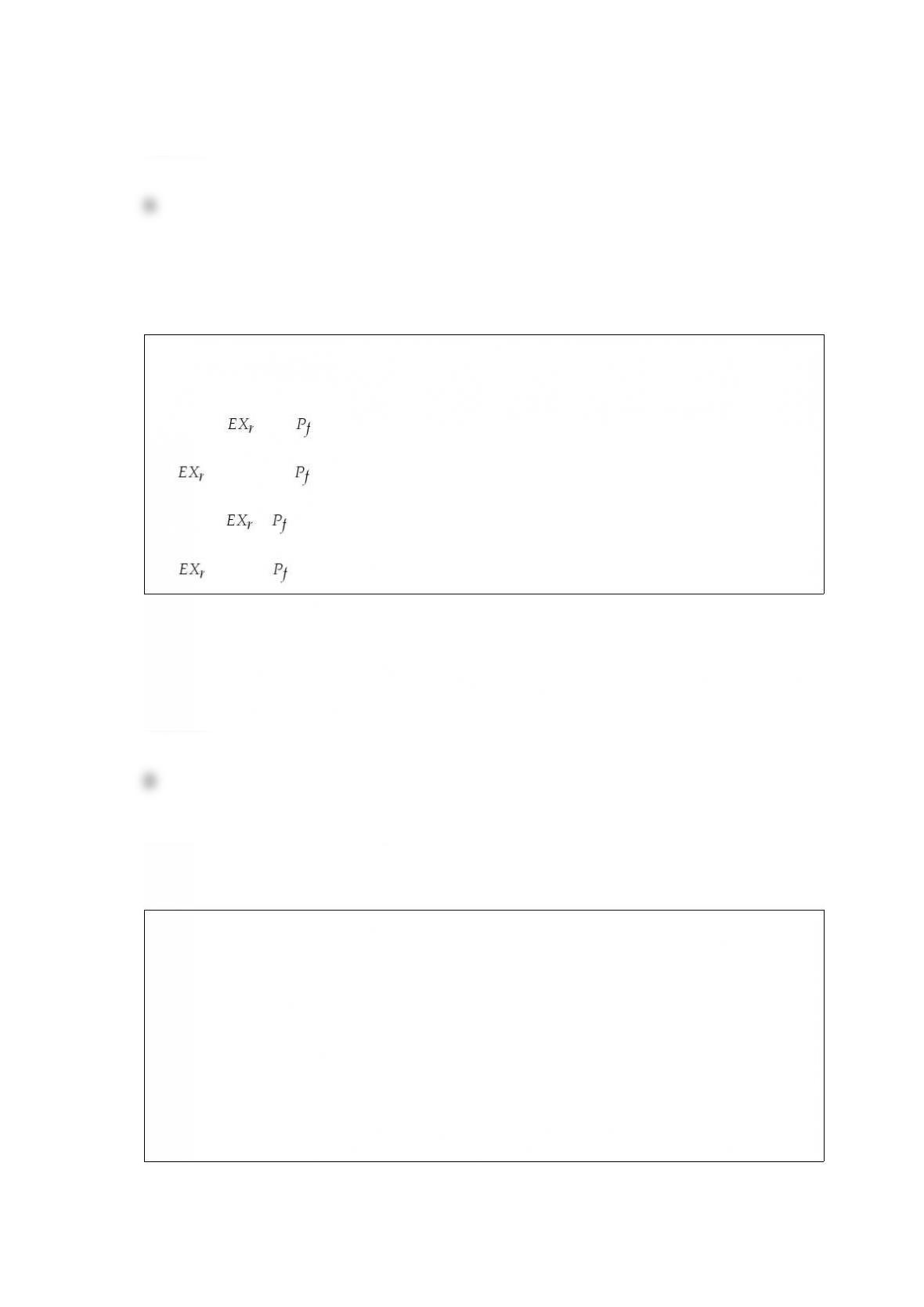
The relation between the nominal and real exchange rates is given by which of the
following equations?
A) EX = ( × P)/
B) = (EX × P)/
C) EX = ( × )/P
D) = (EX × )/P
Answer:
Which of the following was NOT cited as contributing to unusual uncertainty having an
adverse effect on aggregate supply?
A) the possibility that Congress may let the 2001, 2003 tax cuts to expire
B) the Fed’s limited use of monetary policy in fighting the recession
C) the severity of the financial crisis
D) concern that the Affordable Care Act would increase the cost of hiring workers

Answer:
Almost every time that there has been an inverted yield curve, what took place within
one year?
A) recession
B) rising inflation
C) financial crisis
D) higher bond yields
Answer:
What is the current limit on balances that are covered by federal deposit insurance?
A) $100,000
B) $250,000
C) $500,000
D) $1,000,000
Answer:

Which of the following is considered to be a goal of monetary policy?
A) a low federal budget deficit
B) fair wages
C) price stability
D) an end to poverty
Answer:
According to the quantity theory of money, if the long-run economic growth rate is
2.5%, by how much should the Fed increase the money supply if it wants inflation to be
2%?
A) 0.5%
B) 1.25%
C) 4.5%
D) 5%
Answer:

When an economy relies on specialization,
A) the economy will generally produce only one product.
B) the economy will usually be heavily agricultural.
C) each individual in the economy produces the goods or services for which he or she
has relatively the best ability.
D) each individual will be assigned by the government to produce that good or service
the government believes the economy should specialize in.
Answer:
A nation with an official settlements balance of -$100 billion is likely to experience a:
A) balance of payments surplus and accumulate $100 billion in international reserves
B) balance of payments deficit and accumulate $100 billion in international reserves
C) balance of payments surplus and a decline of $100 billion in international reserves
D) balance of payments deficit and a decline of $100 billion in international reserves
Answer:
Which of the following is NOT a financial intermediary?

A) mutual fund
B) bank
C) stock exchange
D) insurance company
Answer:
If oranges sell for $100 per crate in the United States and 4000 pesos per crate in
Mexico, the law of one price indicates that you should be able to exchange $1 for
A) 0.025 peso.
B) 4 pesos.
C) 40 pesos.
D) 400 pesos.
Answer:
Banks have responded to new regulations resulting from the Dodd-Frank Act in all of
the following ways EXCEPT:
A) raising minimum balances on free checking accounts

B) closing branches in low-income neighborhoods
C) raising overdraft fees
D) increased marketing of securities and financial advice to high-income customers
Answer:
In the bond market, the seller is considered to be
A) the lender.
B) the borrower.
C) the lender or the borrower depending upon the use to which the funds are put.
D) the lender or the borrower depending upon whether interest rates are rising or
falling.
Answer:
In 2010, doubts were raised about the debt of all of the following countries EXCEPT
A) Ireland.
B) Greece.
C) Poland.

D) Portugal.
Answer:
The best explanation of why the aggregate demand curve has a negative slope is that
A) at a higher price level households cut back on their spending on goods and services.
B) at a higher price level business firms wish to produce more goods and services.
C) a higher price level results in lower real balances and a higher real interest rate.
D) a higher price level results in less government spending on transfers, such as
unemployment insurance and social security payments.
Answer:
Which of the following statements about junk (high-risk) bonds is true?
A) They never outperform treasury bonds since they’re too risky.
B) The price of junk bonds increase as their perceived risk increases.
C) They tend to perform best during recessions.
D) One can profit by owning them if market perceptions of their risk decline.

Answer:
John Smith leaves his job in New York to go to California in hopes of finding a better
one. If John Smith is unemployed while searching for a job in California, economists
would consider him to be
A) frictionally unemployed.
B) structurally unemployed.
C) cyclically unemployed.
D) naturally unemployed.
Answer:
Why might a nation seek to maintain a pegged exchange rate?
A) It makes business planning easier for firms involved in the global economy.
B) It removes the need to intervene in the foreign exchange market.
C) It ensures that the exchange rate will remain at its equilibrium.
D) It makes their currency more attractive on the foreign exchange market.

Answer:
If you have $2 million in a CD at a commercial bank that is a member of the FDIC,
how much of your funds are uninsured?
A) $0
B) $1 million
C) $1.75 million
D) $2 million
Answer:
The key concept in the new classical approach to the aggregate supply curve is
A) the impact of imperfect information on business decisions.
B) the impact of changes in the price level on real balances.
C) the inverse relationship between the real interest rate and desired investment
spending.
D) the crowding out of investment spending by government spending.
Answer:

A capital gain occurs when the
A) coupon rate increases.
B) current yield increases.
C) price of an asset increases.
D) yield to maturity increases.
Answer:
“Tips” published in leading commercial or financial publications are unlikely to lead to
profitable trades because
A) only wealthy individuals can buy stocks in the volume necessary to take advantage
of tips.
B) whatever is gained by trading on the basis of tips will be taxed away by the
government.
C) the news will already be reflected in the market prices of the assets.
D) the news contained in the tips is usually inaccurate.
Answer:

Alternating periods of economic expansion and recession are known as the:
A) Fisher effect
B) business cycle
C) market risk
D) systematics
Answer:
What is the yield to maturity of a consol with a coupon of $85 and a price of $944.44?
A) 5.56%
B) 8.50%
C) 9.00%
D) Not enough information has been provided to determine the answer.
Answer:
Suppose that you own $10,000 worth of stock in General Motors. Adding stock in
which of the following companies would be least likely to reduce the risk in your
portfolio?
A) Google
B) Walmart
C) Ford
D) General Electric
Answer:
Illustrate the effect of the Fed purchasing $50 million worth of mortgage-backed
securities on the Fed’s balance sheet.
Answer:
What does research suggest as to the relationship between the independence of the
central bank and inflation? What is the rationale for this relationship?
Answer:
According to some economists, what contributed to the unusual uncertainty that
adversely affected aggregate supply during the recovery following the recession of
2007-2009?
Answer:
What is the difference between defensive and dynamic open market operations?

Answer:
How can banks measure interest-rate risk?
Answer:
A one-year discount bond has a face value of $1000 and a price of $925. What is the
yield to maturity on the bond? Report using percentages with two decimal places.
Answer:
What is the primary objective of the Financial Stability Oversight Council?
Answer:
Suppose you are risk averse and you are deciding between two investments. One has a
guaranteed return of 5% while the second has a 50% chance of a 10% return and a 50%
chance of a 0% return. Which investment would you choose? Why?
Answer:
Briefly explain the process of securitizing mortgages.
Answer:

If fiat money has no value apart from its use as money, how can it be used as a medium
of exchange?
Answer:
How would proponents of the efficient markets hypothesis use the Gordon-Growth
model to explain the movement of stock prices during the Financial Crisis of
2007-2009?
Answer:
What is a repurchase agreement?
Answer:
In what way are other assets less liquid than money?
Answer:
Why do households hold less in checking accounts then they once did?
Answer:
How does the liquidity premium theory explain an upward sloping yield curve during
normal economic times?

Answer:
During the Financial Crisis of 2007-2009, banks significantly increased their holdings
of excess reserves. What impact did this have on the money multiplier? How would the
Fed change the monetary base if it wanted to maintain a stable money supply?
Answer: