
Banks use “credit-risk analysis” to
A) determine the appropriate interest rate to charge borrowers.
B) determine whether to invest in the stock of a corporation.
C) determine the appropriate interest rate to pay depositors.
D) determine the likelihood of an audit by bank regulators.
Answer:
An exporter can hedge against the possible decline in a foreign currency by purchasing
A) put options on the currency.
B) call options on the currency.
C) the currency on the spot market.
D) currency on forward contracts.
Answer:
As the time of delivery in a futures contract gets closer
A) the futures price gets closer to the spot price.

B) the futures price generally rises further above the spot price.
C) the futures price generally falls further below the spot price.
D) the futures and spot prices remain the same as they were when the contract was first
created.
Answer:
Since the 1960s, the percentage of U.S. output exported to foreigners
A) remained about the same.
B) more than doubled.
C) increased by more than ten times.
D) declined by about half.
Answer:
Fundamentally, to reap the benefits of specialization, an economy must
A) be heavily industrial.
B) be heavily agricultural.
C) have an extensive system of higher education.

D) develop ways for individuals to trade goods with one another.
Answer:
If bond investors think they lack enough details to evaluate the likelihood of defaults on
certain bonds, this will result in higher:
A) expected return
B) liquidity
C) information costs
D) expected inflation
Answer:
An increase in the expected price level
A) shifts the short-run aggregate supply curve up and to the left.
B) shifts the short-run aggregate supply curve down and to the right.
C) has no effect on the short-run aggregate supply curve.
D) results in a movement along the short-run aggregate supply curve, rather than a shift
in the short-run aggregate supply curve.

Answer:
What is the primary reason for the differences between the U.S. banking system and
those in other major industrial countries?
A) Economies of scale are greater in banking in the United States than in banking in
other countries.
B) legislation that led to the development of state and national banks
C) the Federal Reserve System
D) the National Bank
Answer:
Generally, when there is asymmetric information
A) a lender will only lend to the government.
B) a lender will only lend to well-known borrowers.
C) practical solutions are devised to allow lending to take place.
D) a lender will cease all lending activities.

Answer:
Which of the following is NOT an advantage of a futures contract over a forward
contract?
A) reduced counterparty risk
B) increased flexibility
C) lower information cost
D) increased liquidity
Answer:
Economists define money as
A) cash in circulation.
B) deposits in commercial banks.
C) anything that people are willing to accept in payment for goods and services or to
pay off debts.
D) bonds issued by large corporations.
Answer:

A hyperinflation occurs when
A) inflation persists for more than two years.
B) inflation persists for more than five years.
C) the inflation rate exceeds 50% per year.
D) the inflation rate exceeds 50% per month
Answer:
The shadow banking system refers to
A) commercial banks.
B) community banks.
C) pawn shops and institutions that offer payday loans.
D) nonbank financial institutions such as investment banks and hedge funds.
Answer:

Business finance companies
A) purchase accounts receivable of small firms at a discount.
B) sell commercial paper and buy long-term corporate bonds.
C) take in deposits from savers and buy corporate commercial paper.
D) are strictly regulated by state governments.
Answer:
What new authority did the ECB receive in 2012?
A) the authority to oversee the banking systems of all member countries
B) the ability to set different interest rates in different member countries
C) the ability to require that member nations balance their budget
D) permission to monetize the debt of member countries
Answer:
The rate of return of a stock held for one year equals
A) the change in the price of the stock.

B) the dividend yield plus the rate of capital gain.
C) the rate of capital gain minus the dividend yield.
D) the dividend yield minus the rate of capital gain.
Answer:
Though Treasury bonds may have little default risk, what type of risk exists when
current interest rates are low?
A) price risk
B) refinancing risk
C) interest-rate risk
D) present value risk
Answer:
How does hedging affect the flow of funds in the financial system?
A) It reduces it since it is a sign that investors do not like risk.
B) It reduces it because it increases risk by encouraging speculation.
C) It increases it because it reduces risk thus encouraging more people to make

financial investments.
D) It increases it by encouraging more speculation.
Answer:
If a central bank wishes to lower the foreign-exchange value of its currency, it will
A) buy domestic currency and sell foreign assets.
B) sell domestic currency and buy foreign assets.
C) attempt to raise domestic interest rates.
D) attempt to lower the domestic price level relative to foreign price levels.
Answer:
How can the Gordon Growth model help explain the major decline in stock indexes
during 2007-2009?
A) There was an increase in the required return on equities and a decrease in the
expected growth rate of dividends.
B) There was a decrease in the required return on equities and an increase in the
expected growth rate of dividends.
C) There was an increase in the required return on equities and an increase in the

expected growth rate of dividends.
D) There was a decrease in the required return on equities and a decrease in the
expected growth rate of dividends.
Answer:
Why did fewer state banks choose to become or remain members of the Federal
Reserve System during the 1960s and 1970s?
A) Nominal interest rates rose.
B) The required reserve ratio rose.
C) The discount rate rose.
D) Open market operations declined.
Answer:
The risk premium of corporate bonds typically increases
A) when the average price of corporate bonds increase.
B) during a recession.
C) when the interest rates on corporate bonds decreases.

D) when the risk premium on treasury bonds increases.
Answer:
Financial futures contracts are regulated by
A) the Commodity Futures Trading Commission.
B) the Federal Trade Commission.
C) the Interstate Commerce Commission.
D) the Options and Futures Commission.
Answer:
Which of the following is a name for when a bank promises to lend funds to a borrower
to pay off its commercial paper?
A) loan commitment
B) standby letter of credit
C) securitization
D) loan sale

Answer:
Which of the following represents the equation that would be used to determine the
yield to maturity of a corporate bond with a face value of $1000, price of $1100,
coupon rate of 5%, and maturity in three years?
A) $1100 = $1500/(1 + i)3
B) $1100 = $500/(1 + i) + $500/(1 + i)2 + 1000/(1 + i)3
C) $1100 = $500/(1 + i) + $500/(1 + i)2 + 500/(1 + i)3
D) $1100 = $500/(1 + i) + $500/(1 + i)2 + 1500/(1 + i)3
Answer:
The political business cycle theory predicts that
A) the Fed acts to promote the interests of the general public.
B) the Fed acts to stimulate economic activity before an election.
C) the President’s appointments to the Board of Governors will usually be politicians.
D) political factors over which the Fed has no control are most important in explaining
the business cycle.

Answer:
Which of the following occurred following the failure of the Bank of the United States
in 1930?
A) Interest rates on low-grade corporate bonds rose relative to high-rated corporate
bonds.
B) Other banks in New York City suffered liquidity problems.
C) A bank panic ensued within days.
D) The stock market crashed.
Answer:
In a large open economy,
A) domestic lending and borrowing decisions have no impact on the world real interest
rate.
B) an increase in the domestic supply of loanable funds would lower the world real
interest rate.
C) the domestic equilibrium real interest rate is determined independently of foreign
borrowing and lending.
D) an increase in the domestic demand for loanable funds would lower the world real
interest rate.

Answer:
Most macroeconomic policy consists of:
A) monetary policy
B) fiscal policy
C) exchange-rate policy
D) regulatory policy
Answer:
Debt instruments are also called
A) equities.
B) credit market instruments.
C) prospectuses.
D) units of account.
Answer:

According to the new classical approach to the aggregate supply curve, the aggregate
supply curve slopes upward because
A) increases in the price level result in lower real balances.
B) higher current output results in higher desired investment.
C) higher prices result in higher levels of spending as consumers attempt to stay ahead
of inflation.
D) businesses have difficulty in distinguishing relative price increases from general
price increases.
Answer:
In the current U.S. economy, who plays the role of lender of last resort?
A) The Securities and Exchange Commission
B) The Federal Deposit Insurance Corporation
C) The Federal Reserve System
D) The Social Security Administration
Answer:

An investor will generally find that hiring an investment firm to actively manage his or
her portfolio will
A) result in a higher return than would be received from an index mutual fund.
B) be less expensive than simply placing money in an index mutual fund.
C) result in a higher return, but will be more expensive than placing money in an index
mutual fund.
D) result in about the same return, but be more expensive than placing money in an
index mutual fund.
Answer:
When investment banks buy or sell securities on their own account, it’s called
A) financial engineering.
B) proprietary trading.
C) underwriting.
D) factoring.
Answer:
In what sense does the IMF act as a lender of last resort? How might the IMF’s actions
during the Mexican crisis of the mid-1990s have contributed to the Asian currency
crisis a few years later?
Answer:
What would happen to the value of the dollar if prices in the U.S. increased more
rapidly relative to prices in other countries?
Answer:
How does a sterilized intervention by the Fed in foreign exchange market differ from an
unsterilized intervention?
Answer:
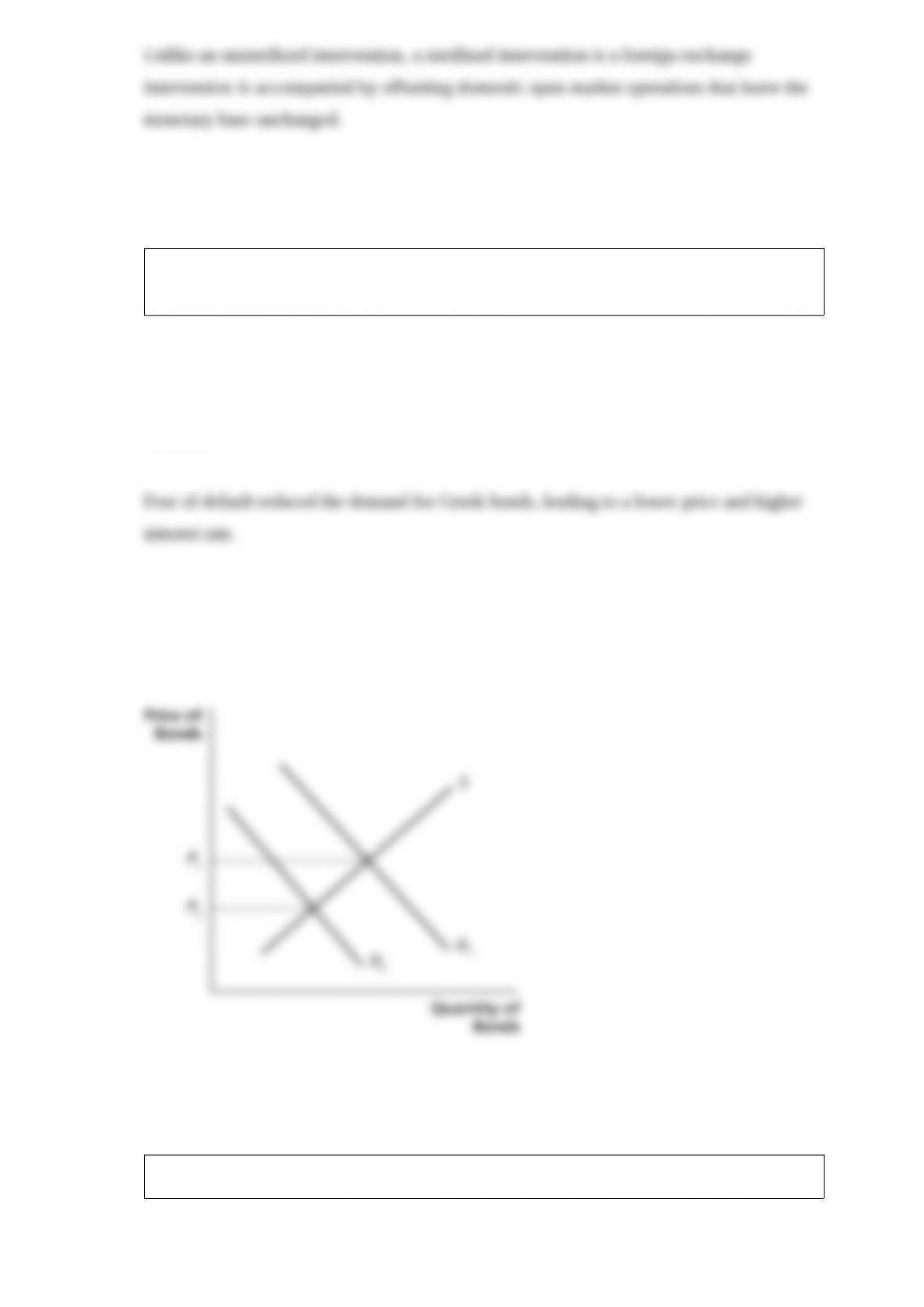
In 2012, many investors feared that Greece may default on its bonds. Make use of a
graph of the bond market to show how this affected interest rates on Greek bonds.
Answer:
Describe the four stages of the financial regulatory pattern.
Answer:
According to the expectations theory, what will be the interest rate on a three-year bond
if a one-year bond has an interest rate of 2% and is expected to have an interest rate of
3% next year and 5% in two year? Report your answer using a percentage with two
decimal places.
Answer:
Why did some economists and policymakers think ratings agencies had a conflict of
interest leading up to the Financial Crisis of 2007-2009?
Answer:
Steve Forbes has run for president twice on a program of a “flat tax.” Under a flat tax,
there would be only one tax bracket for the federal income tax and most tax deductions
and tax exemptions would be eliminated. Suppose that Forbes wins the 2016
presidential election. What would be the likely impact on the market for municipal
bonds?
Answer:
What impact do savings rates in Belgium have on the real interest rate that businesses in
Belgium must pay to obtain the funds to finance their spending on plant and
equipment?
Answer:
What are the effects of the double taxation of dividends?

Answer:
Economic studies have shown that countries that have high inflation rates have lower
rates of economic growth than do countries with low inflation rates. Explain what
underlies this relationship between inflation and economic growth.
Answer:
What are the three key features of the financial system that result from the existence of
transactions and information costs?
Answer:
Why do restrictions on capital inflows receive more support from some economists than
restrictions of capital outflows?
Answer:
A corporation issues a three-year bond with a coupon of $50 and a face value of $1000.
A year later, market interest rates have declined to 4%. What is the price of the bond a
year after it was issued? Report your answer to the nearest dollar.
Answer:
Discuss what happened to the market prices on corporate securities relative to
government securities during the Great Recession.
Answer:
What are the risks and reward for investment banks involved in underwriting a new
security issue?
Answer:
What real-world complications keep purchasing power parity from being a complete
explanation of exchange rates ?
Answer:
In what ways do futures contracts differ from forward contracts?
Answer:
What makes advising on mergers and acquisitions particularly profitable for investment
banks relative to other services that they provide?
Answer: