
A loan officer uses a credit scoring system to
A) compare the interest rate on a loan to interest rates on other assets with comparable
risk.
B) keep track of the fraction of a bank’s assets tied up in loans to a single individual or
business.
C) predict statistically whether an individual is likely to default on a loan.
D) match any particular loan with the deposits being used to fund it.
Answer:
Under the expectations theory, an upward-sloping yield curve indicates that investors
expect future short-term rates to
A) fall.
B) rise.
C) remain constant.
D) either rise or remain constant.
Answer:
The demand for bonds is

A) equivalent to the demand for loanable funds.
B) equivalent to the supply of loanable funds.
C) represented by an upward-sloping line when the price of bonds is on the vertical axis
and the quantity of bonds demanded is on the horizontal axis.
D) represented by a downward-sloping line when the interest rate is on the vertical axis
and the quantity of bonds demanded is on the horizontal axis.
Answer:
The January effect
A) largely disappeared after receiving attention in the 1980s.
B) refers to the gap between futures prices and the prices of the underlying securities
that occurs each January.
C) was stronger during the 1980s than during previous decades.
D) is the observation that stocks tend to be sold off in January.
Answer:
A bubble occurs when

A) the price of a stock is above its fundamental value.
B) inside information is used to make profits from trading a company’s stock.
C) a company reports profits that are significantly above or below the expectations of
financial analysts.
D) the futures price is greater than the price of the underlying asset.
Answer:
The national economic forecast for the next two years prepared by the staff of the Board
of Governors is published in the
A) green book.
B) beige book.
C) blue book.
D) Fed book.
Answer:
The price at which an option may be exercised is called the
A) market price.

B) equilibrium price.
C) strike price.
D) fixed price.
Answer:
The percentage of deposits that banks must hold as reserves is called the
A) percentage rate.
B) required reserve ratio.
C) Fed rate.
D) discount rate.
Answer:
Which of the following is a contractual saving institution?
A) The New York Stock Exchange
B) Greater Illinois Savings and Loan
C) Prudential Insurance Company

D) Fidelity Magellan Mutual Fund
Answer:
Credit risk is the risk that
A) an insufficient number of borrowers will apply for loans or credit.
B) interest rates will rise after a loan has been granted.
C) interest rates will fall after a loan has been granted.
D) borrowers might default on their loans.
Answer:
A one-year discount bond with a par value of $5000 sold today, at issuance, for $4750
has a yield to maturity of
A) 5.00%.
B) 5.26%.
C) 2.50%.
D) 9.75%.

Answer:
The automatic mechanism can best be described as:
A) the process of the economy adjusting back to potential GDP without any action
taken by the government
B) the result of monetary policy implemented by the Fed restoring full employment
C) how fiscal policy is used to return the economy to its potential
D) using rule-based policies to stabilize the economy
Answer:
The double taxation of dividends typically refers to
A) dividends being taxed first as corporate profits and then as income after being paid
to stock holders.
B) stock holders paying both income and social security taxes on dividends.
C) stock holders paying an income tax and dividend surtax on dividends.
D) dividends being taxed at both the state and local level.
Answer:

Which of the following expressions is correct?
A) AE = C + I + G – NX.
B) AE = C + I + G + NX.
C) AE = C + I + (G – T) + NX.
D) AE = C + I + (G – T) – NX.
Answer:
Which of the following is NOT a regulation applying to swap dealers as a result of the
Dodd-Frank Act?
A) Swaps must be traded through a clearinghouse.
B) The value of swap contracts are limited to no more than $8 billion.
C) Dealers are required to deposit a fraction of the value of the contract with the
clearinghouse.
D) Data on trades must be publicly available.
Answer:

Which of the following financial assets has both the highest risk and highest return for
the period of 1926-2011?
A) small company stocks
B) large company stocks
C) corporate bonds
D) Treasury bills
Answer:
Suppose Apple announces that its earnings for the fourth quarter of 2013 rose to $2
billion. As a result of this announcement the price of Apple’s stock does not change. The
best explanation of this is
A) market participants were expecting Apple’s earnings to be greater than $2 billion.
B) market participants expected Apple’s earnings to be $2 billion.
C) market participants expected Apple’s earnings to be less than $2 billion.
D) market participants have adaptive expectations.
Answer:

Which of the following assigns widely-followed bond ratings?
A) Standard & Poor’s Corporation
B) Securities and Exchange Commission
C) Federal Reserve
D) IBM
Answer:
As wealth decreases, which of the following is likely to account for a smaller fraction
of a saver’s portfolio?
A) stocks
B) corporate bonds
C) cash
D) U.S. government securities
Answer:
The “lemons problem” exists in the market for goods because

A) sellers tend to try to take advantage of buyers.
B) buyers tend to try to take advantage of sellers.
C) differences in the quality of the goods being exchanged.
D) of moral hazard.
Answer:
The law of large numbers allows insurance companies to
A) hold capital market instruments as assets without fearing overly large numbers of
defaults.
B) hold money market instruments as assets without fearing overly large numbers of
defaults.
C) predict the average number of occurrences of insurable events in a large population
of policyholders.
D) charge higher premiums than necessary, knowing that large numbers of individuals
will pay them.
Answer:
Private information-collection firms fail to eliminate the adverse selection problem

because
A) the law does not allow them to disclose private information about the
creditworthiness of firms.
B) they do not monitor borrowers after loans have been made.
C) some investors who do not pay for their services will still profit from them.
D) most companies refuse to provide them with any information.
Answer:
When the Fed sells foreign assets and buy domestic assets at the same time,
A) its assets and liabilities rise by the same amount.
B) its assets and liabilities fall by the same amount.
C) the composition of its assets changes, but its liabilities are unaffected.
D) the composition of its liabilities changes, but its assets are unaffected.
Answer:
The primary difference between an American and European option is:
A) American options must be exercised on the expiration date

B) European options must be exercised on the expiration date
C) American options may be exercised at any point up until the expiration date
D) European options may be exercised at any point up until the expiration date
Answer:
Which of the following was NOT a result of the passage of the Gramm-Leach-Bliley
Act?
A) It repealed the Glass-Steagall Act.
B) It allowed commercial banks to participate in securities, insurance, and real estate
activities.
C) It authorized new financial holding companies which permitted securities and
investment firms to own commercial banks.
D) It increased the capital requirements for commercial banks.
Answer:
With debt financing
A) moral hazard problems are eliminated.

B) moral hazard problems are reduced but not eliminated.
C) adverse selection problems are eliminated.
D) firms reduce the risk that they will become bankrupt during a recession.
Answer:
Primary dealers are those
A) permitted to trade directly with the Fed.
B) who work under the account manager at the Federal Reserve Bank of New York.
C) who specialize in selling bonds to small private investors.
D) responsible for assuring that interest rates do not decline unless the FOMC has given
specific instructions that they decline.
Answer:
What is the length of a term for the Chairman of the Board of Governors?
A) one year
B) four years
C) 14 years

D) 28 years
Answer:
During the early 1930s, the Fed was reluctant to rescue nonsolvent banks out of fear of
encouraging:
A) moral hazard
B) adverse selection
C) bank run
D) sovereign debt crisis
Answer:
Forward transactions originated in the market for
A) common stock.
B) corporate bonds.
C) government bonds.
D) agricultural and other commodities.

Answer:
Which of the following would cause the nominal exchange rate to depreciate?
A) The real exchange rate appreciates.
B) The domestic inflation rate increases.
C) The foreign inflation rate increases.
D) The government budget deficit increases.
Answer:
In a put options contract, the
A) seller has the obligation to receive the instrument at a specified time.
B) buyer has the obligation to deliver the instrument at a specified time.
C) buyer has the obligation to receive the instrument at a specified time.
D) seller has the obligation to deliver the instrument at a specified time.
Answer:

All of the following are problems associated with commodity money EXCEPT
A) it is a cumbersome form of payments system.
B) commodities tend to have little value in and of themselves.
C) its value is dependent on its purity.
D) costs are incurred in certifying the purity and weight of commodity money.
Answer:
The Chairman of the Federal Open Market Committee is also
A) the president of the Federal Reserve Bank of New York.
B) the chairman of the Securities and Exchange Commission.
C) the chairman of the Federal Deposit Insurance Corporation.
D) the chairman of the Board of Governors.
Answer:

The presence of information and transactions cost result in all of the following
EXCEPT:
A) reduced efficiency of financial markets.
B) higher returns for savers
C) some funds not being lent at all
D) borrowers need to pay more for funds
Answer:
Suppose you purchase a bond with a coupon of $30 for $1025. You sell it one year later
for $1050. What rate of return did you earn? Report a percentage with two decimal
places.
Answer:
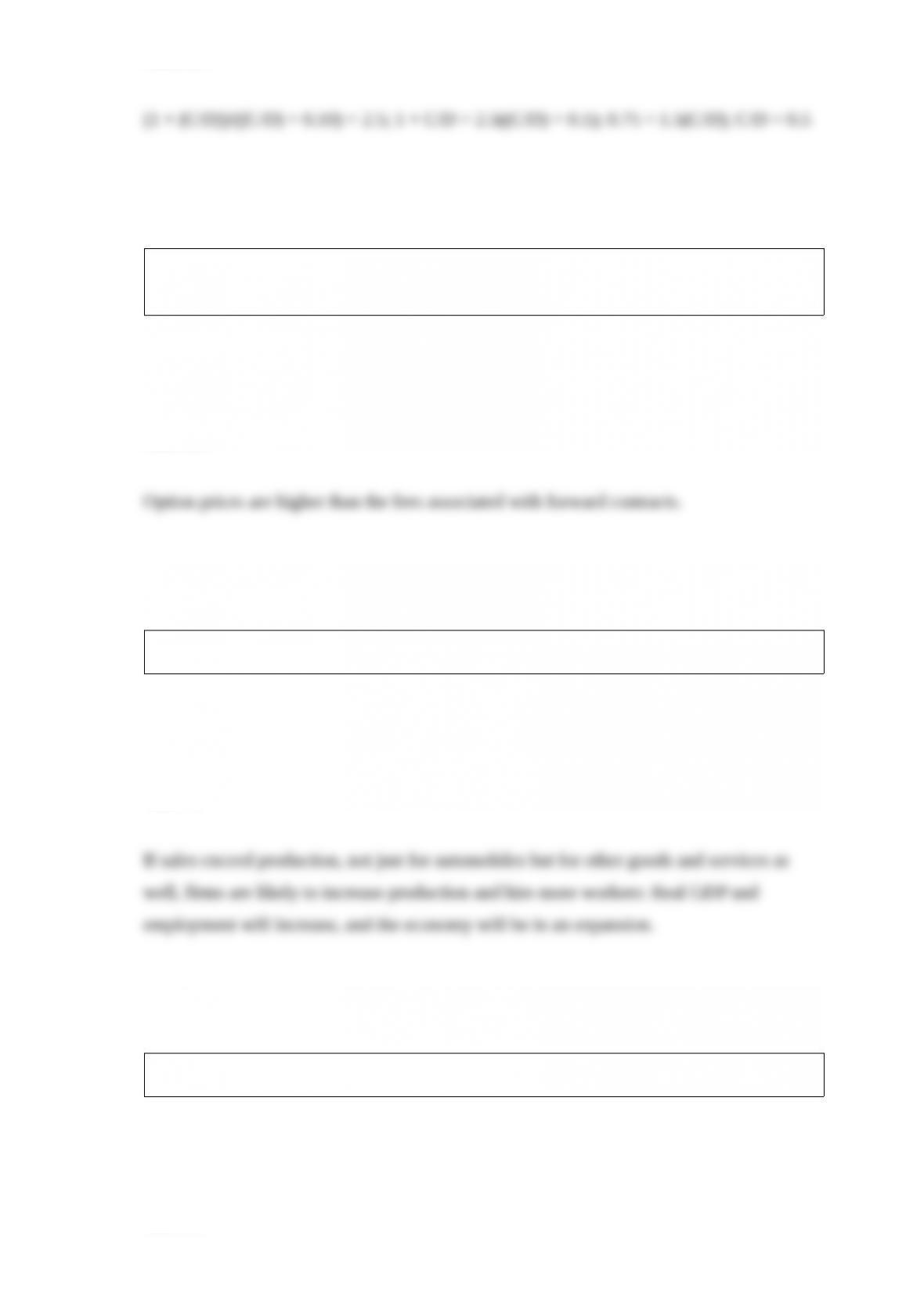
Suppose the banking system holds no excess reserves. If the required reserve ratio is
0.10 and the money multiplier is 2.5, what is the value of the currency-deposit ratio?
Answer:
What is an advantage of using forward contracts instead of options to hedge against
exchange-rate risk?
Answer:
How is the economy likely to respond when AE (sales) exceed production?
Answer:
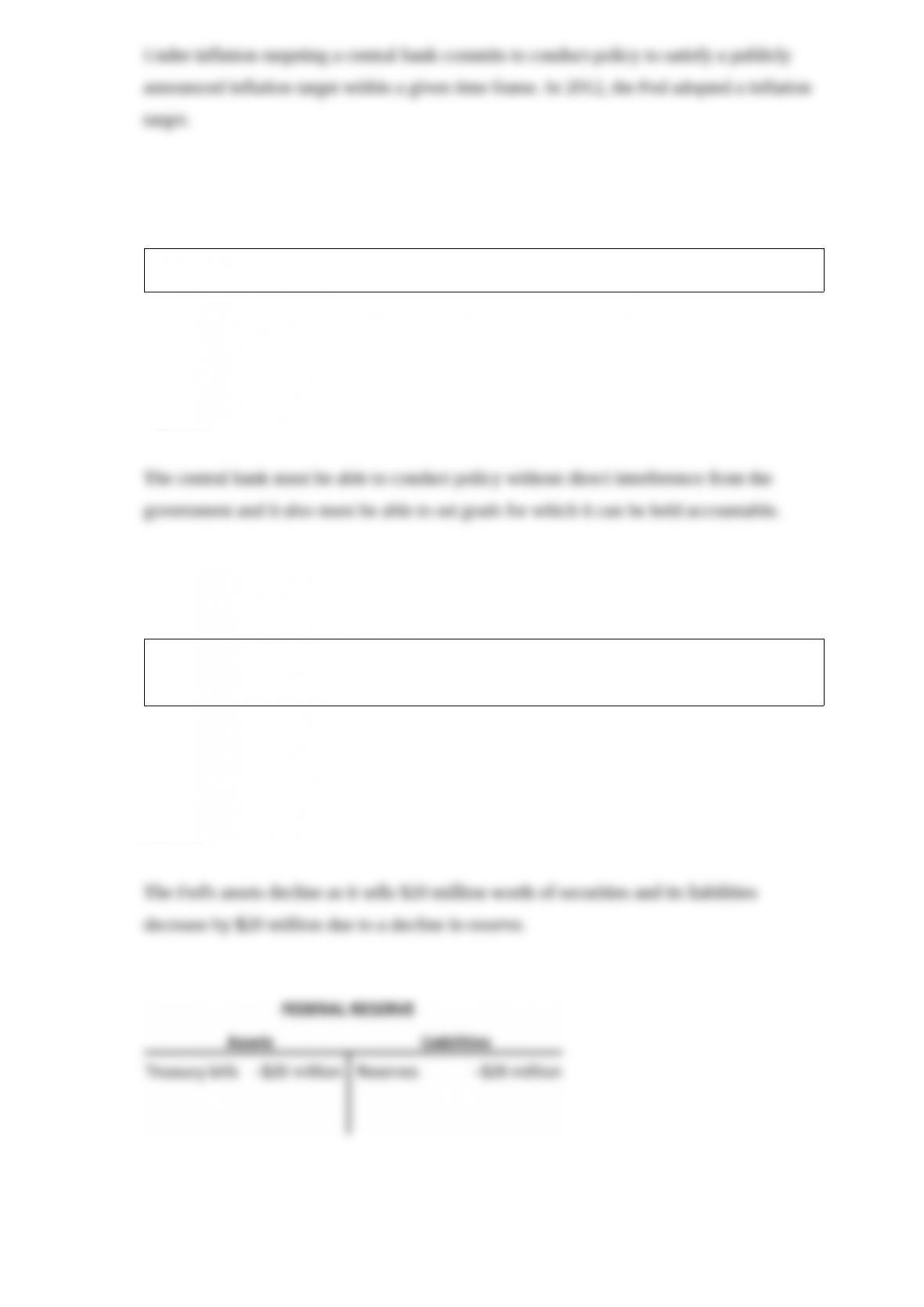
What is meant by inflation targeting? Does the Fed engage in inflation targeting?
Answer:
What constitutes meaningful independence of a central bank?
Answer:
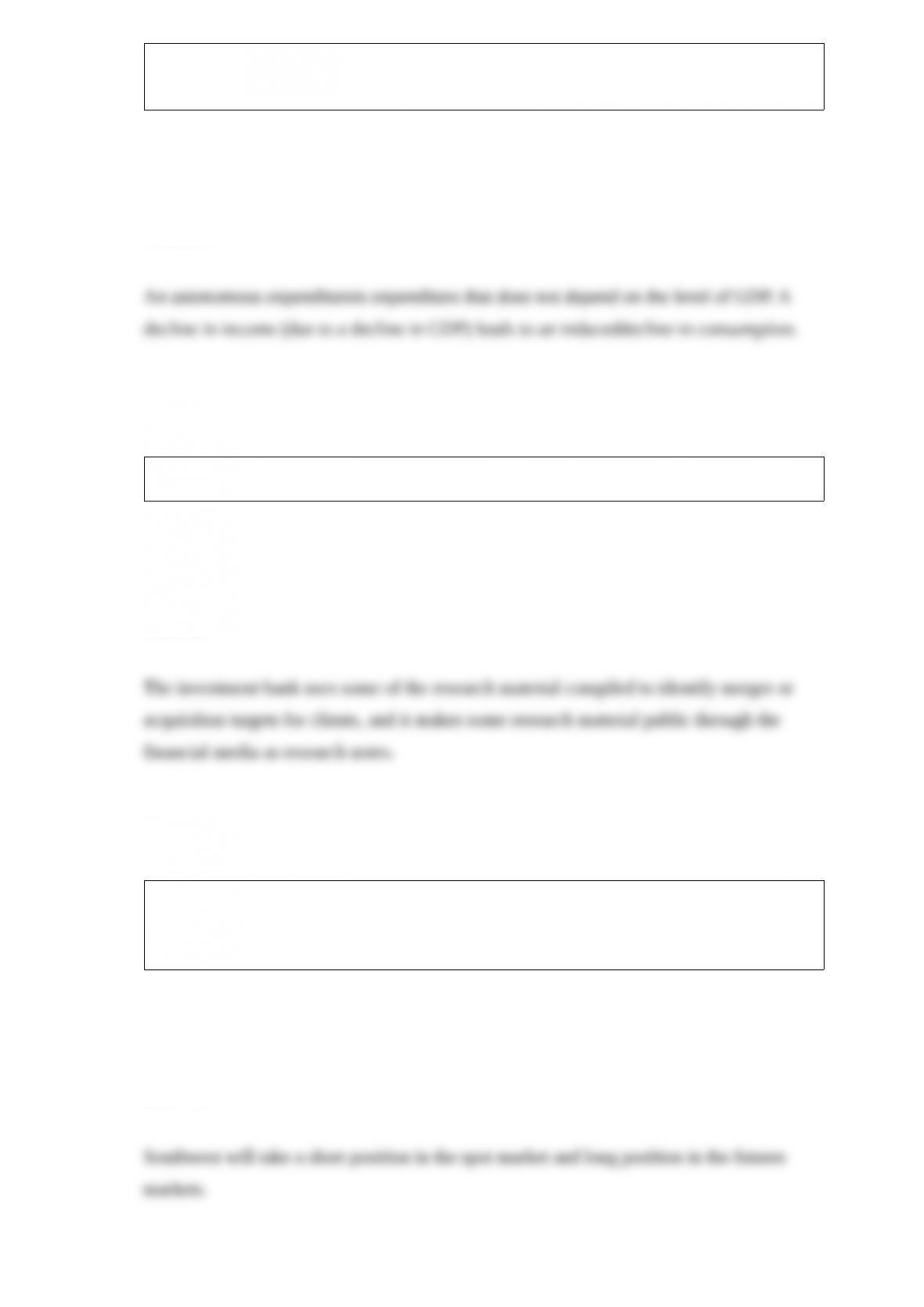
Illustrate the effect of an open market sale of $20 million worth of Treasury bills on the
Fed’s balance sheet.
Answer:
What is the difference between an autonomous change in spending and an induced
change in spending?
Answer:
How do investment banks use the results of their research?
Answer:
Southwest Airlines relies on jet fuel to operate its planes. If it chooses to hedge against
future changes in fuel prices, what positions (long or short) will it take in the spot and
futures markets?
Answer:
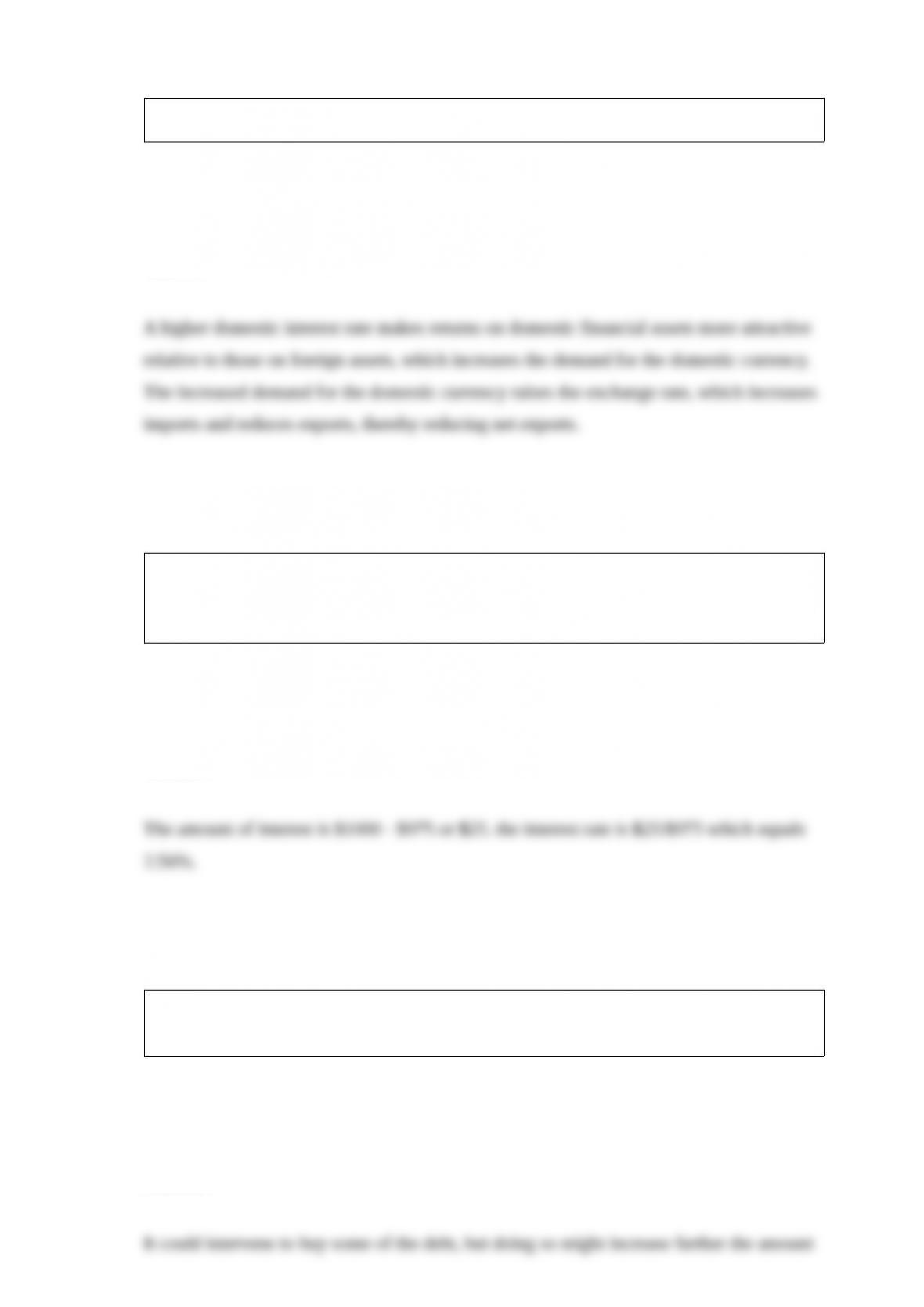
How does an increase in interest rates affect net exports?
Answer:
Suppose a firm receives $975 for a discount bond with a face value of $1000 to be
repaid in one year. What is the amount of interest on the bond? What is the interest rate
on the bond? Report a percentage with two decimal places.
Answer:
What was the dilemma that faced the European Central Bank in response to the
sovereign debt crisis of 2010?
Answer:
Suppose that short-term real interest rates fall in Japan. Is this likely to be good news or
bad news for the tourism industry in Hawaii?
Answer:
In what ways is the Fed independent of the political process?
Answer:
How did maintaining the gold standard deepen the severity of the Great Depression?
Answer:
What are the information costs faced by savers?
Answer: