
Moral hazard is not eliminated in debt financing because
A) borrowers have an incentive to assume greater risk than is in the interest of the
lender.
B) firms with a great deal of debt often go bankrupt.
C) principal-agent problems are greater with debt financing than with equity financing.
D) the use of restrictive covenants tends to increase moral hazard.
Answer:
In effect, banks are able to charge
A) depositors for banks’ superior information about borrowers.
B) borrowers for banks’ superior information about depositors.
C) the government for banks’ superior information about borrowers and depositors.
D) interest rates that are in fact above those legally allowed.
Answer:
When talking about forward contracts, the date on which the contracted delivery must
take place is called:

A) the settlement date
B) the counterparty date
C) forward date
D) spot date
Answer:
A flight to quality refers to a shift by savers from
A) bonds and into stocks.
B) stocks and into gold or other precious metals.
C) bonds and into real assets, such as real estate.
D) low-quality bonds and into high-quality bonds.
Answer:
The Fed tends not to use discount policy as its principal tool in influencing the money
supply since
A) discount loans do not affect the money supply.
B) it does not have as much control over discount loans as it has on open market

operations.
C) it is prohibited from doing so by an act of Congress.
D) it prefers to use reserve requirements.
Answer:
Suppose that Acme Widget is currently selling for $100 per share and you own a call
option to buy Acme Widget at $75 per share. The intrinsic value of your option is
A) $25.
B) $75.
C) $100.
D) not possible to determine in the absence of information on values of the share price
of Acme Widget between now and the expiration date of the call.
Answer:
Which of the following is NOT a reason given by economists for the failure of Okun’s
law to account for the rise in unemployment during the recession of 2007-2009?
A) increased willingness among firms to lay off workers during recessions
B) a surge in productivity during the recession

C) the unusual severity of the recession
D) it does not take into account the effect of the stimulus
Answer:
Since most banks have positive gaps and negative duration gaps, an increase in market
interest rates will
A) increase bank profits and increase bank capital.
B) increase bank profits and decrease bank capital.
C) decrease bank profits and increase bank capital.
D) decrease bank profits and decrease bank capital.
Answer:
Suppose one person buys a copy of Consumer Reports and gives away free copies to all
who request one. This is an example of
A) free rider problem.
B) moral hazard.
C) adverse selection.

D) economies of scale.
Answer:
Foreign-exchange market interventions will always
A) lead to a decline in domestic interest rates relative to foreign interest rates.
B) lead to a rise in domestic interest rates relative to foreign interest rates.
C) lead to a decline in the domestic money supply.
D) alter a central bank’s holdings of international reserves.
Answer:
Which of the following appears to be evidence against the public interest view of the
Fed’s motivation?
A) The conflict with the Treasury over interest rate fixing during World War II.
B) The failure of the Fed to emphasize the goal of price stability.
C) The unwillingness of the Fed to turn over its excess profits to the Treasury.
D) The independence of Fed chairmen from the authority of the President.

Answer:
All of the following are advantages of currency pegging EXCEPT
A) it reduces exchange rate risk.
B) it is a check against inflation.
C) it provides protection for firms that have taken out loans in foreign currencies.
D) it keeps the exchange rate closer to its equilibrium rate.
Answer:
NOW accounts were developed in order to
A) circumvent Regulation Q.
B) provide banks with a checkable deposit on which they did not have to pay interest.
C) provide banks with a liquid, interest-earning asset.
D) provide banks with a means of earning interest on the funds in their reserve accounts
with the Fed.
Answer:

Which of the following is an advantage of hedging with options instead of forward
contracts?
A) Options prices tend to be lower than forward prices.
B) If the price moves in the opposite direction to the one hedged against, the hedger can
decline to exercise the option and limit the loss to what was paid for the option.
C) If the price moves in the direction of the one hedged against, the hedger can decline
to exercise the option and limit the loss to what was paid for the option.
D) Options allow investors to purchase a forward contract at a later date.
Answer:
Which of the following is an example of adverse selection?
A) A homeowner with a large fire insurance policy allows the wiring in her house to
deteriorate.
B) A woman with a large life insurance policy takes up sky diving.
C) Your brother-in-law borrows $20,000 from you to open a pizza parlor, but spends it
gambling at the racetrack instead.
D) A man with a bad heart condition buys a large life insurance policy.
Answer:

The due diligence process is
A) the process by which a firm chooses an investment bank.
B) when an investment bank researches a firm’s value.
C) how an investment bank underwrites large issues.
D) the review of a prospectus by the SEC.
Answer:
Herd behavior can best be described as
A) the large number of investors involved in the stock market.
B) how large participation in financial markets increase market efficiency.
C) informed investors can outperform relatively uninformed investors.
D) relatively uninformed investors follow the behavior of other investors instead of
consider fundamentals.
Answer:

Municipal bonds are issued
A) only by local governments.
B) only by state governments.
C) by both state and local governments.
D) by the federal government, and by state and local governments.
Answer:
An exception to the law of one price occurs if
A) the good is not tradeable.
B) demand for the good is stronger in some countries than in others.
C) exchange rates are flexible, rather than fixed.
D) interest rates differ across countries.
Answer:
How can a bond have a negative rate of return?

A) if the current yield is greater than the coupon rate
B) if the current yield is less than the coupon rate
C) if the rate of capital loss exceeds the current yield
D) if the rate of capital gains is less than the current yield
Answer:
A tariff is a
A) limit on the volume of foreign goods that can be brought into the country.
B) tax on goods purchased from other countries.
C) tax on goods exported to other countries.
D) subsidy by governments to firms that produce goods for export to other countries.
Answer:
Under the Bretton Woods system, exchange rates were supposed to be adjusted
A) only when a country experienced fundamental disequilibrium.
B) daily.

C) weekly.
D) following each annual meeting of the board of governors of the International
Monetary Fund.
Answer:
When a country’s nominal exchange rate depreciates, the price of
A) that country’s goods abroad increases.
B) that country’s goods abroad decreases.
C) foreign goods sold in the country decreases.
D) that country’s goods produced and sold at home decreases.
Answer:
The McFadden Act of 1927
A) separated commercial banking from investment banking.
B) put a tax on the issuance of bank notes by state banks.
C) prohibited national banks from operating branches outside their home states.
D) established the Federal Reserve System.

Answer:
Derivative instruments are
A) assets such as bonds or common stock that derive their value from the value of the
companies which issue them.
B) assets whose rates of returns must be derived from information published in
financial tables.
C) assets which derive their value from underlying assets.
D) computers which display real-time financial information.
Answer:
When a country’s real exchange rate appreciates,
A) its nominal exchange rate must also have appreciated.
B) its nominal exchange rate must have depreciated.
C) it can trade its goods for fewer units of foreign goods.
D) it can trade its goods for more units of foreign goods.

Answer:
Using a good as a medium of exchange confers the benefit that
A) the need to quote so many prices in trade is reduced.
B) the need for a double coincidence of wants is greatly increased.
C) the need for specialization is reduced.
D) transactions costs are increased, but they now may be paid in money terms.
Answer:
What is the rate of return on a bond with a coupon of $55 that was purchased for $900
and sold one year later for $950?
A) 5.56%
B) 6.11%
C) 11.67%
D) 12.43%
Answer:

What was the primary reason that Congress initiated deposit insurance in the 1930s?
A) protect the deposits of individual savers
B) provide more of an incentive for depositors to monitor bank activities
C) reduce systemic risk to the financial system
D) reduce information problems in the banking system
Answer:
When an insurance company makes a direct loan to a firm, the loan is known as
A) a private placement.
B) a commercial paper.
C) an account receivable.
D) an account payable.
Answer:

Suppose you buy 100 shares of 3M at $86 a share and sell all shares one year later for
$99 a share. During the year, you earned a dividend of $2.10 a share. What was your
rate of return? Report your answer in percentages with one decimal point.
Answer:
In what way do owners of stocks have limited liability?
Answer:
Suppose the required reserve ratio is 8% and that banks hold no excess reserves and the
public does not change its currency holdings. If the Fed sells $5 million worth of
securities, what happens to the amount of deposits in the banking system?
Answer:
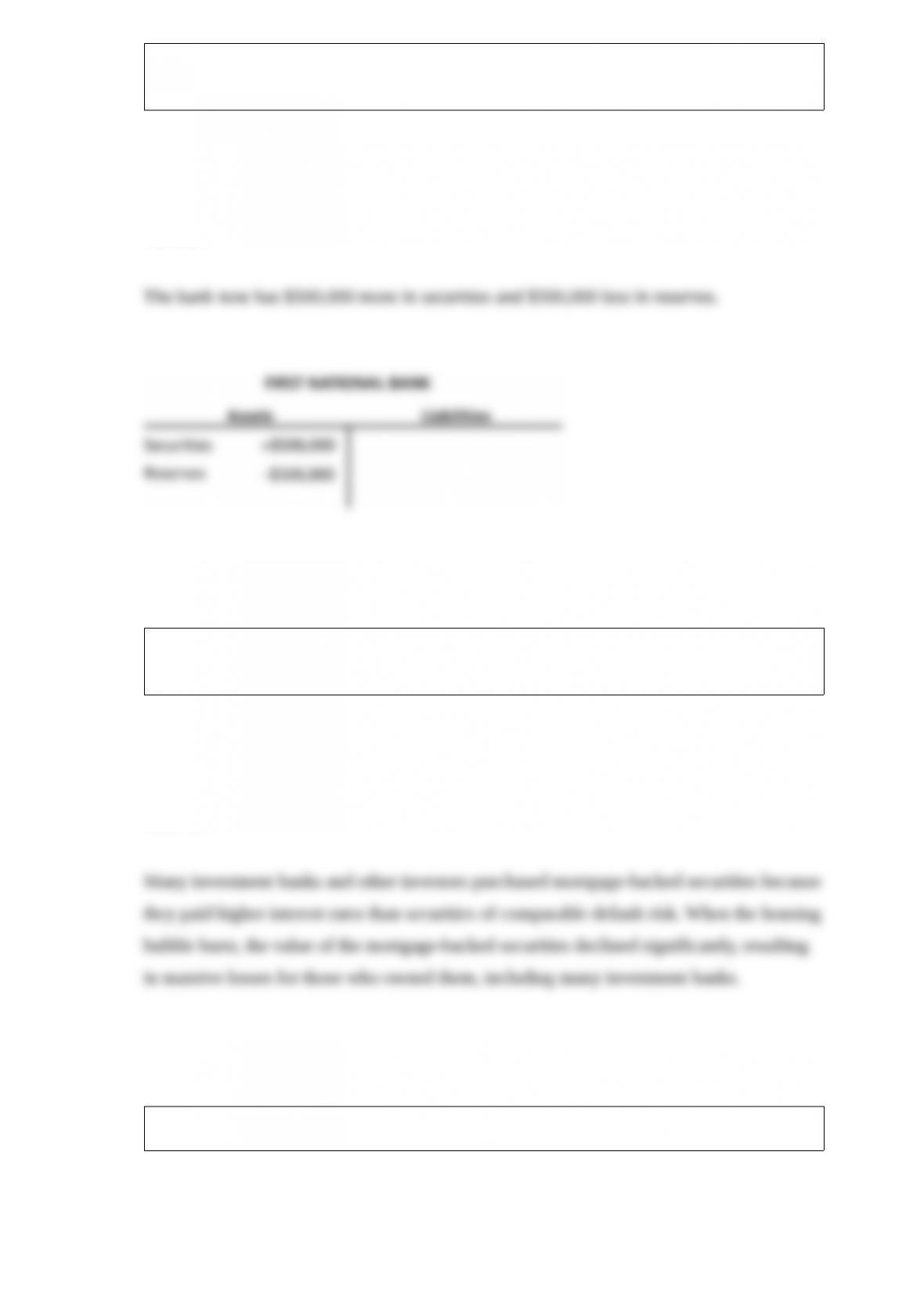
Suppose the Fed sells $500,000 worth of securities to First National Bank. Illustrate the
immediate effect on the bank’s balance sheet.
Answer:
How did securitization and the bursting of the housing bubble contribute to the
Financial Crisis of 2007-2009?
Answer:
What are the information costs associated with forward contracts?
Answer:
How does an increase in the price level lead to a higher interest rate?
Answer:
Describe the temporary lending facilities that the Fed set up during the Financial Crisis
of 2007-2009.
Answer:
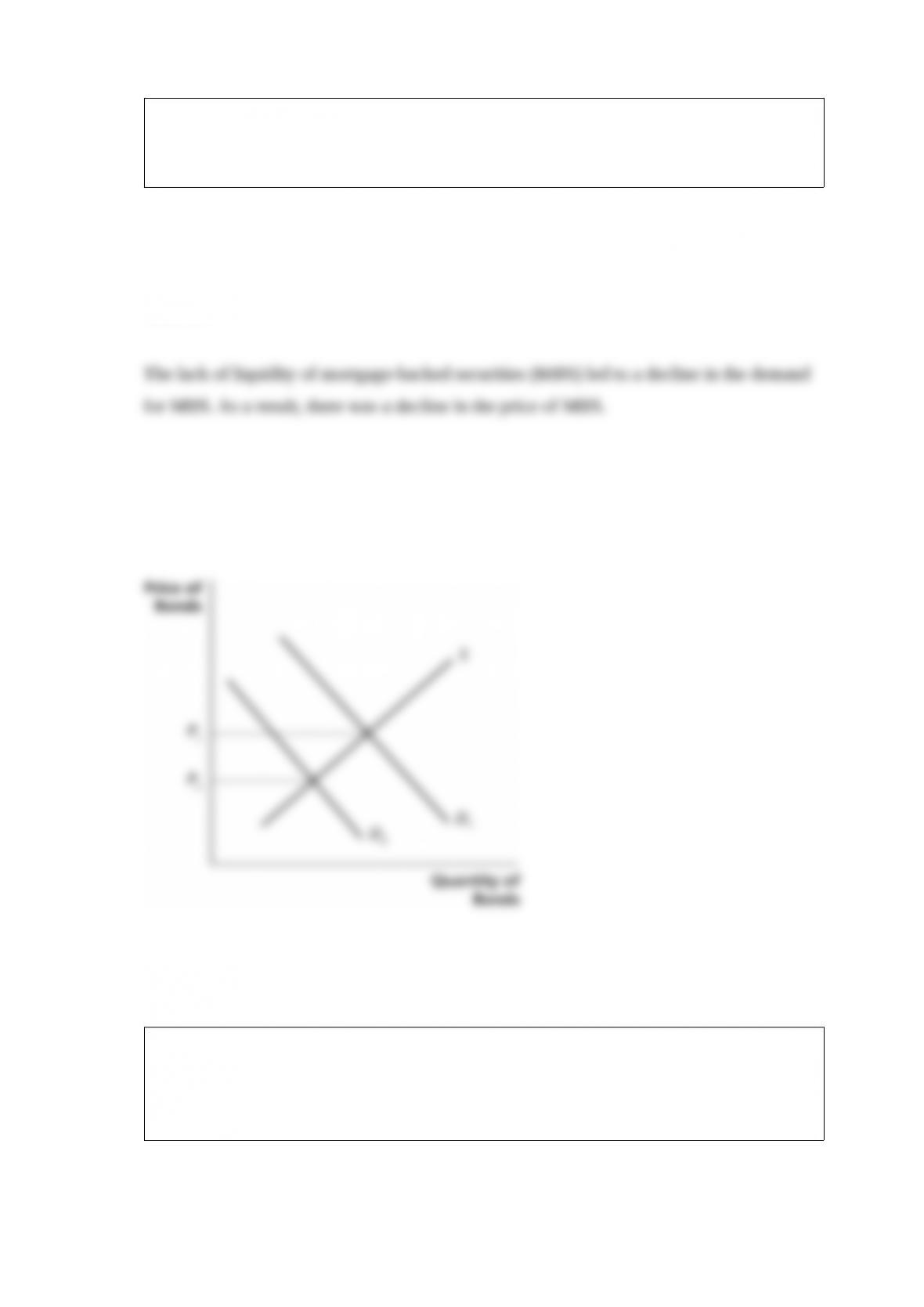
In 2008, the liquidity of mortgage-backed securities declined significantly. Make use of
a graph of the bond market to show how this affected the price of mortgage-backed
securities.
Answer:
Suppose you have two clients who need your services for two years. One agreed to pay
you $50,000 one year from now and another $50,000 in two years while the other paid
$35,000 after one year, but $65,000 after two years. Assuming an interest rate of 10%,
which one has a higher present value? Round off to the nearest dollar.
Answer:
What steps can a bank take to deal with a significant outflow of deposits?
Answer:
How do banks manage credit risk?
Answer:

What are the four explanations given as to why the Fed did not intervene to stabilize the
banking system during the Great Depression?
Answer:
Compare the rights and obligations of buyers and sellers of futures contracts with the
rights of buyers and sellers of options contracts.
Answer:
Why does the segmented markets theory suggest think that bonds of different maturities
are not perfect substitutes for each other?
Answer:
In what ways does a certificate of deposit (CD) differ from a savings deposit?
Answer:
What are the reasons why disclosure by the SEC do not eliminate the information costs
of adverse selection?
Answer: