
Everything else being constant, a lower real interest rate
A) increases desired saving and net exports.
B) decreases desired saving but increases net exports.
C) increases desired saving and investment.
D) increases desired investment but decreases net exports.
Answer:
Suppose that research shows that by buying stocks issued by companies whose names
begin with the letter G investors can earn above-normal returns in even-numbered
years. From the perspective of the efficient markets hypothesis,
A) this is further evidence that the hypothesis is correct.
B) this would be considered a pricing anomaly.
C) investors must have insider information on these companies.
D) purchasers of these stocks must have been noise traders.
Answer:
How did the Fed peg interest rates during World War 2?

A) by setting a low federal funds rate
B) by agreeing to purchase any bonds that were not purchased by private investors
C) through extensive use of discount loans
D) through nationalization of the banking system
Answer:
The principal-agent view of Fed motivation predicts that the Fed acts
A) to promote the interests of the general public.
B) to promote the interests of the Fed’s principalthe President of the United States.
C) in order to increase its power, influence, and prestige.
D) in order to make sure its agentscommercial bankscarry out its wishes.
Answer:
What was the purpose of the stress test administered by the Treasury in 2009?
A) Evaluate potential losses of Fannie Mae and Freddie Mac.
B) Assess the viability of AIG.

C) Gauge how well the largest financial firms would fare if the recession deepened.
D) Evaluate the solvency of the major investment banks.
Answer:
The Fed has attempted to solve the problems of being unable to directly control the
variables that determine economic performance and the timing lags in observing and
reacting to economic fluctuations by
A) pressing Congress for legislation which would expand its powers.
B) using targets to meet its goals.
C) abandoning some goals in order to achieve others.
D) devising new monetary policy tools.
Answer:
Which of the following statements is correct?
A) The discount rate is generally above the federal funds rate.
B) The discount rate is generally below the federal funds rate.
C) The discount rate is generally equal to the federal funds rate.

D) There is no general pattern to the relation between the discount rate and the federal
funds rate.
Answer:
On the day of delivery
A) the spot price will equal the futures price.
B) the spot price will be greater than the futures price by an amount equal to the current
interest rate times the futures price.
C) the futures price will be greater than the spot price by an amount equal to the current
interest rate times the spot price.
D) there is no necessary relation between the spot price and the futures price.
Answer:
Expansionary monetary policy consists of all of the following EXCEPT
A) open market sales.
B) lower interest rates.
C) increased monetary base.
D) increased money supply.
Answer:
Hedgers are primarily interested in
A) betting on anticipated changes in prices.
B) reducing their exposure to the risk of price fluctuations.
C) increasing market liquidity.
D) reducing the spread between bid and ask prices on bonds.
Answer:
Fracking involves:
A) extracting certain forms of energy from shale rock formations
B) deep water drilling for energy with minimal externalities
C) the reduction of menu costs thus allowing prices to adjust more freely
D) breaking down the production of goods resulting in more competitive markets
Answer:

Open market operations
A) lack flexibility because only very small purchases or sales may be carried out in any
given month.
B) lack flexibility because open market purchases cannot easily be offset by subsequent
open market sales.
C) are more flexible than other policy tools.
D) may be carried out only on the third Friday of each month.
Answer:
In the long run, one-time increases or decreases in the nominal money supply affect
A) real output, but not the price level.
B) the price level, but not real output.
C) both real output and the price level.
D) neither real output nor the price level.
Answer:

Congress introduced deposit insurance in response to
A) the savings-and-loan crisis of the 1980s.
B) the banking crisis of the 1930s.
C) the demise of the Second Bank of the United States in 1836.
D) the demise of the First Bank of the United States in 1811.
Answer:
Under a barter system
A) each good has many prices.
B) each good has a single price.
C) no prices for goods exist.
D) prices for goods are very stable.
Answer:

As a result of an open market purchase, bank reserves
A) rise and interest rates fall.
B) fall and interest rates rise.
C) and interest rates both rise.
D) and interest rates both fall.
Answer:
When economists and policymakers refer to the Fed’s dual mandate, they are referring
to:
A) price and exchange rate stability.
B) price stability and maximum employment.
C) moderate long-term interest rates and maximum employment.
D) price stability and moderate long-term interest rates.
Answer:
Stabilization policy refers to attempts to
A) shift the AD curve to smooth short-run fluctuations in output.
B) shift the SRAS curve to smooth short-run fluctuations in output.
C) shift the AD curve to keep the price level as low as possible.
D) shift the SRAS curve to keep the nominal interest rate as low as possible.
Answer:
Default risk
A) is the probability that a borrower will not pay in full the promised coupon or
principal.
B) exists only for the bonds of small corporations.
C) is also known as market risk.
D) is zero for bonds issued by cities and states.
Answer:
Which of the following is the correct expression for the approximate expected real
interest rate?
A) r = i +
B) r = i –
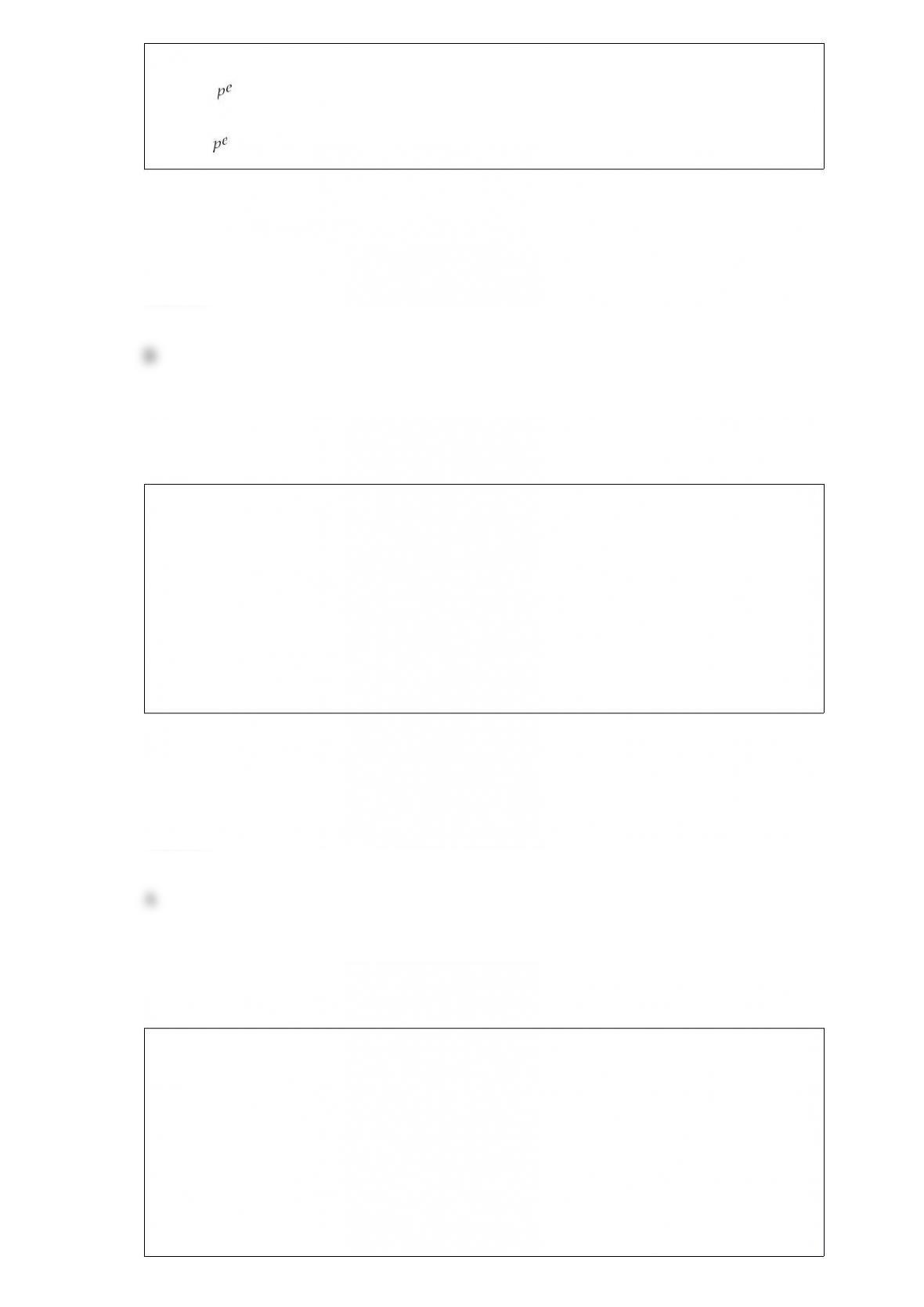
C) r = i/
D) r = i
Answer:
Which of the following is an intermediate target?
A) M2
B) reserves
C) unemployment rate
D) inflation rate
Answer:
Which president said, “Prosperity is just around the corner”?
A) Herbert Hoover near the start of the Great Depression
B) Franklin Delano Roosevelt near the start of the Great Depression
C) George W. Bush near the start of the Great Recession
D) Barack Obama near the start of the Great Recession

Answer:
How does the Open Market Trading Desk conduct its operations?
A) directly with private securities dealers on the floor of the New York Stock Exchange
B) directly with private securities dealers on the floor of the Federal Reserve Bank of
New York
C) over-the-counter electronically with private securities dealers
D) by sending its buy and sell orders to the U.S. Treasury for execution
Answer:
The expected real interest rate approximately equals
A) the nominal interest rate minus the tax rate.
B) the nominal interest rate minus the expected rate of inflation.
C) the nominal interest rate plus the expected rate of inflation.
D) the yield to maturity on a coupon bond held to maturity.
Answer:
U.S. Treasury securities
A) are considered risk free because their prices never change.
B) have been defaulted on several time in U.S. history.
C) are considered default-risk-free instruments.
D) have a large default risk premium.
Answer:
Which of the following statements about the Depository Institutions Deregulation and
Monetary Control Act of 1980 is NOT correct?
A) It required all banks to maintain reserve deposits with the Fed.
B) It gave member and nonmember banks equivalent access to discount loans.
C) It halted the decline in Fed membership.
D) It eliminated restrictions on interstate banking for member banks.
Answer:

The process by which identical products that are tradeable converge to the same price is
called
A) arbitrage.
B) hedging.
C) speculation.
D) risk aversion.
Answer:
Lenders prefer to lend to firms with high net worth because
A) such firms are usually willing to pay higher interest rates.
B) the owners of such firms have more to lose if the firm defaults on a loan.
C) the government requires most bank loans to be made to such firms.
D) such firms usually are unable to raise funds directly through financial markets.
Answer:
Which of the following statements is correct?

A) The Fed is fully insulated from external pressures due to the long terms that
members of the Board of Governors serve.
B) The Fed is fully insulated from external pressures because it does not need to go
through the normal congressional appropriations process.
C) The Fed is fully insulated from external pressures because it has a constitutional
mandate.
D) The Fed is only partially insulated from external pressures.
Answer:
When it takes more euros to purchase a dollar, the dollars is said to have:
A) depreciated
B) appreciated
C) it depends on whether one is using direct or indirect quotations
D) it depends on whether one is considering cross rates or exchange rates
Answer:
In 2012, net worth was about what percentage of total funds raised by banks?

A) 2%
B) 7%
C) 13%
D) 35%
Answer:
Which of the following is NOT a step involved in using checks?
A) The recipient must take the check to the bank.
B) The bank must present the check to the checkwriter’s bank.
C) The funds must be transferred from the checkwriter’s bank to the recipient’s bank.
D) The funds must be transferred from the recipient’s bank to the checkwriter’s bank.
Answer:
Which of the following statements is correct?
A) The volume of open market operations is determined jointly by the actions of the
public, banks, and the Fed.
B) The volume of open market operations is determined jointly by the actions of banks

and the Fed.
C) The volume of open market operations is determined jointly by the actions of the
public and the Fed.
D) The volume of open market operations is determined solely by the Fed.
Answer:
Which of the following banned most proprietary trading by commercial banks?
A) Consumer financial Protection Bureau
B) Regulation Q
C) Greenspan rule
D) Volcker rule
Answer:
A primary criticism of preferential tax treatment of dividends and capital gains is:
A) there is not a double taxation of dividends
B) it adversely affects the distribution of after-tax income
C) there is no locked-in effect resulting from taxation of capital gains
D) it does not have any impact on efficiency
Answer:
What three parts of the economy are represented in the IS-MP model?
Answer:
How does deflation affect those with debt?
Answer:
Who serves as voting members of the Federal Open Market Committee (FOMC)?
Answer:
On which type of unemployment can monetary policy have the most effect? Why?
Answer:
Analyze the following statement: “I know the fact that prices have started to rise rapidly
seems like bad news, but at least prices starting to go up means that output must be
starting to go up as well.”
Answer:
How does adverse selection in financial markets affect the method by which firms raise
funds?
Answer:
What are three reasons that banks charge interest on loans?
Answer:
In what ways did the stock market crash of 1929 increase the severity of the downturn?
Answer:
How is the use of leverage a “double-edged sword”?
Answer:
Why must the spot price equal the futures price on the settlement date?
Answer:
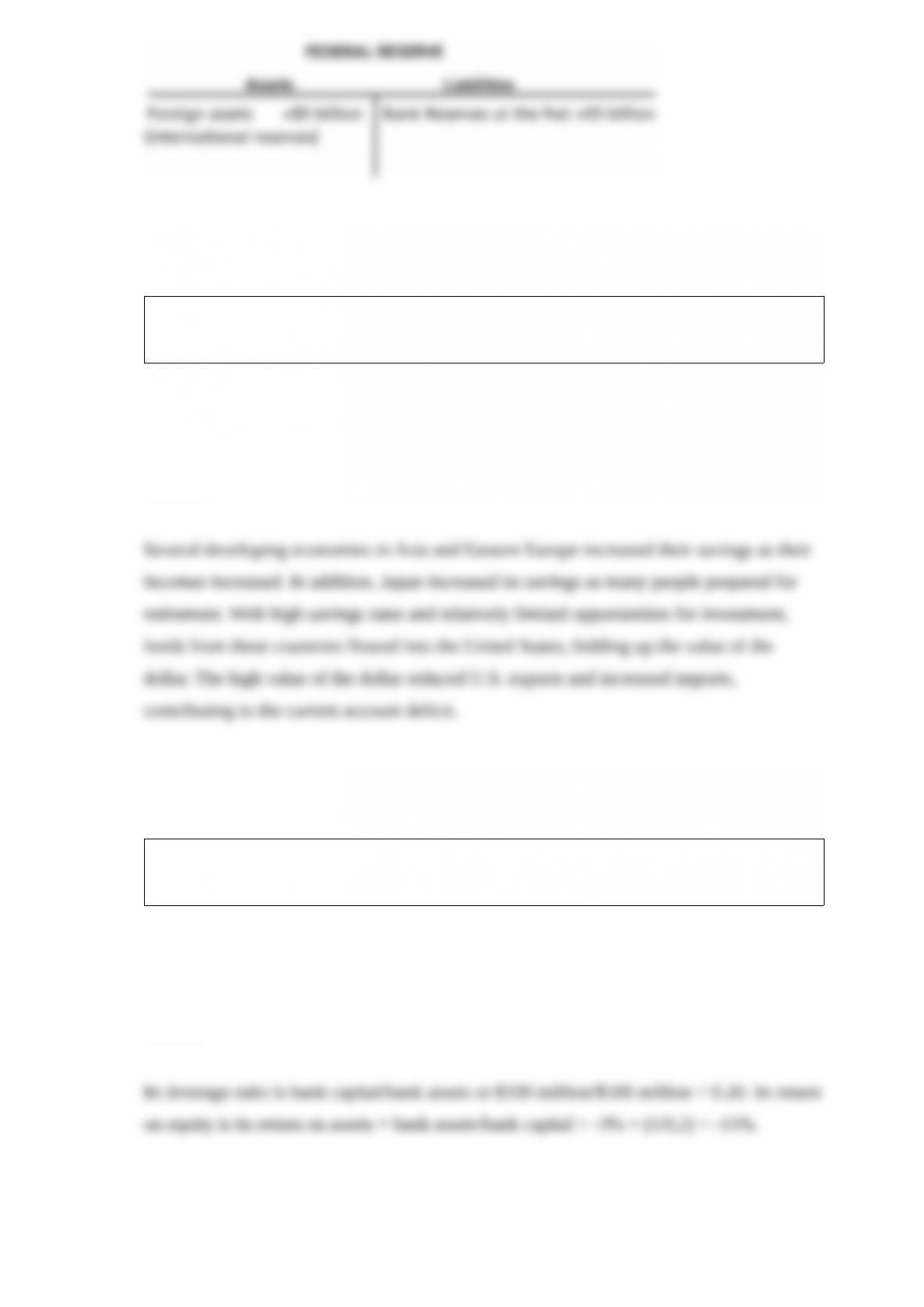
Make use of a T-account to show the effect of the Fed’s purchase of $5 billion worth of
foreign government securities on the Fed’s balance sheet (note: assume the Fed writes a
check to purchase the securities)
Answer:
Why do some economists think a global savings glut contributed to the U.S. running a
current account deficit in the 2000s?
Answer:
Suppose a bank has assets of $500 million and capital of $100 million. Its return on
assets is -3%. What is its leverage ratio? What is its return on equity?
Answer:
Suppose an investment bank buys $100 million worth of mortgage-backed securities. It
finances the purchase by borrowing $90 million and using $10 million from its equity.
If the value of holdings of mortgage-backed securities declines by 5%, what is its return
on equity investment?
Answer:
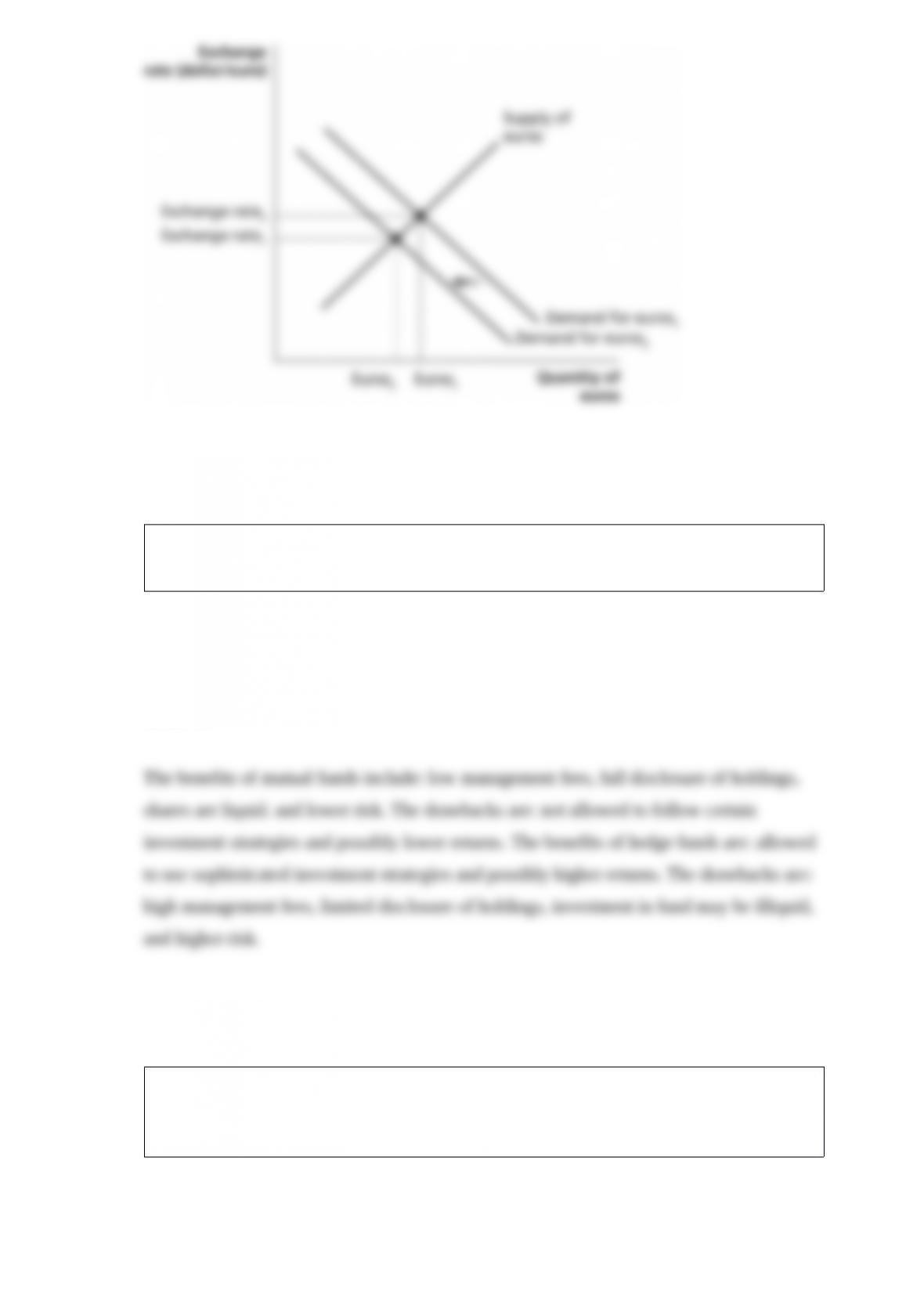
Suppose that investors perceive a higher risk of investing in Europe as a result of a
sovereign debt crisis. Make use of a graph of the foreign exchange market to show how
this will affect the value of the euro.
Answer:
Compare and contrast hedge funds and mutual funds in terms of the benefits and
drawbacks of each.
Answer:
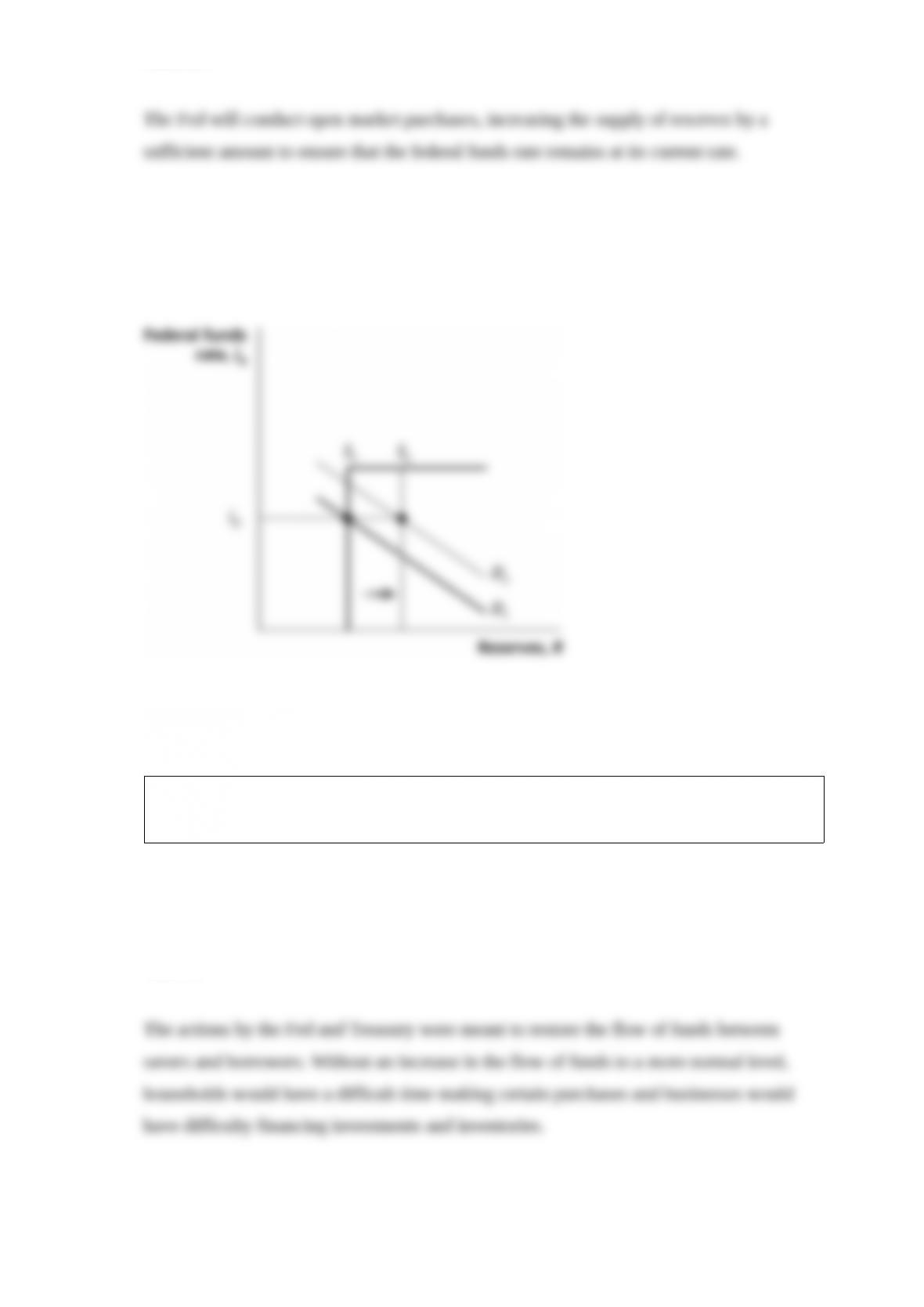
Suppose banks incur heavy losses and become more cautious, increasing their demand
for reserve. Make use of a graph of the loanable funds market to show how the Fed can
use open market operations to maintain the same federal funds rate.
Answer:
What was the intent behind the intervention of the Fed and Treasury in financial
markets during the Financial Crisis of 2007-2009?
Answer: