
Finance companies
A) issue stock and use the proceeds to purchase bonds.
B) raise funds in financial markets to lend to households and firms.
C) raise funds from banks to lend to households and firms.
D) issue bonds and use the proceeds to purchase stock.
Answer:
The reduction in transactions costs brought about by financial intermediaries benefits
A) small savers, but not small borrowers.
B) small borrowers, but not small savers.
C) both small savers and small borrowers.
D) society through greater economic efficiency; small savers and borrowers do not gain
directly.
Answer:
Which of the following statements is correct?
A) The supply curve for loanable funds slopes up, whereas the supply curve for bonds

slopes down.
B) The demand curve for loanable funds slopes up, whereas the demand curve for
bonds slopes down.
C) The demand curve for loanable funds and the demand curve for bonds both slope up.
D) The supply curve for bonds and the supply curve for loanable funds both slope up.
Answer:
Which president failed to renew the charter of the Second Bank of the United States?
A) George Washington
B) Andrew Jackson
C) Franklin Roosevelt
D) Lyndon Johnson
Answer:
Given the behavior of the stock market in recent years:
A) most economists still think the efficient markets hypothesis is an accurate
description of the daily behavior of the stock market

B) most economists think the efficient markets hypothesis provides little insight into the
behavior of the stock market
C) most economists think the rational investor can outperform the stock market in the
long run
D) many economists still believe that it is unlikely that investors can hope to earn
above-average returns in the stock market by following traditional strategies
Answer:
Why do investors hedge using futures contracts?
A) they are seeking to increase liquidity
B) they are willing to pay for a reduction in risk
C) in order to provide a counterparty to speculators
D) they are more flexible than forward contracts
Answer:
According to Taylor’s rule, all of the following variables help explain the behavior of
the federal funds rate EXCEPT
A) output gap.

B) current inflation.
C) inflation gap.
D) yield curve.
Answer:
In the long run, the key reason that money is neutral is that
A) the federal budget is balanced.
B) prices are flexible.
C) business cycles have become much milder.
D) the nominal interest rate must equal the real interest rate.
Answer:
Reserve requirements are changed
A) more frequently than the discount rate is changed, but less frequently than open
market operations are conducted.
B) more frequently than the discount rate is changed and more frequently than open
market operations are conducted.

C) more frequently than open market operations are conducted, but less frequently than
the discount rate is changed.
D) less frequently than open market operations are conducted and less frequently than
the discount rate is changed.
Answer:
The ratio of a bank’s after-tax profit to bank capital is known as
A) net interest margin.
B) return on equity.
C) return on capital.
D) spread.
Answer:
In what way did the Dodd-Frank Act reduce bank revenue?
A) It increased the amount banks had to pay on interest to depositors.
B) It reduced fees banks could charge when customers took out loans.
C) It reduced the amount of interest banks could charge on mortgages.

D) It capped the fees that banks could charge stores for debit card transactions.
Answer:
The Consumer Financial Protection Bureau is part of the
A) Treasury Department
B) Federal Reserve System
C) Justice Department
D) Commerce Department
Answer:
Banks in the United States have been prohibited from investing deposits in significant
equity holdings since the passage of the
A) Bank Reform Act of 1980.
B) Securities and Exchange Acts of 1933 and 1934.
C) National Banking Acts of 1863 and 1864.
D) Sherman Antitrust Act of 1890.

Answer:
Which of the following would shift the aggregate demand curve to the left?
A) an increase in the money supply
B) a cut in federal income taxes
C) an expected decrease in future income
D) an increase in the price level
Answer:
According to Robert Gordon, what led to the decline in unemployment in the 1940s?
A) structural barriers to expanding output and employment disappeared once a
sufficiently large increase in aggregate demand had taken place
B) decline in unionization of the workforce
C) President Truman moving away from the policies implemented by President
Roosevelt
D) the strengthening of property rights following the end of the New Deal
Answer:

If the British pound depreciates against the U.S. dollar,
A) British businesses gain by an increase in the dollar price of exports to the United
States.
B) British consumers gain by a decrease in the pound price of U.S. exports to Britain.
C) British consumers lose by an increase in the pound price of U.S. exports Britain.
D) U.S. consumers lose by an increase in the dollar price of British exports to the
United States.
Answer:
As wealth increases in the economy, we would expect to observe
A) bond prices and interest rates both rise.
B) bond prices and interest rates both fall.
C) bond prices rise and interest rates fall.
D) bond prices fall and interest rates rise.
Answer:

In which of the following assets are commercial banks in the United States NOT
allowed to invest checkable deposits?
A) home mortgages
B) corporate bonds
C) municipal bonds
D) U.S. Treasury bonds
Answer:
A load fund
A) charges a commission for purchases or sales.
B) is not obligated to redeem shares issued.
C) earns income only from management fees.
D) issues shares that may sell at a discount to the market value of the underlying assets.
Answer:

If major traders believe the price of a stock should be higher than its current market
price,
A) they have an incentive to sell the stock.
B) their actions will result in the information they possess being incorporated into the
price of the stock.
C) there is little they can do because government regulation precludes their acting on
what they know.
D) they should petition the Securities and Exchange Commission to authorize an
adjustment in the price of the stock.
Answer:
According to the new classical view, aggregate output will differ from full-employment
output
A) whenever saving does not equal investment.
B) only if the actual price level does not equal the expected price level.
C) only if the federal government’s expenditures are greater than its tax receipts.
D) whenever imports exceed exports.
Answer:

As of 2012, what portion of bank assets were owned by the five largest bank holding
companies?
A) 10%
B) 25%
C) 50%
D) 80%
Answer:
Analysts have attempted to model the impact of monetary policy on net worth by
emphasizing
A) the impact of lower interest rates on business spending on fixed investment.
B) the impact of lower interest rates on household spending on housing and durable
goods.
C) the liquidity of balance sheet positions as a determinant of business and household
spending.
D) the greater variability of business spending compared to household spending.
Answer:

In an efficient market with rational expectations, the actual price of an asset
A) will equal its expected price.
B) will often be below its expected price.
C) will often be above its expected price.
D) equals its expected price plus a random error term.
Answer:
In the new Keynesian view a monopolistically competitive firm may fail to increase the
price of its product as demand increases because
A) if it does so it will lose all of its customers.
B) the cost to it of changing prices may exceed the benefit of doing so.
C) prices of monopolistically competitive firms are regulated by the federal government
and may only be changed with permission.
D) for a monopolistically competitive firm, price is below marginal cost.
Answer:
Which of the following does not serve on the Governing Council of the European
Central Bank?

A) governors of the national central banks
B) members of the executive board
C) finance ministers of each country
D) chair of the executive board
Answer:
Under the Bretton Woods system the international reserve currency was the
A) U.S. dollar.
B) British pound.
C) German mark.
D) Japanese yen.
Answer:
Which of the following is NOT true of an insolvent bank?
A) Its net worth is negative.
B) It may be unable to pay off its depositors.

C) The value of its assets is less than the value of its liabilities.
D) It must have no more deposits.
Answer:
In investment banking the ‘spread” is the difference between
A) the value of a firm’s assets and the value of its liabilities.
B) the bid and asked prices on a bond.
C) the price of new capital guaranteed to the issuing firm and the price that can be
obtained in the market.
D) the price of a new stock issue and the price of an equivalent new bond issue.
Answer:
According to the Gordon-Growth model, what is the value of a stock with a dividend of
$1, required return on equity of 10% and expected growth rate of dividends of 5%?
A) $2
B) $10
C) $20

D) $21
Answer:
Which of the following is NOT true of the term premium?
A) It is zero under the expectations theory.
B) It is infinite under the segmented markets theory.
C) It increases as a bond’s maturity increases.
D) It is zero for thirty-year bonds.
Answer:
Which of the following is NOT true of adverse selection?
A) It would not exist in a world of perfect information.
B) It arises because borrowers typically know more than lenders.
C) It describes a lender’s problem of distinguishing the good-risk applicants from the
bad-risk applicants.
D) It describes a lender’s problem in verifying borrowers are using their funds as
intended.

Answer:
Which of the following is NOT a reason that firms in the shadow banking system were
more vulnerable than commercial banks during the financial crisis of 2007-2009?
A) They could invest in riskier assets.
B) Investors had no insurance against loss of principal.
C) They made investments that would lose value if housing prices decline.
D) They were more heavily regulated than commercial banks, making them less able to
adjust to changing market conditions.
Answer:
One benefit of a swap compared to futures and options is that they
A) promote liquidity.
B) reduce the risk for both the buyer and seller.
C) can be better tailored to meet the needs of market participants.
D) can involve financial instruments and not just commodities.

Answer:
Which of the following factors would tend to increase the size of the premium on an
options contract?
A) The option is near its expiration date.
B) The current default-risk-free interest rate is high.
C) The price volatility of the underlying asset is low.
D) The option is far away from its expiration date.
Answer:
What are the primary arguments for and against the independence of the Fed?
Answer:
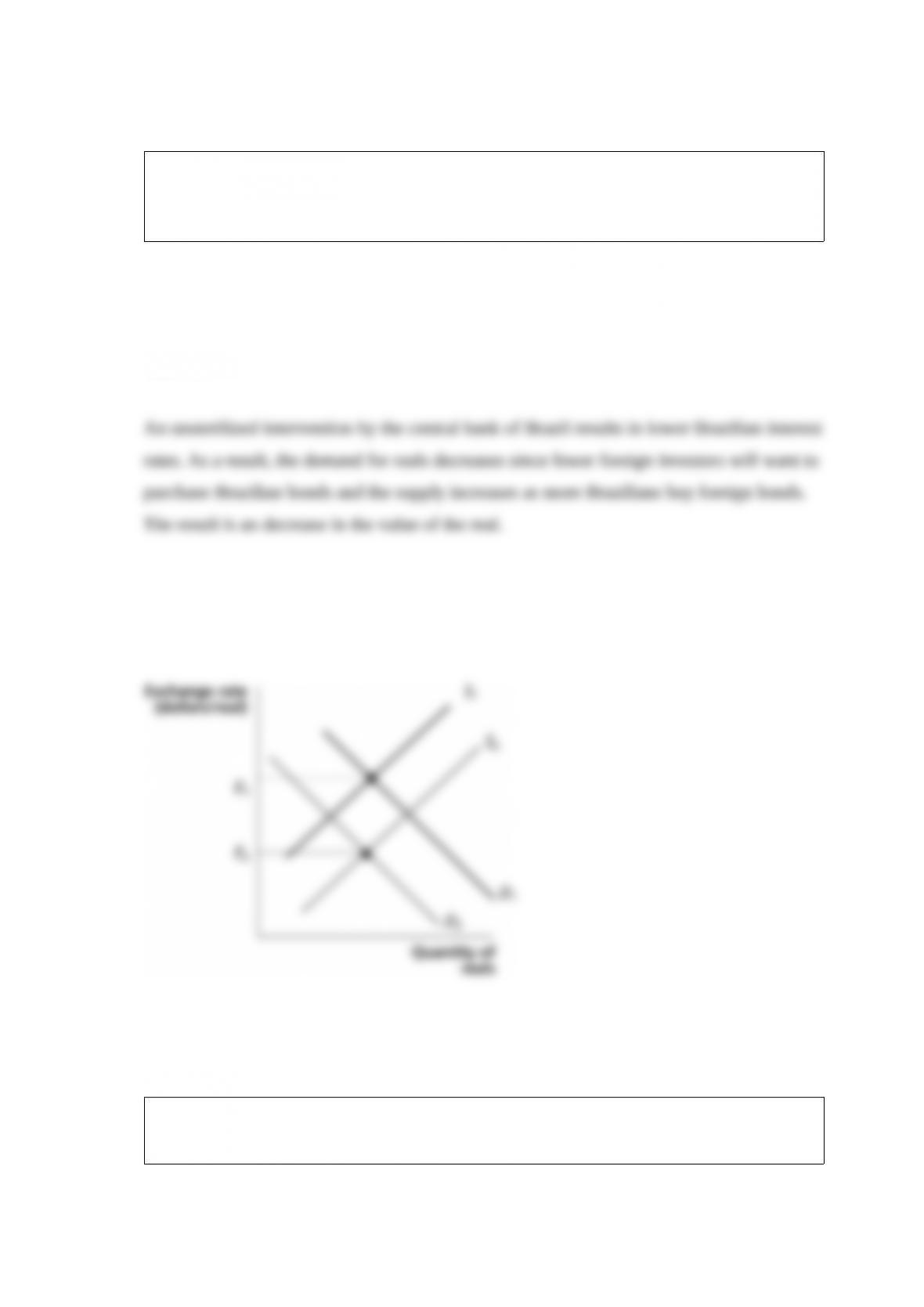
Make use of a graph of the foreign exchange market to show how the Brazilian Central
Bank can use an unsterilized intervention to reduce the value of its currency, the real, in
terms of the dollar.
Answer:
What actions must a central bank take if it is trying to maintain a pegged exchange rate,
but there’s downward pressure on the value of its currency.

Answer:
If the expectations theory of the term structure is correct, would a reduction in the
supply of thirty-year Treasury bonds affect their yields?
Answer:
How does adverse selection affect the participation of small- and medium-sized firms in
the stock market?
Answer:
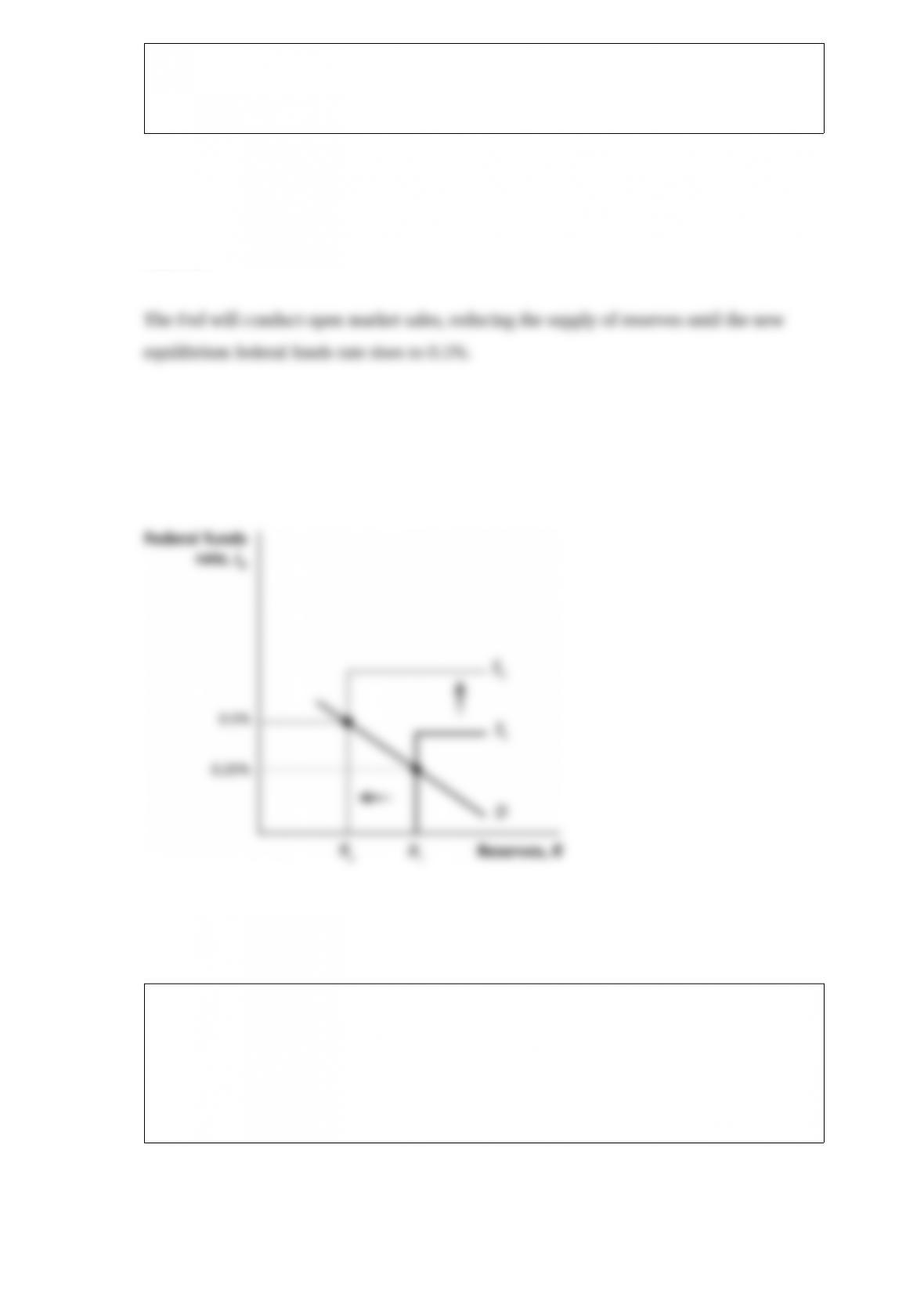
Suppose the current federal funds rate is 0.25% and the Fed chooses to raise its target to
0.5%. Make use of a graph of the federal funds market to show how it will use open
market operations to accomplish this.
Answer:
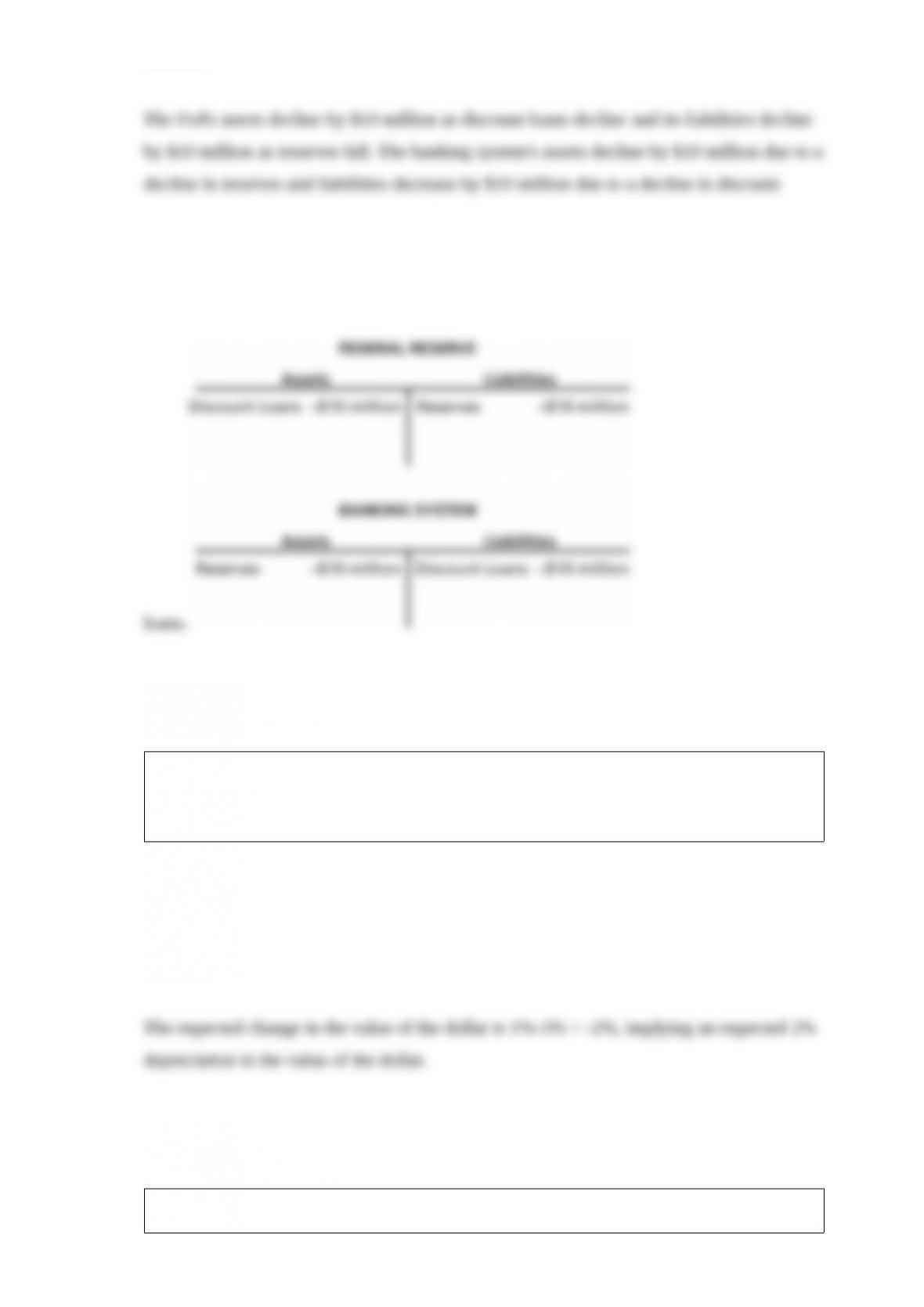
Suppose a bank repays a $10 million discount loan that it had previously borrowed
from the Fed. Illustrate how this affects the balance sheets of the Fed and the banking
system. The Fed’s assets decline by $10 million as discount loans decline and its
liabilities decline by $10 million as reserves fall. The banking system’s assets decline by
$10 million due to a decline in reserves and liabilities decrease by $10 million due to a
decline in discount loans.
Answer:
Suppose interest rates in the U.S. are 3% while interest rates on comparable bonds in
Japan are 1%. By how much is the exchange rate between the yen and dollar expected
to change according to the interest-rate parity condition?
Answer:
Why do banking panics normally lead to recessions?

Answer:
According to the New Classical theory, why may output differ from its full-employment
level in the short run?
Answer:
Why is the short-term nominal interest rate the opportunity cost of holding money?
Answer:

How does the goods market return to equilibrium if AE is less than production?
Answer:
Why did banks increase their holdings of excess reserves during the Financial Crisis of
2007-2009?
Answer:
A corporation issues a three year bond with a coupon of $50 and a face value of $1000.
Immediately after being issued, market interest rates decline to 4%. What is the price of
the bond? Report your answer to the nearest dollar.
Answer:

How is the lemons problem in the used car market an example of asymmetric
information?
Answer:
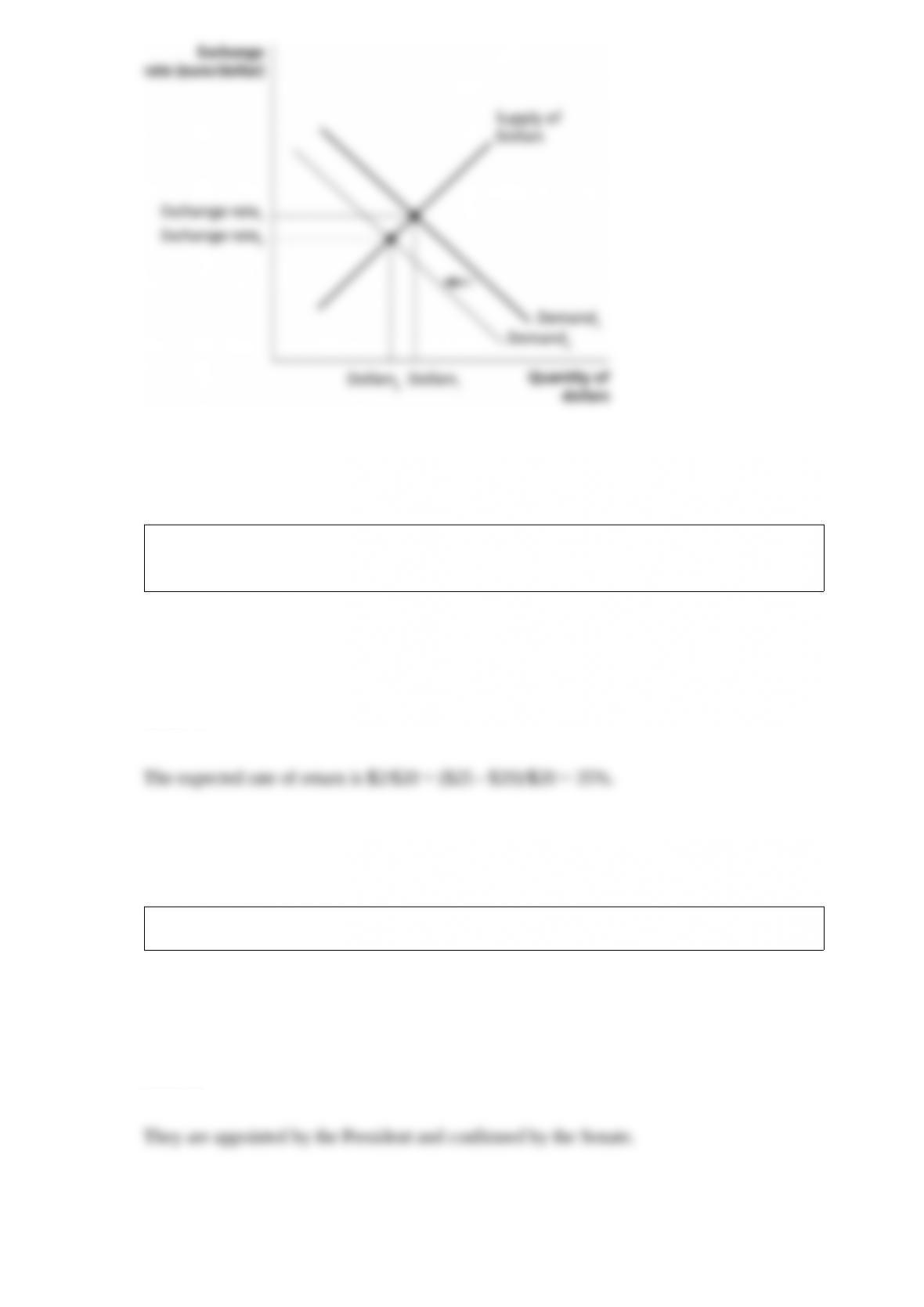
Suppose the Federal Reserve reduces interest rates while interest rates in Europe do not
change. Make use of a graph of the foreign exchange market to show how this will
affect the value of the dollar.
Answer:
Suppose you buy a stock that sells for $20. It’s expected annual dividend is $2 and you
expect its price to be $25 in one year. What is your expected rate of return on the stock?
Answer:
How do individual become members of the Board of Governors?
Answer:

What limited the effectiveness of monetary policy during the Financial Crisis of
2007-2009?
Answer:
Explain the process by which prices of securities adjust so as to eliminate arbitrage
profits.
Answer: