Archives

978-0077687342 Appendix B Part 1
APPENDIX B PROBLEM B.1 A thin plate of mass m is cut in the shape of an equilateral triangle of side a. Determine the mass moment of inertia of the plate with respect to (a) the centroidal axes AA and […]
978-0077687342 Appendix B Part 2
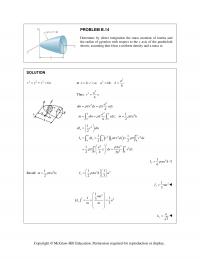
PROBLEM B.14 Determine by direct integration the mass moment of inertia and the radius of gyration with respect to the x axis of the paraboloid shown, assuming that it has a uniform density and a mass m. SOLUTION 222 :ryzkx […]
978-0077687342 Appendix B Part 3
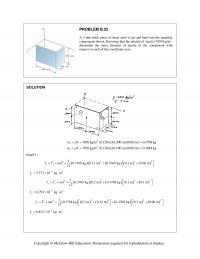
PROBLEM B.25 A 2-mm thick piece of sheet steel is cut and bent into the machine component shown. Knowing that the density of steel is 7850 kg/m3, determine the mass moment of inertia of the component with respect to each […]
978-0077687342 Appendix B Part 4
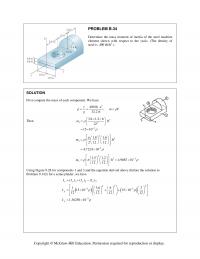
PROBLEM B.34 Determine the mass moment of inertia of the steel machine element shown with respect to the yaxis. (The density of steel is 3 490 lb/ft .) SOLUTION First compute the mass of each component. We have 2 490 […]
978-0077687342 Appendix B Part 5
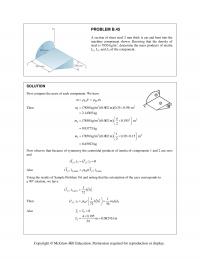
PROBLEM B.45 A section of sheet steel 2 mm thick is cut and bent into the machine component shown. Knowing that the density of steel is 7850 kg/m 3 , determine the mass products of inertia I xy , I […]
978-0077687342 Appendix B Part 6
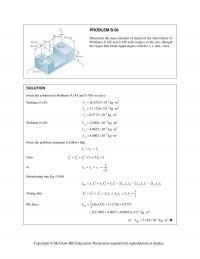
PROBLEM B.56 Determine the mass moment of inertia of the steel fixture of Problems 9.145 and 9.149 with respect to the axis through the origin that forms equal angles with the x, y, and z axes. SOLUTION From the solutions […]
978-0077687342 Appendix B Part 7
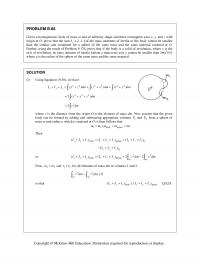
PROBLEM B.68 Given a homogeneous body of mass m and of arbitrary shape and three rectangular axes x , y , and z with origin at O , prove that the sum Ix + Iy + Iz of the mass […]
978-0077687342 Appendix B Part 8
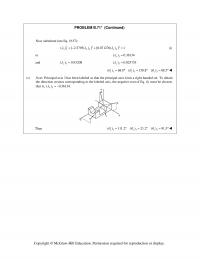
PROBLEM B.71* (Continued) Now substitute into Eq. (9.57): 22 2 33 3 ( ) [ 2.5795( ) ] [0.071276( ) ] 1 xx x (i) or 3 ( ) 0.36134 x and 3 […]

978-0077687342 Chapter 11 Part 1
CHAPTER 11 PROBLEM 11.1 A snowboarder starts from rest at the top of a double black diamond hill. As he rides down the slope, GPS coordinates are used to determine his displacement as a function of time: x= 0.5t3 + […]
978-0077687342 Chapter 11 Part 10
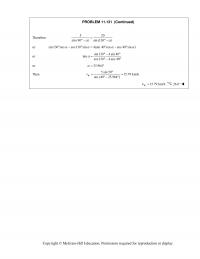
PROBLEM 11.131 (Continued) Therefore 520 sin (40 ) sin (130 ) or sin 130 cos cos 130 sin 4(sin 40 cos cos 40 sin ) or sin 130 4 […]
978-0077687342 Chapter 11 Part 11
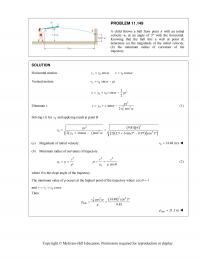
PROBLEM 11.149 A child throws a ball from point A with an initial velocity v0 at an angle of 3 with the horizontal. Knowing that the ball hits a wall at point B, determine (a) the magnitude of the initial […]
978-0077687342 Chapter 11 Part 12
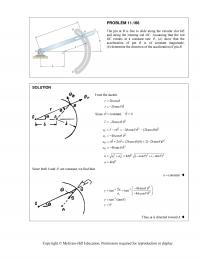
PROBLEM 11.166 The pin at B is free to slide along the circular slot DE and along the rotating rod OC. Assuming that the rod OC rotates at a constant rate , (a) show that the acceleration of pin […]
978-0077687342 Chapter 11 Part 13
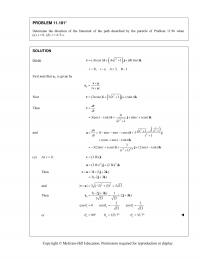
PROBLEM 11.181* Determine the direction of the binormal of the path described by the particle of Problem 11.96 when (a) 0,t (b) /2 s.t SOLUTION Given: 2 (cos) 1 (sin) A tt At Bttri jk ft, […]
978-0077687342 Chapter 11 Part 14
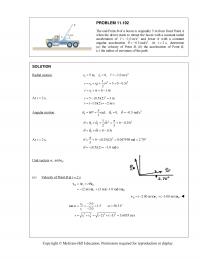
PROBLEM 11.192 The end Point B of a boom is originally 5 m from fixed Point A when the driver starts to retract the boom with a constant radial acceleration of 2 1.0 m/sr and lower it with a […]
978-0077687342 Chapter 11 Part 2
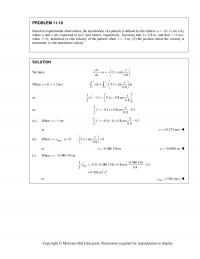
PROBLEM 11.19 Based on experimental observations, the acceleration of a particle is defined by the relation (0.1a sin x/b), where a and x are expressed in m/s2 and meters, respectively. Knowing that 0.8 mb and that 1 m/sv when […]
978-0077687342 Chapter 11 Part 3
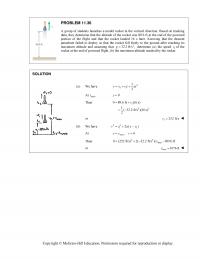
PROBLEM 11.36 A group of students launches a model rocket in the vertical direction. Based on tracking data, they determine that the altitude of the rocket was 89.6 ft at the end of the powered portion of the flight and […]
978-0077687342 Chapter 11 Part 4
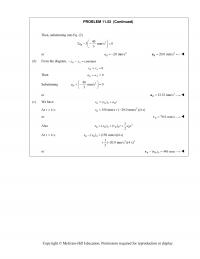
PROBLEM 11.52 (Continued) Then, substituting into Eq. (2) 2 40 2 3 mm/s 0 3 B a or 2 20 mm/s B a 2 20.0 mm/s Ba (b) From the diagram, constant DA xx […]
978-0077687342 Chapter 11 Part 5
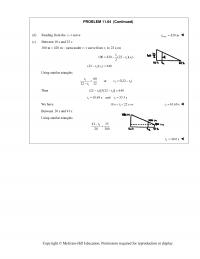
PROBLEM 11.64 (Continued) (b) Reading from the x tcurve max 420 mx (c) Between 10 s and 22 s 100 m 420 m (area under curve from , to 22 s) mvt t 11 1 100 420 (22 […]
978-0077687342 Chapter 11 Part 6
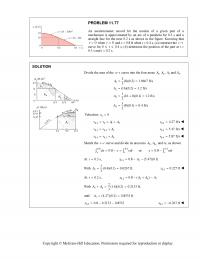
PROBLEM 11.77 An accelerometer record for the motion of a given part of a mechanism is approximated by an arc of a parabola for 0.2 s and a straight line for the next 0.2 s as shown in the figure. […]
978-0077687342 Chapter 11 Part 7
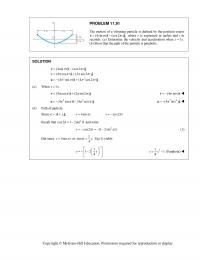
PROBLEM 11.91 The motion of a vibrating particle is defined by the position vector (4sin ) (cos2 ) ,tt rij where r is expressed in inches and t in seconds. (a) Determine the velocity and acceleration when […]
978-0077687342 Chapter 11 Part 8
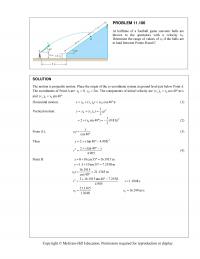
PROBLEM 11.106 At halftime of a football game souvenir balls are thrown to the spectators with a velocity v0. Determine the range of values of v0 if the balls are to land between Points B and C. SOLUTION The motion […]
978-0077687342 Chapter 11 Part 9
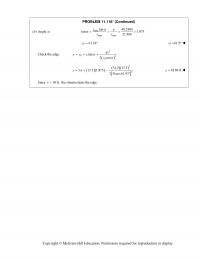
PROBLEM 11.116* (Continued) (b) Angle Check the edge. Since the stream clears the edge. . max max tan 1.875 21.466 xx 61.93 61.9 2 02 0 tan 2cos gx yy x […]

978-0077687342 Chapter 12 Part 1
CHAPTER 12 PROBLEM 12.1 Astronauts who landed on the moon during the Apollo 15, 16 and 17 missions brought back a large collection of rocks to the earth. Knowing the rocks weighed 139 lb when they were on the moon, […]
978-0077687342 Chapter 12 Part 10
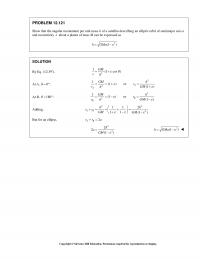
PROBLEM 12.121 Show that the angular momentum per unit mass h of a satellite describing an elliptic orbit of semimajor axis a and eccentricity about a planet of mass M can be expressed as SOLUTION By Eq. At A, At […]
978-0077687342 Chapter 12 Part 11
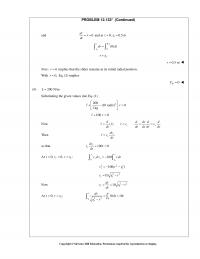
PROBLEM 12.133* (Continued) and and at Note: implies that the slider remains at its initial radial position. With Eq. (2) implies (b) Substituting the given values into Eq. (1) Now Then so that At Now At 0 dr […]
978-0077687342 Chapter 12 Part 12
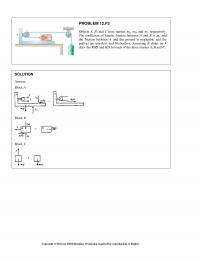
PROBLEM 12.F3 Objects A, B, and C have masses mA, mB, and mC respectively. The coefficient of kinetic friction between A and B is µ k, and the friction between A and the ground is negligible and the pulleys are […]
978-0077687342 Chapter 12 Part 2
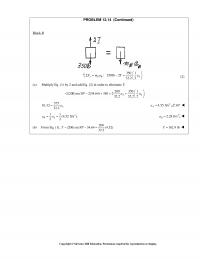
PROBLEM 12.14 (Continued) Block B 350 1 : 350lb 2 32.2 2 y BB A F ma T a Σ= − = (2) (a) Multiply Eq. (1) by 2 and add Eq. (2) in order to eliminate […]
978-0077687342 Chapter 12 Part 3
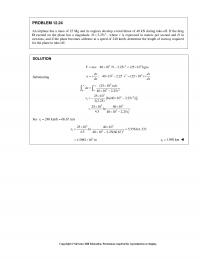
PROBLEM 12.24 An airplane has a mass of 25 Mg and its engines develop a total thrust of 40 kN during take-off. If the drag D exerted on the plane has a magnitude 2 2.25 ,Dv= where v is expressed […]
978-0077687342 Chapter 12 Part 4
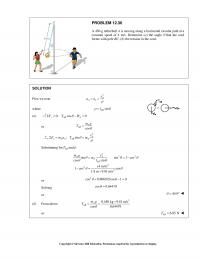
PROBLEM 12.36 A 450–g tetherball A is moving along a horizontal circular path at a constant speed of 4 m/s. Determine (a) the angle θ that the cord forms with pole BC, (b) the tension in the cord. SOLUTION First […]
978-0077687342 Chapter 12 Part 5
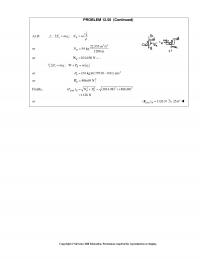
PROBLEM 12.50 (Continued) At B: :B n nB F ma N m ρ Σ= = or 22 22,555 m /s 54 kg 1200 m B N= or 1014.98 N B =N : || tt B t F ma W P […]
978-0077687342 Chapter 12 Part 6
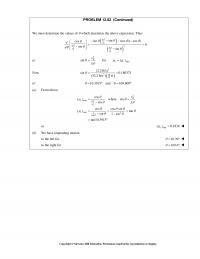
PROBLEM 12.62 (Continued) We must determine the values of θ which maximize the above expression. Thus ( ) ( ) 2 2 2 2 sin sin (cos )( cos ) cos 0 sin sin B B B g v g […]
978-0077687342 Chapter 12 Part 7
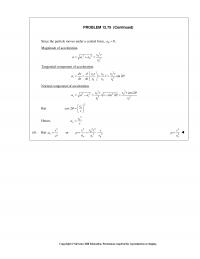
PROBLEM 12.75 (Continued) Since the particle moves under a central force, 0. θ =a Magnitude of acceleration. 2 22 0 2 0 r vr aaa r θ = += Tangential component of acceleration. 2 0 00 2 00 0 sin […]
978-0077687342 Chapter 12 Part 8
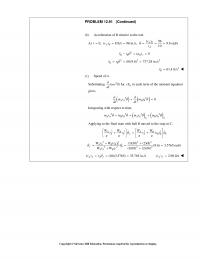
(b) Acceleration of B relative to the rod. At ( ) 96 0, ( ) 8 ft/s 96 in./s, 9.6 rad/s 10 A A A v tv r θ θ θ = = = = = = 2 () […]
978-0077687342 Chapter 12 Part 9
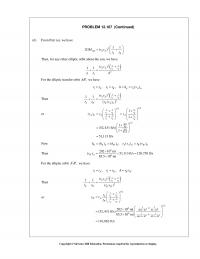
PROBLEM 12.107 (Continued) (b) From Part (a), we have 2 sun 11 2 () AA AB GM r v rr = + Then, for any other elliptic orbit about the sun, we have ( ) 211 2 […]

978-0077687342 Chapter 13 Part 1
CHAPTER 13 PROBLEM 13.1 A 400-kg satellite is placed in a circular orbit 6394 km above the surface of the earth. At this elevation the acceleration of gravity is 2 4.09 m/s . Knowing that its orbital speed is 20 […]
978-0077687342 Chapter 13 Part 10
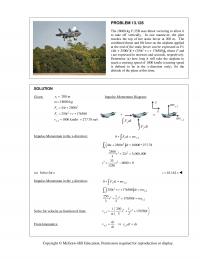
PROBLEM 13.126 The 18000-kg F-35B uses thrust vectoring to allow it to take off vertically. In one maneuver, the pilot reaches the top of her static hover at 200 m. The combined thrust and lift force on the airplane applied […]
978-0077687342 Chapter 13 Part 11
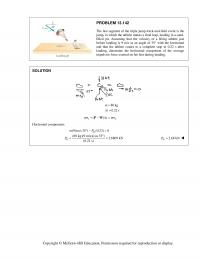
PROBLEM 13.142 The last segment of the triple jump track–and–field event is the jump, in which the athlete makes a final leap, landing in a sand- filled pit. Assuming that the velocity of a 80–kg athlete just before landing is […]
978-0077687342 Chapter 13 Part 12
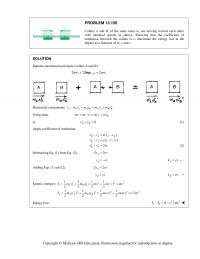
PROBLEM 13.156 Collars A and B, of the same mass m, are moving toward each other with identical speeds as shown. Knowing that the coefficient of restitution between the collars is e, determine the energy lost in the impact as […]
978-0077687342 Chapter 13 Part 13
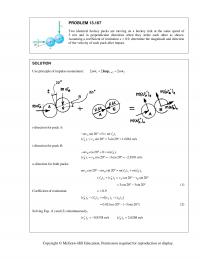
PROBLEM 13.167 Two identical hockey pucks are moving on a hockey rink at the same speed of 3 m/s and in perpendicular directions when they strike each other as shown. Assuming a coefficient of restitution e = 0.9, determine the […]
978-0077687342 Chapter 13 Part 14
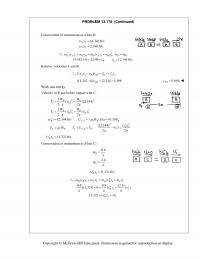
PROBLEM 13.178 (Continued) Conservation of momentum as A hits B: 2 2 ( ) 14.342 ft/s ( ) 2.198 ft/s A A v v = ′= 22 () () 14.342 0 2.198 12.144 ft/s A A BB B A BB […]
978-0077687342 Chapter 13 Part 15
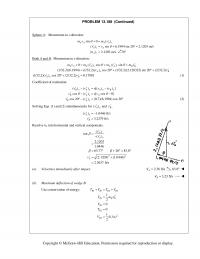
PROBLEM 13.188 (Continued) Sphere A: Momentum in t–direction: ( ) sin 6.1994 sin 20 2.1203 m/s ( ) 2.1203 m/s 70° At A At vv θ ′= = °= =v Both A and B: Momentum in x–direction: 0 ()cos ()sin […]
978-0077687342 Chapter 13 Part 16
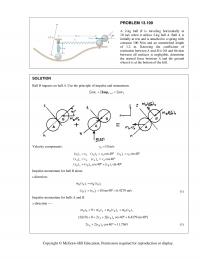
PROBLEM 13.199 A 2–kg ball B is traveling horizontally at 10 m/s when it strikes 2-kg ball A. Ball A is initially at rest and is attached to a spring with constant 100 N/m and an unstretched length of 1.2 […]

978-0077687342 Chapter 13 Part 17
PROBLEM 13.CQ5 The expected damages associated with two types of perfectly plastic collisions are to be compared. In the first case, two identical cars traveling at the same speed impact each other head on. In the second case, the car […]
978-0077687342 Chapter 13 Part 2
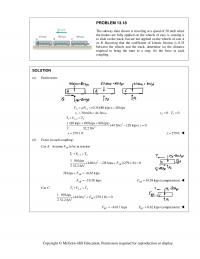
PROBLEM 13.18 The subway train shown is traveling at a speed of 30 mi/h when the brakes are fully applied on the wheels of cars A, causing it to slide on the track, but are not applied on the wheels […]
978-0077687342 Chapter 13 Part 3
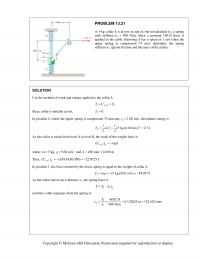
PROBLEM 13.31 A 5–kg collar A is at rest on top of, but not attached to, a spring with stiffness k1 = 400 N/m; when a constant 150-N force is applied to the cable. Knowing A has a speed of […]
978-0077687342 Chapter 13 Part 4
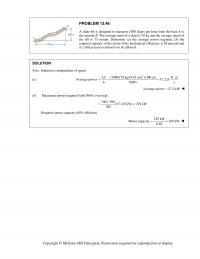
PROBLEM 13.46 A chair–lift is designed to transport 1000 skiers per hour from the base A to the summit B. The average mass of a skier is 70 kg and the average speed of the lift is 75 m/min. Determine […]
978-0077687342 Chapter 13 Part 5
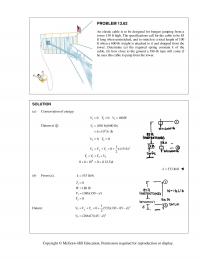
PROBLEM 13.62 An elastic cable is to be designed for bungee jumping from a tower 130 ft high. The specifications call for the cable to be 85 ft long when unstretched, and to stretch to a total length of 100 […]
978-0077687342 Chapter 13 Part 6
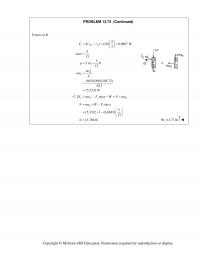
PROBLEM 13.72 (Continued) Forces at B. 0 2 2 ( ) (10) 6.6667 lb. 3 5 sin 13 5 5 in. ft 12 (0.031056)(205.72) 5/12 15.3332 lb sB B n Fk mv ma α ρ ρ = −= = […]
978-0077687342 Chapter 13 Part 7
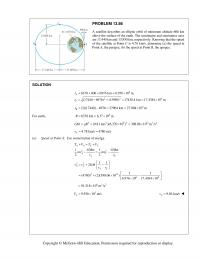
PROBLEM 13.86 A satellite describes an elliptic orbit of minimum altitude 606 km above the surface of the earth. The semimajor and semiminor axes are 17,440 km and 13,950 km, respectively. Knowing that the speed of the satellite at Point […]
978-0077687342 Chapter 13 Part 8
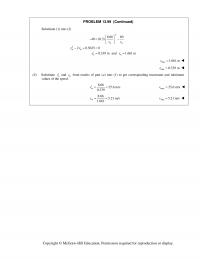
PROBLEM 13.99 (Continued) Substitute (1) into (2) 2 2 8.66 80 40 (0.3) 2 0.5625 0 0.339 m and 1.661 m mm mm mm rr rr rr −= − −+ = ′= = max 1.661 mr= […]
978-0077687342 Chapter 13 Part 9
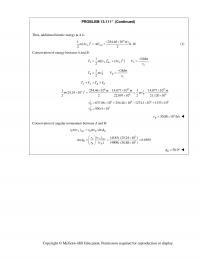
PROBLEM 13.111* (Continued) Thus, additional kinetic energy at A is 6 2 110 1 (254.46 10 ) ( ) ft lb 22 A m mv E × ∆ =∆= ⋅ (1) Conservation of energy between A and B: 22 circ […]

978-0077687342 Chapter 14 Part 1
CHAPTER 14 PROBLEM 14.1 A 30-g bullet is fired with a horizontal velocity of 450 m/s and becomes embedded in block B which has a mass of 3 kg. After the impact, block B slides on 30-kg carrier C until […]
978-0077687342 Chapter 14 Part 2
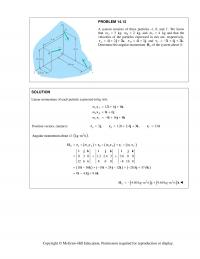
PROBLEM 14.13 A system consists of three particles A, B, and C. We know that 3 A m kg, 2 B m kg, and 4 C m kg and that the velocities of the particles expressed in m/s […]
978-0077687342 Chapter 14 Part 3
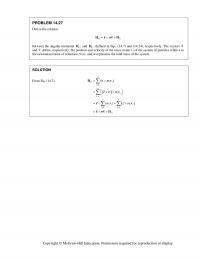
PROBLEM 14.27 Derive the relation OG m HrvH between the angular momenta O H and G H defined in Eqs. (14.7) and (14.24), respectively. The vectors r and v define, respectively, the position and velocity of the mass center G […]
978-0077687342 Chapter 14 Part 4
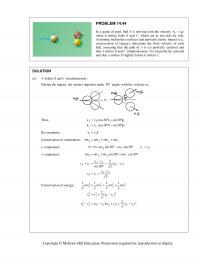
PROBLEM 14.44 In a game of pool, ball A is moving with the velocity 00 vvi when it strikes balls B and C, which are at rest side by side. Assuming frictionless surfaces and perfectly elastic impact (i.e., conservation of […]
978-0077687342 Chapter 14 Part 5
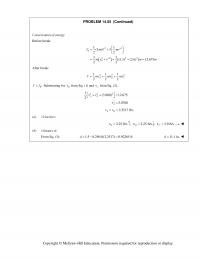
PROBLEM 14.55 (Continued) Conservation of energy. Before break: 22 0 22 2 2 0 11 (3 ) 3 22 33 [(1.3) (2.6) ] 12.675 22 Tmv mv mv v m m […]
978-0077687342 Chapter 14 Part 6
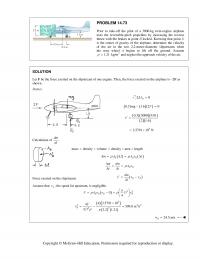
PROBLEM 14.73 Prior to take-off the pilot of a 3000-kg twin-engine airplane tests the reversible-pitch propellers by increasing the reverse thrust with the brakes at point B locked. Knowing that point G is the center of gravity of the airplane, […]
978-0077687342 Chapter 14 Part 7
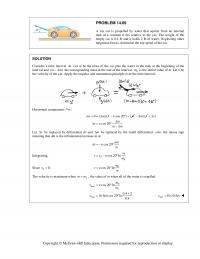
PROBLEM 14.89 A toy car is propelled by water that squirts from an internal tank at a constant 6 ft/s relative to the car. The weight of the empty car is 0.4 lb and it holds 2 lb of water. […]
978-0077687342 Chapter 14 Part 8
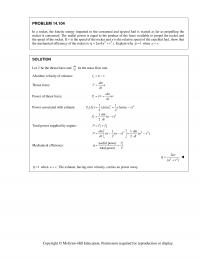
PROBLEM 14.104 In a rocket, the kinetic energy imparted to the consumed and ejected fuel is wasted as far as propelling the rocket is concerned. The useful power is equal to the product of the force available to propel the […]

978-0077687342 Chapter 15 Part 1
CHAPTER 15 PROBLEM 15.1 The brake drum is attached to a larger flywheel that is not shown. The motion of the brake drum is defined by the relation 2 36 1.6 ,tt θ = − where θ is expressed in […]
978-0077687342 Chapter 15 Part 10
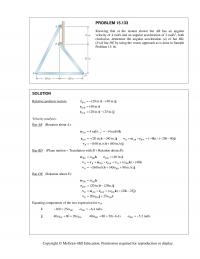
PROBLEM 15.133 Knowing that at the instant shown bar AB has an angular velocity of 4 rad/s and an angular acceleration of 2 rad/s2, both clockwise, determine the angular acceleration (a) of bar BD, (b) of bar DE by using […]
978-0077687342 Chapter 15 Part 11
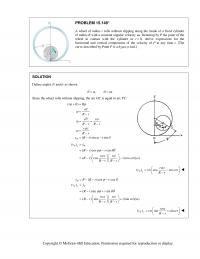
PROBLEM 15.148* A wheel of radius r rolls without slipping along the inside of a fixed cylinder of radius R with a constant angular velocity .ω Denoting by P the point of the wheel in contact with the cylinder at […]
978-0077687342 Chapter 15 Part 12
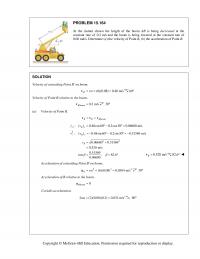
constant rate of 0.2 m/s and the boom is being lowered at the constant rate of 0.08 rad/s. Determine (a) the velocity of Point B, (b) the acceleration of Point B. SOLUTION Velocity of coinciding Point B′ on boom. (6)(0.08) […]
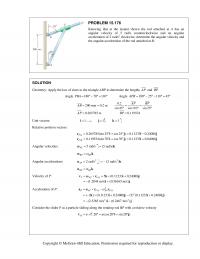
978-0077687342 Chapter 15 Part 13
PROBLEM 15.176 Knowing that at the instant shown the rod attached at A has an angular velocity of 5 rad/s counterclockwise and an angular acceleration of 2 rad/s2 clockwise, determine the angular velocity and the angular acceleration of the rod […]
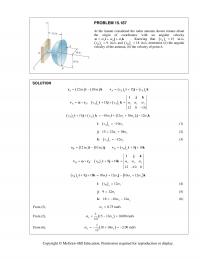
978-0077687342 Chapter 15 Part 14
PROBLEM 15.187 At the instant considered the radar antenna shown rotates about the origin of coordinates with an angular velocity xyz ωωω =++i jk ω . Knowing that ( ) 15 Ay v= in./s, ( ) 9 By v= in./s, […]
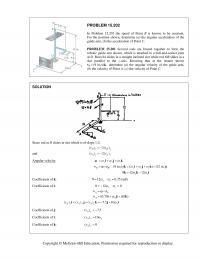
978-0077687342 Chapter 15 Part 15
PROBLEM 15.202 In Problem 15.201 the speed of Point B is known to be constant. For the position shown, determine (a) the angular acceleration of the guide arm, (b) the acceleration of Point C. PROBLEM 15.201 Several rods are brazed […]
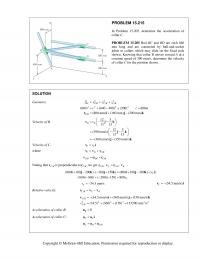
978-0077687342 Chapter 15 Part 16
PROBLEM 15.215 In Problem 15.205, determine the acceleration of collar C. PROBLEM 15.205 Rod BC and BD are each 840 mm long and are connected by ball-and–socket joints to collars which may slide on the fixed rods shown. Knowing that […]
978-0077687342 Chapter 15 Part 17
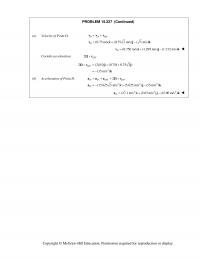
PROBLEM 15.227 (Continued) D=+−a ij k Copyright © McGraw–Hill Education. Permission required for reproduction or display. (a) Velocity of Point D. / (0.75 m/s) (0.75 3 m/s) ( 3 m/s) D D DF D ′ = + =+− vvv v […]
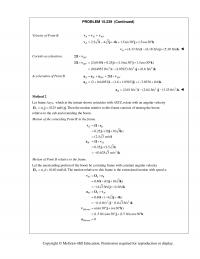
978-0077687342 Chapter 15 Part 18
PROBLEM 15.239 (Continued) /boom /boom (1.5 ft/s)sin 30 (1.5 ft/s) cos30 0 B B = °+ ° = jk a Copyright © McGraw–Hill Education. Permission required for reproduction or display. Velocity of Point B. / 2.5 3 4 3 4 […]
978-0077687342 Chapter 15 Part 19
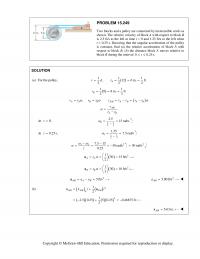
PROBLEM 15.249 Two blocks and a pulley are connected by inextensible cords as shown. The relative velocity of block A with respect to block B is 2.5 ft/s to the left at time t = 0 and 1.25 ft/s to […]
978-0077687342 Chapter 15 Part 2
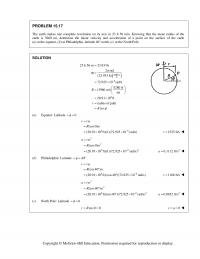
PROBLEM 15.17 The earth makes one complete revolution on its axis in 23 h 56 min. Knowing that the mean radius of the earth is 3960 mi, determine the linear velocity and acceleration of a point on the surface of […]
978-0077687342 Chapter 15 Part 20
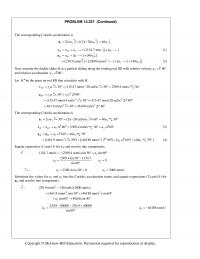
PROBLEM 15.257 (Continued) 2 sin 60 ° 2 Copyright © McGraw–Hill Education. Permission required for reproduction or display. The corresponding Coriolis acceleration is 11 [2 u ω =a 1 ] [(2)( 20)u= − 1 ] 40u= 1HH u ′ = […]
978-0077687342 Chapter 15 Part 3
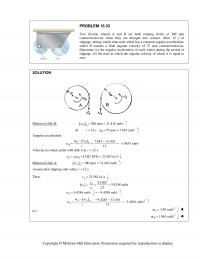
PROBLEM 15.33 Two friction wheels A and B are both rotating freely at 300 rpm counterclockwise when they are brought into contact. After 12 s of slippage, during which time each wheel has a constant angular acceleration, wheel B reaches […]
978-0077687342 Chapter 15 Part 4
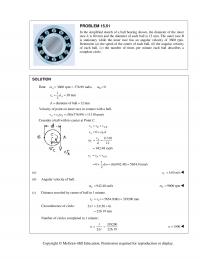
PROBLEM 15.51 In the simplified sketch of a ball bearing shown, the diameter of the inner race A is 60 mm and the diameter of each ball is 12 mm. The outer race B is stationary while the inner race […]
978-0077687342 Chapter 15 Part 5
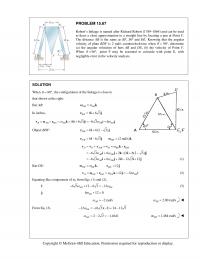
PROBLEM 15.67 Robert’s linkage is named after Richard Robert (1789–1864) and can be used to draw a close approximation to a straight line by locating a pen at Point F. The distance AB is the same as BF, DF and […]
978-0077687342 Chapter 15 Part 6
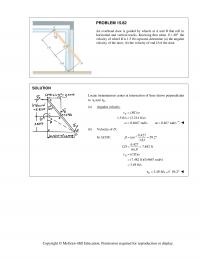
PROBLEM 15.82 An overhead door is guided by wheels at A and B that roll in horizontal and vertical tracks. Knowing that when 40 θ = ° the velocity of wheel B is 1.5 ft/s upward, determine (a) the angular […]
978-0077687342 Chapter 15 Part 7
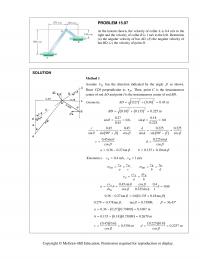
PROBLEM 15.97 At the instant shown, the velocity of collar A is 0.4 m/s to the right and the velocity of collar B is 1 m/s to the left. Determine (a) the angular velocity of bar AD, (b) the angular […]
978-0077687342 Chapter 15 Part 8
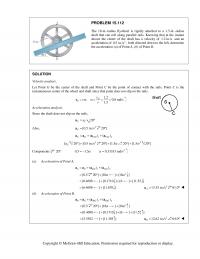
PROBLEM 15.112 The 18-in.–radius flywheel is rigidly attached to a 1.5-in. –radius shaft that can roll along parallel rails. Knowing that at the instant shown the center of the shaft has a velocity of 1.2 in./s and an acceleration of […]
978-0077687342 Chapter 15 Part 9
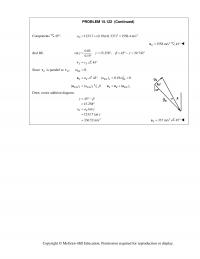
PROBLEM 15.122 (Continued) E Copyright © McGraw–Hill Education. Permission required for reproduction or display. Components 45 :° 22 1233.7 (0.19)(41.337) 1558.4 m/s D a=+= 2 1558 m/s D =a 45° Rod BE. 0.05 sin , 15.258 , 45 29.742 […]

978-0077687342 Chapter 16 Part 1
CHAPTER 16 PROBLEM 16.1 A 60–lb uniform thin panel is placed in a truck with end A resting on a rough horizontal surface and end B supported by a smooth vertical surface. Knowing that the deceleration of the truck is […]
978-0077687342 Chapter 16 Part 10
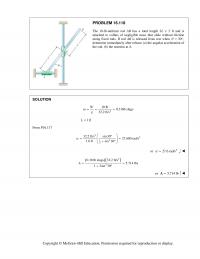
PROBLEM 16.118 The 10-lb–uniform rod AB has a total length 2L = 2 ft and is attached to collars of negligible mass that slide without friction along fixed rods. If rod AB is released from rest when 30 , θ […]
978-0077687342 Chapter 16 Part 11
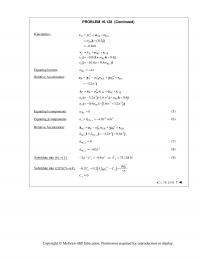
PROBLEM 16.128 (Continued) Kinematics: Equating i–terms: Relative Acceleration: 2 BC ωπ = − =aa 2 ω −+ra × r Equating i components: (5) Equating j components: (6) 0 BC a = 22 aa π = = − Relative Acceleration: (7) […]
978-0077687342 Chapter 16 Part 13
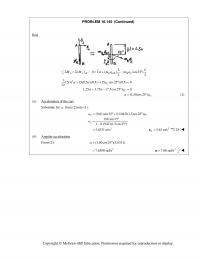
PROBLEM 16.145 (Continued) Rod eff / ( ) : 0 ( ) ( cos 25 ) 22 A A RGR RC M M I ma ma a Σ=Σ =+ − ° 2 115(1) 15(0.5 )(0.5) (15 cos 25 )(0.5) 0 […]
978-0077687342 Chapter 16 Part 14
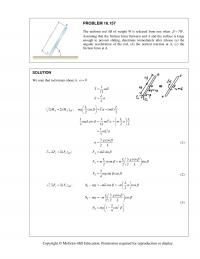
PROBLEM 16.157 The uniform rod AB of weight W is released from rest when 70 . β = ° Assuming that the friction force between end A and the surface is large enough to prevent sliding, determine immediately after release […]
978-0077687342 Chapter 16 Part 15
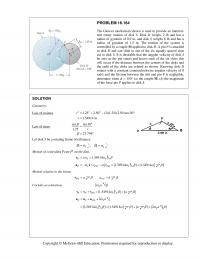
PROBLEM 16.164 The Geneva mechanism shown is used to provide an intermit- tent rotary motion of disk S. Disk D weighs 2 lb and has a radius of gyration of 0.9 in. and disk S weighs 6 lb and has […]
978-0077687342 Chapter 16 Part 2
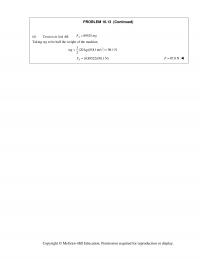
PROBLEM 16.13 (Continued) (b) Tension in link AB. A Taking mg to be half the weight of the machine, 2 1(20 kg)(9.81 m/s ) 98.1 N 2 mg = = (0.89522)(98.1 N) A F= 87.8 NF= 89525 F mg= […]
978-0077687342 Chapter 16 Part 3
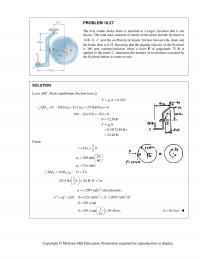
PROBLEM 16.27 The 8–in.–radius brake drum is attached to a larger flywheel that is not shown. The total mass moment of inertia of the drum and the flywheel is 2 14 lb ft s⋅⋅ and the coefficient of kinetic friction […]
978-0077687342 Chapter 16 Part 4
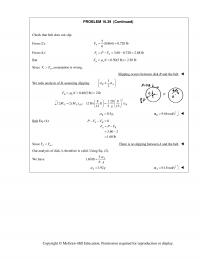
PROBLEM 16.39 (Continued) Check that belt does not slip. From (2): 6 A F= = From (4): 3.60 0.720 2.88 lb eA F PF=−= − = But 0.50(5 lb) 2.50 lb FN µ = = = 5(0.864) 0.720 lb ms […]
978-0077687342 Chapter 16 Part 5
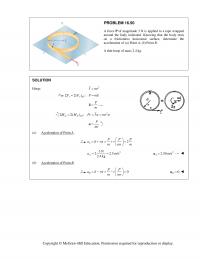
PROBLEM 16.50 A force P of magnitude 3 N is applied to a tape wrapped around the body indicated. Knowing that the body rests on a frictionless horizontal surface, determine the acceleration of (a) Point A, (b) Point B. A […]
978-0077687342 Chapter 16 Part 6
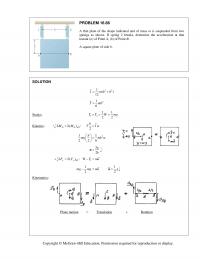
PROBLEM 16.66 A thin plate of the shape indicated and of mass m is suspended from two springs as shown. If spring 2 breaks, determine the acceleration at that instant (a) of Point A, (b) of Point B. A square […]
978-0077687342 Chapter 16 Part 7
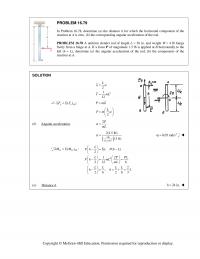
PROBLEM 16.79 In Problem 16.78, determine (a) the distance h for which the horizontal component of the reaction at A is zero, (b) the corresponding angular acceleration of the rod. PROBLEM 16.78 A uniform slender rod of length L = […]
978-0077687342 Chapter 16 Part 8
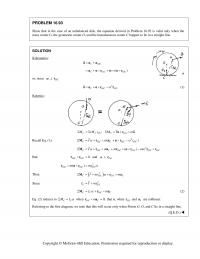
PROBLEM 16.93 Show that in the case of an unbalanced disk, the equation derived in Problem 16.92 is valid only when the mass center G, the geometric center O, and the instantaneous center C happen to lie in a straight […]
978-0077687342 Chapter 16 Part 9
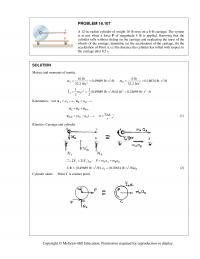
PROBLEM 16.107 A 12–in.–radius cylinder of weight 16 lb rests on a 6-lb carriage. The system is at rest when a force P of magnitude 4 lb is applied. Knowing that the cylinder rolls without sliding on the carriage and […]

978-0077687342 Chapter 17 Part 1
CHAPTER 17 PROBLEM 17.1 A 200-kg flywheel is at rest when a constant 300 N m couple is applied. After executing 560 revolutions, the flywheel reaches its rated speed of 2400 rpm. Knowing that the radius of gyration of […]
978-0077687342 Chapter 17 Part 10
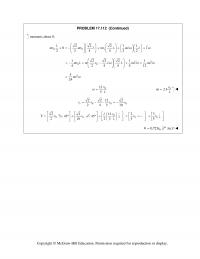
PROBLEM 17.112 (Continued) moments about B: 00 0 224 422 t mv mv L mv L mL L I 22 00 122211 4244412 mv L m v L L […]
978-0077687342 Chapter 17 Part 11
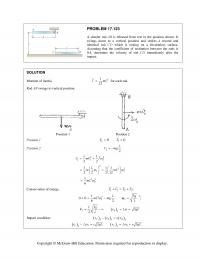
PROBLEM 17.123 A slender rod AB is released from rest in the position shown. It swings down to a vertical position and strikes a second and identical rod CD which is resting on a frictionless surface. Assuming that the coefficient […]
978-0077687342 Chapter 17 Part 12
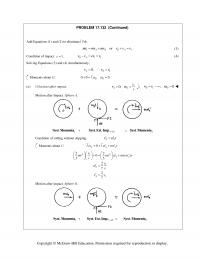
PROBLEM 17.132 (Continued) Add Equations (1) and (2) to eliminate .Pdt 11 or AB BA mv mv mv v v v (3) Condition of impact. 1. e 11BA vvevv (4) Solving Equations (3) and (4) simultaneously, 1 0, […]
978-0077687342 Chapter 17 Part 13
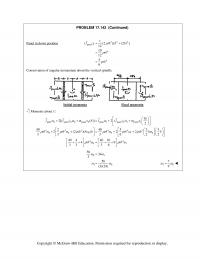
PROBLEM 17.142 (Continued) Panel in down position 22 2 panel 1 4 4 10 12 5 tb 1 ( ) (2 )[ (2 ) ] 12 6 tb Itbbb Conservation of angular momentum about […]
978-0077687342 Chapter 17 Part 14
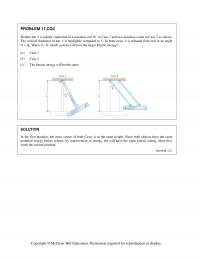
PROBLEM 17.CQ3 Slender bar A is rigidly connected to a massless rod BC in Case 1 and two massless cords in Case 2 as shown. The vertical thickness of bar A is negligible compared to L. In both cases A […]
978-0077687342 Chapter 17 Part 2
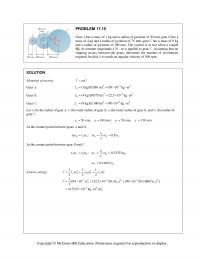
PROBLEM 17.15 Gear A has a mass of 1 kg and a radius of gyration of 30 mm; gear B has a mass of 4 kg and a radius of gyration of 75 mm; gear C has a mass of […]
978-0077687342 Chapter 17 Part 3
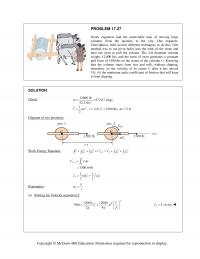
PROBLEM 17.27 Greek engineers had the unenviable task of moving large columns from the quarries to the city. One engineer, Chersiphron, tried several different techniques to do this. One method was to cut pivot holes into the ends of the […]
978-0077687342 Chapter 17 Part 4
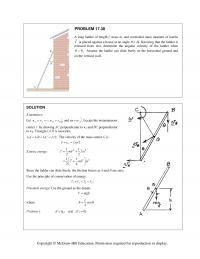
PROBLEM 17.38 A long ladder of length l, mass m, and centroidal mass moment of inertia I is placed against a house at an angle . Knowing that the ladder is released from rest, determine the angular […]
978-0077687342 Chapter 17 Part 5
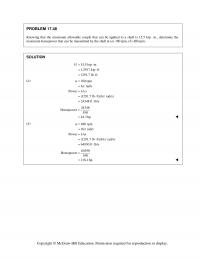
PROBLEM 17.48 Knowing that the maximum allowable couple that can be applied to a shaft is 15.5 kip in., determine the maximum horsepower that can be transmitted by the shaft at (a) 180 rpm, (b) 480 rpm. SOLUTION 15.5 […]
978-0077687342 Chapter 17 Part 6
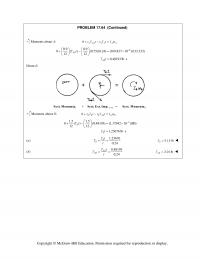
PROBLEM 17.64 (Continued) Moments about A: 0 AAB AA A A rT t rTt I 6 0.9 0.9 0 ( ) (0.75)(0.24) (169.837 10 )(133.333) 12 12 0.48193 lb s AB AB Tt Tt […]
978-0077687342 Chapter 17 Part 7
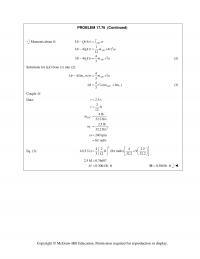
PROBLEM 17.76 (Continued) Moments about B: 2 (4 ) 1 4( ) (4 ) 12 ABC ABC Mt Qt r I Mt Qt r m r 2 4 4( ) 3ABC M tQtrmr (2) […]
978-0077687342 Chapter 17 Part 8
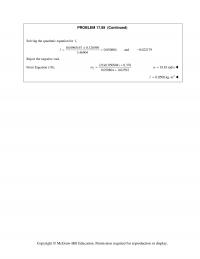
PROBLEM 17.89 (Continued) Solving the quadratic equation for , I 0.04965167 0.126590 0.050804 and 0.022179 3.46904 I Reject the negative root. From Equation (10), 2 (21)(0.050804) 0.378 0.050804 0.02592 18.83 rad/s 2 0.0508 […]
978-0077687342 Chapter 17 Part 9
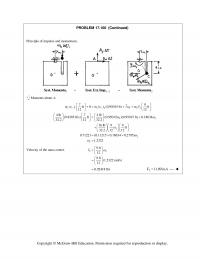
PROBLEM 17.100 (Continued) Principle of impulse and momentum. 1 Syst. Momenta 12 Syst. Ext. Imp. 2 Syst. Momenta Moments about A: 1222 22 2 ( ) ft 0 ( ) (0.95015 ft) ft 12 12 4lb 7 […]

978-0077687342 Chapter 18 Part 1
CHAPTER 18 PROBLEM 18.1 A thin, homogeneous disk of mass m and radius r spins at the constant rate 1 ω about an axle held by a fork-ended vertical rod, which rotates at the constant rate 2 . ω Determine […]
978-0077687342 Chapter 18 Part 10
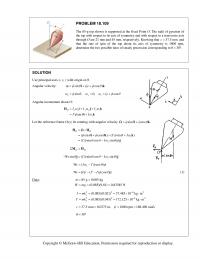
PROBLEM 18.109 The 85-g top shown is supported at the fixed Point O. The radii of gyration of the top with respect to its axis of symmetry and with respect to a transverse axis through O are 21 mm and […]
978-0077687342 Chapter 18 Part 11
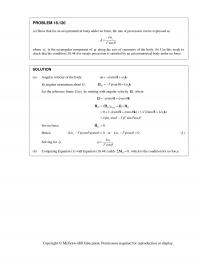
PROBLEM 18.120 (a) Show that for an axisymmetrical body under no force, the rate of precession can be expressed as cos z I I ω φθ =′ where z ω is the rectangular component of ω along the axis […]
978-0077687342 Chapter 18 Part 12
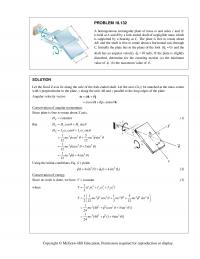
PROBLEM 18.132 A homogeneous rectangular plate of mass m and sides c and 2c is held at A and B by a fork–ended shaft of negligible mass which is supported by a bearing at C. The plate is free to […]
978-0077687342 Chapter 18 Part 13
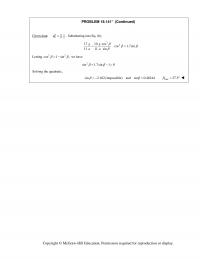
PROBLEM 18.141* (Continued) Given data: 217 011 g a φ = ⋅ Substituting into Eq. (6), 11 11 sin aa β = = Letting 22 cos 1 sin , ββ = − we have 2 sin 1.7sin 1 0 […]
978-0077687342 Chapter 18 Part 14
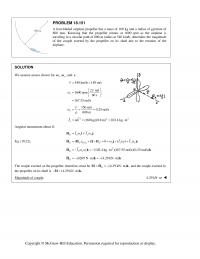
PROBLEM 18.151 A four-bladed airplane propeller has a mass of 160 kg and a radius of gyration of 800 mm. Knowing that the propeller rotates at 1600 rpm as the airplane is traveling in a circular path of 600-m radius […]
978-0077687342 Chapter 18 Part 2
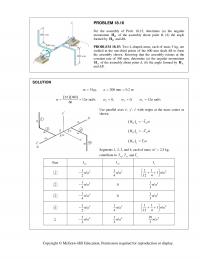
PROBLEM 18.16 For the assembly of Prob. 18.15, determine (a) the angular momentum B H of the assembly about point B, (b) the angle formed by B H and BA. PROBLEM 18.15: Two L–shaped arms, each of mass 5 kg, […]
978-0077687342 Chapter 18 Part 3
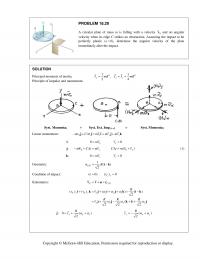
PROBLEM 18.29 A circular plate of mass m is falling with a velocity 0 v and no angular velocity when its edge C strikes an obstruction. Assuming the impact to be perfectly plastic ( 0),e= determine the angular velocity of […]
978-0077687342 Chapter 18 Part 4
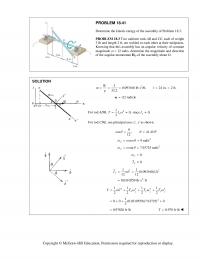
PROBLEM 18.41 Determine the kinetic energy of the assembly of Problem 18.3. PROBLEM 18.3 Two uniform rods AB and CE, each of weight 3 lb and length 2 ft, are welded to each other at their midpoints. Knowing that this […]
978-0077687342 Chapter 18 Part 5
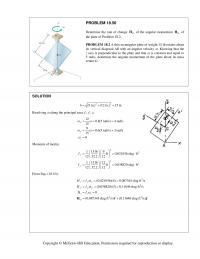
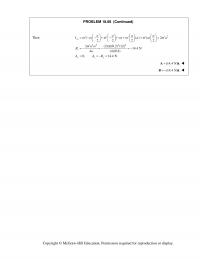
PROBLEM 18.56 Determine the rate of change G H of the angular momentum G H of the plate of Problem 18.2. PROBLEM 18.2 A thin rectangular plate of weight 15 lb rotates about its vertical diagonal AB with an […]
978-0077687342 Chapter 18 Part 6
PROBLEM 18.68 (Continued) Then 22 2 2 ( ) ( ) () () 2 22 2 2 2 (2)(1)(0.2) (12) 14.4 N 4 (4)(0.2) 0, 14.4 N xz z y zz I ma m am ama ma ma Ba A […]
978-0077687342 Chapter 18 Part 7
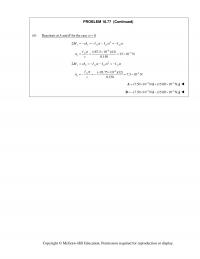
PROBLEM 18.77 (Continued) (b) Reactions at and for the case 0.AB ω = x y xz yz xz M cA I I I αω α Σ=−=− − =− 6 3 (187.5 10 )(12) 15 10 N 0.150 xz y I […]
978-0077687342 Chapter 18 Part 8
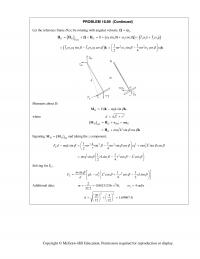
PROBLEM 18.89 (Continued) Let the reference frame Dxyz be rotating with angular velocity 1 .=Ωω ( ) ( ) ( ) 11 0 sin cos G G G xx yy Gxyz II ω βω β ω ω = +× =+ […]
978-0077687342 Chapter 18 Part 9
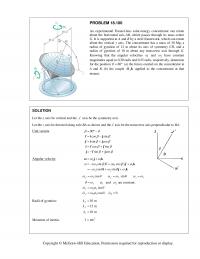
PROBLEM 18.100 An experimental Fresnel–lens solar–energy concentrator can rotate about the horizontal axis AB, which passes through its mass center G. It is supported at A and B by a steel framework, which can rotate about the vertical y axis. […]

978-0077687342 Chapter 19 Part 1
CHAPTER 19 PROBLEM 19.1 A particle moves in simple harmonic motion. Knowing that the maximum velocity is 200 mm/s and the maximum acceleration is 4 m/s2, determine the amplitude and frequency of the motion. SOLUTION Eq. 19.15: 2 mmn mmn […]
978-0077687342 Chapter 19 Part 10
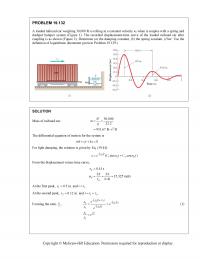
PROBLEM 19.132 A loaded railroad car weighing 30,000 lb is rolling at a constant velocity v0 when it couples with a spring and dashpot bumper system (Figure 1). The recorded displacement-time curve of the loaded railroad car after coupling is […]
978-0077687342 Chapter 19 Part 11
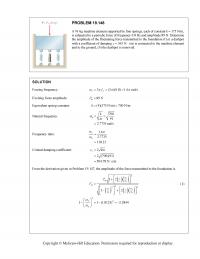
PROBLEM 19.148 A 91-kg machine element supported by four springs, each of constant k = 175 N/m, is subjected to a periodic force of frequency 0.8 Hz and amplitude 89 N. Determine the amplitude of the fluctuating force transmitted to […]
978-0077687342 Chapter 19 Part 12
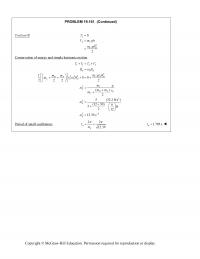
PROBLEM 19.161 (Continued) P osition 2 2 2 2 0 2 C Cm T Vmgh mg θ = = = Conservation of energy and simple harmonic motion. 11 2 2 2 222 2 2 2 22 100 22 22 […]
978-0077687342 Chapter 19 Part 2
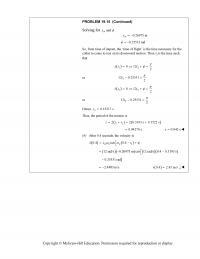
PROBLEM 19.15 (Continued) Solving for and m x φ 0.26975 m m x=− 0.25531 rad φ = − So, from time of impact, the ‘time of flight’ is the time necessary for the collar to come to rest on its […]
978-0077687342 Chapter 19 Part 3
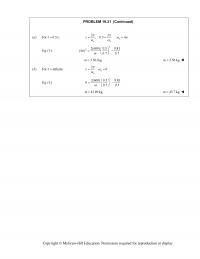
PROBLEM 19.31 (Continued) (a) For 0.5 s: τ = 22 ;0.5 4 n nn π π τ ωπ ωω === Eq. (1): 2 22(600) 0.5 9.81 (4 ) 0.7 0.7m π ⎛⎞ =− ⎜⎟ ⎝⎠ 3.561 kgm = 3.56 kgm […]
978-0077687342 Chapter 19 Part 6
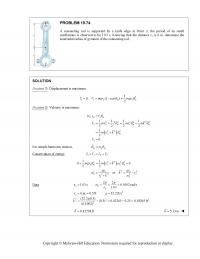
PROBLEM 19.74 A connecting rod is supported by a knife edge at Point A; the period of its small oscillations is observed to be 1.03 s. Knowing that the distance ra is 6 in. determine the centroidal radius of gyration […]
978-0077687342 Chapter 19 Part 7
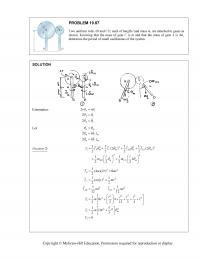
SO LUTION PR O Tw o sho w dete r O BLEM 1 9 o uniform rod s w n. Knowing r mine the per i 9 .87 s AB and CD, that the mas s i od of small […]
978-0077687342 Chapter 19 Part 9
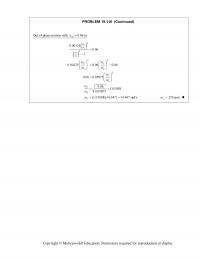
PROBLEM 19.116 (Continued) Out of phase motion with | | 0.06 in. m x= ( ) () 2 2 22 2 0.00125 0.06 1 0.00125 0.06 0.06 0.06 0.05875 f n f n ff nn f n ω ω ω […]