PROBLEM 12.91 (Continued)
Af Af
Af
PROBLEM 12.92
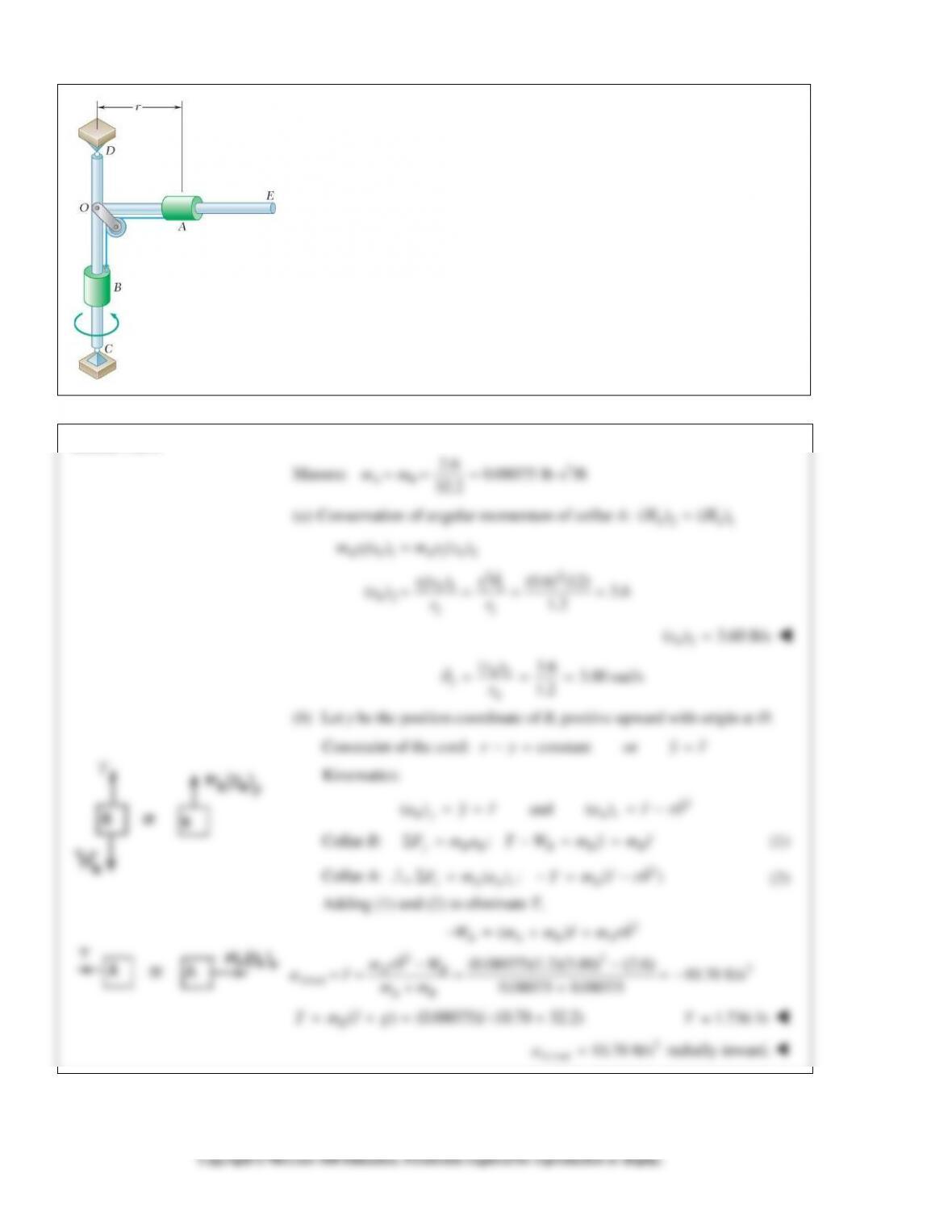
Two 2.6-lb collars A and B can slide without friction on a frame, consisting
of the horizontal rod OE and the vertical rod CD, which is free to rotate
about CD. The two collars are connected by a cord running over a pulley
that is attached to the frame at O and a stop prevents collar B from moving.
The frame is rotating at the rate
12 rad/s
θ
=
and
0.6 ftr=
when the stop
is removed allowing collar A to move out along rod OE. Neglecting
friction and the mass of the frame, determine, for the position
1.2 ft,r=
(a) the transverse component of the velocity of collar A, (b) the tension in
the cord and the acceleration of collar A relative to the rod OE.
SOLUTION
2
2.6 0.08075 lb s /ft
/ rod
A
PROBLEM 12.93
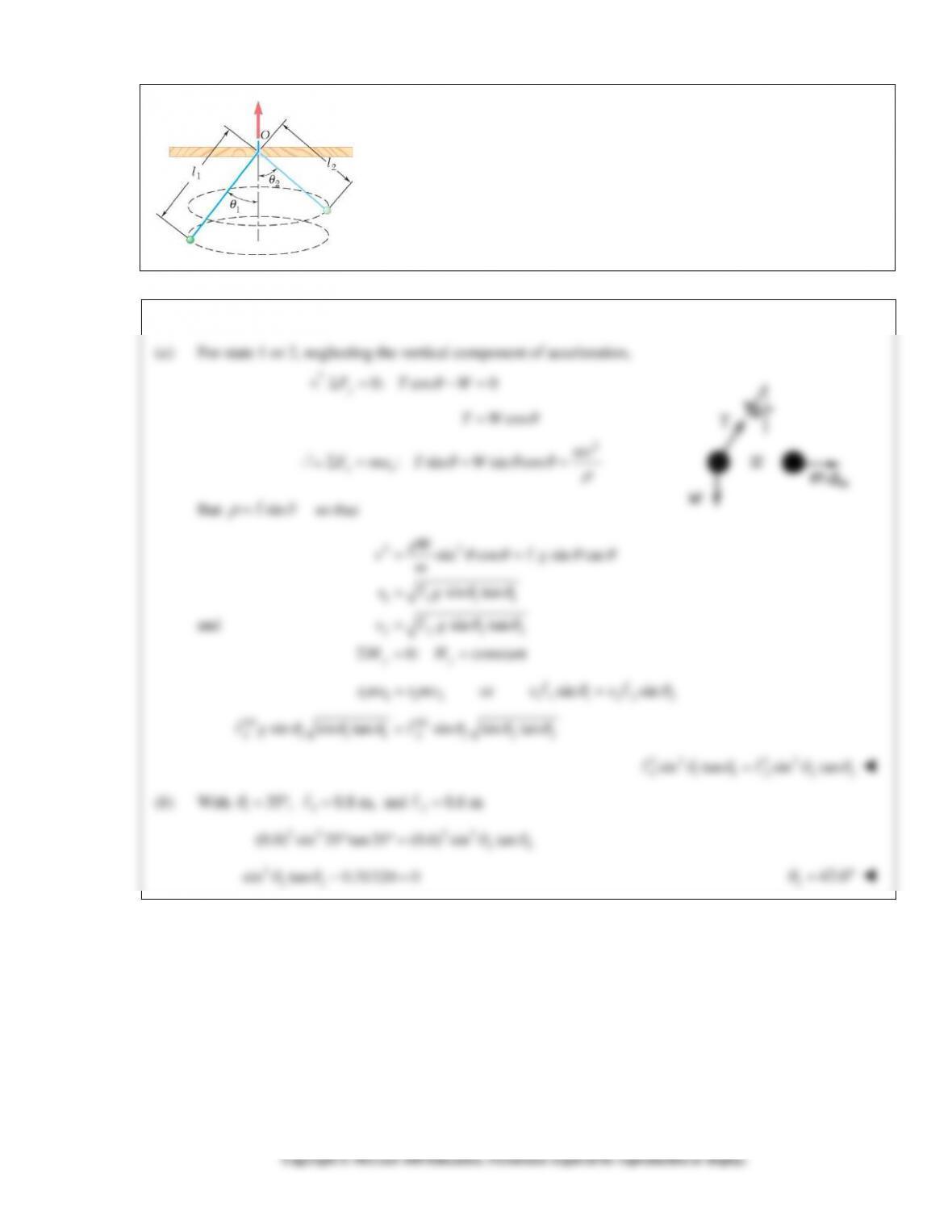
A small ball swings in a horizontal circle at the end of a cord of length
1
l
,
which forms an angle
1
θ
with the vertical. The cord is then slowly drawn
through the support at O until the length of the free end is
2
.l
(a) Derive a
relation among
1
,l
2
,l
1
,
θ
and
2
.
θ
(b) If the ball is set in motion so that
initially
1
0.8 ml=
and
1
35 ,
θ
= °
determine the angle
2
θ
when
2
0.6 m.l=
SOLUTION
22
2
PROBLEM 12.94
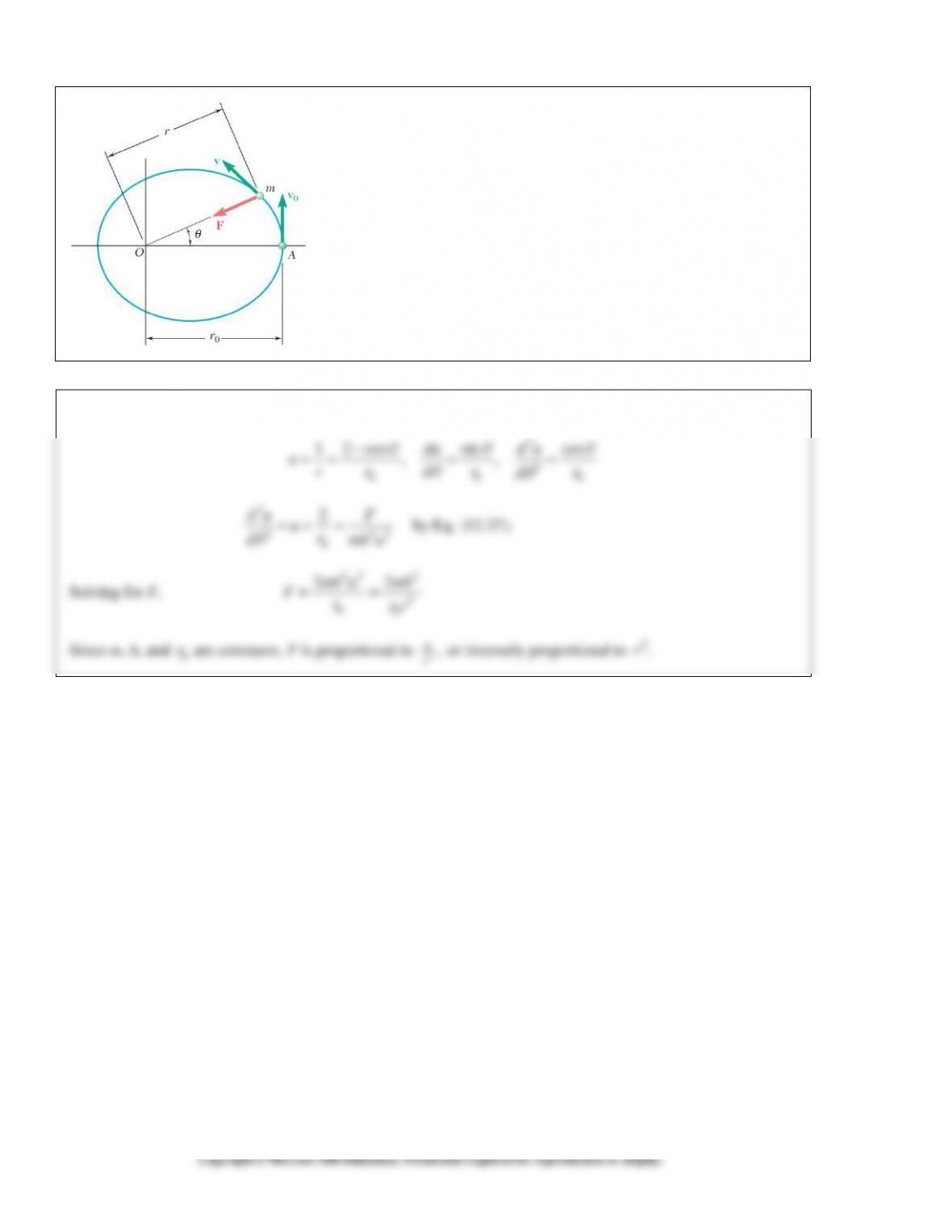
A particle of mass m is projected from Point A with an initial velocity
0
v
perpendicular to OA and moves under a central force F along an
elliptic path defined by the equation
0/(2 cos ).rr
θ
= −
Using Eq.
(12.35), show that F is inversely proportional to the square of the
distance r from the particle to the center of force O.
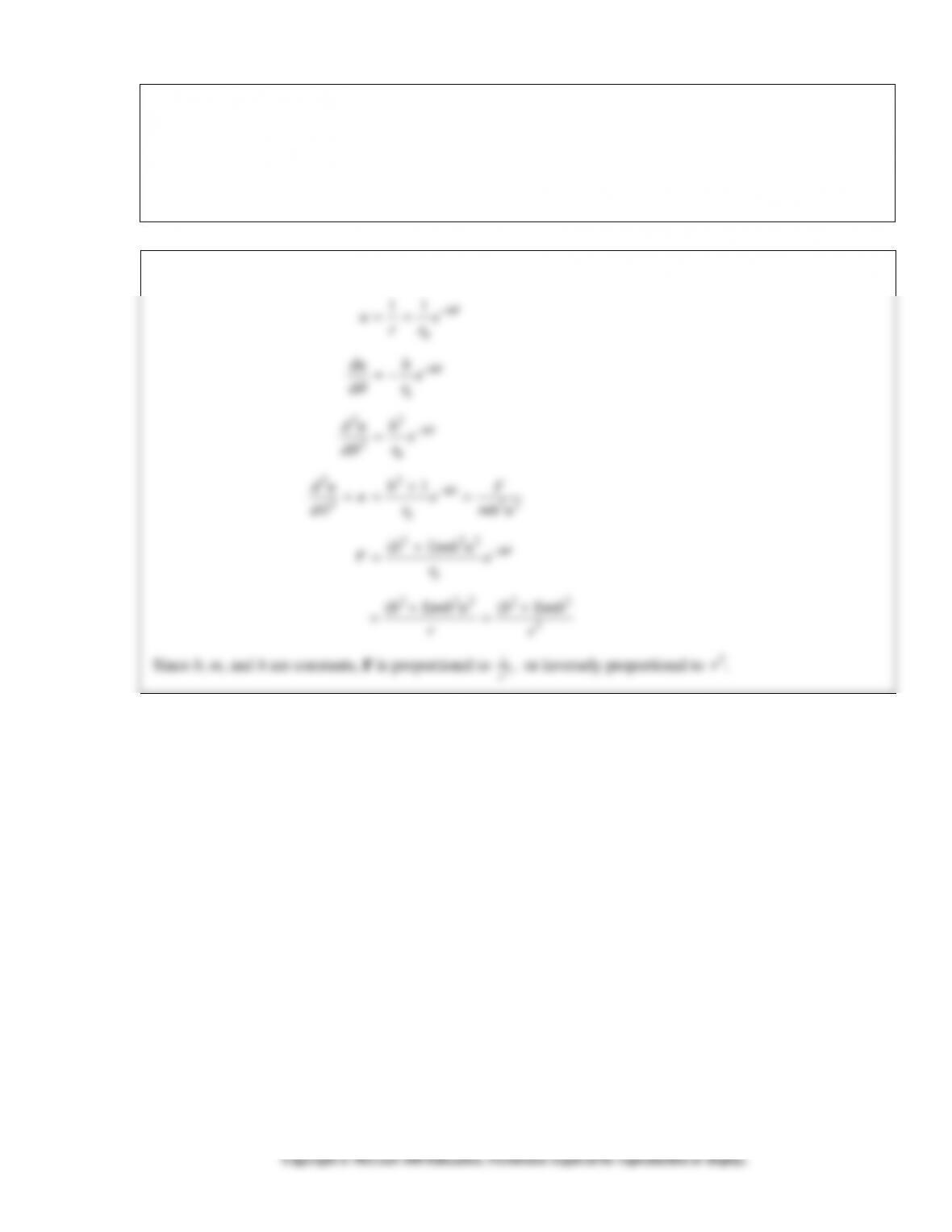
SOLUTION
2
1 2 cos sin cos
du d u
θθ θ
−
0
r
PROBLEM 12.95
A particle of mass m describes the logarithmic spiral
0b
r re
θ
=
under a central force F directed toward the
center of force O. Using Eq. (12.35) show that F is inversely proportional to the cube of the distance r from
the particle to O.
SOLUTION
11
b
θ
−
3
r
PROBLEM 12.96
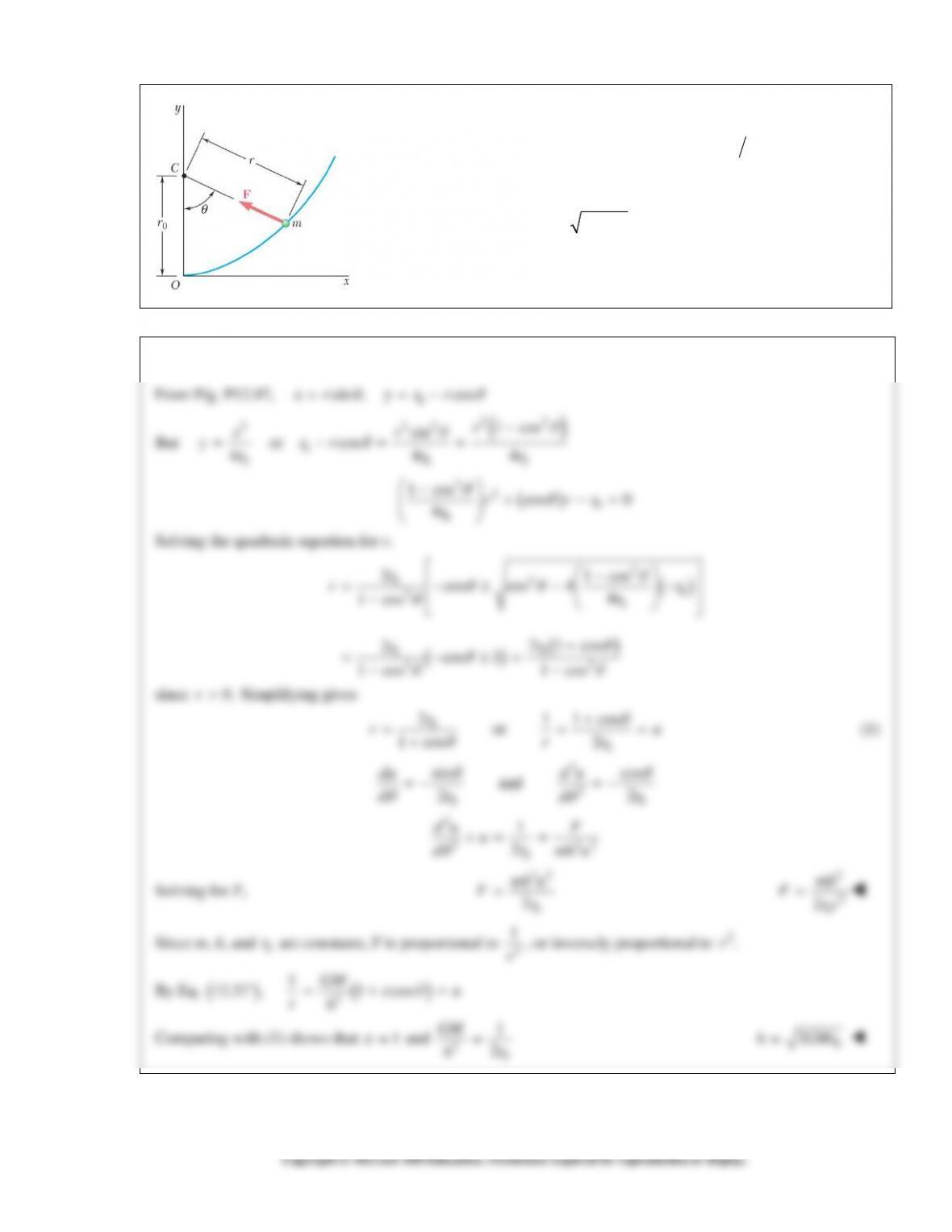
A particle of mass m describes the path defined by the equation
0
(6cos 5)rr
θ
= −
under a central force F directed away from the
center of force O. Using Eq. (12.35), show that F is inversely
proportional to the square of the distance r from the particle to O.
SOLUTION
0
0
2
0
1 6cos 5
6sin
6cos
urr
du
dr
du
dr
θ
θ
θ
θ
θ
−
= =
= −
= −
2
2 22
0
5du F
ur
d mh u
θ
+=− =
by Eq. (12.35).
Solving for F,
22
0
5mh u
Fr
= −
Substitute
1
ur
=
2
2
0
5mh
Frr
= −
Since m, h, and
0
r
are constants, F is proportional to
2
1
r
, or inversely proportional to
2.r
The minus sign
indicates that the force is repulsive, as shown in Fig. P12.96.
PROBLEM 12.97
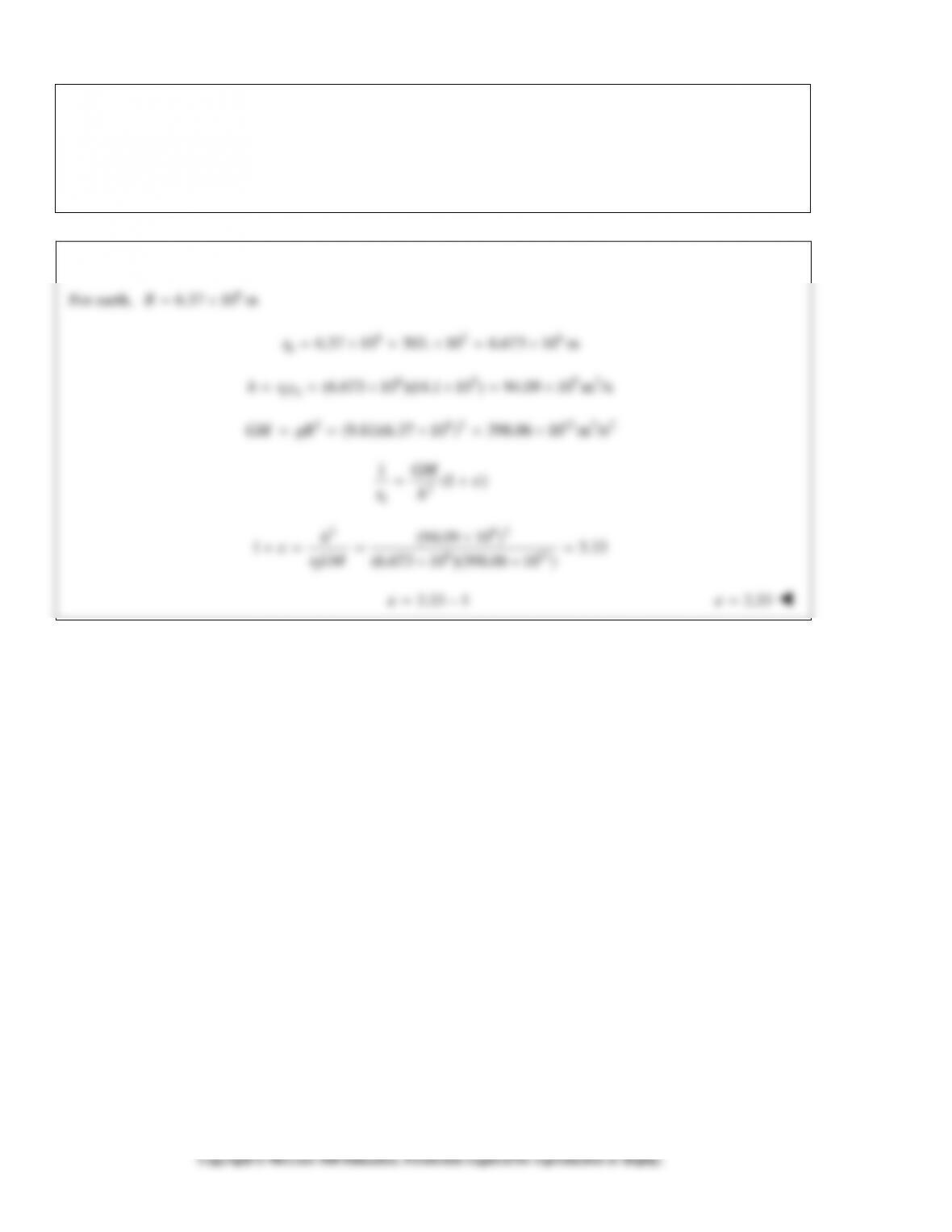
A particle of mass m describes the parabola
20
4yxr=
under a central
force F directed toward the center of force C. Using Eq. (12.35) and
Eq.
( )
12.37‘
with
1,
ε
=
show that F is inversely proportional to the square
of the distance r from the particle to the center of force and that the angular
momentum per unit mass
0
2.h GMr=
SOLUTION
20
2
r
h=
0
PROBLEM 12.98
It was observed that during its second flyby of the earth, the Galileo spacecraft had a velocity of 14.1 km/s as
it reached its minimum altitude of 303 km above the surface of the earth. Determine the eccentricity of the
trajectory of the spacecraft during this portion of its flight.
SOLUTION
6
PROBLEM 12.99
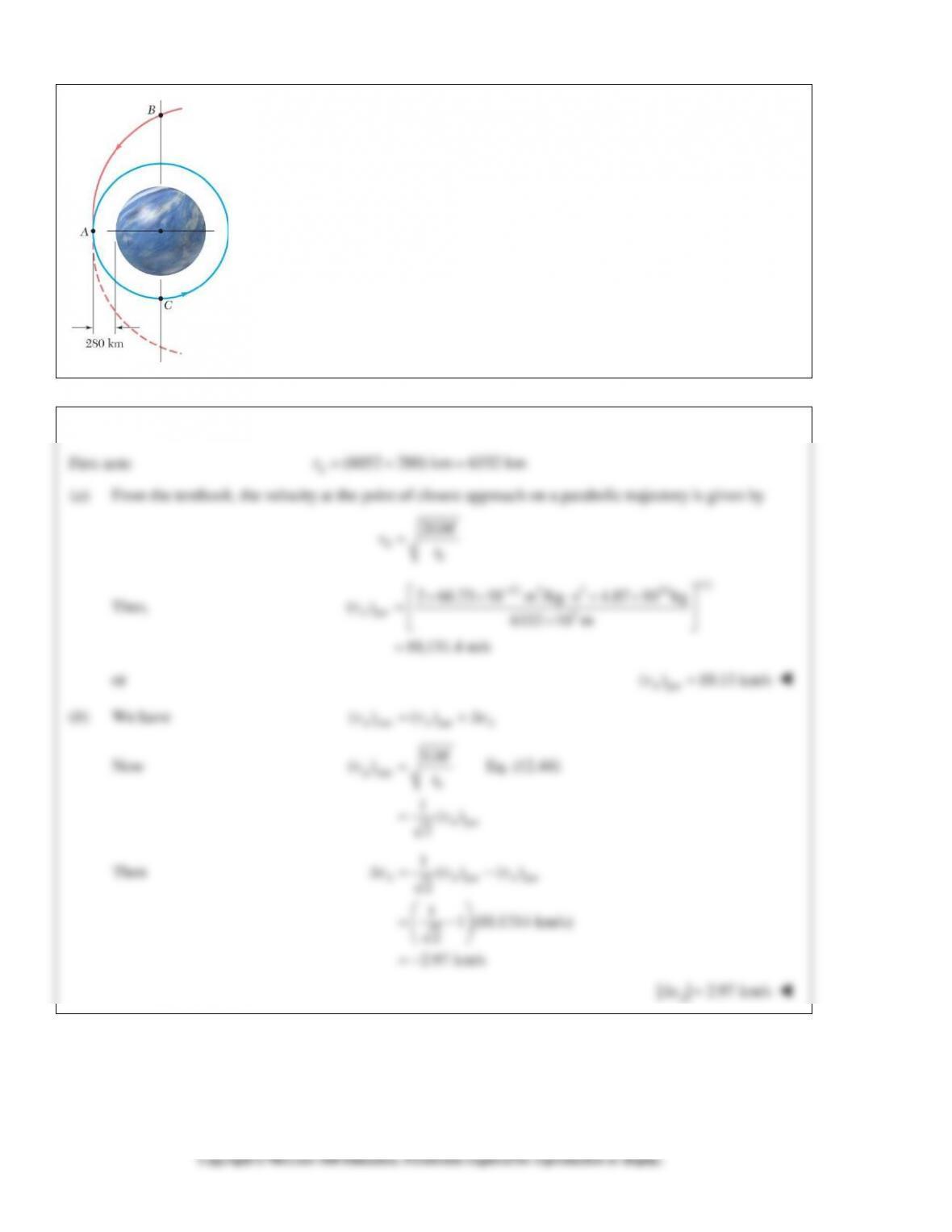
It was observed that during the Galileo spacecraft’s first flyby of the earth, its maximum altitude was 600 mi
above the surface of the earth. Assuming that the trajectory of the spacecraft was parabolic, determine the
maximum velocity of Galileo during its first flyby of the earth.
SOLUTION
6
0
PROBLEM 12.100
As a space probe approaching the planet Venus on a parabolic trajectory reaches
Point A closest to the planet, its velocity is decreased to insert it into a circular
orbit. Knowing that the mass and the radius of Venus are 4.87
24
10 kg×
and 6052
km, respectively, determine (a) the velocity of the probe as it approaches A,
(b) the decrease in velocity required to insert it into the circular orbit.
SOLUTION
A
PROBLEM 12.101
It was observed that as the Voyager I spacecraft reached the point of its trajectory closest to the planet Saturn,
it was at a distance of
3
185 10×
km from the center of the planet and had a velocity of 21.0 km/s. Knowing
that Tethys, one of Saturn’s moons, describes a circular orbit of radius
3
295 10×
km at a speed of 11.35 km/s,
determine the eccentricity of the trajectory of Voyager I on its approach to Saturn.
SOLUTION
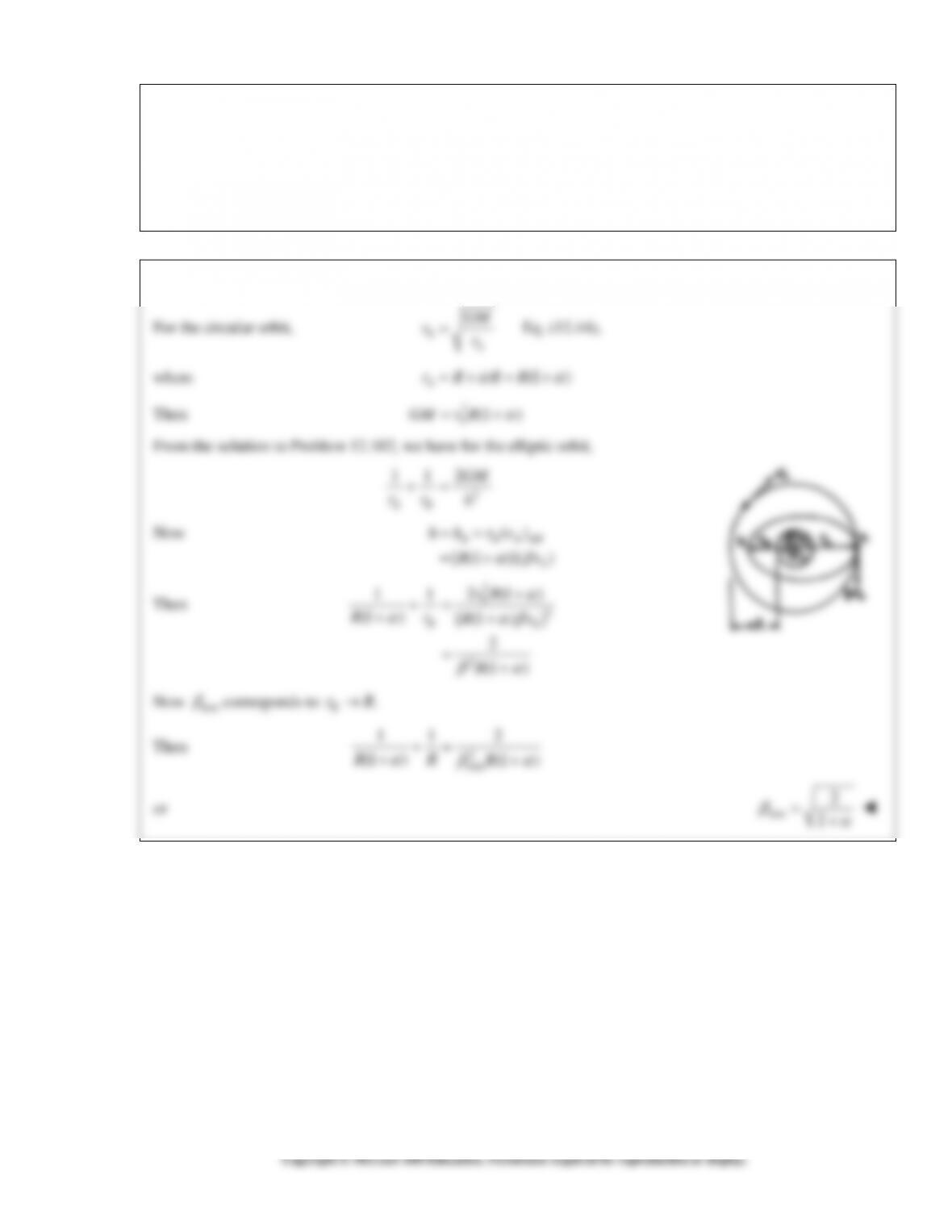
PROBLEM 12.102
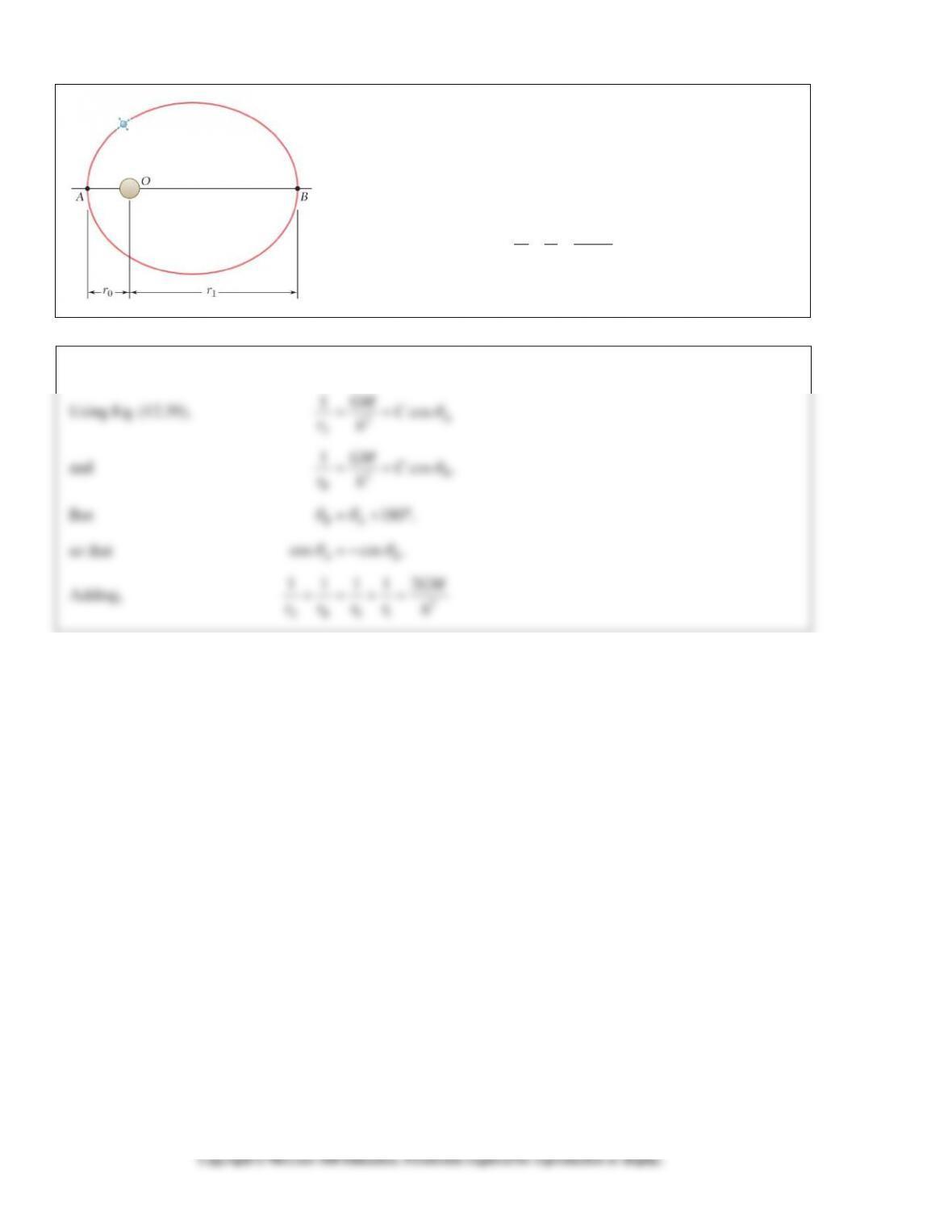
A satellite describes an elliptic orbit about a planet of mass M.
Denoting by
0
r
and
1
,r
respectively, the minimum and maximum
values of the distance r from the satellite to the center of the planet,
derive the relation
2
01
112GM
rr h
+=
where h is the angular momentum per unit mass of the satellite.
SOLUTION
1cos
GM C
2
01
AB
r r rr h
PROBLEM 12.103
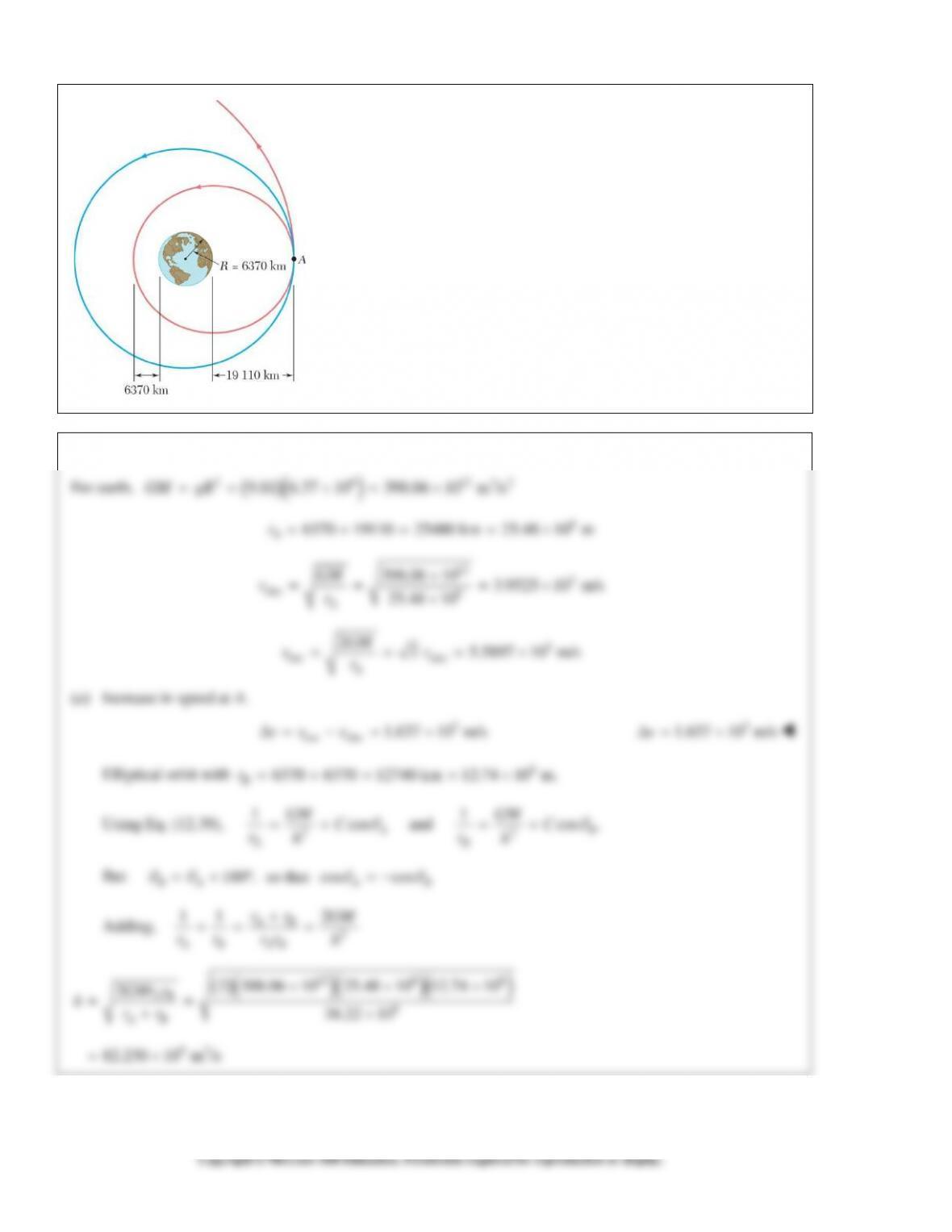
A space probe is describing a circular orbit about a planet of radius R. The altitude of the probe above the
surface of the planet is
R
α
and its speed is v0. To place the probe in an elliptic orbit which will bring it closer
to the planet, its speed is reduced from v0 to
0
,v
b
where
1,
b
<
by firing its engine for a short interval of
time. Determine the smallest permissible value of
b
if the probe is not to crash on the surface of the planet.
SOLUTION
GM
2
PROBLEM 12.104
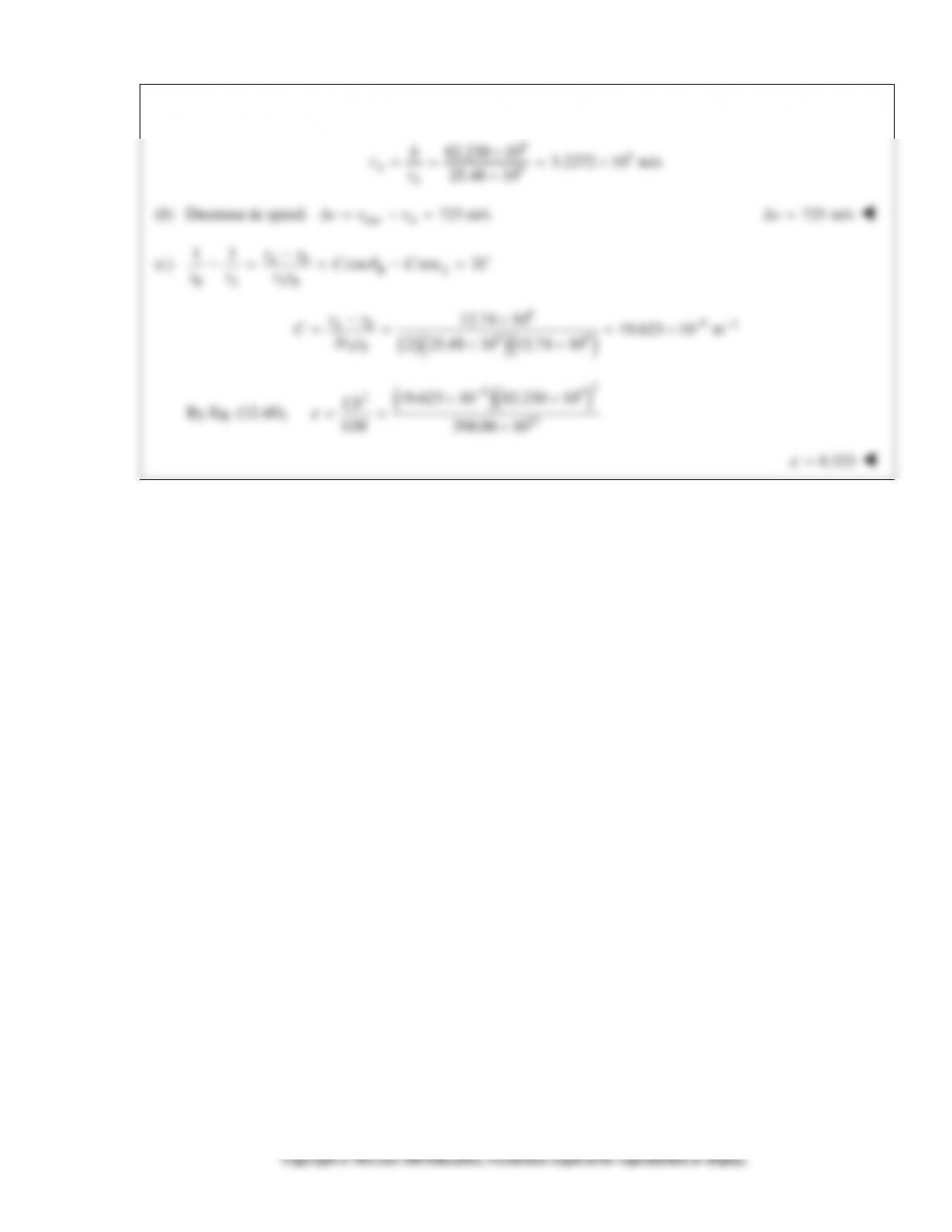
A satellite describes a circular orbit at an altitude of 19 110 km above
the surface of the earth. Determine (a) the increase in speed required at
point A for the satellite to achieve the escape velocity and enter a
parabolic orbit, (b) the decrease in speed required at point A for the
satellite to enter an elliptic orbit of minimum altitude 6370 km, (c) the
eccentricity
ε
of the elliptic orbit.
SOLUTION
2 6 12 3 2
92
82.230 10 m /s
= ×
PROBLEM 12.104 (Continued)
93
6
82.230 10 3.2272 10 m/s
25.48 10
A
A
h
vr
×
= = = ×
×
(b) Decrease in speed.
circ 725 m/s
A
vv v∆= − =
725 m/sv∆=
(c)
11 cos cos 2
AB BA
B A AB
rr CCC
r r rr
θ
−
−= = − =
(
)
( )( )
691
66
12.74 10 19.623 10 m
22 25.48 10 12.74 10
AB
AB
rr
Crr
−−
−×
= = = ×
××
By Eq. (12.40),
( )( )
2
99
2
12
19.623 10 82.230 10
398.06 10
Ch
GM
ε
−
××
= = ×
0.333
ε
=
PROBLEM 12.105
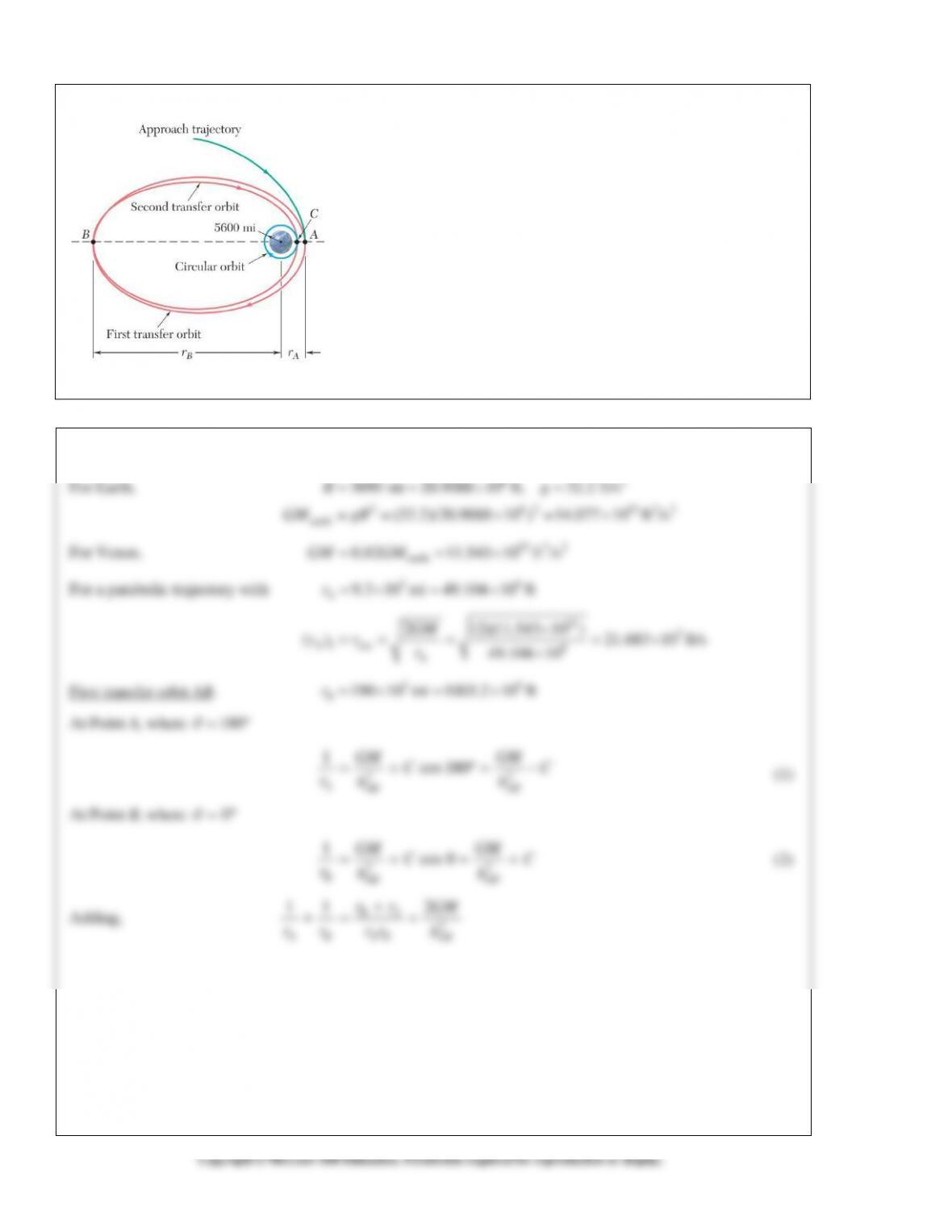
A space probe is to be placed in a circular orbit of 5600 mi radius
about the planet Venus in a specified plane. As the probe reaches
A, the point of its original trajectory closest to Venus, it is inserted
in a first elliptic transfer orbit by reducing its speed by
Δ.
A
v
This
orbit brings it to Point B with a much reduced velocity. There the
probe is inserted in a second transfer orbit located in the specified
plane by changing the direction of its velocity and further reducing
its speed by
Δ.
B
v
Finally, as the probe reaches Point C, it is
inserted in the desired circular orbit by reducing its speed by
Δ.
C
v
Knowing that the mass of Venus is 0.82 times the mass of the earth,
that
3
9.3 10 mi
A
r= ×
and
3
190 10
B
r= ×
mi, and that the probe
approaches A on a parabolic trajectory, determine by how much the
velocity of the probe should be reduced (a) at A, (b) at B, (c) at C.
SOLUTION
62
PROBLEM 12.105 (Continued)
12
CC
C
PROBLEM 12.106
For the space probe of Problem 12.105, it is known that rA
3
9.3 10 mi= ×
and that the velocity of the probe is
reduced to
20,000 ft/s
as it passes through A. Determine (a) the distance from the center of Venus to Point B,
(b) the amounts by which the velocity of the probe should be reduced at B and C, respectively.
SOLUTION
6
16
280.01 10
B
B
×
PROBLEM 12.106 (Continued)
6
C
PROBLEM 12.107
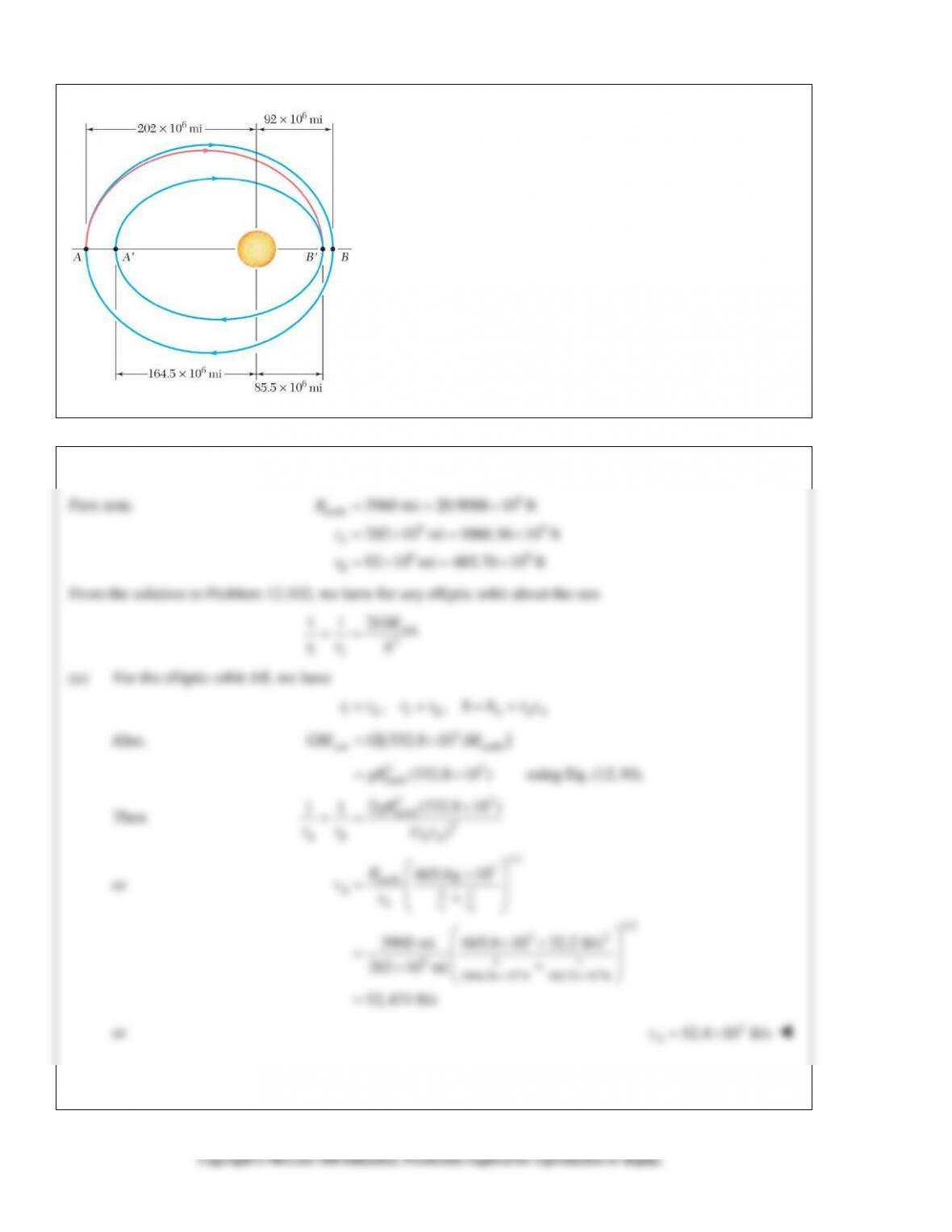
As it describes an elliptic orbit about the sun, a spacecraft
reaches a maximum distance of
6
202 10×
mi from the center
of the sun at Point A (called the aphelion) and a minimum
distance of
6
92 10×
mi at Point B (called the perihelion). To
place the spacecraft in a smaller elliptic orbit with aphelion at
A′
and perihelion at
,B′
where
A′
and
B′
are located
6
164.5 10×
mi and
6
85.5 10×
mi, respectively, from the center
of the sun, the speed of the spacecraft is first reduced as it
passes through A and then is further reduced as it passes
through
.B′
Knowing that the mass of the sun is 332.8
3
10×
times the mass of the earth, determine (a) the speed of the
spacecraft at A, (b) the amounts by which the speed of the
spacecraft should be reduced at A and
B′
to insert it into the
desired elliptic orbit.
SOLUTION
6