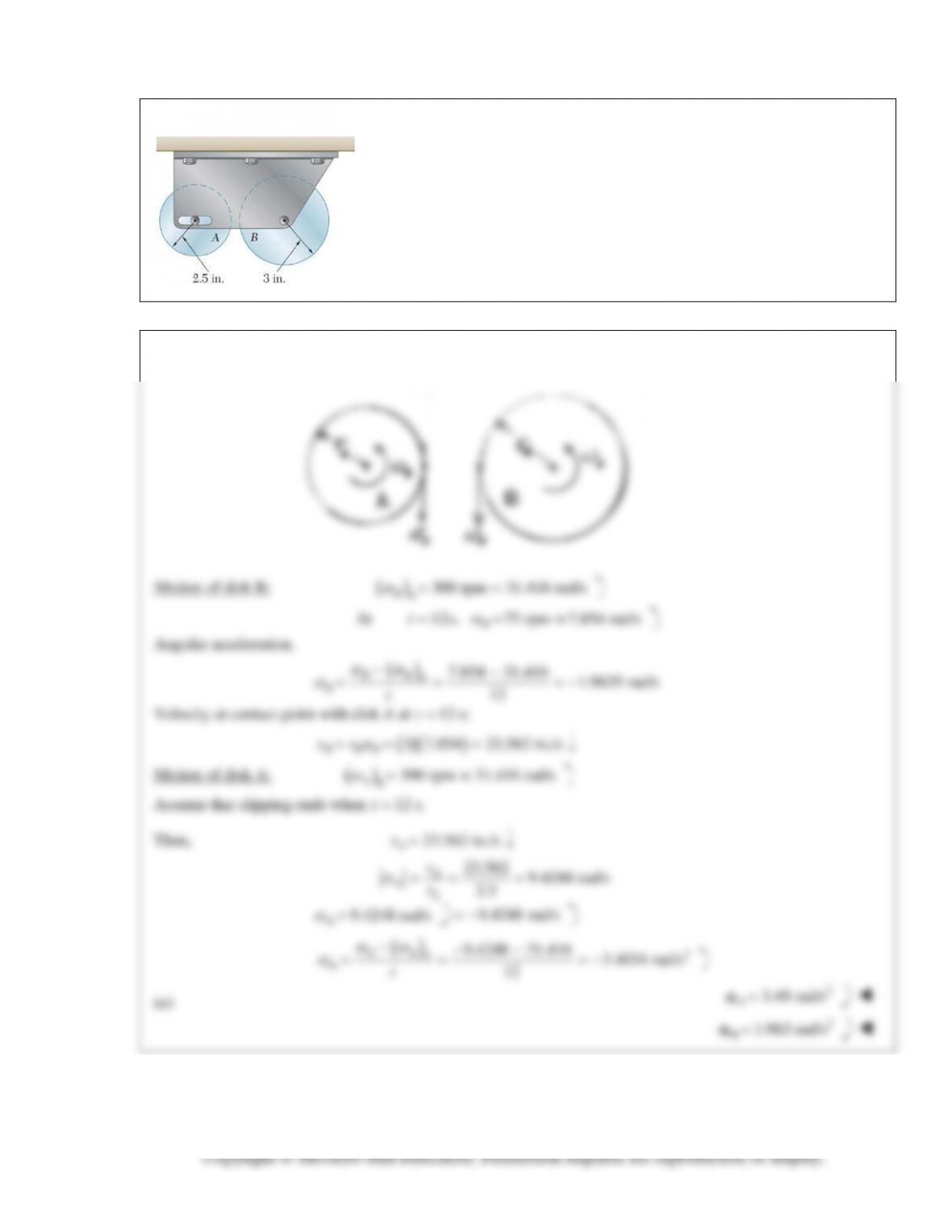
PROBLEM 15.33
Two friction wheels A and B are both rotating freely at 300 rpm
counterclockwise when they are brought into contact. After 12 s of
slippage, during which time each wheel has a constant angular acceleration,
wheel B reaches a final angular velocity of 75 rpm counterclockwise.
Determine (a) the angular acceleration of each wheel during the period of
slippage, (b) the time at which the angular velocity of wheel A is equal to
zero.
SOLUTION
PROBLEM 15.33 (Continued)
3.4034
A
α
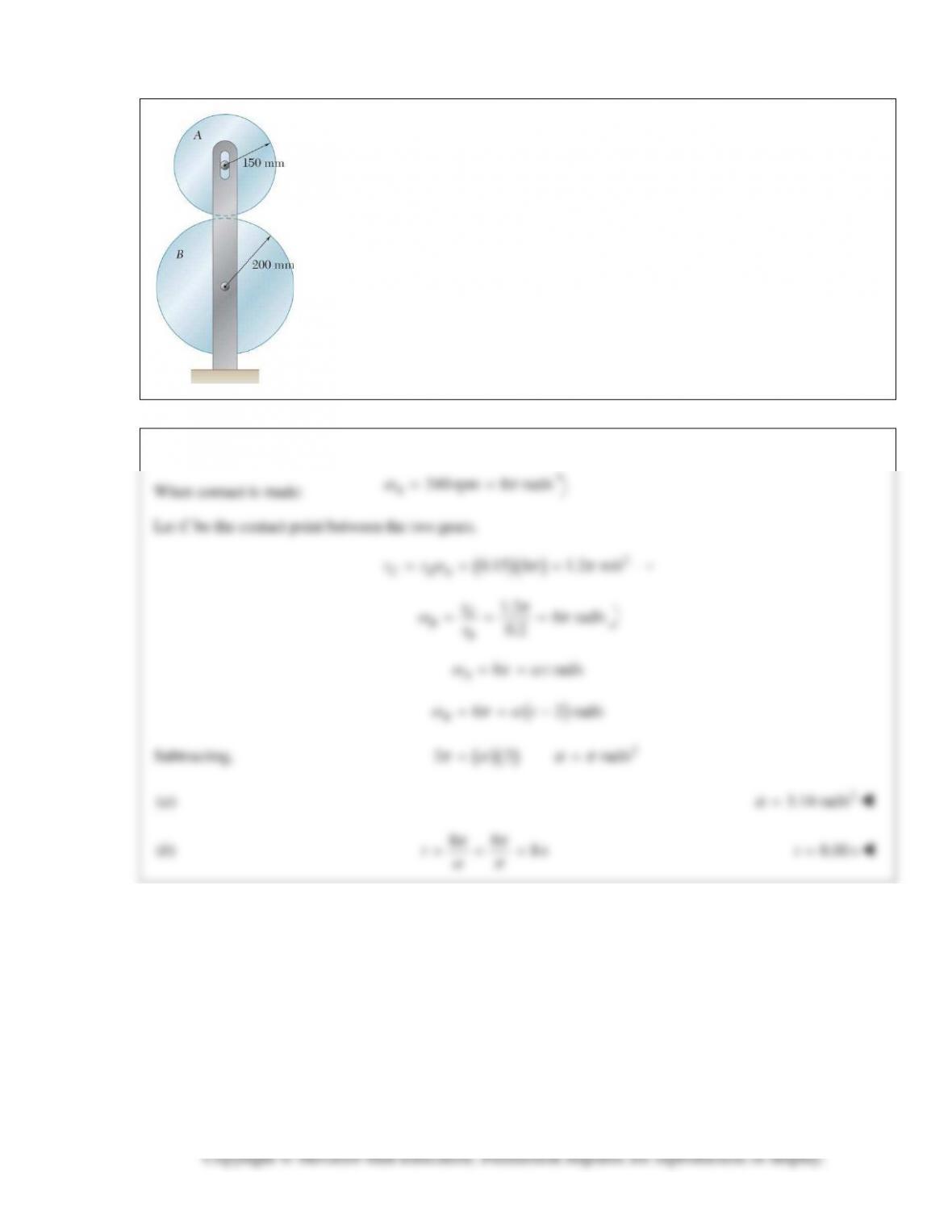
PROBLEM 15.34
Two friction disks A and B are to be brought into contact without slipping when the
angular velocity of disk A is 240 rpm counterclockwise. Disk A starts from rest at
time t = 0 and is given a constant angular acceleration of magnitude
.
α
Disk B starts
from rest at time t = 2 s and is given a constant clockwise angular acceleration, also
of magnitude
.
α
Determine (a) the required angular acceleration magnitude
,
α
(b) the time at which the contact occurs.
SOLUTION
240 rpm 8 rad/s
ωπ
= =
απ
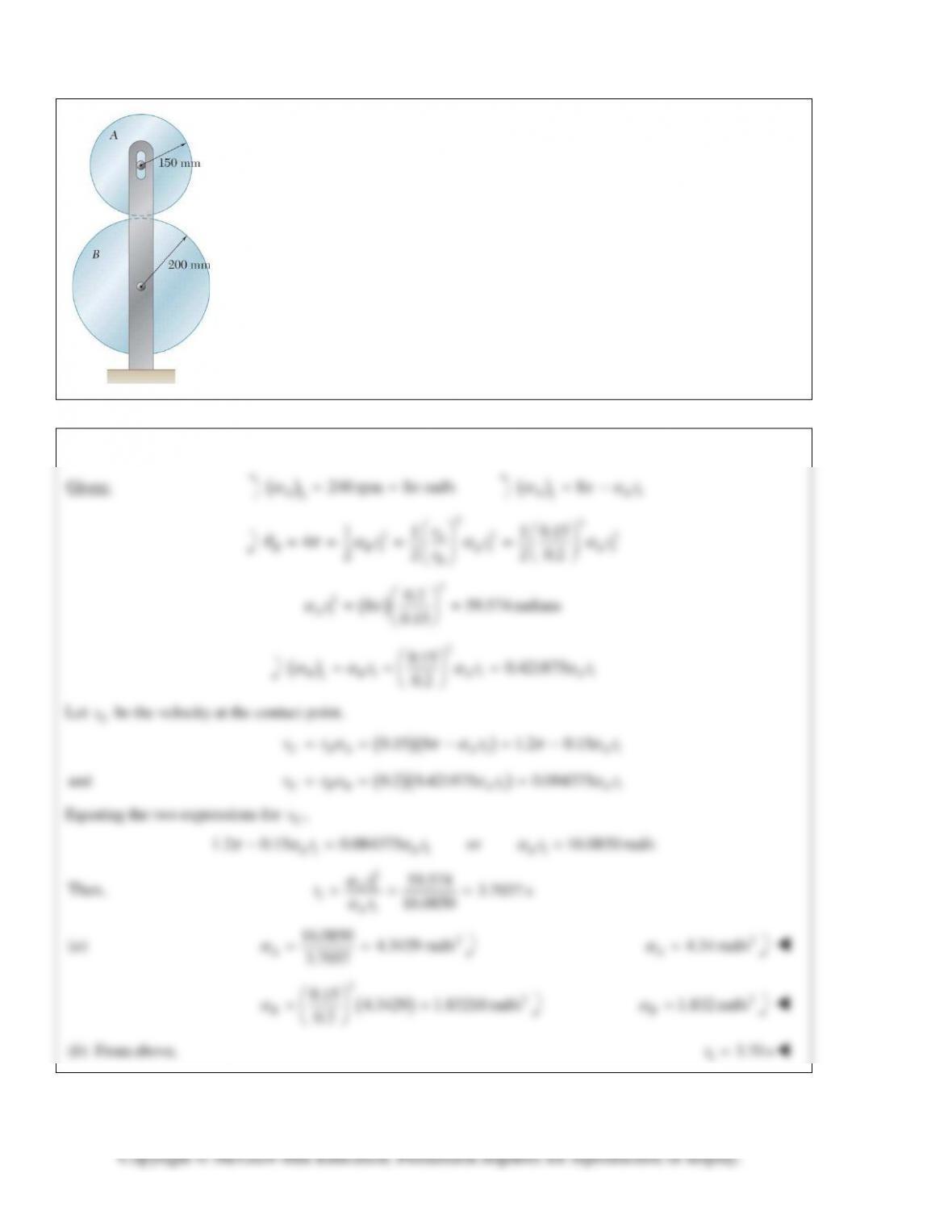
PROBLEM 15.35
Two friction disks A and B are brought into contact when the angular velocity of disk
A is 240 rpm counterclockwise and disk B is at rest. A period of slipping follows and
disk B makes 2 revolutions before reaching its final angular velocity. Assuming that
the angular acceleration of each disk is constant and inversely proportional to the
cube of its radius, determine (a) the angular acceleration of each disk, (b) the time
during which the disks slip.
SOLUTION
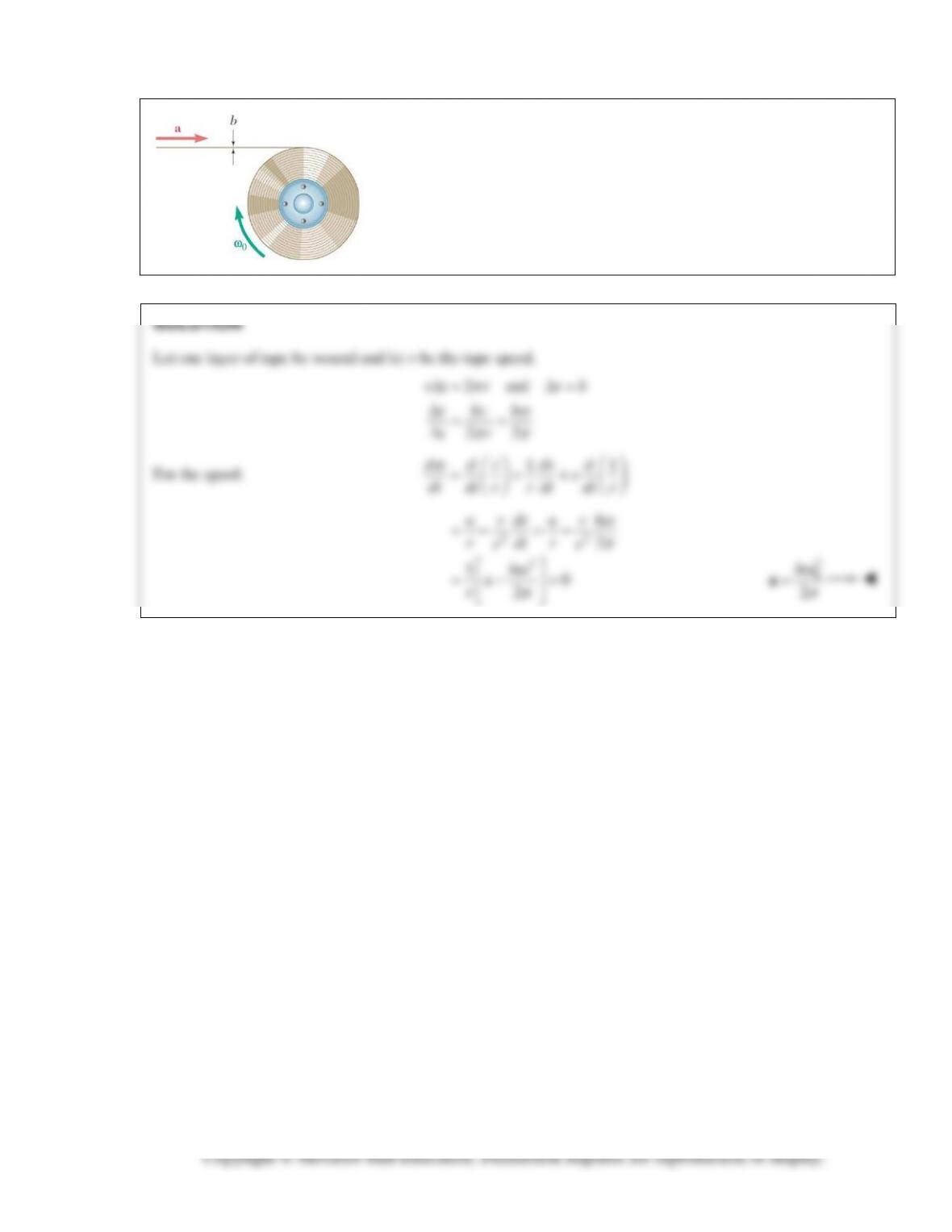
PROBLEM 15.36*
Steel tape is being wound onto a spool that rotates with a constant angular
velocity
0.
ω
Denoting by r the radius of the spool and tape at any given
time and by b the thickness of the tape, derive an expression for the
acceleration of the tape as it approaches the spool.
2
r
π
2
π
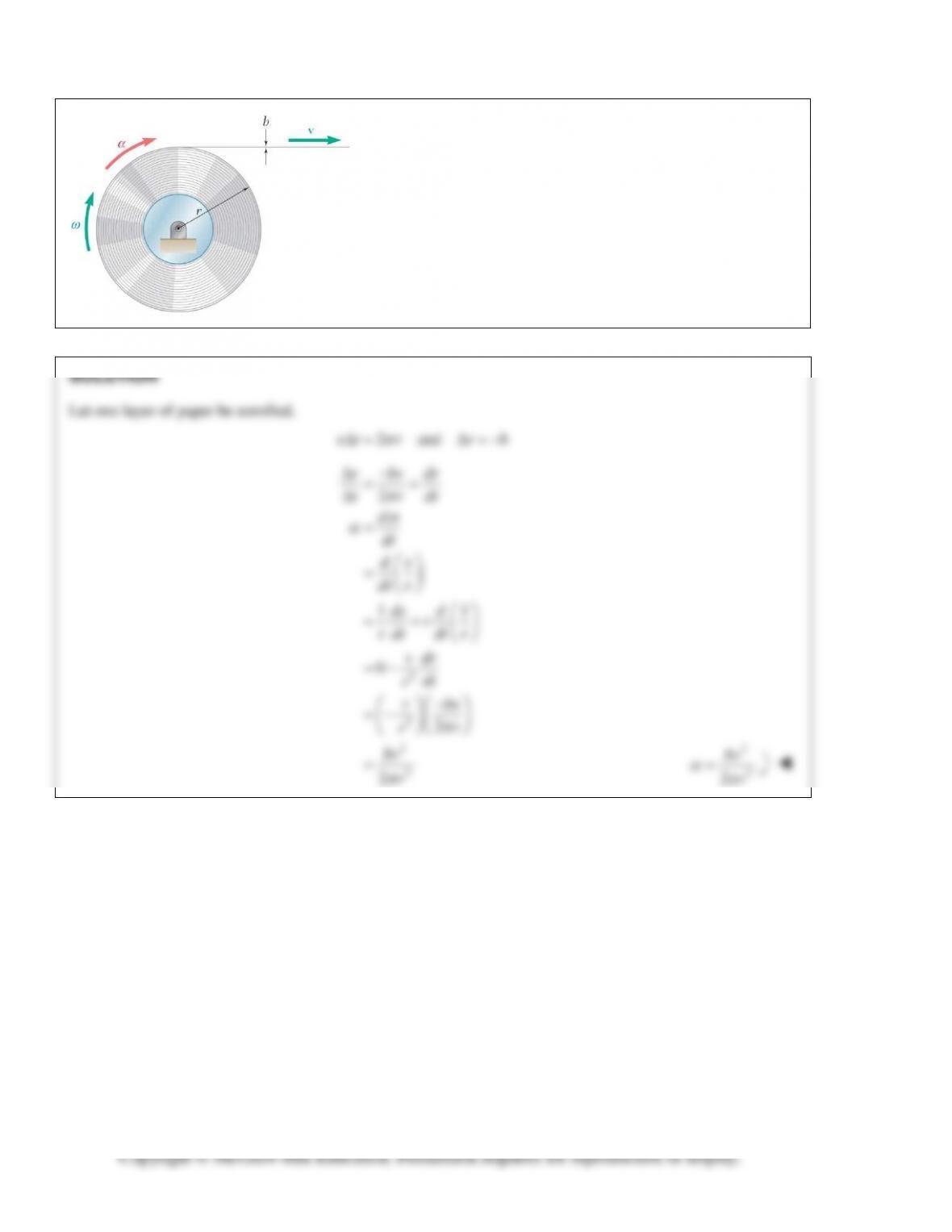
PROBLEM 15.37*
In a continuous printing process, paper is drawn into the presses
at a constant speed v. Denoting by r the radius of the paper roll
at any given time and by b the thickness of the paper, derive an
expression for the angular acceleration of the paper roll.
3
2
r
π
3
2
r
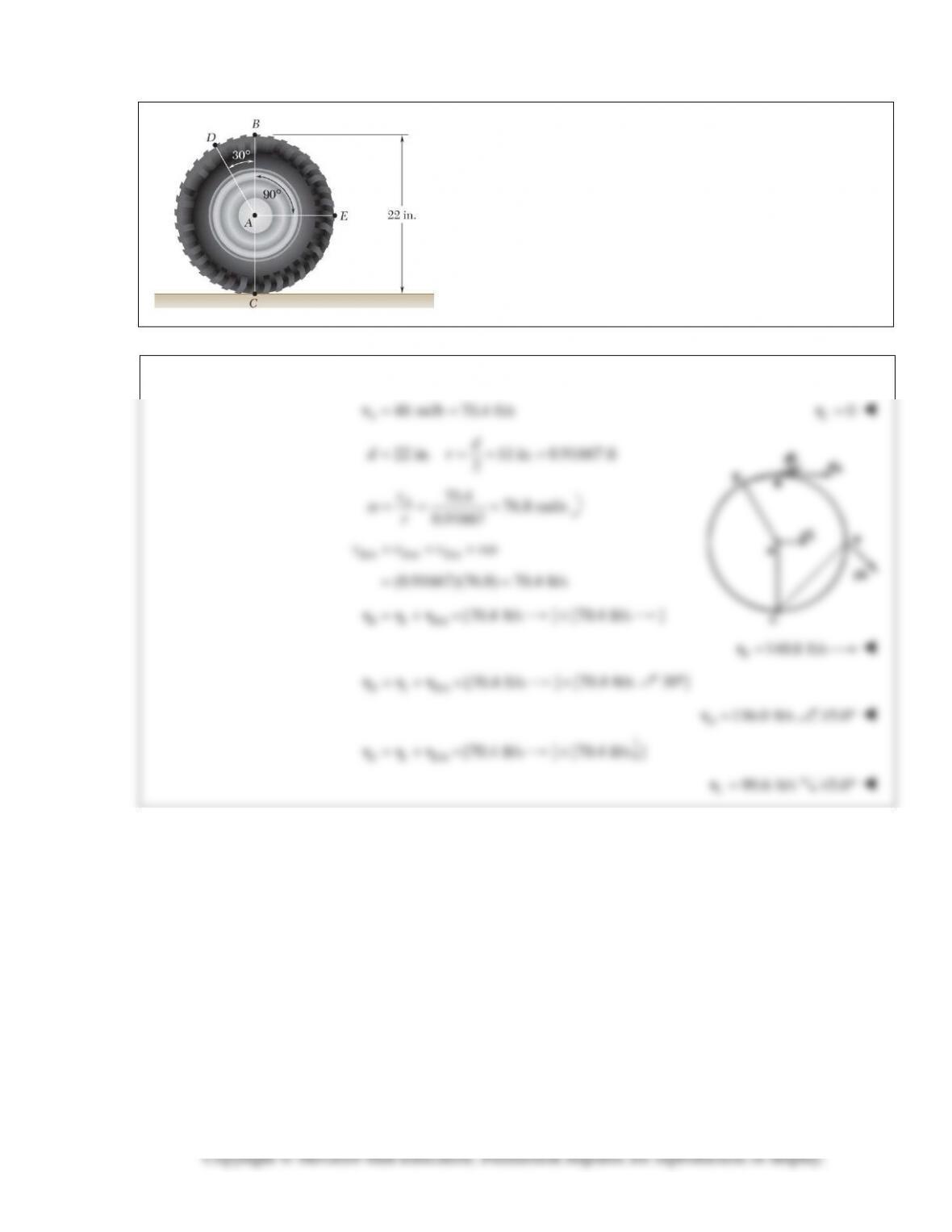
PROBLEM 15.38
An automobile travels to the right at a constant speed of
48 mi/h. If the diameter of a wheel is 22 in., determine the
velocities of Points B, C, D, and E on the rim of the wheel.
SOLUTION
E=v
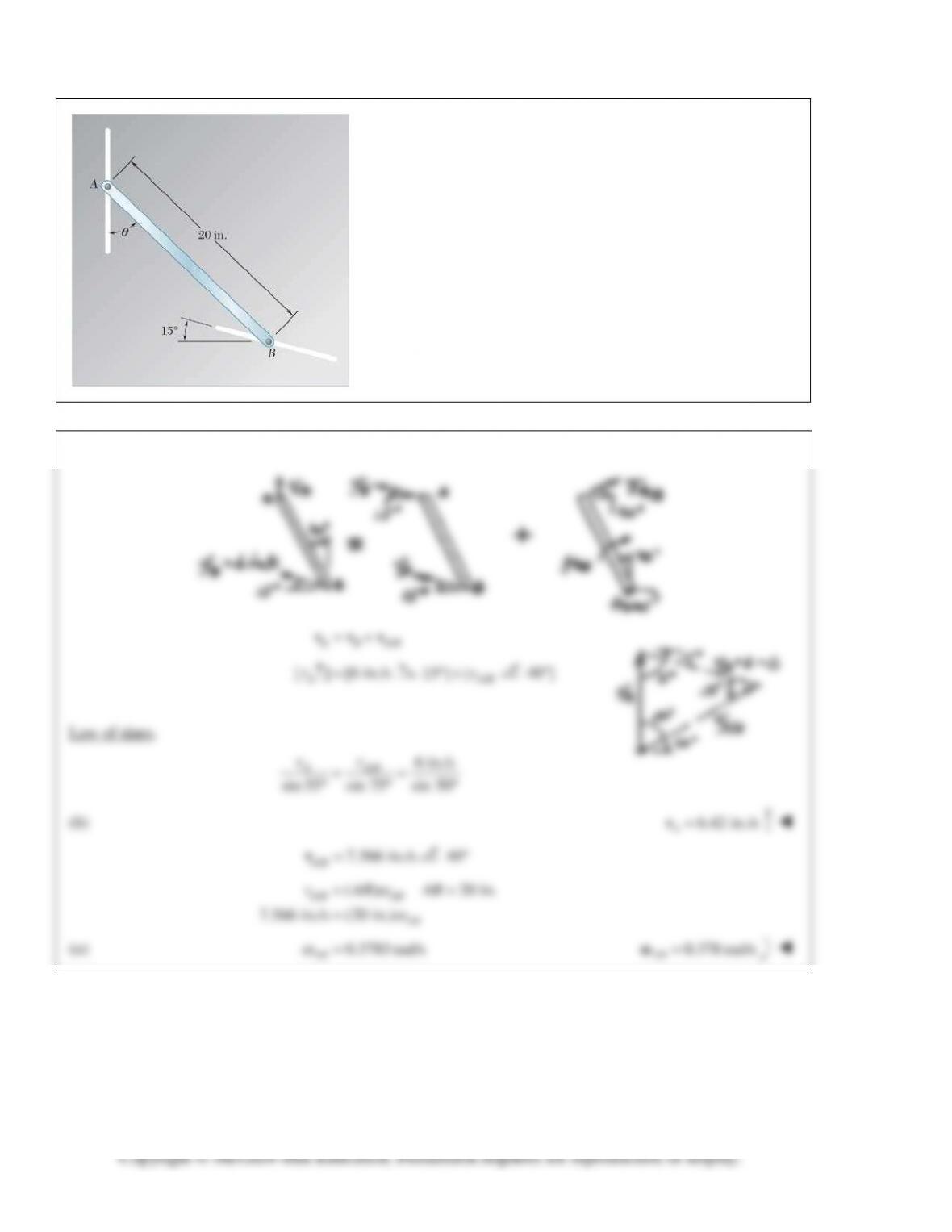
PROBLEM 15.39
The motion of rod AB is guided by pins attached at A and B
which slide in the slots shown. At the instant shown,
40
θ
= °
and the pin at B moves upward to the left with a constant
velocity of 6 in./s. Determine (a) the angular velocity of the
rod, (b) the velocity of the pin at end A.
SOLUTION
AB
AB
PROBLEM 15.40
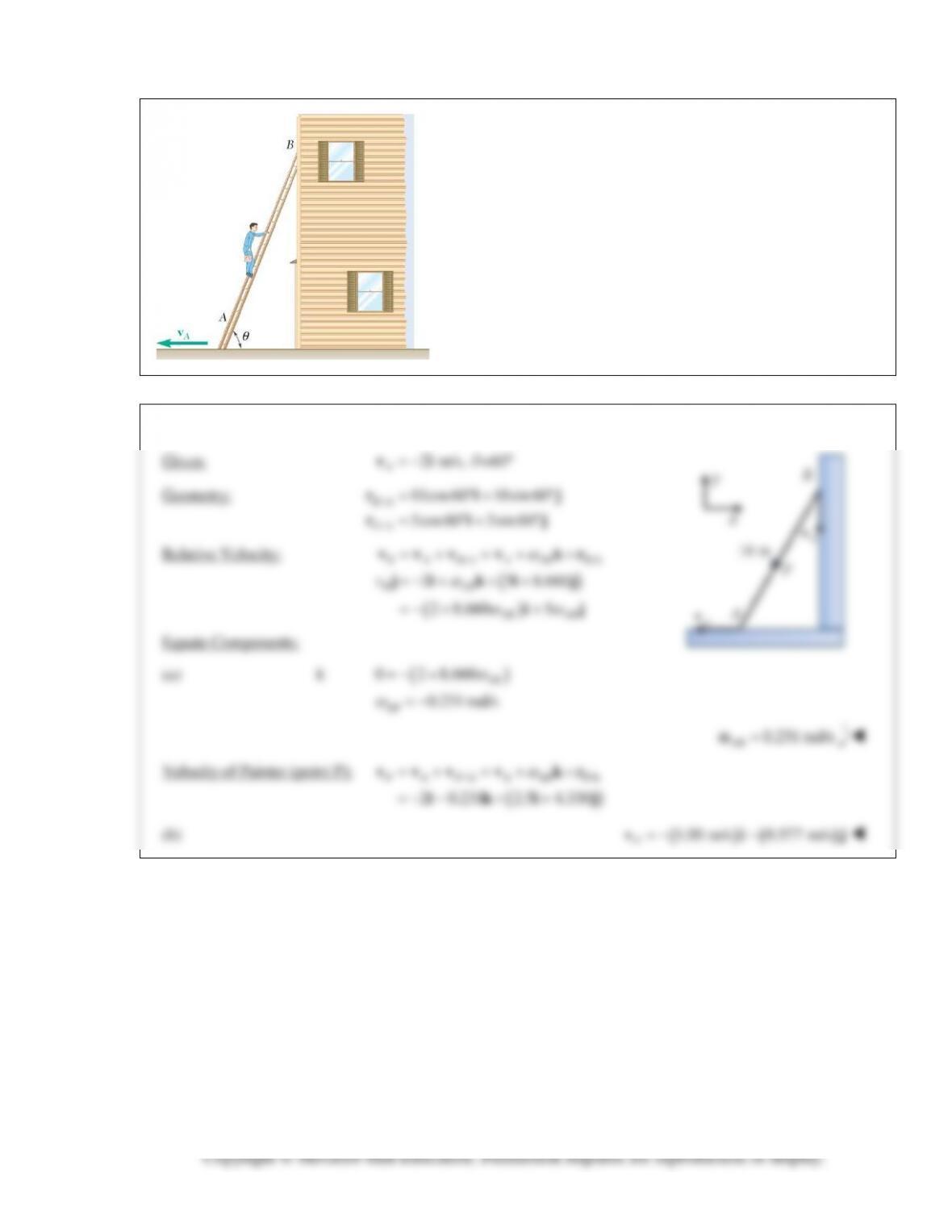
A painter is halfway up a 10-m ladder when the bottom starts
sliding out from under him. Knowing that point A has a velocity
vA = 2 m/s directed to the left when θ= 60°, determine (a) the
angular velocity of the ladder, (b) the velocity of the painter.
SOLUTION
P
PROBLEM 15.41
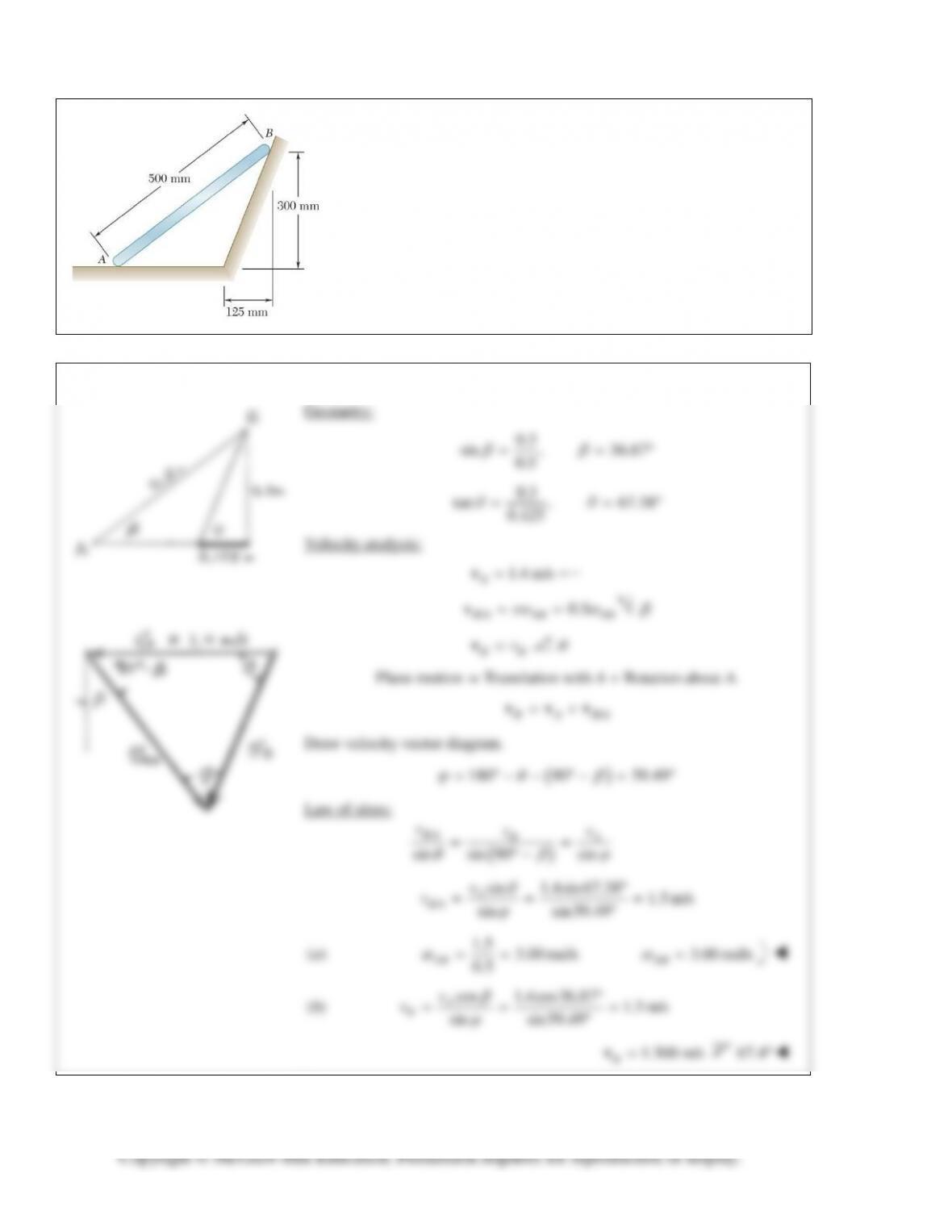
Rod AB can slide freely along the floor and the inclined plane. At
the instant shown the velocity of end A is 1.4 m/s to the left.
Determine (a) the angular velocity of the rod, (b) the velocity of end
B of the rod.
SOLUTION
Geometry
:
0.3
sin , 36.87
0.5
ββ
= = °
0.3
tan , 67.38
0.125
θθ
= = °
Velocity analysis
:
PROBLEM 15.42
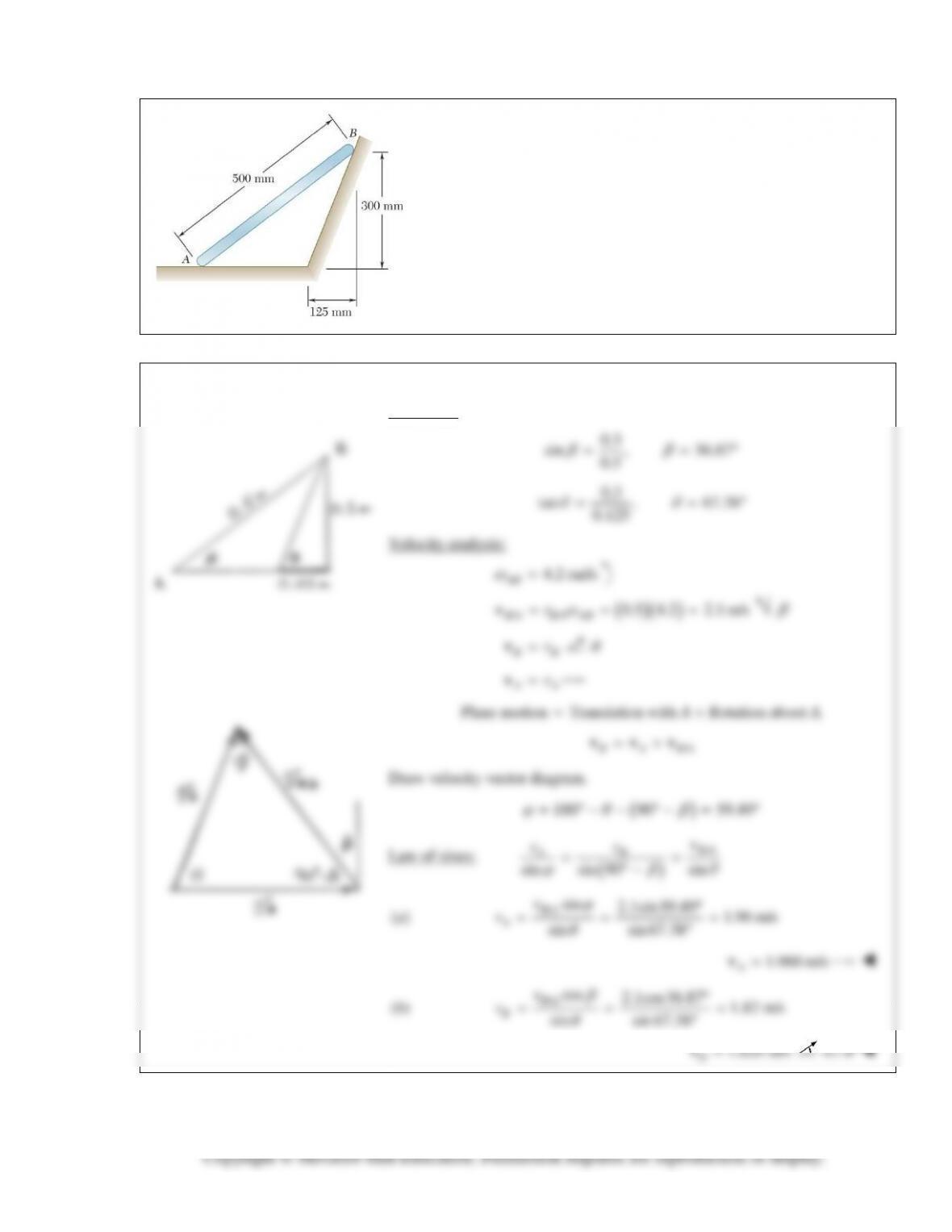
Rod AB can slide freely along the floor and the inclined plane. At
the instant shown the angular velocity of the rod is 4.2 rad/s
counterclockwise. Determine (a) the velocity of end A of the rod,
(b) the velocity of end B of the rod.
SOLUTION
Geometry
:
0.3
sin , 36.87
0.5
ββ
= = °
0.3
tan , 67.38
0.125
θθ
= = °
Velocity analysis
:
4.2 rad/s
AB
ω
=
()a
sin sin 67.38
A
v
θ
= = =
°
1.960 m/s
A
=v
()b
/cos 2.1cos36.87 1.82 m/s
sin sin 67.38
BA
B
v
v
β
θ
°
= = =
°
1.820 m/s
B
=v
67.4°
PROBLEM 15.43
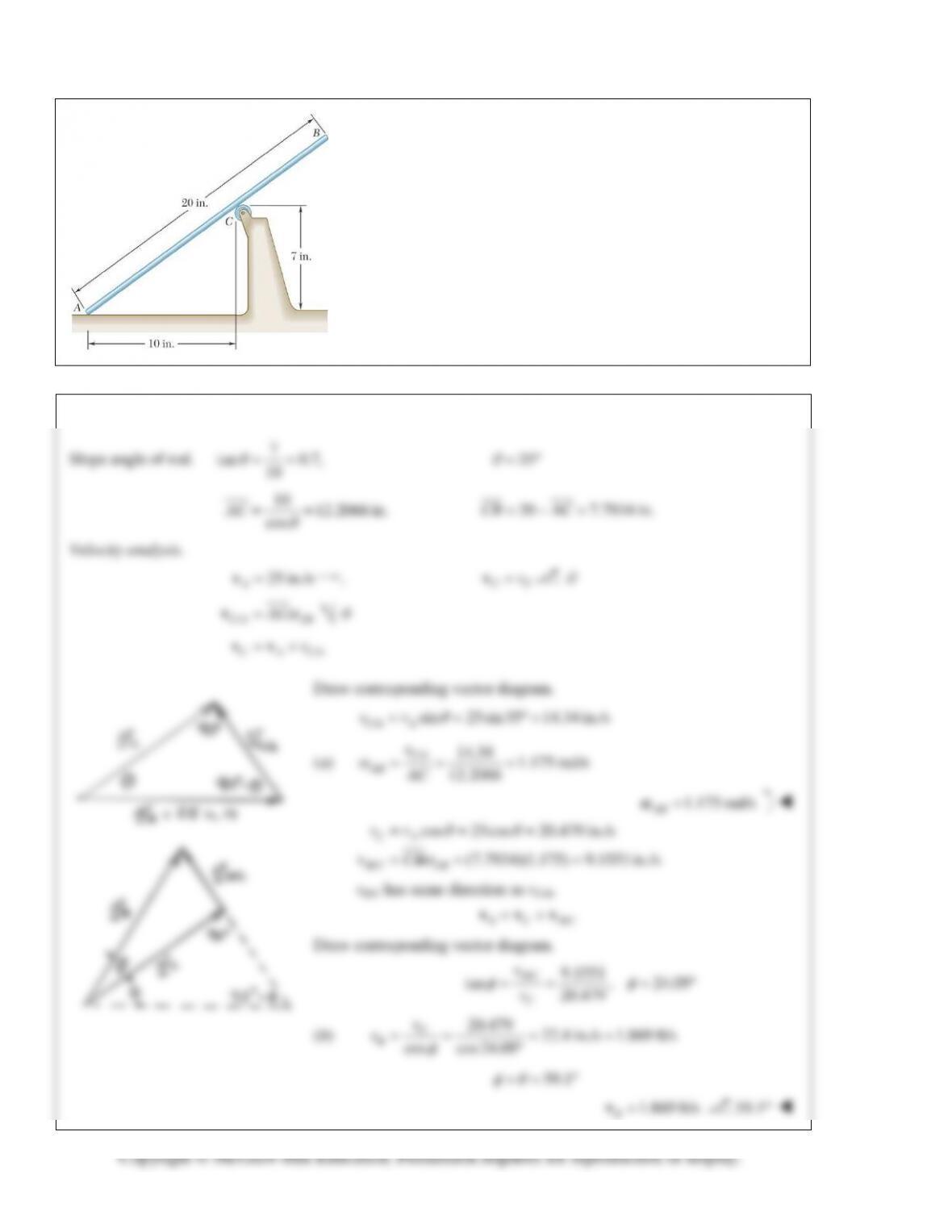
Rod AB moves over a small wheel at C while end A moves to the
right with a constant velocity of 25 in./s. At the instant shown,
determine (a) the angular velocity of the rod, (b) the velocity of
end B of the rod.
SOLUTION
7
B=v
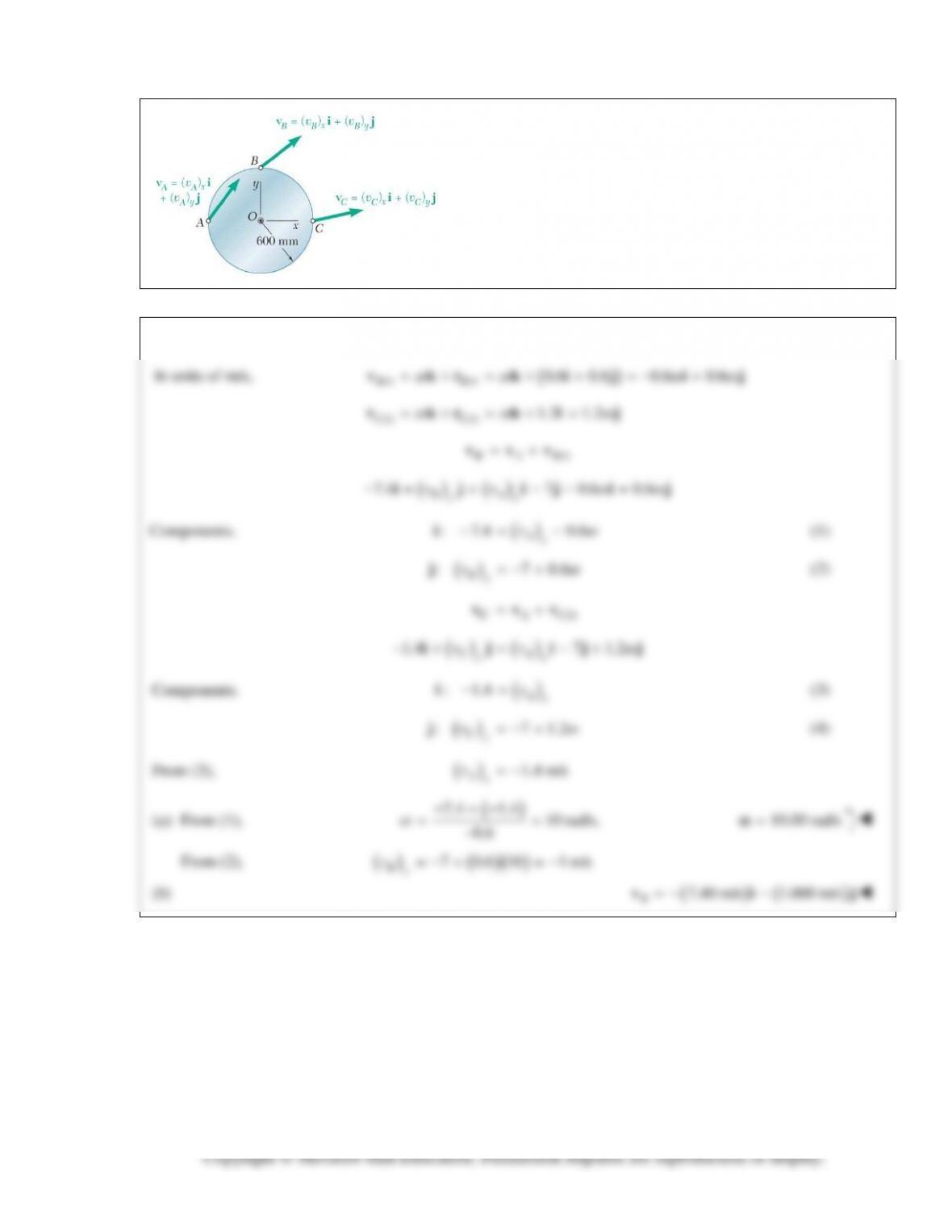
PROBLEM 15.44
The disk shown moves in the xy plane. Knowing that
( ) 7 m/s,
Ay
v= −
( ) = 7.4 m/s,
Bx
v−
and
( ) 1.4 m/s,
Cx
v= −
determine (a) the angular velocity of the disk, (b) the velocity
of point B.
SOLUTION
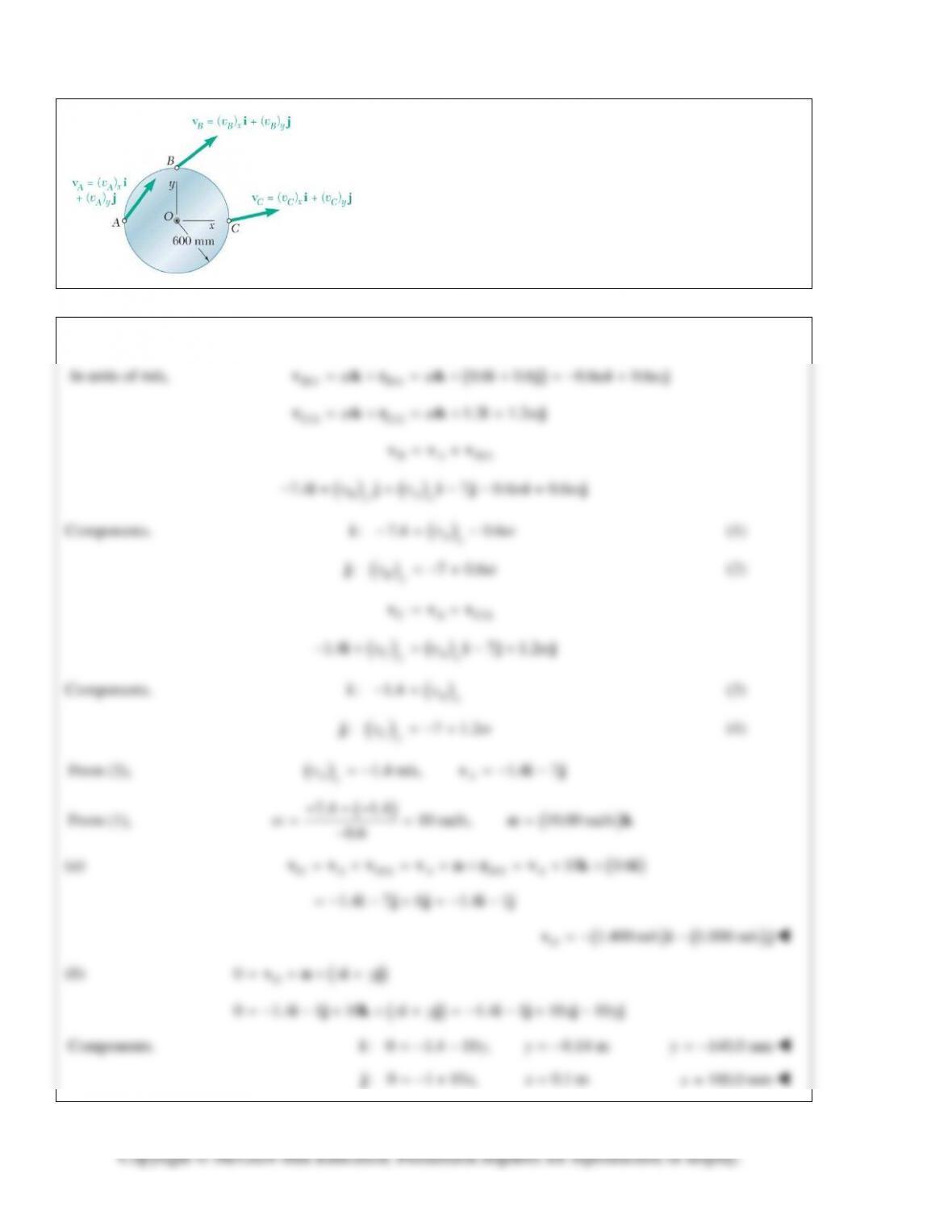
PROBLEM 15.45
The disk shown moves in the xy plane. Knowing that
( ) 7 m/s,
Ay
v= −
( ) = 7.4 m/s,
Bx
v−
and
( ) 1.4 m/s,
Cx
v= −
,
determine (a) the velocity of point O, (b) the point of the disk
with zero velocity.
SOLUTION
: 0 1 10 ,x=−+j
0.1 mx=
100.0 mmx=
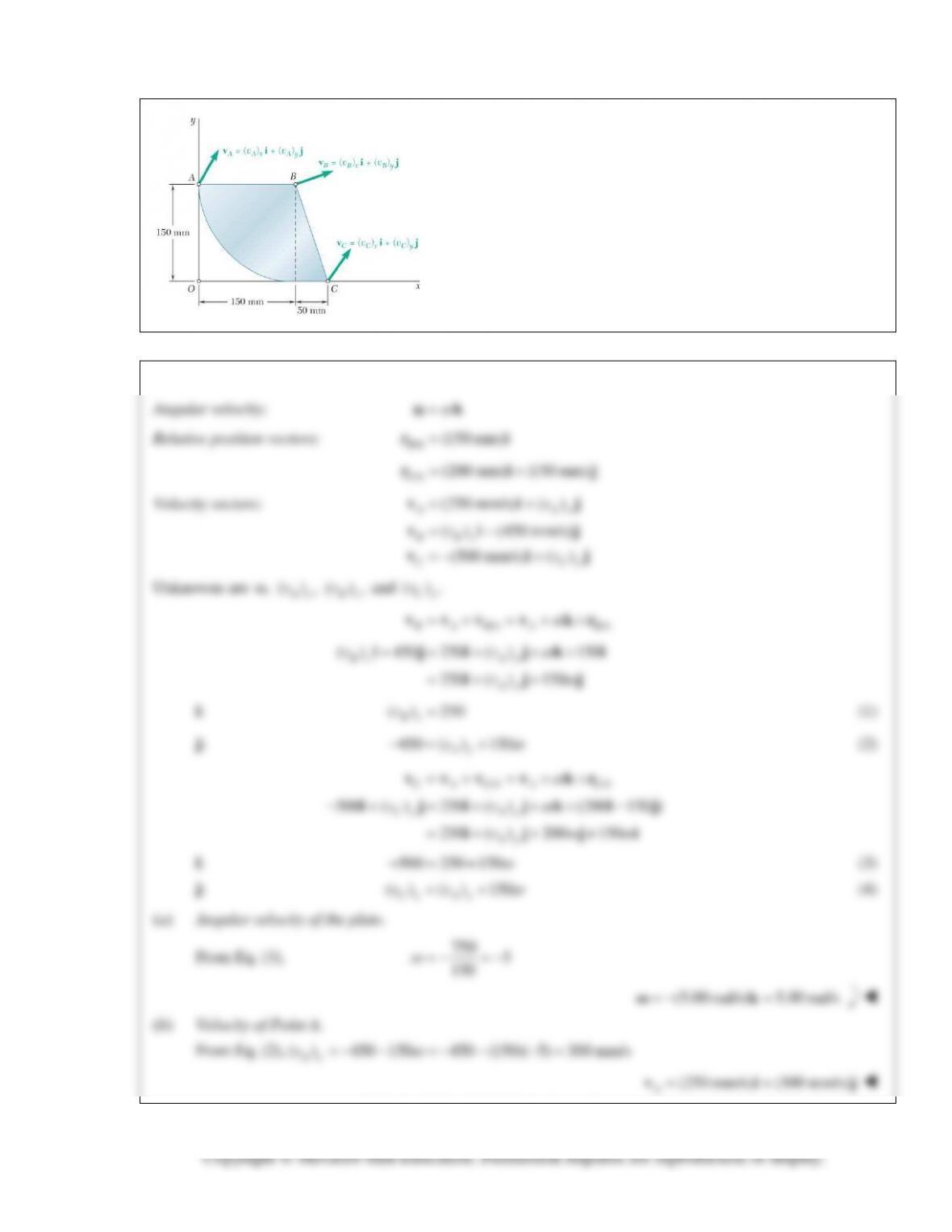
PROBLEM 15.46
The plate shown moves in the xy plane. Knowing that
()
Ax
v
=
250 mm/s,
( ) 450 mm/s,
Bx
v= −
and
( ) 500 mm/s,
Cx
v= −
determine (a) the angular velocity of the plate, (b) the velocity of
Point A.
SOLUTION
A= +v ij
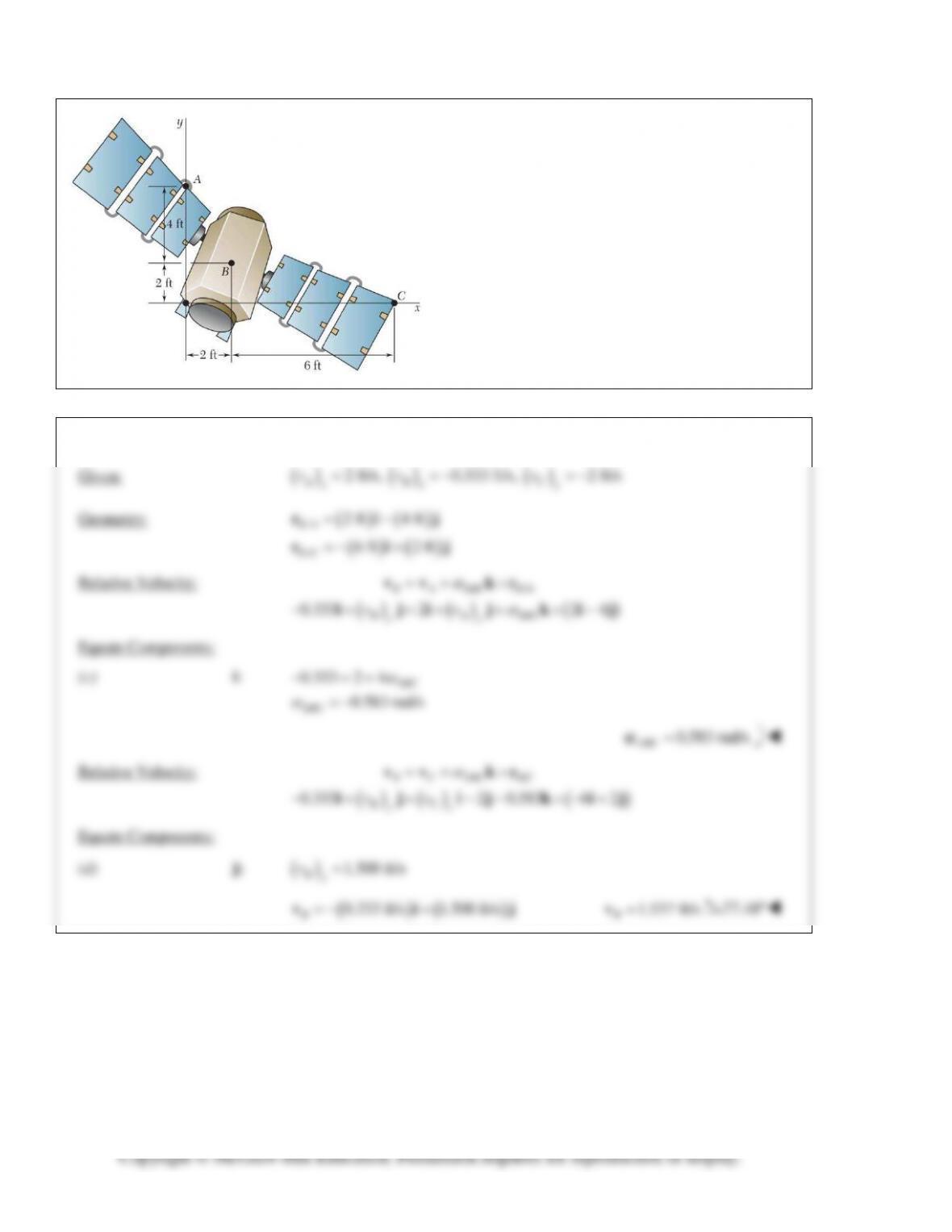
PROBLEM 15.47
Velocity sensors are placed on a satellite that is
moving only in the xy plane. Knowing that at the
instant shown the uni-directional sensors measure
(vA)x = 2 ft/s, (vB)x = −0.333 ft/s, and (vC)y = −2 ft/s,
determine (a) the angular velocity of the satellite,
(b) the velocity of point B.
SOLUTION
B
B
PROBLEM 15.48
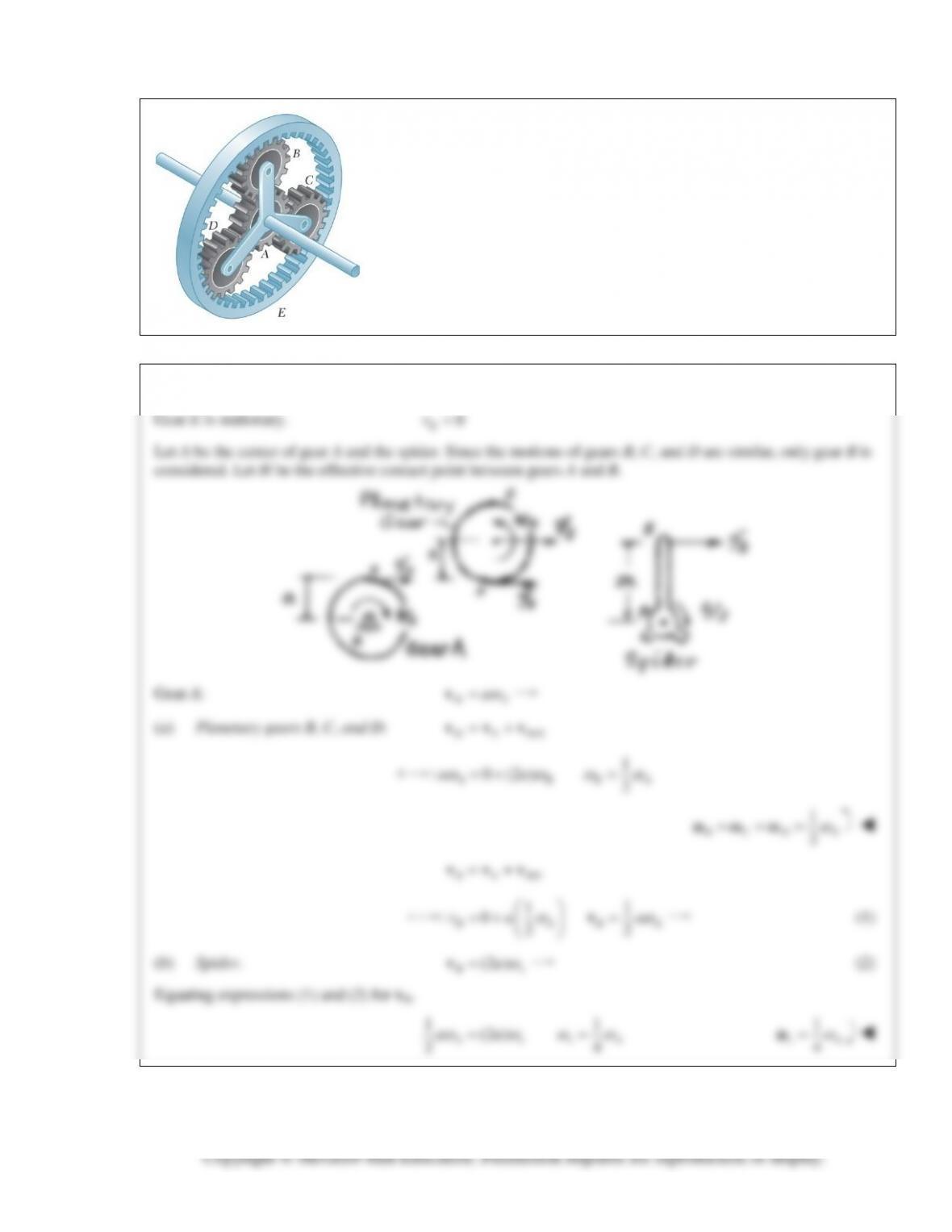
In the planetary gear system shown, the radius of gears A, B, C, and D is a
and the radius of the outer gear E is 3a. Knowing that the angular velocity
of gear A is
ω
A clockwise and that the outer gear E is stationary, determine
(a) the angular velocity of each planetary gear, (b) the angular velocity of
the spider connecting the planetary gears.
SOLUTION
24
A s sA
4
sA
PROBLEM 15.49
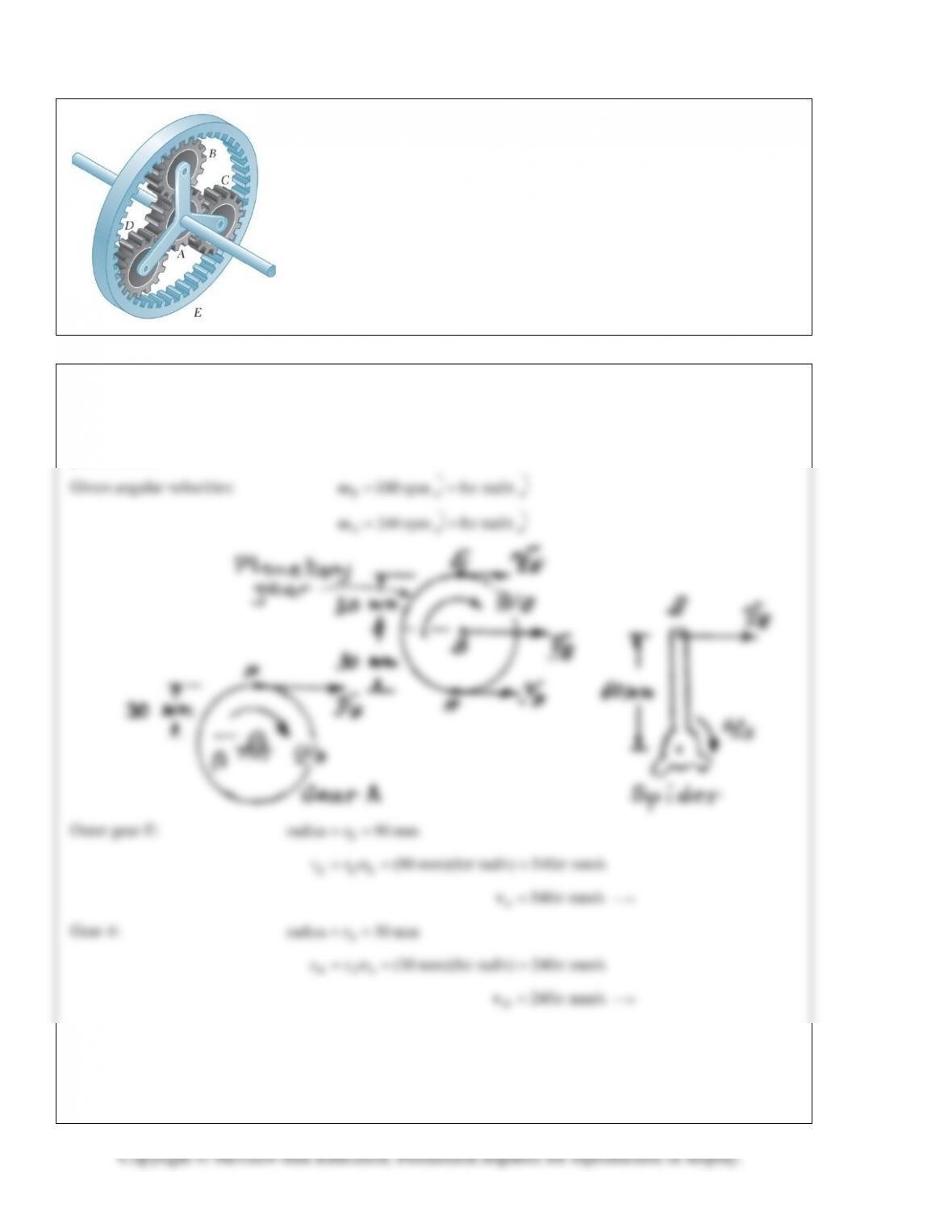
In the planetary gear system shown, the radius of gears A, B, C, and D is
30 mm and the radius of the outer gear E is 90 mm. Knowing that gear E
has an angular velocity of 180 rpm clockwise and that the central gear A
has an angular velocity of 240 rpm clockwise, determine (a) the angular
velocity of each planetary gear, (b) the angular velocity of the spider
connecting the planetary gears.
SOLUTION
Since the motions of the planetary gears B, C, and D are similar, only gear B is considered. Let Point H
be the effect contact point between gears A and B and let Point E be the effective contact point between
gears B and E.
H
PROBLEM 15.49 (Continued)
s
PROBLEM 15.50
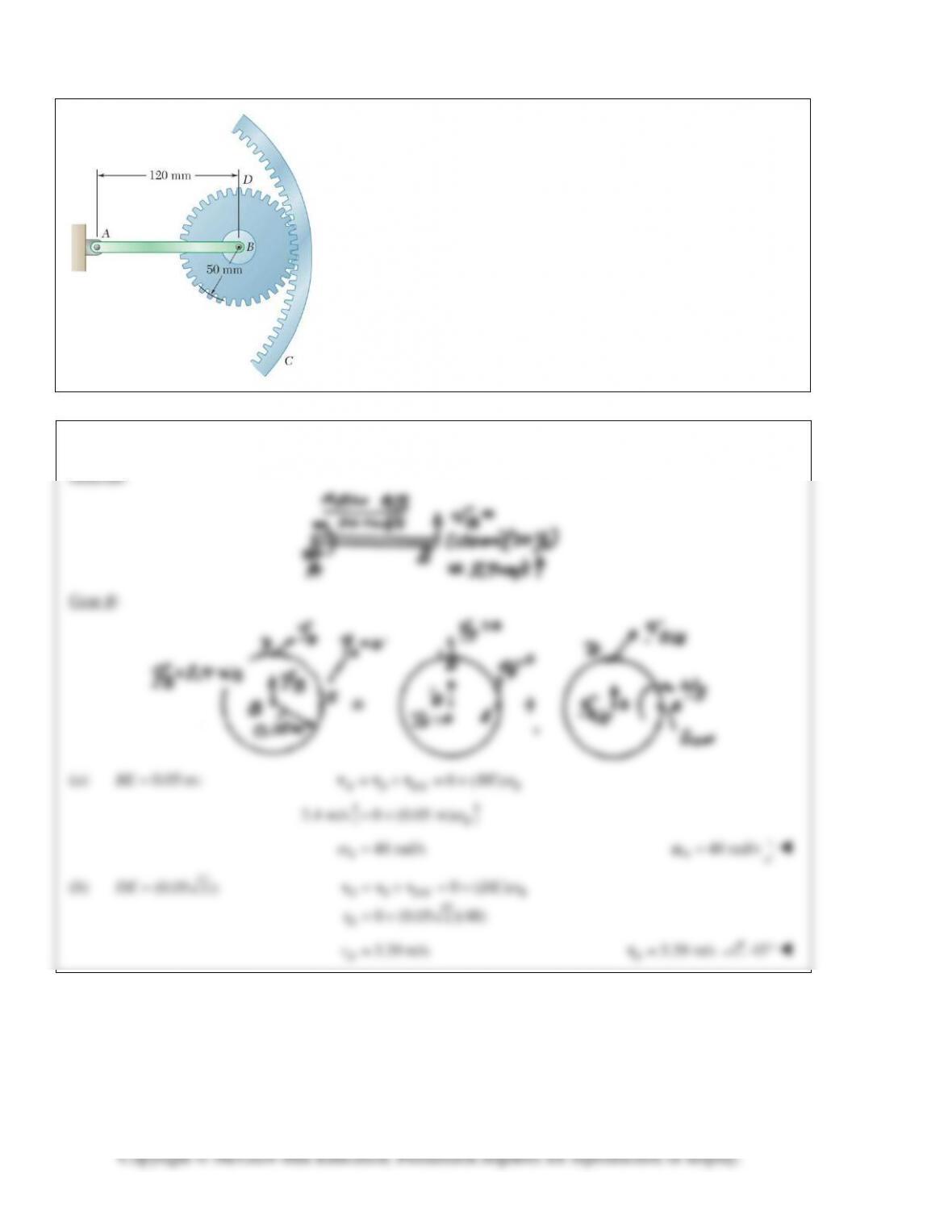
Arm AB rotates with an angular velocity of 20 rad/s counter–
clockwise. Knowing that the outer gear C is stationary, determine
(a) the angular velocity of gear B, (b) the velocity of the gear tooth
located at Point D.
SOLUTION
Arm AB:
D
D