Archives
BUS 22774
The quantity demanded of a product increases as its price declines because the: A. lower price shifts the demand curve rightward. B. lower price shifts the demand curve leftward. C. lower price results in an increase in supply. D. demand […]
BUS 27731
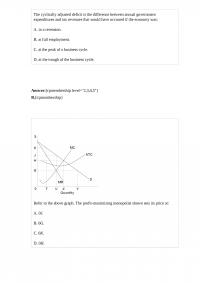
The cyclically adjusted deficit is the difference between annual government expenditures and tax revenues that would have occurred if the economy was: A. in a recession. B. at full employment. C. at the peak of a business cycle. D. at […]
BUS 49768
There tends to be a high positive correlation between the rate of productivity growth and the rate of economic growth. In the short run, a competitive firm will not produce unless price is equal to average total costs. Answer: FALSE […]
BUS 56040
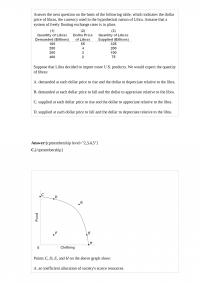
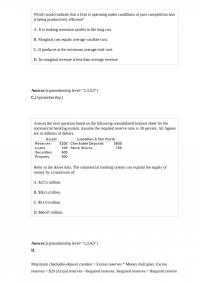
Answer the next question on the basis of the following table, which indicates the dollar price of libras, the currency used in the hypothetical nation of Libra. Assume that a system of freely floating exchange rates is in place. Suppose […]
BUS 70900
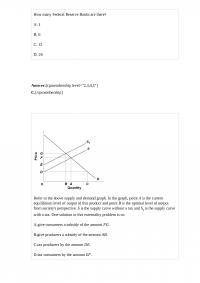
Which would indicate that a firm is operating under conditions of pure competition and is being productively efficient? A. It is making economic profits in the long run. B. Marginal cost equals average variable cost. C. It produces at the […]
BUS 76580
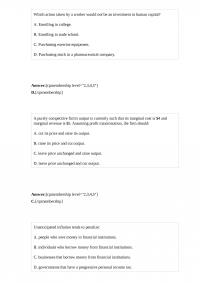
How many Federal Reserve Banks are there? A. 1 B. 6 C. 12 D. 24 Refer to the above supply and demand graph. In the graph, point A is the current equilibrium level of output of this product and point […]
BUS 86255
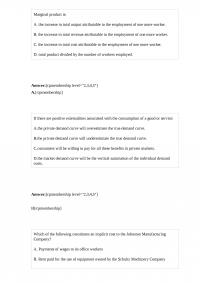
Which action taken by a worker would not be an investment in human capital? A. Enrolling in college. B. Enrolling in trade school. C. Purchasing exercise equipment. D. Purchasing stock in a pharmaceutical company. A purely competitive firm’s output is […]
BUS 95609
Marginal product is: A. the increase in total output attributable to the employment of one more worker. B. the increase in total revenue attributable to the employment of one more worker. C. the increase in total cost attributable to the […]
ECB 10709
Suppose that a business incurred implicit costs of $500,000 and explicit costs of $5 million in a specific year. If the firm sold 100,000 units of its output at $50 per unit, its accounting: A. profits were $100,000 and its […]
ECB 15431
When the excess capacity problem under monopolistic competition becomes greater, there will be: A. a narrower range of consumer choice. B. fewer advertisements and promotions. C. a wider range of consumer choice. D. more entry by firms into the market. […]
ECB 23757
The functions of money are to serve as a: A. resource allocator, method for accounting, and means of income distribution. B. unit of account, store of value, and medium of exchange. C. determinant of consumption, investment, and government spending. D. […]
ECB 39391
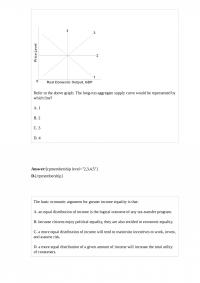
Refer to the above graph. The long-run aggregate supply curve would be represented by which line? A. 1 B. 2 C. 3 D. 4 The basic economic argument for greater income equality is that: A. an equal distribution of income […]
ECB 49026
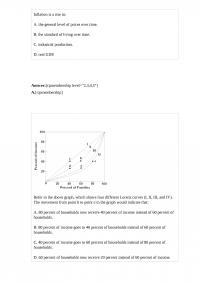
Inflation is a rise in: A. the general level of prices over time. B. the standard of living over time. C. industrial production. D. real GDP. Refer to the above graph, which shows four different Lorenz curves (I, II, III, […]
ECB 65596
Competitive firms are price takers largely because of intensive advertising by their competitors. A decrease in government spending and taxes would be an example of fiscal policies that reinforce each other. Answer: FALSE About one-fourth of all American households have […]
ECB 77249
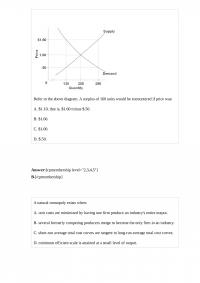
Refer to the above diagram. A surplus of 160 units would be encountered if price was: A. $1.10, that is, $1.60 minus $.50. B. $1.60. C. $1.00. D. $.50. A natural monopoly exists when: A. unit costs are minimized by […]
ECB 81700
In a corporation, the interests of the owners, who seek to maximize profits, may differ from the interests of the managers, who seek prestige and high income. This divergence would be considered: A. a free-rider problem. B. a rationing problem. […]
ECON 40070
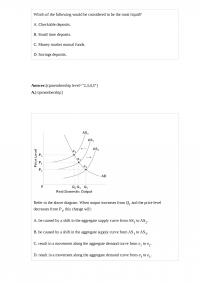
Which of the following would be considered to be the most liquid? A. Checkable deposits. B. Small time deposits. C. Money market mutual funds. D. Savings deposits. Refer to the above diagram. When output increases from Q1 and the price […]
ECON 46914
Advantages of specialization do not include: A. increased production of economic goods with no increase in resources. B. the more efficient use of scarce resources. C. increased ability to utilize the division of labor. D. less interdependence. What “backs” the […]
ECON 47012
The crowding-out effect of an expansionary fiscal policy is likely to be fully or partially offset during a recession. The government receives all of the benefits associated with the production of a public good. Answer: False The concave, or bowed-out, […]
ECON 79655
Which is one of the conditions that must be realized before a seller finds that price discrimination is workable? A. The demand for the product is perfectly elastic so any price can be charged for the product. B. The seller […]
ECON 82469
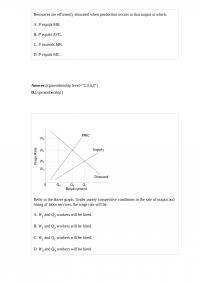
Resources are efficiently allocated when production occurs at that output at which: A. P equals MR. B. P equals AVC. C. P exceeds MR. D. P equals MC. Refer to the above graph. Under purely competitive conditions in the sale […]
ECON 82663
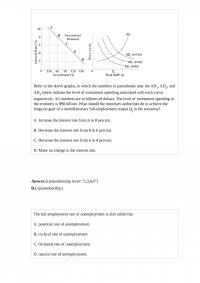
Refer to the above graphs, in which the numbers in parentheses near the AD1, AD2, and AD3 labels indicate the level of investment spending associated with each curve, respectively. All numbers are in billions of dollars. The level of investment […]
ECON 85484
Which product is most likely to be most price elastic? A. Milk B. Gasoline C. Clothing D. Automobiles To the economist, total cost includes: A. explicit and implicit costs, including a normal profit. B. neither implicit nor explicit costs. C. […]
ECON 87032
Sales taxes on consumer goods are regressive because poor people consume a larger proportion of their incomes than do rich people. The market demand curve for a pure public good shows the total value that all individuals place on each […]
ECON 91021
If a firm doubles its output in the long run and its unit costs of production decline, we can conclude that: A. technological progress has occurred. B. economies of scale are being realized. C. the firm is encountering diminishing returns. […]
ECON A 23373
The nondiscriminating monopolist’s demand curve: A. is less elastic than a purely competitive firm’s demand curve. B. is perfectly elastic. C. coincides with its marginal revenue curve. D. is perfectly inelastic. Which of the following will lead to an increase […]
ECON A 26012
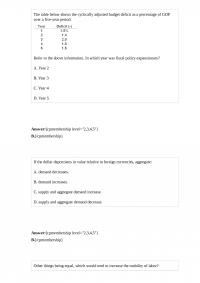
The table below shows the cyclically adjusted budget deficit as a percentage of GDP over a five-year period. Refer to the above information. In which year was fiscal policy expansionary? A. Year 2 B. Year 3 C. Year 4 D. […]
ECON A 28790
When the Federal Reserve acts to ease money and credit in the economy, then the aggregate: A. supply curve will shift to the right. B. supply curve will shift to the left. C. demand curve will shift to the right. […]
ECON A 39636
The downward-sloping demand curve of a monopolistic competitor: A. reflects product differentiation. B. becomes horizontal in the long run. C. indicates collusion among the members of the product group. D. ensures that the firm will produce at minimum average cost […]
ECON A 46262
The long-run supply curve for a competitive, decreasing-cost industry is downward sloping. The unemployment rate for managerial and professional workers tends to be high. Answer: FALSE The selling of stock is debt financing for a corporation. Answer: FALSE If the […]
ECON A 51556
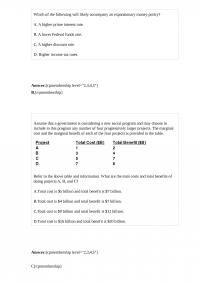
Which of the following will likely accompany an expansionary money policy? A. A higher prime interest rate. B. A lower Federal funds rate. C. A higher discount rate. D. Higher income tax rates. Assume that a government is considering a […]
ECON A 57591
The four factors of production are land, labor, capital, and government services. Monetary policy is subject to less political pressure than fiscal policy. Answer: TRUE Built-in stability refers to the fact that net tax revenues vary inversely with the level […]
ECON A 65509
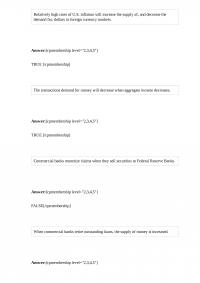
Relatively high rates of U.S. inflation will increase the supply of, and decrease the demand for, dollars in foreign currency markets. The transactions demand for money will decrease when aggregate income decreases. Answer: TRUE Commercial banks monetize claims when they […]
ECON A 81683
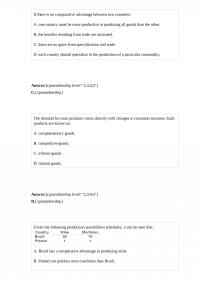
If there is no comparative advantage between two countries: A. one country must be more productive in producing all goods than the other. B. the benefits resulting from trade are increased. C. there are no gains from specialization and trade. […]
ECON A 89718
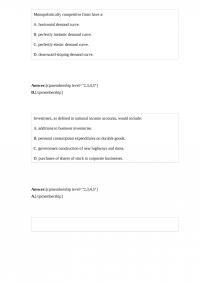
Monopolistically competitive firms have a: A. horizontal demand curve. B. perfectly inelastic demand curve. C. perfectly elastic demand curve. D. downward-sloping demand curve. Investment, as defined in national income accounts, would include: A. additions to business inventories. B. personal consumption […]
ECON A 91328
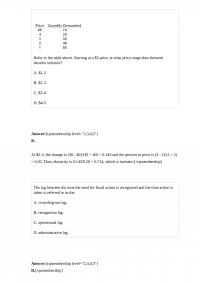
Refer to the table above. Starting at a $5 price, at what price range does demand become inelastic? A. $1-2 B. $2-3 C. $3-4 D. $4-5 The lag between the time the need for fiscal action is recognized and the […]
ECON A 94554
Which factors contributed to a further reduction in the money supply in addition to the withdrawal of currency from banks during the 1930-1933 bank panic? A. Bank purchases of government bonds to meet liquidity demands. B. Bank sales of government […]
ECON A 96948
Price elasticity of supply decreases the longer the time period. When the public debt is held by foreigners, it is not a real burden on real domestic output. Answer: FALSE Depreciation of the dollar relative to foreign currencies will tend […]
ECON A 97275
The unemployment rate in an economy is 12 percent. The civilian labor force is 50 million. The number of employed workers in the economy is: A. 6 million. B. 24 million. C. 42 million. D. 44 million. Which fundamental question […]
ECON A 97857
In a fractional reserve banking system: A. bank panics cannot occur. B. the monetary system must be backed by gold. C. banks can create money through the lending process. D. the Federal Reserve has no control over the amount of […]
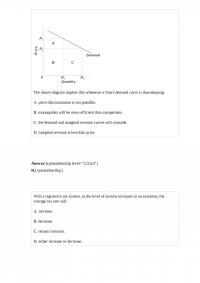
ECON E 24264
The above diagram implies that whenever a firm’s demand curve is downsloping: A. price discrimination is not possible. B. monopolists will be more efficient than competitors. C. the demand and marginal revenue curves will coincide. D. marginal revenue is less […]
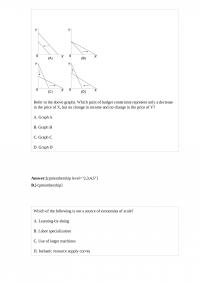
ECON E 29676
Refer to the above graphs. Which pairs of budget constraints represent only a decrease in the price of X, but no change in income and no change in the price of Y? A. Graph A B. Graph B C. Graph […]
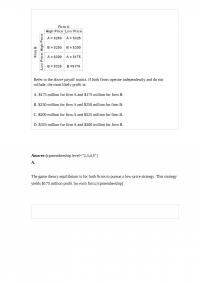
ECON E 39885
Refer to the above payoff matrix. If both firms operate independently and do not collude, the most likely profit is: A. $175 million for firm A and $175 million for firm B. B. $250 million for firm A and $250 […]
ECON E 40403
Other things equal, if a full-employment economy reallocated a substantial quantity of its resources to capital goods, we would expect: A. present consumption to rise. B. future consumption to fall. C. a lower rate of growth of real GDP. D. […]
ECON E 40447
A basic characteristic of a command system is that: A. wages paid to labor are higher. B. government owns most economic resources. C. markets function mostly free from government intervention. D. government planners play a limited role in deciding what […]
ECON E 40769
The Federal Reserve alters the amount of the nation’s money supply by: A. reducing the liabilities of the banking system. B. controlling the assets of the nation’s largest banks. C. minting coins and printing currency that is distributed to banks. […]
ECON E 44321
The crowding-out effect occurs when an expansionary fiscal policy increases the interest rate, decreases investment spending, and weakens fiscal policy. An expansionary monetary policy may be more effective than a restrictive monetary policy because commercial banks may decide to hold […]
ECON E 46695
A peak in the business cycle: A. occurs when the unemployment rate is its greatest. B. occurs when the inflation rate is its lowest. C. is a temporary maximum point. D. is a temporary minimum point. If the price of […]
ECON E 72307
The public debt is the accumulation of all deficits and surpluses that have occurred through time. An expansionary monetary policy lowers the Federal funds rate, increases the money supply, and lowers other interest rates. Answer: TRUE The larger the number […]
ECON E 75126
The wages and salaries that people earn differ partly because of differences in: A. wealth. B. ability. C. Social Security payments. D. in-kind transfer payments. Economic resources in the capitalist system are brought together by: A. government units. B. entrepreneurs. […]
ECON E 80158
The Federal Open Market Committee (FOMC): A. provides advice on banking policy to the Fed. B. monitors regulatory banking laws for member banks. C. sets policy on the sale and purchase of government bonds by the Fed. D. follows the […]
ECON E 91191
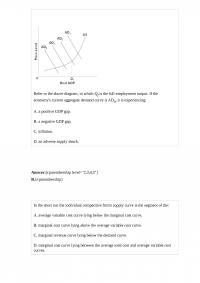
Refer to the above diagram, in which Qf is the full-employment output. If the economy’s current aggregate demand curve is AD0, it is experiencing: A. a positive GDP gap. B. a negative GDP gap. C. inflation. D. an adverse supply […]
Economics 10629
Suppose that real domestic output in an economy is 2400 units, the quantity of inputs is 60, and the price of each input is $30. The per-unit cost of production is: A. $0.25. B. $0.50. C. $0.75. D. $2.00. Of […]
Economics 23589
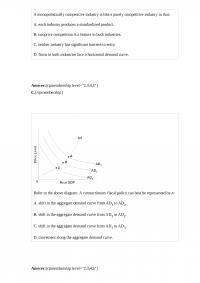
A monopolistically competitive industry is like a purely competitive industry in that: A. each industry produces a standardized product. B. nonprice competition is a feature in both industries. C. neither industry has significant barriers to entry. D. firms in both […]
Economics 40310
The federal backing for the money in the United States comes from: A. providing sufficient quantities of precious metals such as gold and silver to cover the amount of paper money in circulation. B. pledging physical assets, such as land, […]
Economics 42458
Money functions as a store of value if it allows you to: A. measure the value of goods in a reliable way. B. make exchanges in a more efficient manner. C. delay purchases until you want the goods. D. increase […]
Economics 43834
One important reason why the U.S. government is not likely to go bankrupt even with a large public debt is that it has: A. the ability to refinance debt as it comes due by selling new bonds. B. s strong […]
Economics 44554
The cornerstone of antitrust policy in the United States is generally considered to be the Sherman Antitrust Act of 1890. In the cause-effect chain, a restrictive money policy increases the money supply, decreases the interest rate, increases investment spending, and […]
Economics 54053
The ability-to-pay principle of taxation: A. has been declared unconstitutional because it deprives individuals of property without due process of law. B. suggests that people should pay taxes in proportion to the benefits they derive from public goods and services. […]
Economics 63866
Which combination of fiscal policy actions would most likely be offsetting? A. Increase in taxes and government spending B. Decrease in taxes and increase in government spending C. Increase in taxes but no change in government spending D. Decrease in […]
Economics 63928
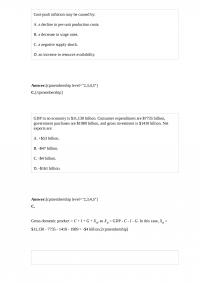
Cost-push inflation may be caused by: A. a decline in per-unit production costs. B. a decrease in wage rates. C. a negative supply shock. D. an increase in resource availability. GDP in an economy is $11,130 billion. Consumer expenditures are […]
Economics 68134
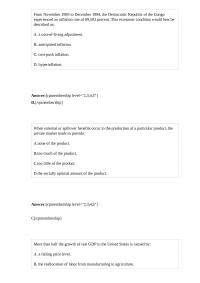
From November 1993 to December 1994, the Democratic Republic of the Congo experienced an inflation rate of 69,502 percent. This economic condition would best be described as: A. a cost-of-living adjustment. B. anticipated inflation. C. cost-push inflation. D. hyperinflation. When […]
Economics 76740
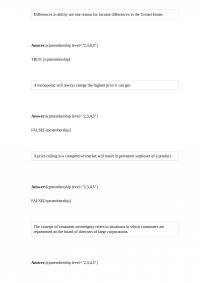
Differences in ability are one reason for income differences in the United States. A monopolist will always charge the highest price it can get. Answer: FALSE A price ceiling in a competitive market will result in persistent surpluses of a […]
Economics 80591
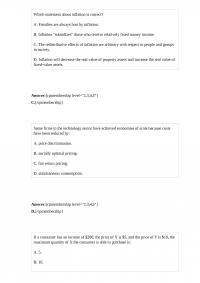
Which statement about inflation is correct? A. Families are always hurt by inflation. B. Inflation “subsidizes” those who receive relatively fixed money income. C. The redistributive effects of inflation are arbitrary with respect to people and groups in society. D. […]
Economics 91137
Under oligopoly, a kinked-demand curve would explain why firms: A. avoid price wars. B. undertake new investment. C. have different levels of efficiency. D. are approximately the same size. Which factor has most contributed to the increased concentration in the […]
MicroEconomic 12382
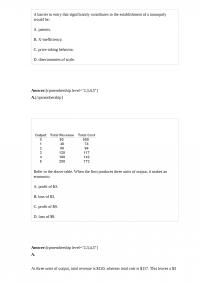
A barrier to entry that significantly contributes to the establishment of a monopoly would be: A. patents. B. X-inefficiency. C. price-taking behavior. D. diseconomies of scale. Refer to the above table. When the firm produces three units of output, it […]
MicroEconomic 18962
Dumping of goods abroad: A. constitutes a general case for permanent tariffs. B. may be part of a firm’s price discrimination strategy. C. may be part of a nation’s strategy to rectify its trade deficit. D. drives up prices of […]
MicroEconomic 22804
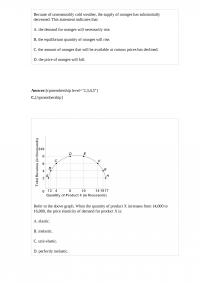
Because of unseasonably cold weather, the supply of oranges has substantially decreased. This statement indicates that: A. the demand for oranges will necessarily rise. B. the equilibrium quantity of oranges will rise. C. the amount of oranges that will be […]
MicroEconomic 23148
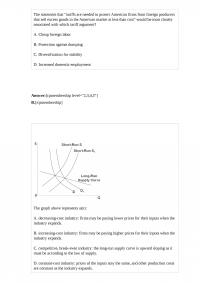
The statement that “tariffs are needed to protect American firms from foreign producers that sell excess goods in the American market at less than cost” would be most closely associated with which tariff argument? A. Cheap foreign labor B. Protection […]
MicroEconomic 30654
In the long run: A. all costs are variable costs. B. all costs are fixed costs. C. variable costs equal fixed costs. D. fixed costs are greater than variable costs. What does TARP stand for? A. Toxic Asset Rescue Program. […]
MicroEconomic 42483
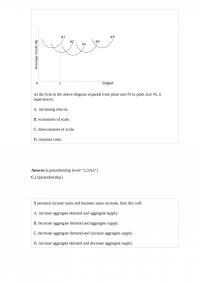
As the firm in the above diagram expands from plant size #3 to plant size #5, it experiences: A. increasing returns. B. economies of scale. C. diseconomies of scale. D. constant costs. If personal income taxes and business taxes increase, […]
MicroEconomic 70302
Economists who believe the recent productivity acceleration may be permanent claim that the above-normal economic growth in the United States between 1995 and 2009 was caused by: A. increases in the rate of personal saving. B. increased entrepreneurial activity, application […]
MicroEconomic 71439
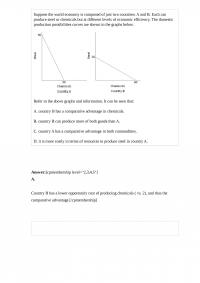
Suppose the world economy is composed of just two countries: A and B. Each can produce steel or chemicals but at different levels of economic efficiency. The domestic production possibilities curves are shown in the graphs below. Refer to the […]
MicroEconomic 71622
A large public debt will not bankrupt the federal government because it can refinance the debt or increase taxes to pay it. The gross domestic product (GDP) is the market value of all goods and services produced by the economy […]
MicroEconomic 82009
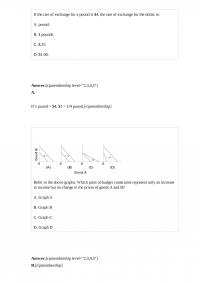
If the rate of exchange for a pound is $4, the rate of exchange for the dollar is: A. pound. B. 4 pounds. C. $.25. D. $1.00. Refer to the above graphs. Which pairs of budget constraints represent only an […]
MicroEconomic 83157
If nominal GDP in one year is $5000 billion and the price index is 135, the real GDP that year is $3704 billion. Only the bondholders of a corporation have the right to vote for a corporation’s directors. Answer: FALSE […]
MicroEconomic 85320
The total volume of business sales in our economy is several times as large as the GDP because: A. the GDP does not take taxes into account. B. the GDP excludes intermediate transactions. C. the GDP grossly understates the value […]