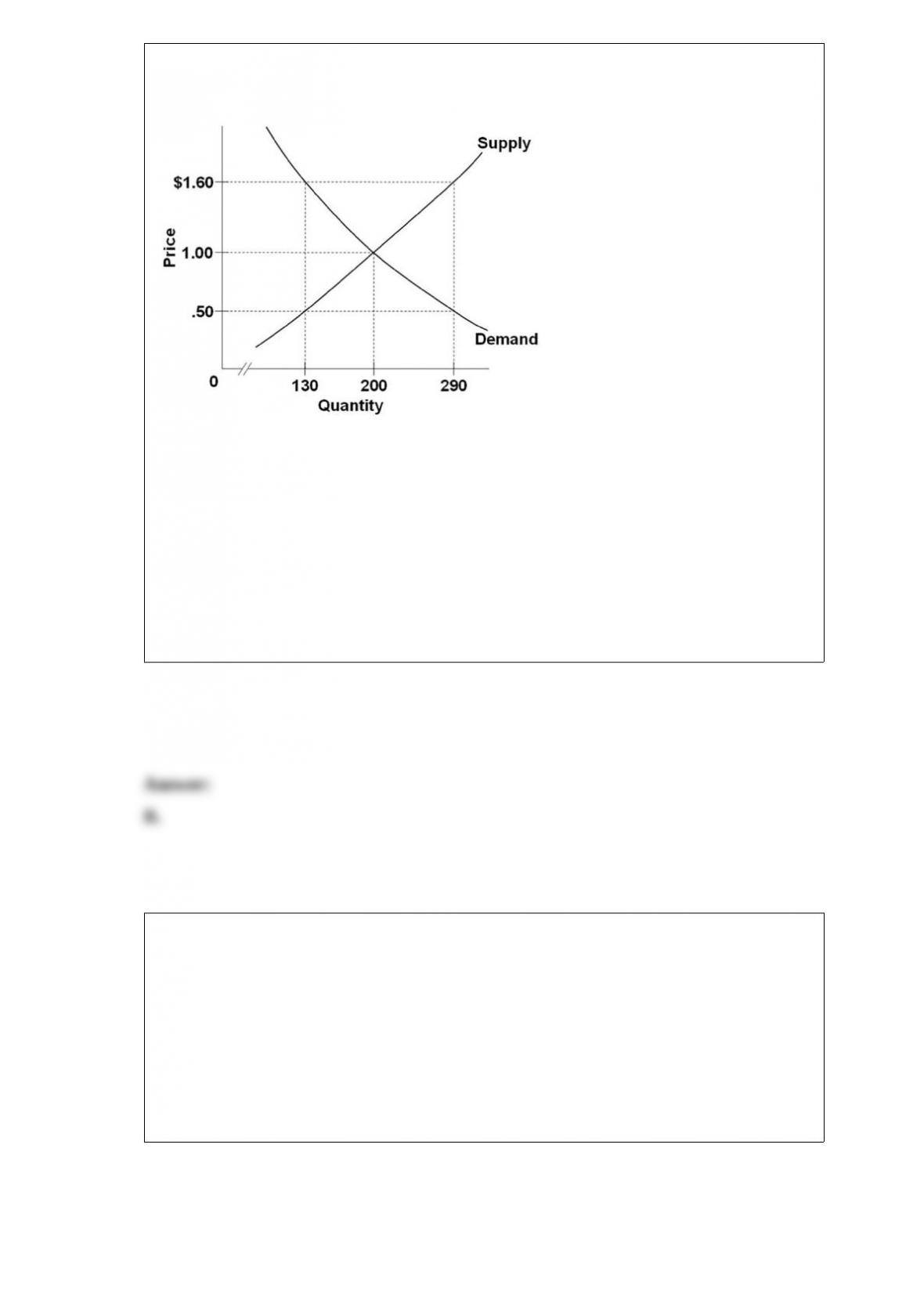
Refer to the above diagram. A surplus of 160 units would be encountered if price was:
A. $1.10, that is, $1.60 minus $.50.
B. $1.60.
C. $1.00.
D. $.50.
A natural monopoly exists when:
A. unit costs are minimized by having one firm produce an industry’s entire output.
B. several formerly competing producers merge to become the only firm in an industry.
C. short-run average total cost curves are tangent to long-run average total cost curves.
D. minimum efficient scale is attained at a small level of output.

The transactions demand for money will shift to the:
A. left when nominal GDP increases.
B. left when nominal GDP decreases.
C. right when nominal GDP decreases.
D. right when the interest rate increases.
The introduction in 1996 of “Arch Deluxe” was a hit product for McDonald’s. This
example shows that in the market for such fast-food products:
A. normal profits are greater than economic profits.
B. the medium of exchange is more important than the message.
C. consumer sovereignty is less important than specialization.
D. the dollar votes of consumers determined which products succeed.
A monopolistically competitive firm is producing at an output level in the short run
where average total cost is $4.50, price is $4.00, marginal revenue is $2.50, and
marginal cost is $2.50. This firm is operating:

A. with a profit in the short run.
B. with a loss in the short run.
C. at the break-even level of output in the short run.
D. at an efficient level of output in the short run.
The demand for labor would most likely become more elastic as a result of:
A. a decrease in the elasticity of the demand for the product that the labor produces.
B. a decrease in the time for employers to make technological changes or purchase new
equipment.
C. a decrease in the proportion of labor costs to total costs.
D. an increase in the proportion of labor costs to total costs.
Generally, the prime interest rate:
A. moves in the opposite direction of the Federal funds rate.
B. remains constant over long periods of time.
C. is highly inflexible downward.
D. moves in the same direction as the Federal funds rate.

The law of diminishing returns indicates that:
A. as extra units of a variable resource are added to a fixed resource, marginal product
will decline beyond some point.
B. because of economies and diseconomies of scale, a competitive firm’s long-run
average total cost curve will be U-shaped.
C. the demand for goods produced by purely competitive industries is downsloping.
D. beyond some point, the extra utility derived from additional units of a product will
yield the consumer smaller and smaller extra amounts of satisfaction.
The claims of nonowners of a bank against the bank’s assets are called:
A. loans.
B. net worth.
C. liabilities.
D. required reserves.
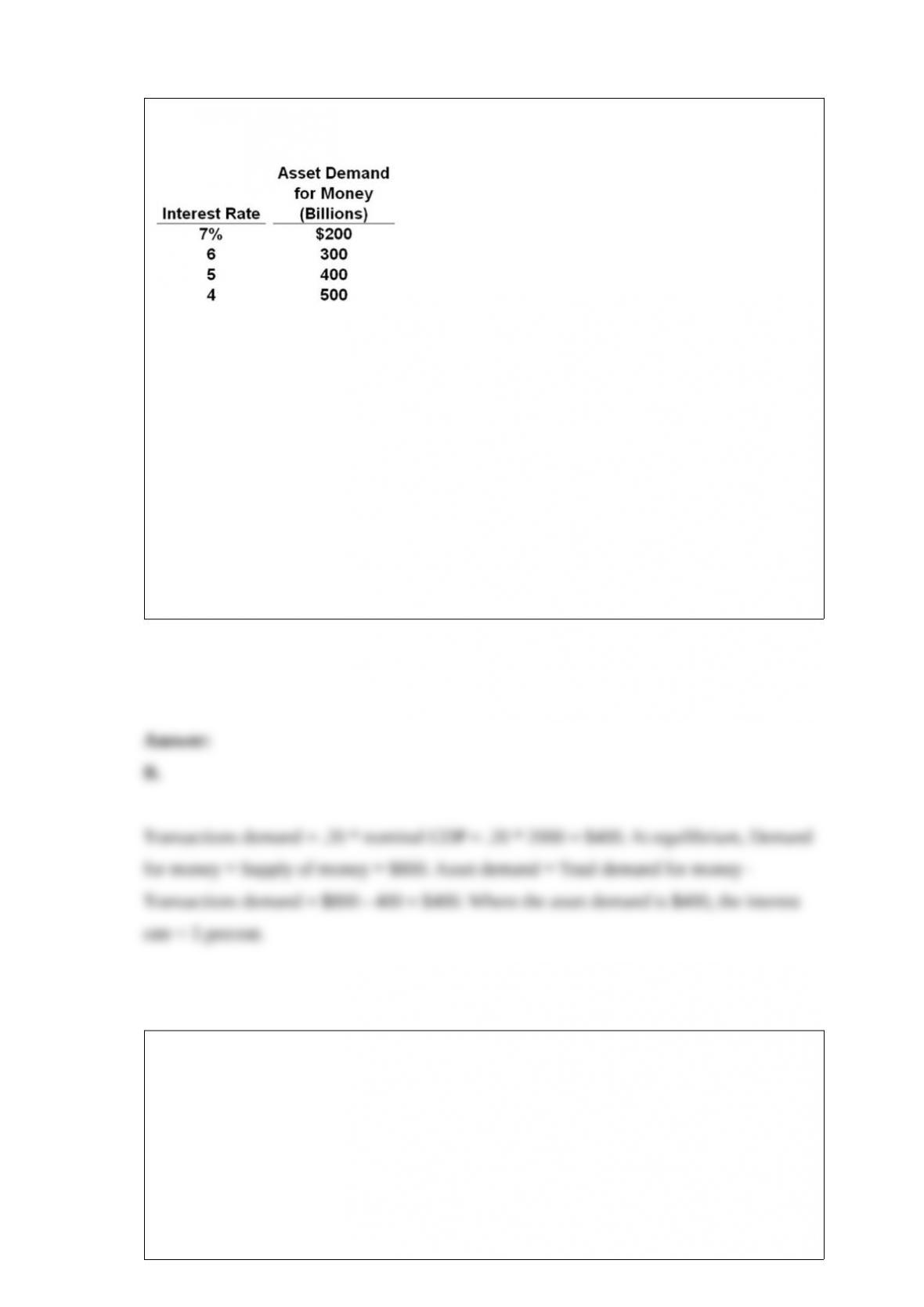
Refer to the above table. Suppose the transactions demand for money is equal to 20
percent of the nominal GDP, the supply of money is $800 billion, and the asset demand
for money is that shown in the table. If the nominal GDP is $2000 billion, the
equilibrium interest rate is:
A. 4 percent.
B. 5 percent.
C. 6 percent.
D. 7 percent.
The vertical slope of the long-run aggregate supply curve is based on the assumption
that:
A. nominal wages and other resource costs do not respond to price level changes.
B. nominal wages and other resource costs do respond to price level changes.
C. nominal wages are greater than real wages.
D. nominal wages are less than real wages.
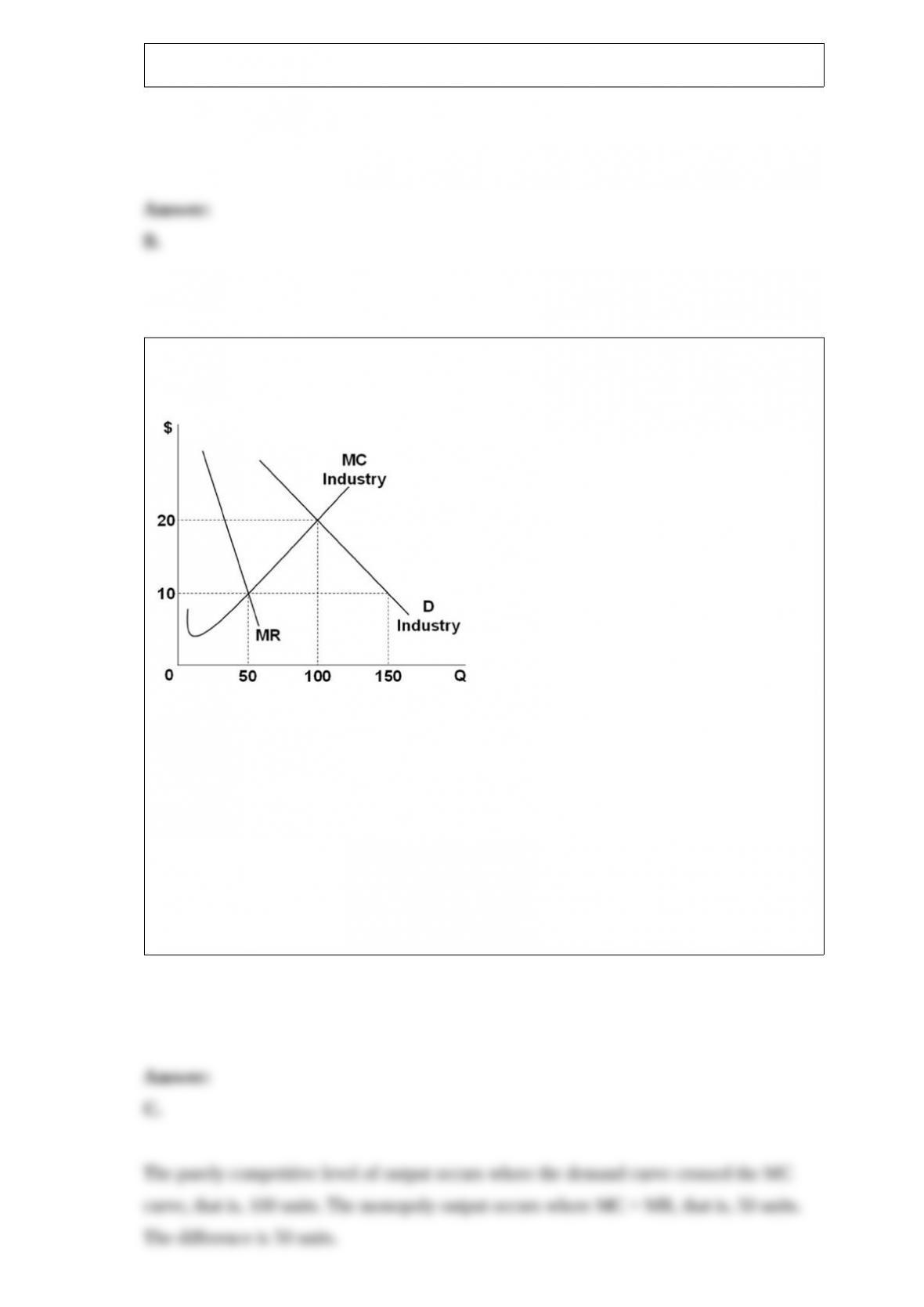
Based on the diagram above, what is the difference between the purely competitive
level of output and the pure monopolist level of output?
A. 10
B. 20
C. 50
D. 100

Nation X has a comparative advantage in the production of a product compared to
nation Y when:
A. it imposes a tariff on the import of the product.
B. the trading possibilities line shifts outward.
C. it is achieving full employment of resources.
D. it has the lower domestic opportunity cost of the two countries.
Increases in resources or improvements in technology will tend to cause a society’s
production possibilities curve to:
A. shift inward or to the left.
B. shift outward or to the right.
C. become horizontal.
D. become vertical.
In pure competition, a profit-maximizing firm will equate the marginal revenue product
of labor with the:
A. wage rate.

B. profits produced by the employment of an extra worker.
C. cost of producing one extra unit of output.
D. price received from selling one extra unit of output.
In the following question you are asked to determine, other things equal, the effects of a
given change in a determinant of demand or supply for product X upon (1) the demand
(D) for, or supply (S) of, X; (2) the equilibrium price (P) of X; and (3) the equilibrium
quantity (Q) of X.
An increase in the prices of resources used to produce X will:
A. increase S, increase P, and increase Q.
B. increase D, increase P, and increase Q.
C. decrease S, decrease P, and decrease Q.
D. decrease S, increase P, and decrease Q.
The income elasticity of demand for a food is unity. A consumer’s monthly income is
$2,000, of which 20 percent is spent on food. If income doubles, the amount spent on
food will be:
A. $400 per month.
B. $500 per month.
C. $800 per month.
D. $1,000 per month.
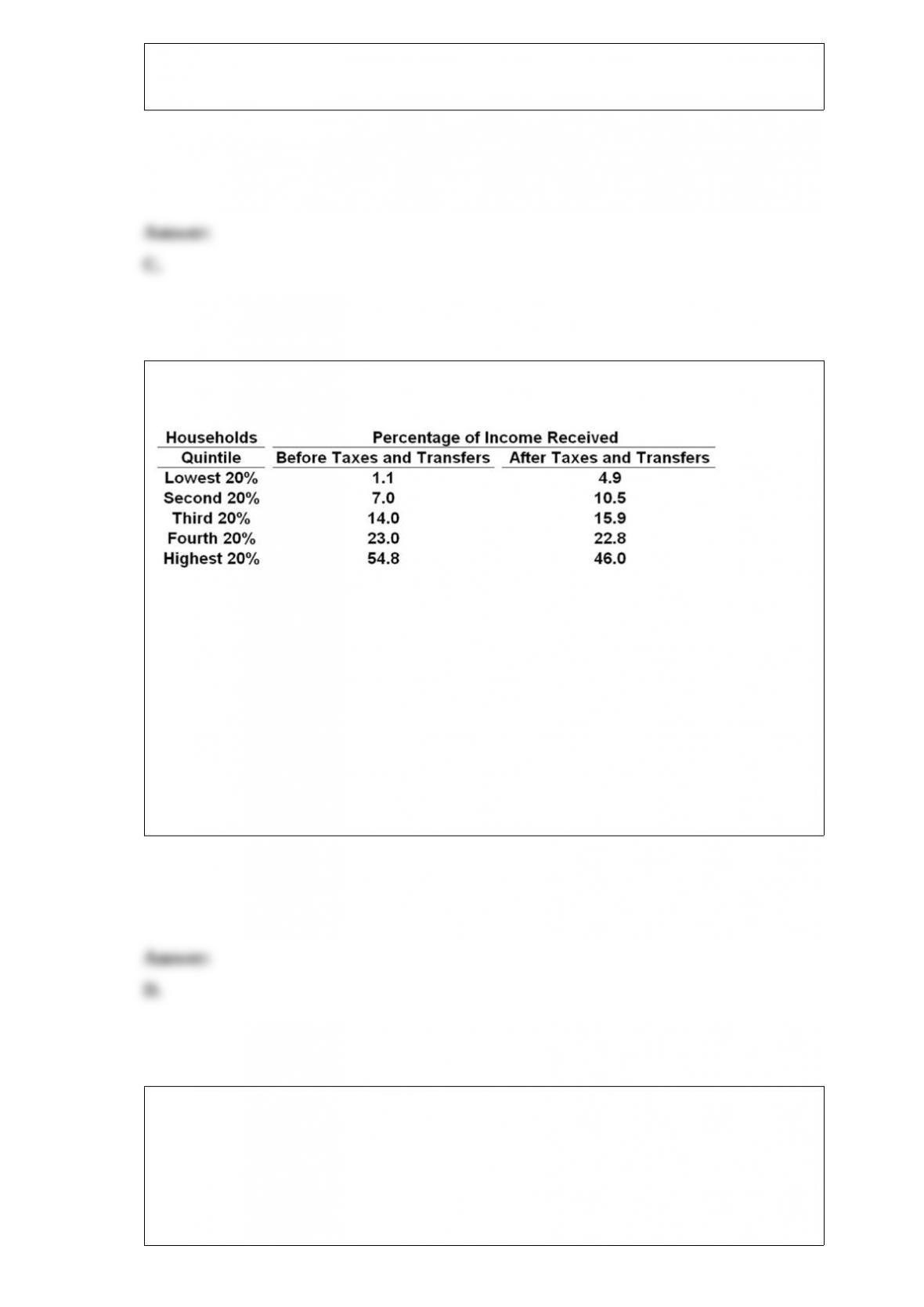
Refer to the above table. The decline in percentage of income received from before
taxes and transfers to after taxes and transfers is greatest for the:
A. second 20 percent of households.
B. third 20 percent of households.
C. fourth 20 percent of households.
D. highest 20 percent of households.
If country A has a comparative advantage in the production of good X over country B,
then:
A. country A should not trade with country B.
B. the domestic opportunity cost of producing X in country A is higher than in country
B.
C. the domestic opportunity cost of producing X in country A is lower than in country
B.
D. the domestic opportunity cost of producing X in country A is higher or lower than in
country B.
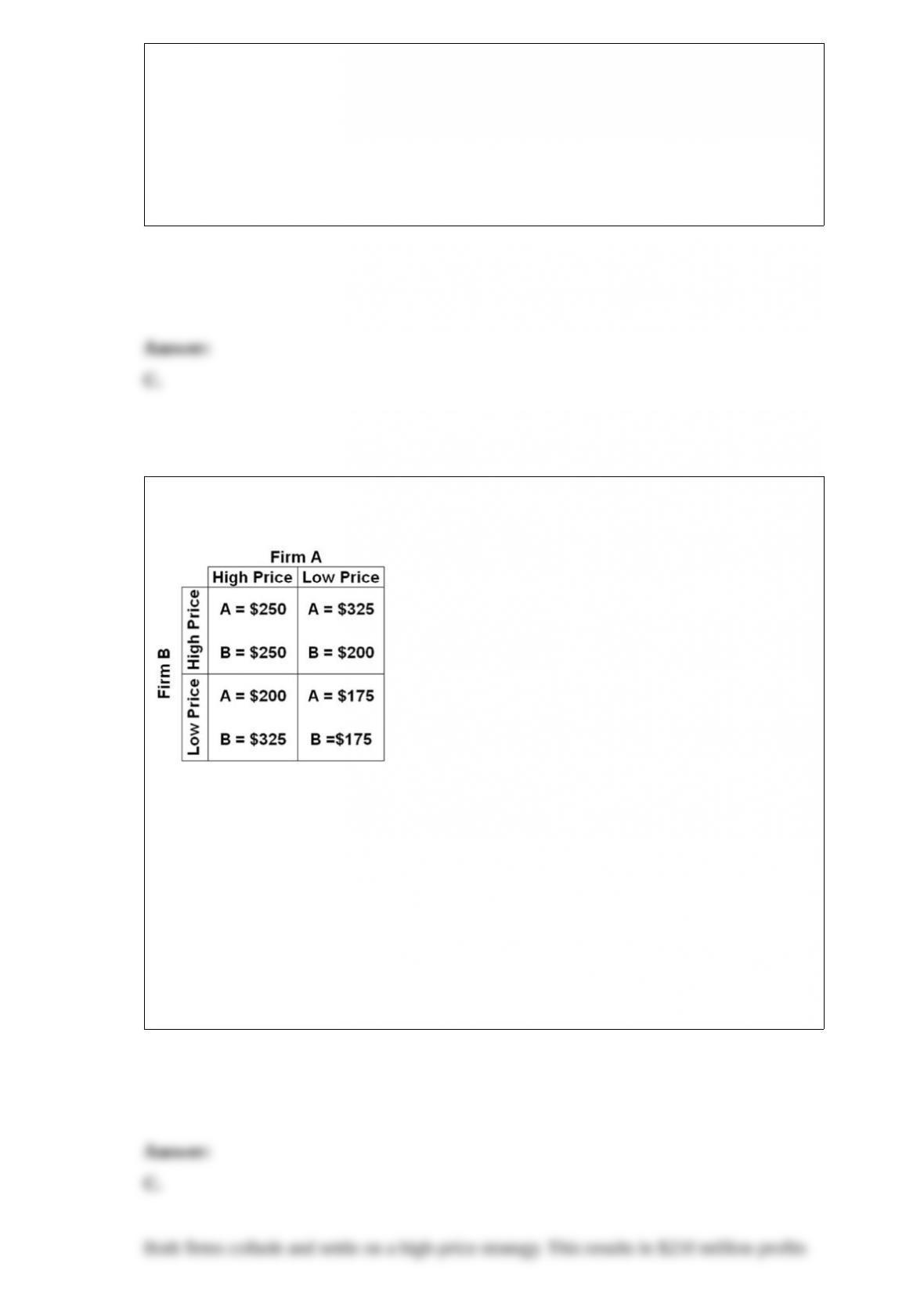
Refer to the above payoff matrix. If both firms collude to maximize joint profits, the
total profits for the two firms will be:
A. $350 million.
B. $400 million.
C. $500 million.
D. $525 million.
The short run in macroeconomics is a period in which nominal wages:
A. do not respond as the price level stays constant.
B. change as the price level stays constant.
C. do not respond as the price level changes.
D. change as the price level changes.
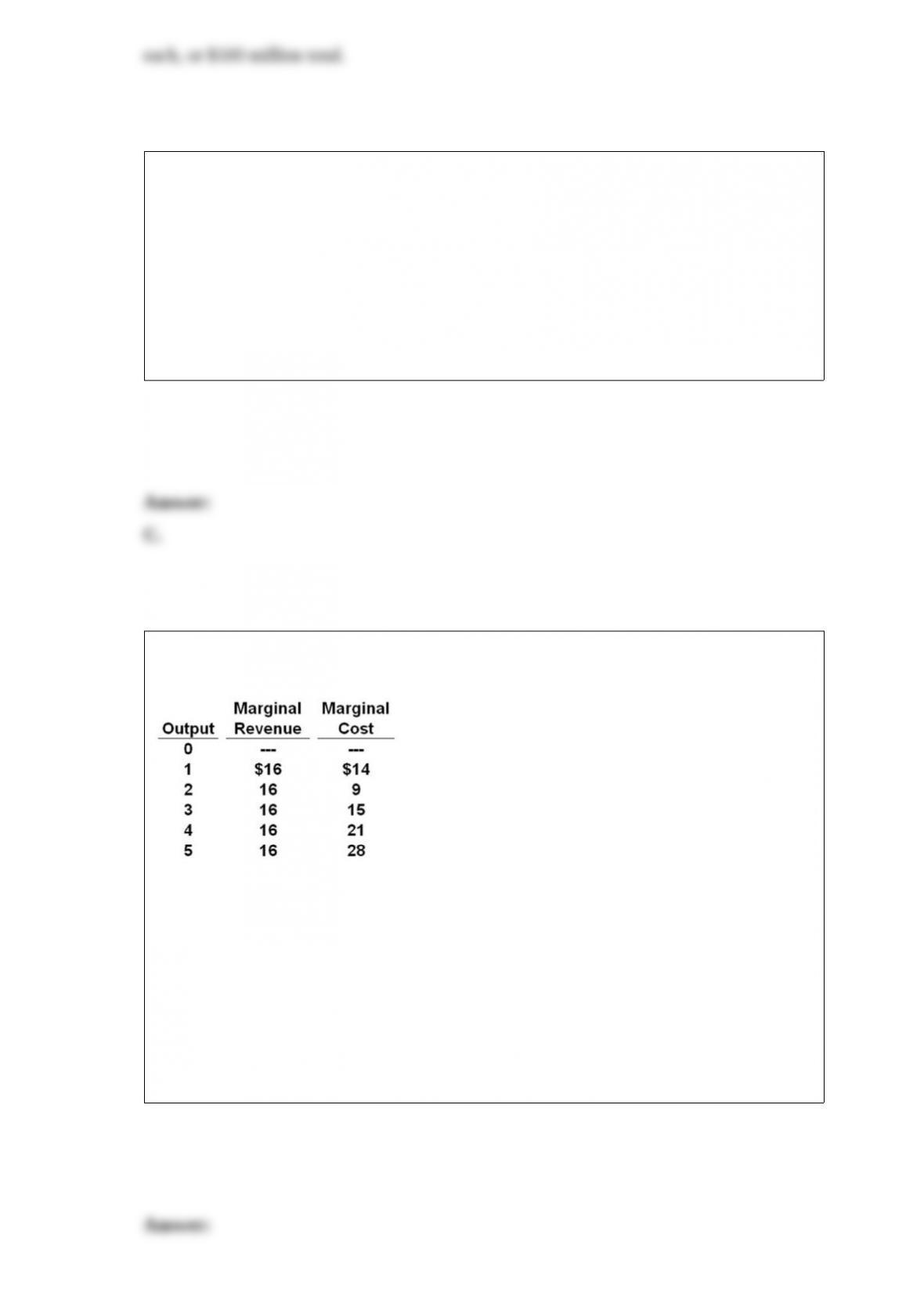
Refer to the above data. This firm is selling its output in a(n):
A. imperfectly competitive market.
B. monopolistic market.
C. purely competitive market.
D. oligopolistic market.

Automatic stabilizers smooth fluctuations in the economy because they produce
changes in the government’s deficit that:
A. reinforce changes in GDP.
B. help offset changes in GDP.
C. produce a cyclically adjusted budget.
D. produce a standardized budget.
The purpose of an expansionary money policy is to:
A. increase aggregate demand.
B. decrease aggregate demand.
C. increase investment demand.
D. decrease investment demand.
The rate of unemployment when the economy is at its potential output is called the:
A. full-employment rate of unemployment.

B. natural rate of unemployment.
C. structural rate of unemployment.
D. frictional rate of unemployment.
Opportunity cost is best defined as:
A. marginal cost minus marginal benefit.
B. the value of the best forgone alternative.
C. the time spent on an economic activity.
D. the money cost of an economic decision.
Which is a likely characteristic of a differentiated oligopolistic market?
A. There are minimal barriers to entry.
B. The market demand curve is inelastic.
C. There is minimal advertising expenditure.
D. Price and output decisions of firms are interdependent.
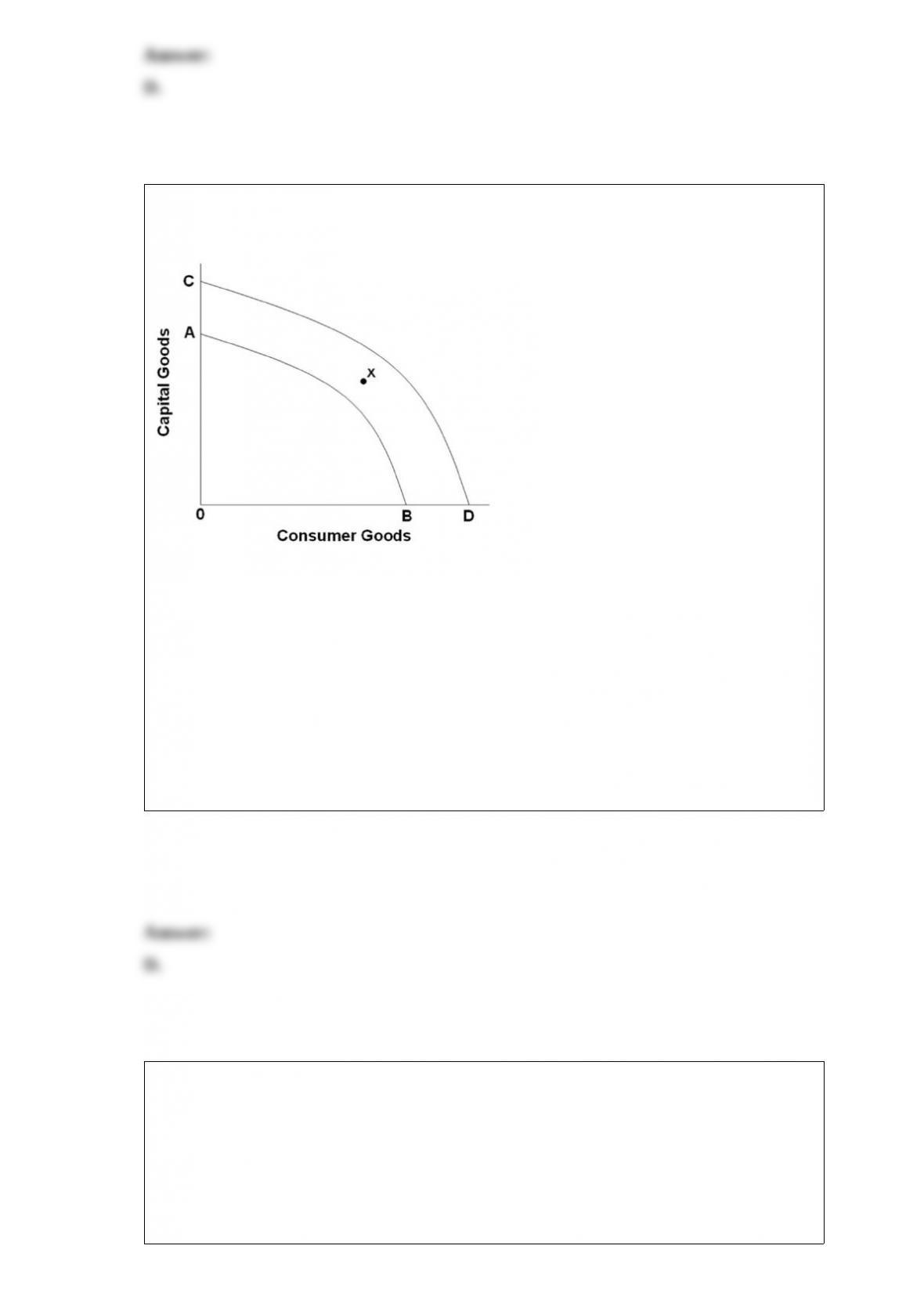
Refer to the above graph. If the production possibilities curve for an economy is at CD,
but the economy is operating at point x, the reasons are most likely to be because of:
A. technological progress and industrial change.
B. increases in the quantity and the quality of resources.
C. improvement in labor productivity and the number of work-hours.
D. lack of full employment and inefficient allocation of resources.
When the price of a product is increased 10 percent, the quantity demanded decreases
15 percent. In this range of prices, demand for this product is:
A. elastic.
B. inelastic.
C. cross-elastic.
D. unitary elastic.
Why might a company use barter rather than money to make a transaction?
A. Barter is generally more efficient than money exchanges.
B. Barter can enable two firms to trade when their cash flows are limited.
C. Money requires a coincidence of wants but barter is more direct.
D. Money is economically efficient for large transactions, but barter is preferred for
smaller transactions.
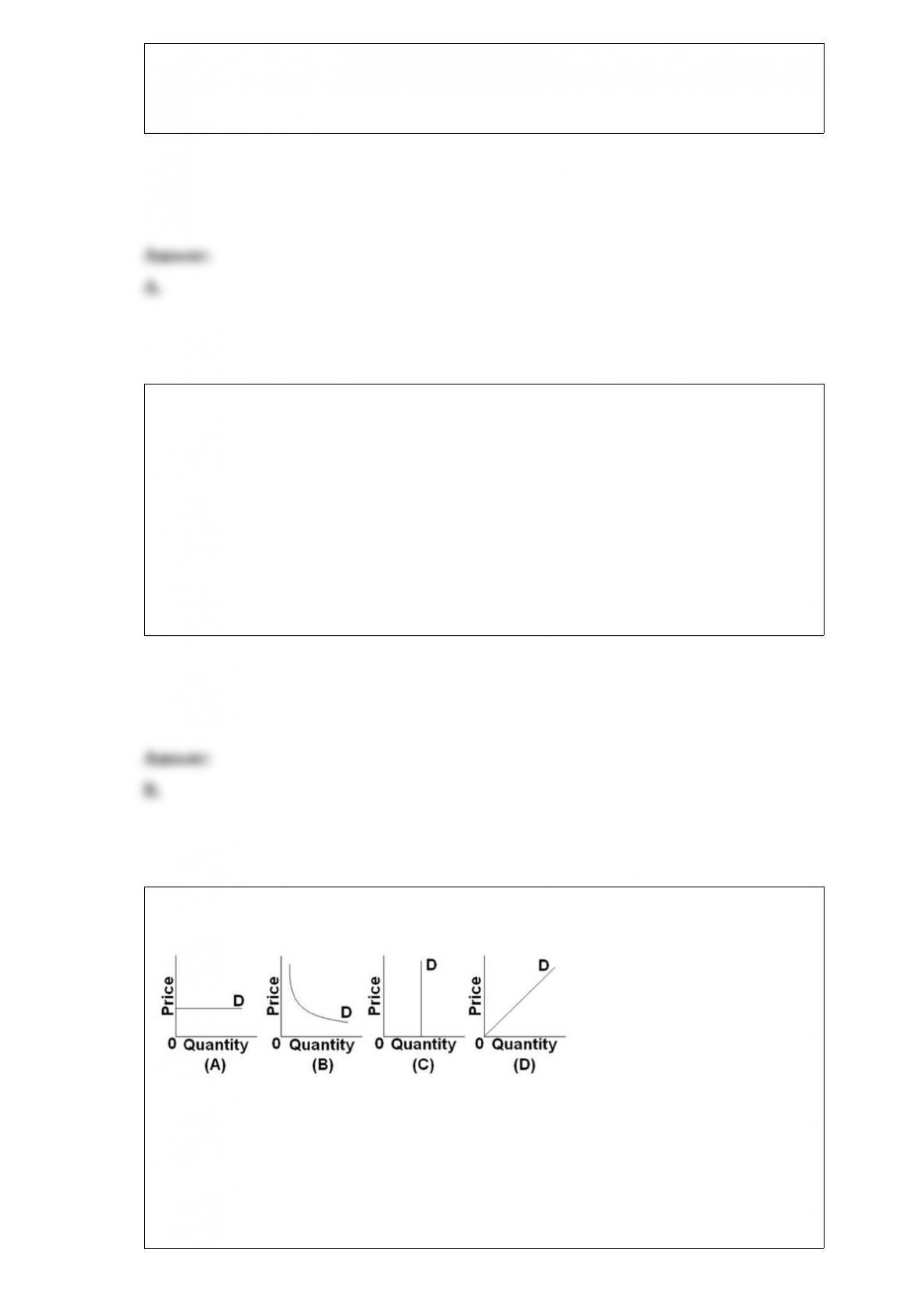
Refer to the above graphs. Which shows a perfectly elastic demand curve?
A. Graph A
B. Graph B

C. Graph C
D. Graph D
Estimates of the income elasticity of demand for health care indicate that it is about 1.
These estimates suggest that spending on health care will probably:
A. increase proportionately with income.
B. increase faster than income.
C. increase less than income.
D. not increase or decrease.
DVD players and DVDs are:
A. complementary goods.
B. substitute goods.
C. independent goods.
D. inferior goods.

A group of firms that produce the same or similar products is:
A. a plant.
B. an industry.
C. a partnership.
D. a multiplant firm.
Value added is the value of a firm’s output minus:
A. the value of intermediate goods purchased from other firms.
B. the compensation it pays to employees.
C. the value of its capital goods.
D. its depreciation.