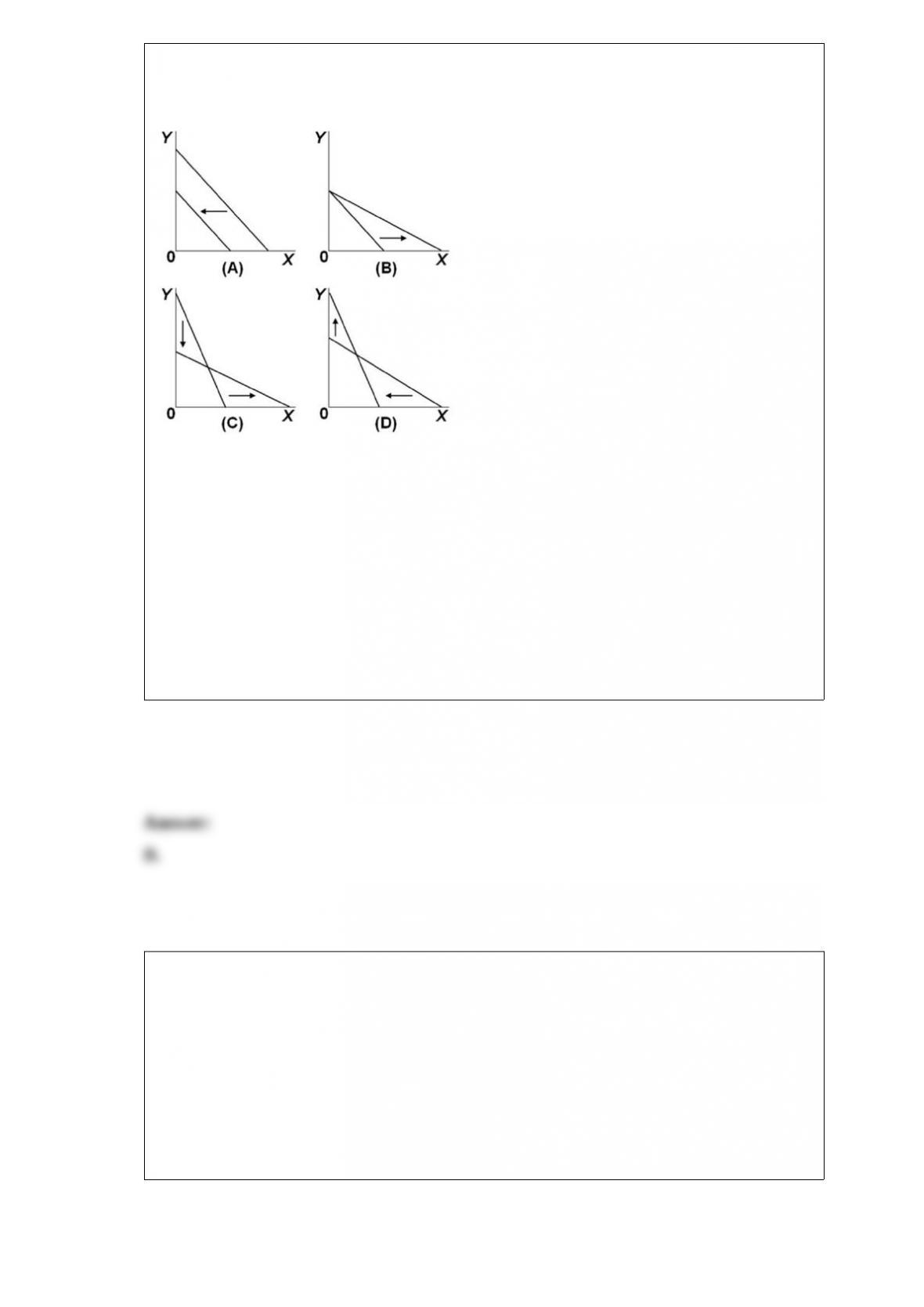
Refer to the above graphs. Which pairs of budget constraints represent only a decrease
in the price of X, but no change in income and no change in the price of Y?
A. Graph A
B. Graph B
C. Graph C
D. Graph D
Which of the following is not a source of economies of scale?
A. Learning-by-doing
B. Labor specialization
C. Use of larger machines
D. Inelastic resource supply curves
An emission fee levied against polluters will tend to:
A.internalize the internal cost of pollution.
B.externalize the internal cost of pollution.
C.internalize the external cost of pollution.
D.externalize the external cost of pollution.
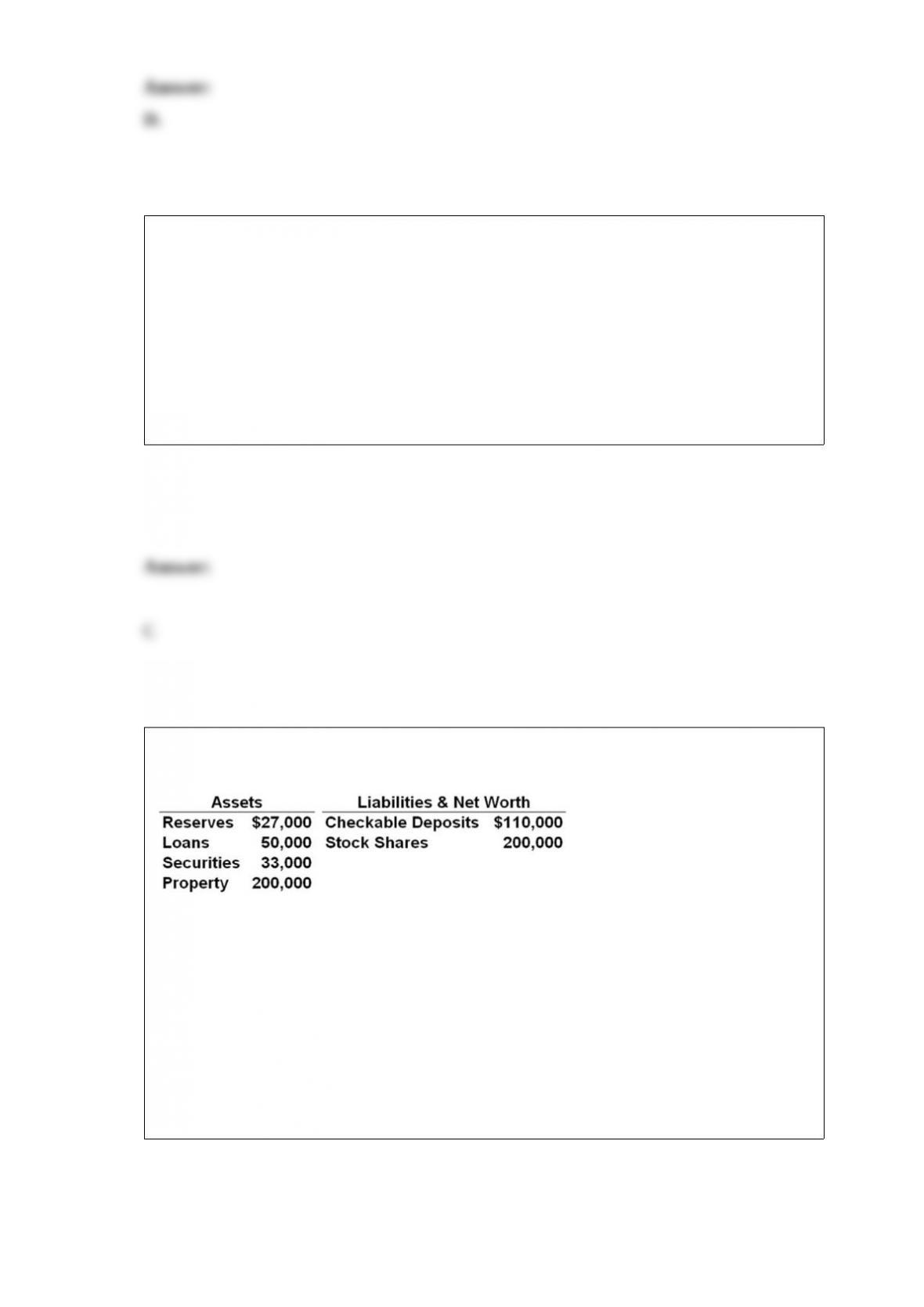
Use the following balance sheet for the ABC National Bank in answering the next
question. Assume the required reserve ratio is 20 percent.
Refer to the above data. This commercial bank has excess reserves of:
A. $0.
B. $3000.
C. $12,000.
D. $5000.

Which of the following statements is true about price ceilings?
A. Price ceilings cause goods to be rationed by prices.
B. Price ceilings cause goods to be rationed by some other means than free market
prices.
C. Ration coupons are the only way to ration goods when price ceilings are in place.
D. All of these statements are correct.
Over time, the equilibrium price of a gigabyte of computer memory has fallen while the
equilibrium quantity purchased has increased. Based on this we can conclude that:
A. decreases in the demand for computer memory have exceeded increases in supply.
B. decreases in the supply of computer memory have exceeded increases in demand.
C. increases in the demand for computer memory have exceeded increases in supply.
D. increases in the supply of computer memory have exceeded increases in demand.

In Germany, one worker can produce one cuckoo clock or one beer mug. In Taiwan,
one worker can produce two cuckoo clocks or three beer mugs. Who has the
comparative advantage in each good?
A. Taiwan in both goods
B. Taiwan in clocks and Germany in mugs
C. Germany in clocks and Taiwan in mugs
D. Germany in both goods
The development of CDs and DVDs, which significantly reduced the market for
cassette tapes, is an example of:
A. specialization.
B. derived demand.
C. roundabout production.
D. creative destruction.

In the short run, a monopolist’s profits:
A. may be positive, negative, or zero.
B. are positive because of the monopolist’s market power.
C. are positive if the monopolist’s elasticity of demand is less than 1.
D. are positive if the monopolist’s selling price is above average variable cost.
Barriers to entry:
A. usually result in pure competition.
B. can result from government regulation.
C. exist in economic theory but not in the real world.
D. are typically the result of wrongdoing on the part of a firm.
Gambling increases in popularity, thus increasing the demand for card dealers at
casinos. This would be caused by which change in a determinant of labor demand?
A. An increase in labor productivity.
B. An increase in product demand.
C. A decrease in the price of another resource.
D. An increase in the price of another resource.

The most likely way the public debt burdens future generations, if at all, is by:
A. reducing the current level of investment.
B. causing future unemployment.
C. causing deflation.
D. reducing real interest rates.
The major purpose of the Federal Reserve buying government securities in open-market
operations is to:
A. increase interest rates.
B. raise money for government spending.
C. reduce the excess reserves of banks.
D. allow banks to increase their lending.

In an economy, 35 million workers are employed, the labor force is 50 million, and total
population is 70 million. The unemployment rate is:
A. 15 percent.
B. 25 percent.
C. 30 percent.
D. 50 percent.
An example of an intermediate good or service would be:
A. a calculator purchased by a college student for taking exams.
B. gasoline used by an insurance agent visiting clients.
C. a house bought by a banking executive with five children.
D. a boat bought by a medical doctor for use on vacation.
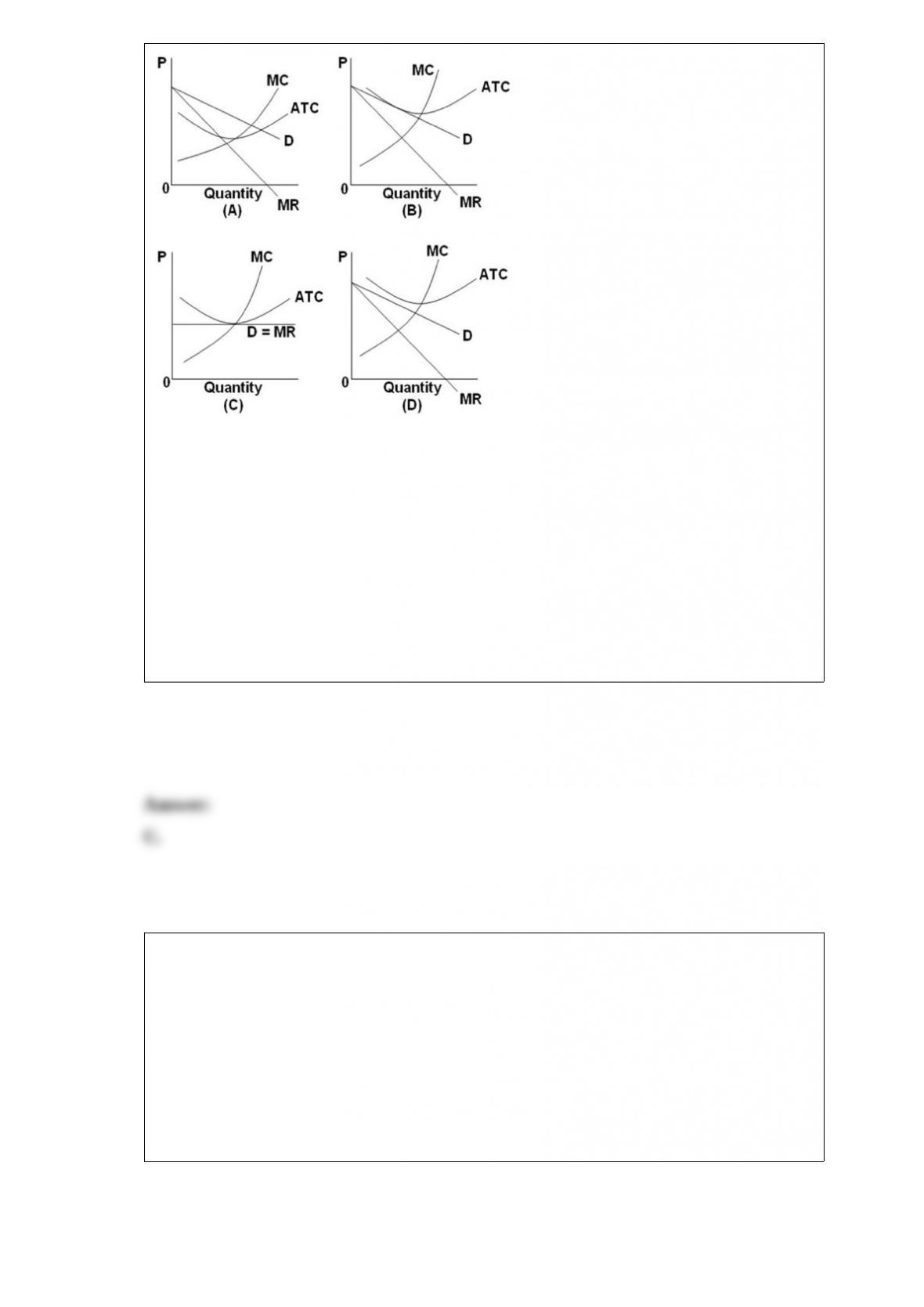
Refer to the above graphs. Which graph would not be a possible depiction of short-run
or long-run outcomes for a monopolistically competitive firm?
A. A
B. B
C. C
D. D
Changes in demand have a large effect on the price of gold because the:
A. supply of gold is relatively elastic.
B. supply of gold is relatively inelastic.
C. demand for gold is relatively elastic.
D. demand for gold is relatively inelastic.

If monies added to, or subtracted from, the Social Security trust fund were excluded
from federal budget calculations, the current federal budget:
A. deficit would nearly disappear.
B. deficit would be substantially larger.
C. surplus would nearly disappear.
D. surplus would be substantially smaller.
To avoid multiple counting in national income accounts, only:
A. final goods and services should be counted.
B. intermediate goods and services should be counted.
C. both final and intermediate goods and services should be counted.
D. primary, intermediate, and final goods and services should be counted.
The long-run average total cost curve:
A. displays declining unit costs so long as output is increasing.
B. indicates the lowest unit costs achievable when a firm has had sufficient time to alter
plant size.
C. has a shape that is the inverse of the law of diminishing returns.
D. can be derived by summing horizontally the average total cost curves of all firms in
an industry.
A decrease in the demand for recreational fishing boats might be caused by an increase
in the:
A. income of sports fishers.
B. price of outboard motors.
C. size and number of fish available.
D. price of sailing boats.
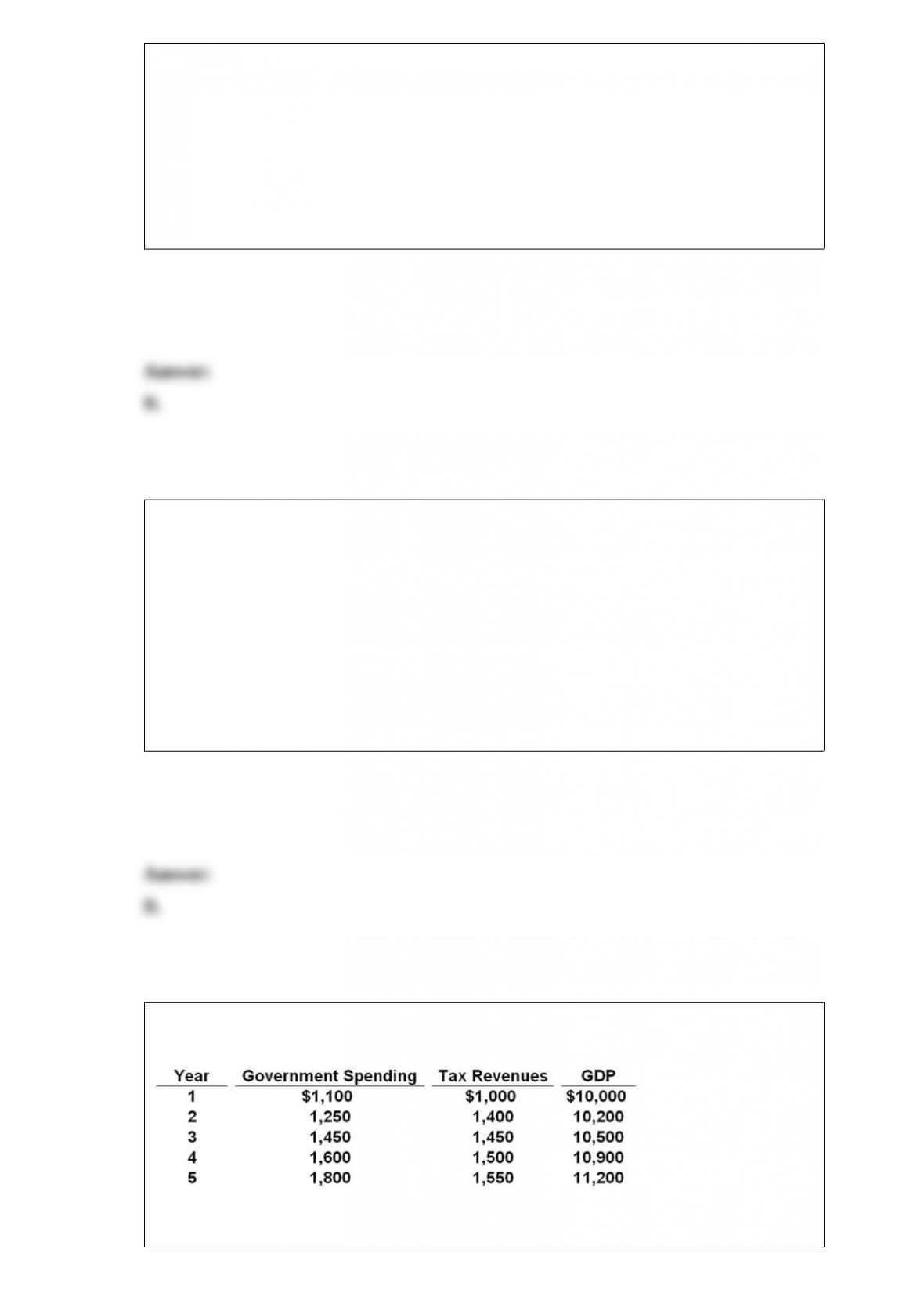
The following is budget information for a hypothetical economy. All data are in billions
of dollars.
Refer to the above data. Assume that year 1 is the first year for this economy and year 5

is the current year. What is the public debt in this economy?
A. $100 billion
B. $150 billion
C. $250 billion
D. $300 billion
The wages of plumbers are likely to increase when:
A. licensing standards for the occupation are increased.
B. there is an increase in the cost of plumbing supplies.
C. the length of the training period for plumbers is decreased.
D. more do-it-yourself home improvement centers open across the nation.
Which fiscal policy would be the most expansionary?
A. A $40 billion increase in government spending

B. A $20 billion tax cut and $20 billion increase in government spending
C. A $10 billion tax cut and $30 billion increase in government spending
D. A $40 billion tax cut
A contractionary fiscal policy can be illustrated by a(n):
A. increase in aggregate demand.
B. decrease in aggregate demand.
C. increase in aggregate supply.
D. change in the price level.
Sony is considering a 10 percent price reduction on its LCD television sets. If the
demand for sets in this price range is inelastic:
A. revenues from LCD sets will remain constant.
B. revenues from LCD sets will decrease.
C. revenues from LCD sets will increase.
D. the number of LCD sets sold will decrease.

Which is one cause of the unequal distribution of income in the United States?
A. Income mobility over time
B. Differences in preferences for work and leisure
C. The high levels of noncash transfers
D. The low benefit-reduction rate
The excess capacity of business rises due to:
A. demand increases.
B. demand decreases.
C. supply increases.
D. supply decreases.
Other things being equal, the demand for a factor of production will be less elastic if the
demand for the final product it produces is:
A. elastic.

B. inelastic.
C. unitary elastic.
D. perfectly elastic.
A cause of the unequal distribution of income in the United States is:
A. differences in preferences and risks.
B. differences in noncash transfers.
C. high expenditures for social insurance.
D. a low benefit-reduction rate for income.
If the exchange rate changes so that more Mexican pesos are required to buy a dollar,
then:
A. the peso has appreciated in value.
B. Americans will buy more Mexican goods and services.
C. more U.S. goods and services will be demanded by the Mexicans.
D. the dollar has depreciated in value.

The direct exchange of goods for goods is:
A. barter.
B. the circular flow.
C. the invisible hand.
D. roundabout production.