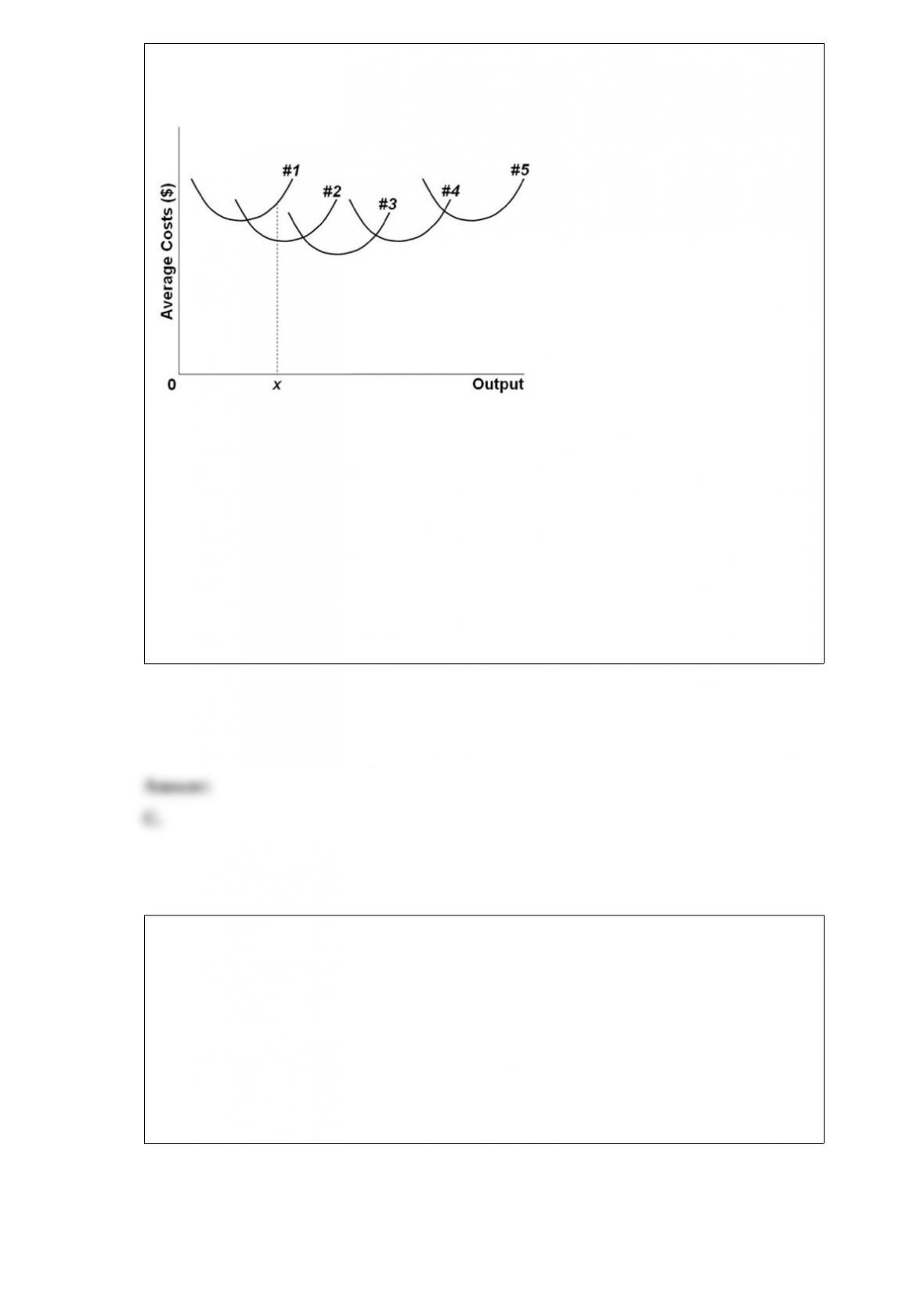
As the firm in the above diagram expands from plant size #3 to plant size #5, it
experiences:
A. increasing returns.
B. economies of scale.
C. diseconomies of scale.
D. constant costs.
If personal income taxes and business taxes increase, then this will:
A. increase aggregate demand and aggregate supply.
B. decrease aggregate demand and aggregate supply.
C. decrease aggregate demand and increase aggregate supply.
D. increase aggregate demand and decrease aggregate supply.

When compared with the purely competitive industry with identical costs of production,
a monopolist will produce:
A. more output and charge the same price.
B. more output and charge a higher price.
C. less output and charge a higher price.
D. less output and charge the same price.
Labor mobility is:
A. higher in the short run than in the long run.
B. higher in the long run than in the short run.
C. approximately the same in the long run as in the short run.
D. higher for the entire labor force than for individuals.
Geographic immobility in the labor force results in:
A. homogeneous wage rates.
B. homogeneous unemployment rates.
C. local labor markets that reach equilibrium quickly and efficiently.
D. persistent wage and unemployment differentials in different regions of the country.
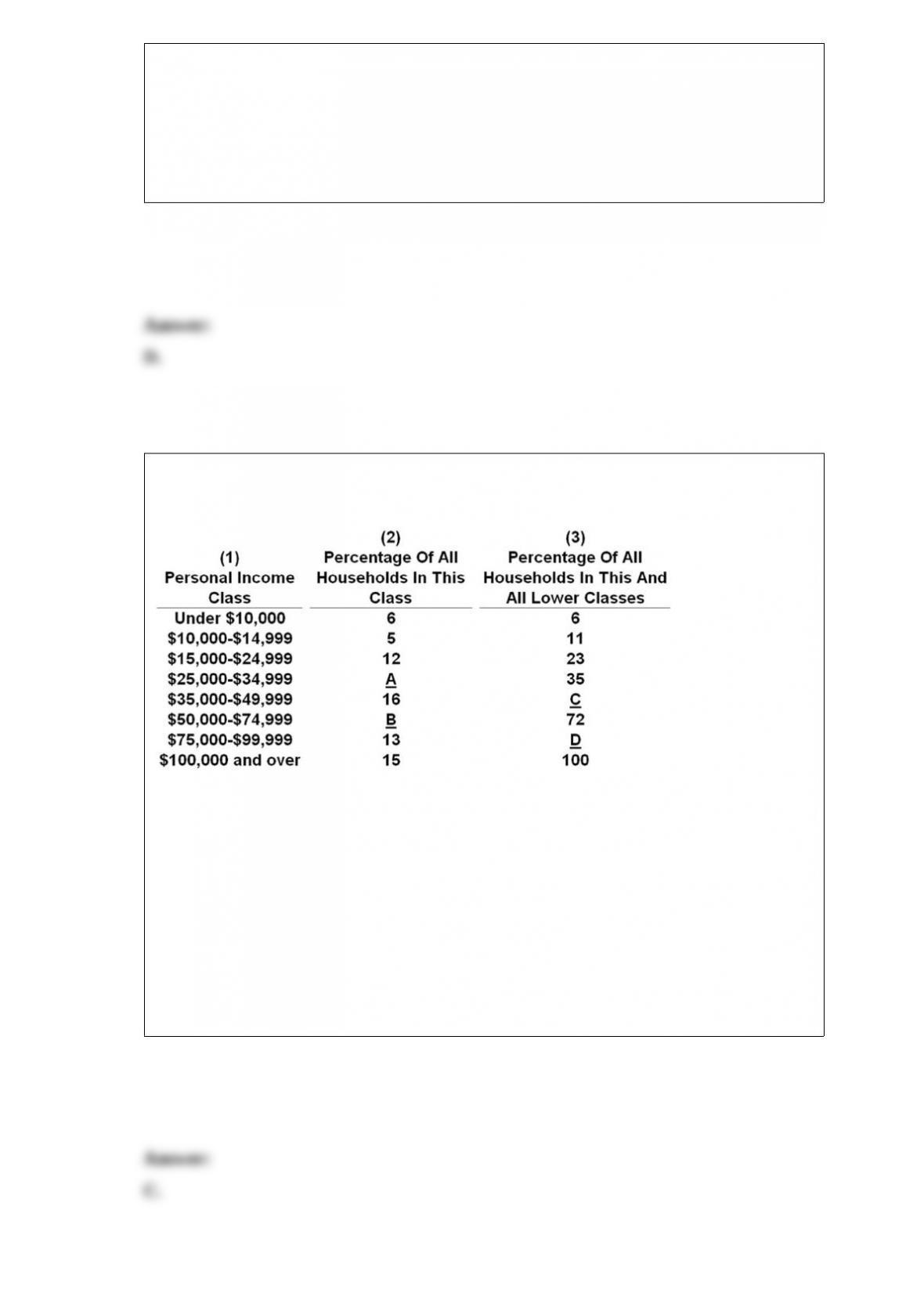
Using the data in the above table, what percentage should be reported in blank B of
column 2?
A. 6
B. 16
C. 21
D. 25
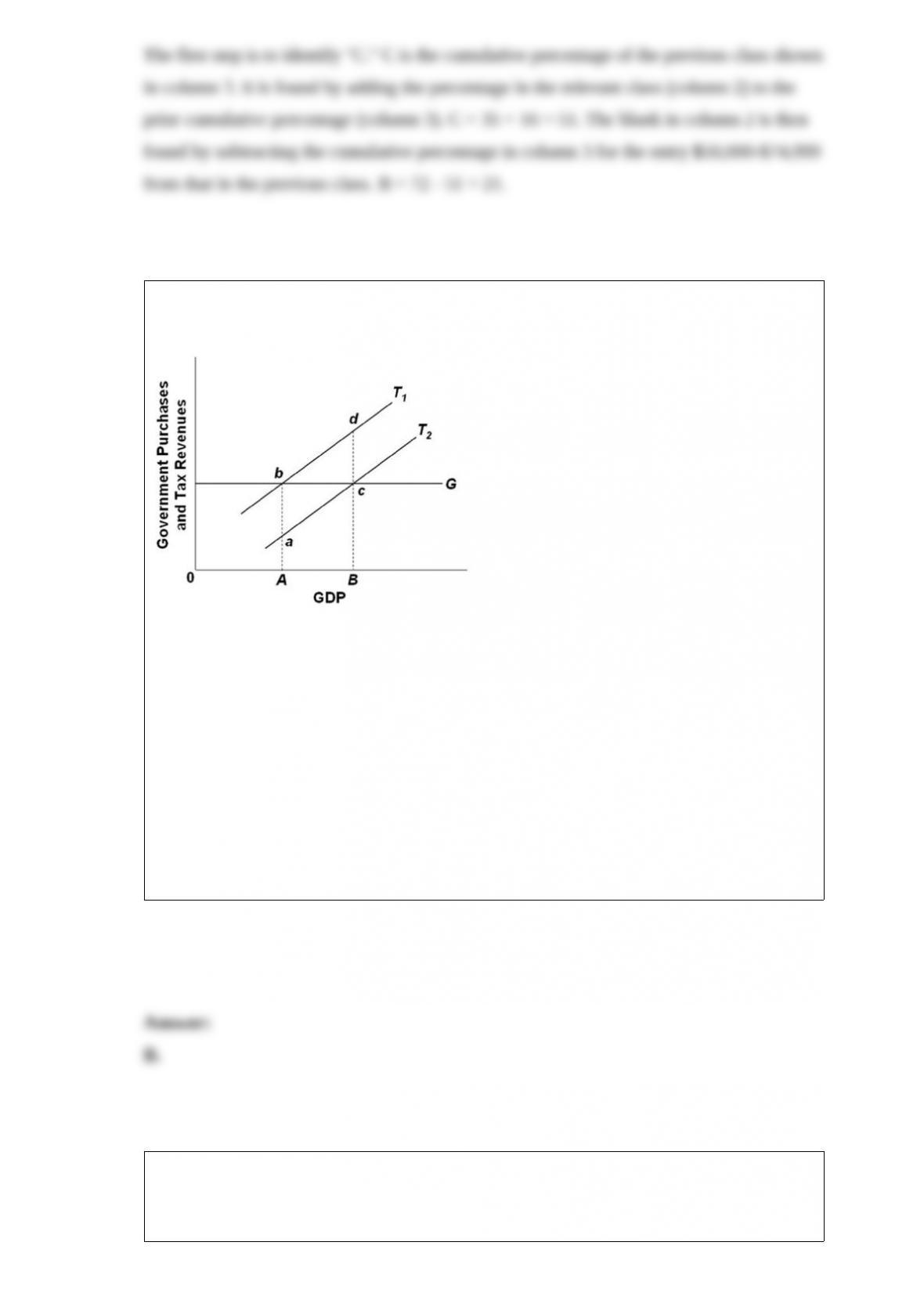
Refer to the above diagram. Discretionary fiscal policy designed to slow the economy is
illustrated by:
A. the shift of curve T1 to T2.
B. the shift of curve T2 to T1.
C. a movement from a to c along curve T2.
D. a movement from d to b along curve T1.
One shortcoming of the kinked-demand curve model of oligopoly is it does not explain:
A. why the marginal revenue curve is kinked.

B. how the going price gets determined in the first place.
C. what the equilibrium level of profits is for the firm.
D. why the firm is a least-cost producer.
A major prediction of the kinked-demand curve model is:
A. price stability in oligopolies.
B. price instability in oligopolies.
C. stability of production costs in oligopolies.
D. stable purchasing behavior by consumers over time.
Markets in which firms sell their output of goods and services are called:
A. resource markets.
B. product markets.
C. command markets.
D. mixed markets.

Which of the following best describes the idea of a political business cycle?
A. Politicians are more willing to cut taxes and increase government spending than they
are to do the reverse.
B. Fiscal policy will result in alternating budget deficits and surpluses.
C. Politicians will use fiscal policy to cause output, real incomes, and employment to be
rising prior to elections.
D. Despite good intentions, various timing lags will cause fiscal policy to reinforce the
business cycle.
The time that elapses between the beginning of a recession or an inflationary episode
and the identification of the macroeconomic problem is referred to as a(n):
A. budget lag.
B. recognition lag.
C. operational lag.
D. administrative lag.

If the U.S. dollar depreciates in value relative to foreign currencies, then this will:
A. increase aggregate demand.
B. decrease aggregate demand.
C. cause a movement along the aggregate demand curve.
D. cause a movement along the aggregate supply curve.
An effective price ceiling will:
A. induce new firms to enter the industry.
B. result in a product surplus.
C. result in a product shortage.
D. clear the market.
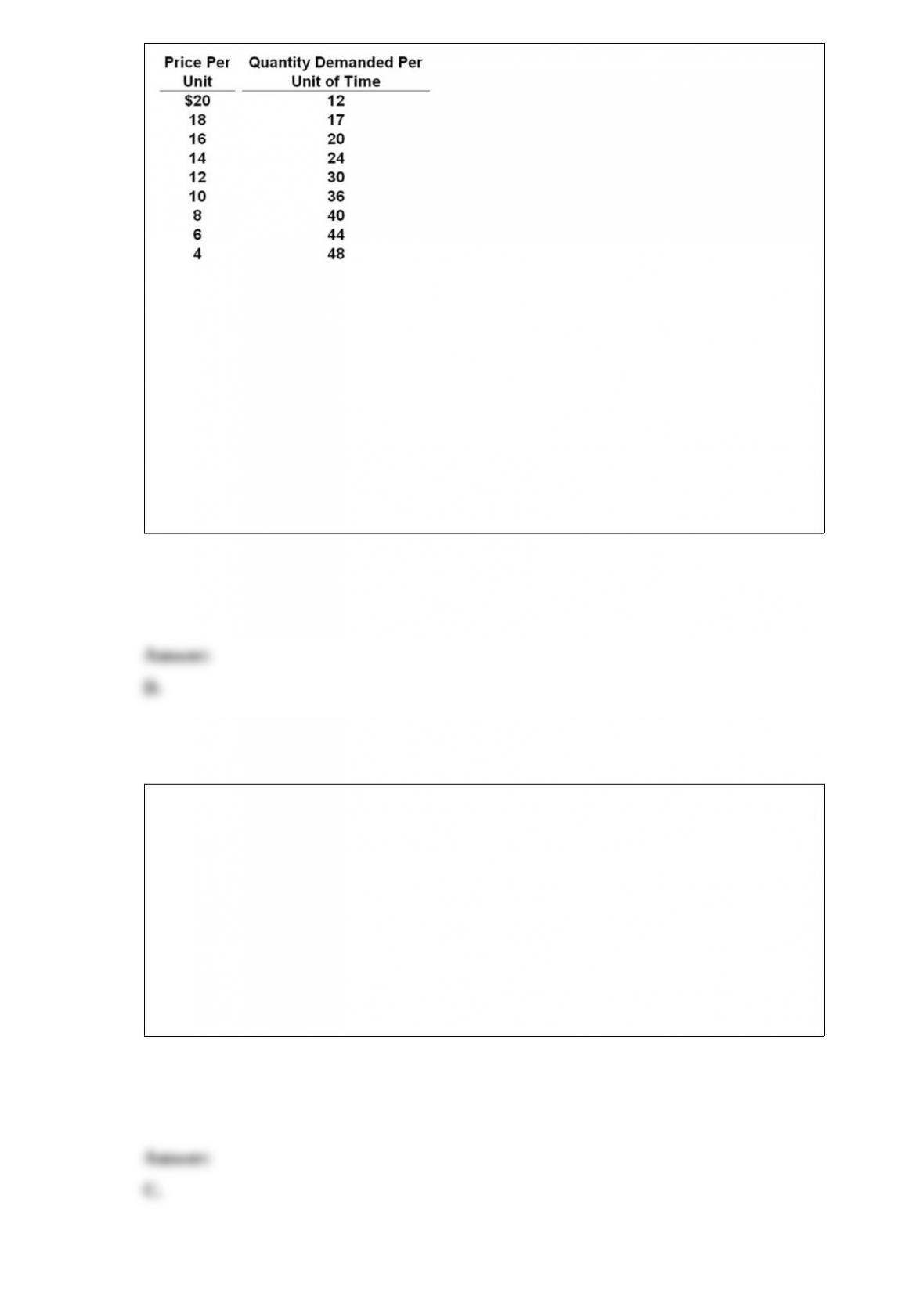
Refer to the above data. Over which price range is the price elasticity of demand
inelastic?
A. $20-$18
B. $18-$16
C. $12-$10
D. $10-$8
GDP tends to underestimate the productive activity in the economy because it excludes
the value of output from:
A. public transfer payments to households.
B. the consumption of fixed capital.
C. the underground economy.
D. intermediate goods.

Money spent on the purchase of a new house is included in the GDP as a part of:
A. the consumption of private fixed capital.
B. personal consumption expenditures.
C. personal saving.
D. investment.
If marginal costs decrease, a typical monopolist will:
A. reduce price and reduce quantity of output.
B. reduce price and increase quantity of output.
C. increase price and reduce quantity of output.
D. increase price and increase quantity of output.
An organization that provides a public good is:
A.the United Parcel Service.
B.Federal Express.
C.DHL Overnight.
D.the U.S. Post Office.

In an economy, the value of inventories rose from $100 billion in 2008 to $150 billion
in 2009. In calculating total investment for 2009 compared to 2008, national income
accountants would:
A. decrease it by $50 billion.
B. increase it by $50 billion.
C. decrease it by $100 billion.
D. increase it by $150 billion.
A nondiscriminating pure monopolist’s demand curve:
A. is perfectly inelastic.
B. coincides with its marginal revenue curve.
C. lies above its marginal revenue curve.
D. lies below its marginal revenue curve.

Inflation is a:
A. sustained decline in the general level of prices.
B. sustained rise in the general level of prices.
C. one-time change in the general level of prices.
D. movement of the economy toward full employment.
Economic growth may be represented by a:
A. rightward shift of the production possibilities curve.
B. leftward shift of the production possibilities curve.
C. production possibilities curve that remains fixed.
D. point outside (to the right) of the production possibilities curve.
When national income in other nations decreases, aggregate:
A. demand increases.
B. demand decreases.
C. supply increases.
D. supply decreases.
T-Shirt Enterprises is selling in a purely competitive market. Its output is 300 units,
which sell for $1 each. At this level of output, marginal cost is $1 and average variable
cost is $1.50. The firm should:
A. produce zero units of output.
B. decrease output to 250 units.
C. continue to produce 300 units.
D. increase output to 350 units.
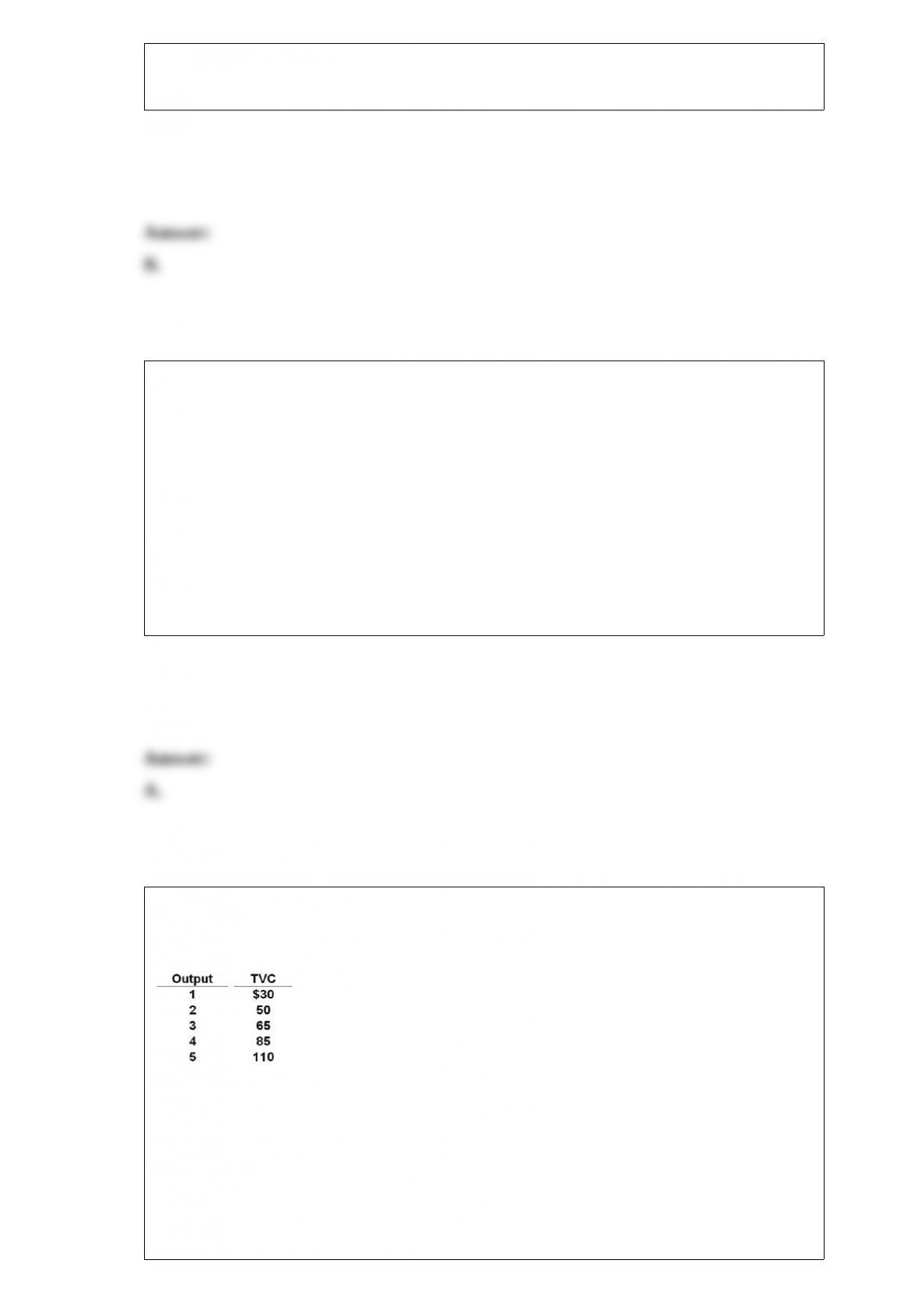
The Sunshine Corporation finds its costs are $40 when it produces no output. Its total
variable costs (TVC) change with output as shown in the accompanying table. Use this
information to answer the following question.
Refer to the above information. The total cost of producing 3 units of output is:
A. $65.
B. $105.
C. $145.
D. $185.
If the Consumer Price Index was 115 in one year and 120 in the next year, then the rate
of inflation from one year to the next was:
A. 4.3 percent.
B. 5.1 percent.
C. 6.3 percent.
D. 6.8 percent.
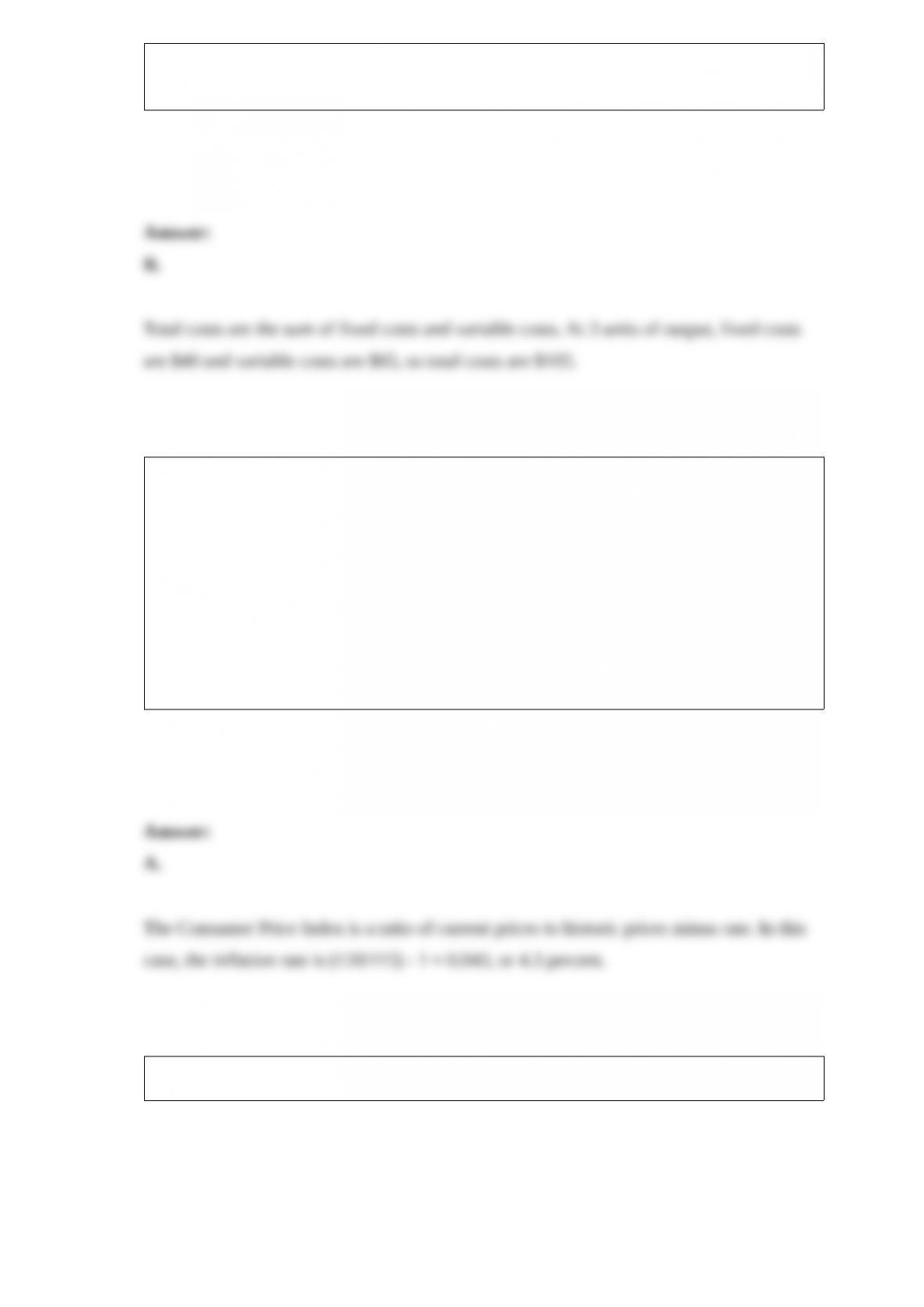
Refer to the above graph. Consider a monopolist in short-run equilibrium. This
monopolist:
A. has total fixed costs equal to area BEFC.
B. has total variable costs equal to area 0CFQ.
C. earns economic profit equal to area ABED.
D. will cease production since its economic profits are negative.
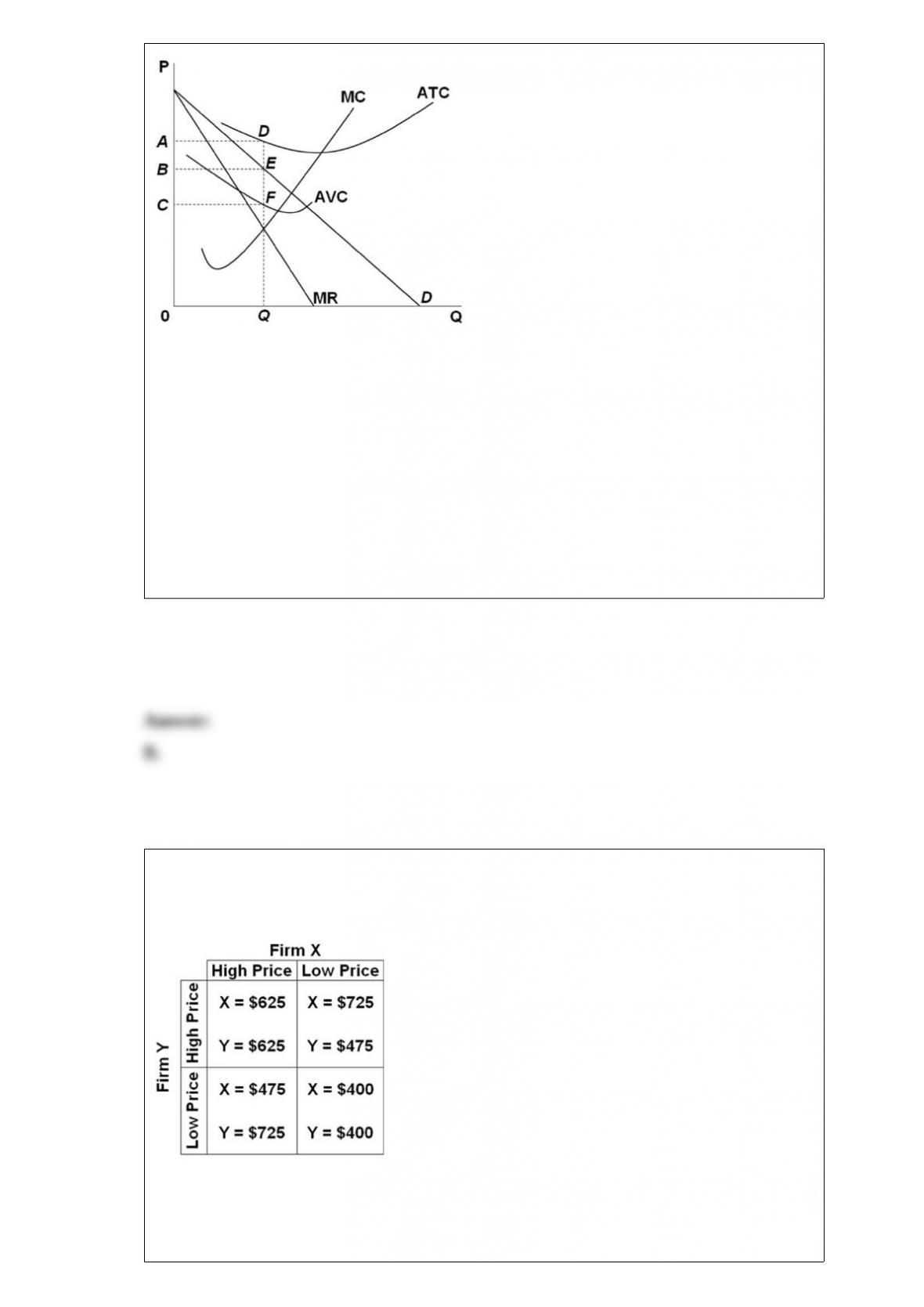
Answer the next question based on the following payoff matrix for a duopoly. The
numbers indicate the profit in thousands of dollars for a high-price or a low-price
strategy
Refer to the above payoff matrix. If both firms operate independently and do not
collude, the most likely profit is:

A. $400,000 for firm X and $400,000 for firm Y.
B. $725,000 for firm X and $475,000 for firm Y.
C. $475,000 for firm X and $725,000 for firm Y.
D. $625,000 for firm X and $625,000 for firm Y.
If a monopolist engages in price discrimination, it will:
A. realize a smaller profit.
B. charge a higher price where individual demand is inelastic and a lower price where
individual demand is elastic.
C. produce a smaller output than when it did not discriminate.
D. charge a competitive price to all its customers.
The labor market for teachers in a small, isolated community that has one school district
would be best described as a(n):
A. natural monopoly.
B. bilateral monopoly.
C. monopsony.
D. oligopsony.