
Which factors contributed to a further reduction in the money supply in addition to the
withdrawal of currency from banks during the 1930-1933 bank panic?
A. Bank purchases of government bonds to meet liquidity demands.
B. Bank sales of government bonds to meet liquidity demands.
C. An increase in the required reserve ratio.
D. A decrease in the required reserve ratio.
Which factor has most affected productivity growth since 1929?
A. Quantity of capital.
B. Education and training.
C. Economies of scale.
D. Improved resource allocation.
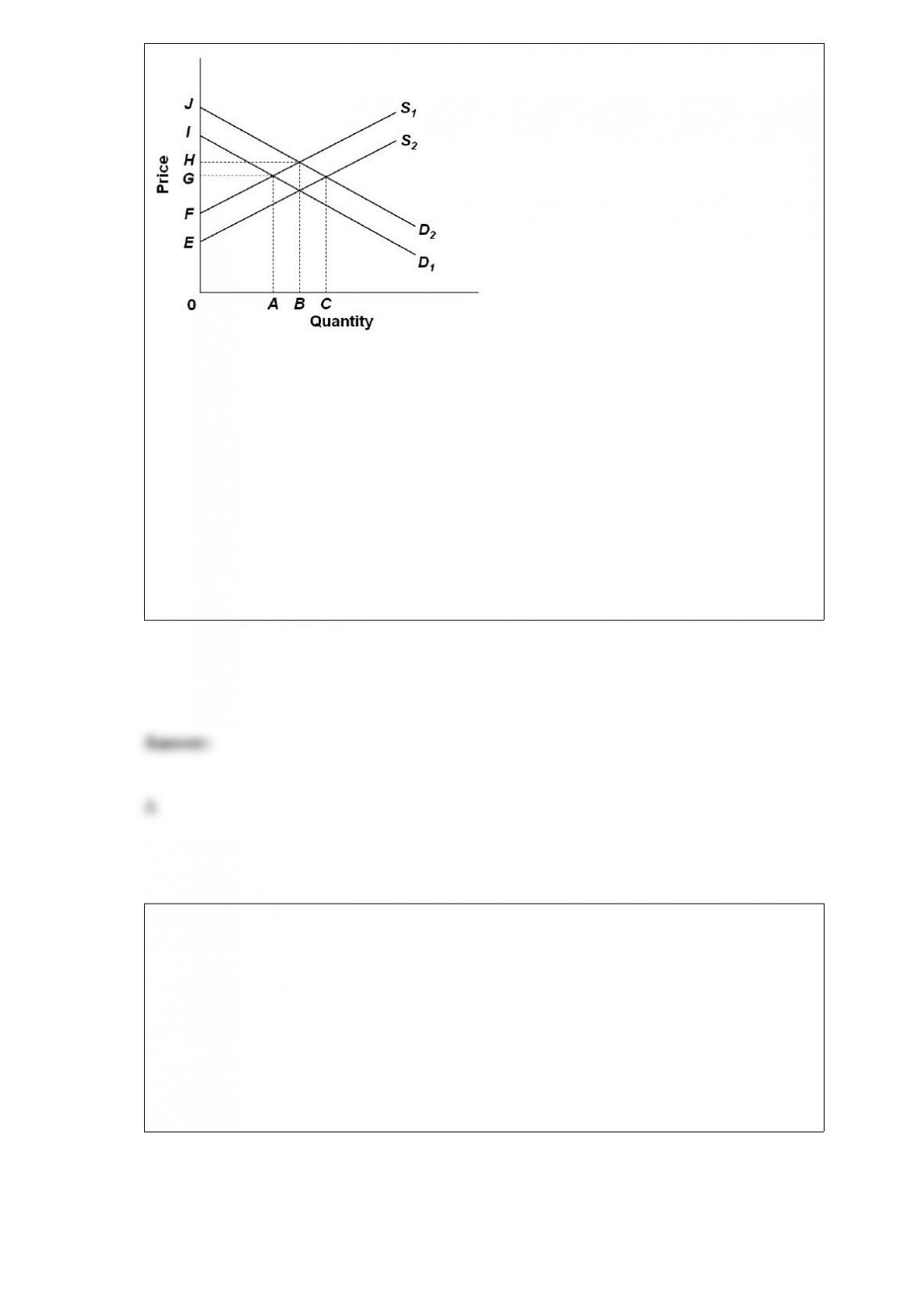
Refer to the above supply and demand graph. Point A represents the current equilibrium
level of output of this product and point B represents the optimal level of output from
society’s perspective. This supply and demand graph indicates that there is (are):
A.spillover benefits to the production of this product.
B.spillover costs to the production of this product.
C.an overallocation of resources to the production of this product.
D.a negative externality from the production of this product.
Which will cause a demand curve to be relatively elastic?
A. Few substitutes exist.
B. The time interval considered is long.
C. The good is considered a necessity.
D. Purchases of the good require a small portion of consumers’ budgets.

GDP excludes expenditures by:
A. businesses on pollution control equipment.
B. business for travel and entertainment.
C. government on military hardware.
D. consumers on used automobiles.
The percentage of the population living in poverty during the 1959 to 1969 period:
A. decreased.
B. increased.
C. remained relatively constant.
D. both increased and decreased.
The production possibilities curve represents which of the following?
A. The amount of goods attainable with variable resources
B. The maximum amount of goods attainable with variable resources
C. The maximum combinations of goods attainable with fixed resources
D. The amount of goods attainable if prices decline
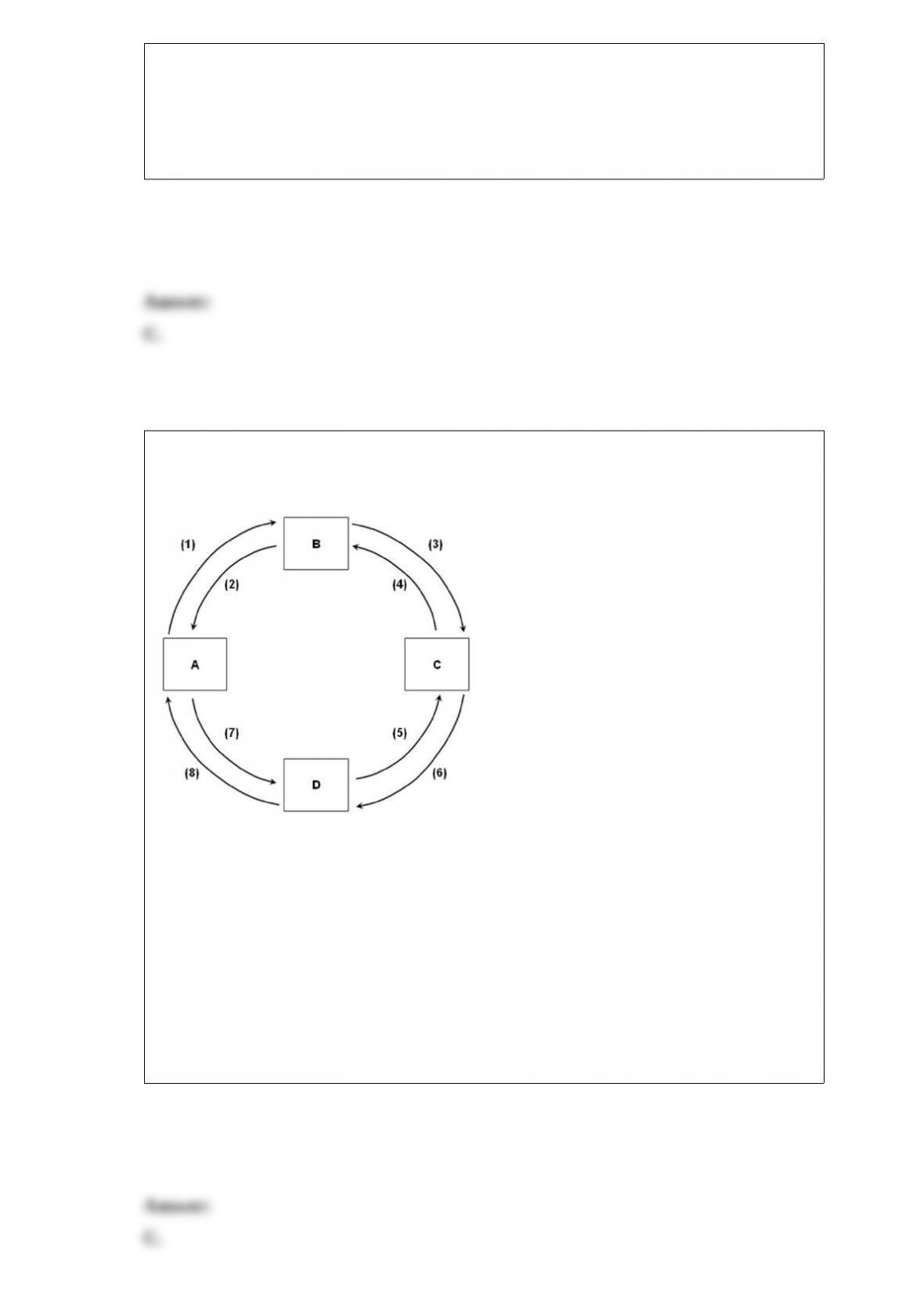
Refer to the above figure. If box B represents the resource market and flow (3)
represents money income, then:
A. box A is the product market and box C is households.
B. box C is the product market and box A is households.
C. box D is the product market and box C is households.
D. box C is the product market and box D is households.
The branch of economics that focuses primarily on aggregates is:
A. macroeconomics.
B. microeconomics.
C. scientific economics.
D. consumer economics.
In an economy it costs $1500 to produce 2000 units of output. If the costs increase to
$2500, then the per-unit cost of production will have increased from:
A. $0.75 to $1.25.
B. $0.75 to $1.00.
C. $1.33 to $1.75.
D. $0.80 to $1.33.
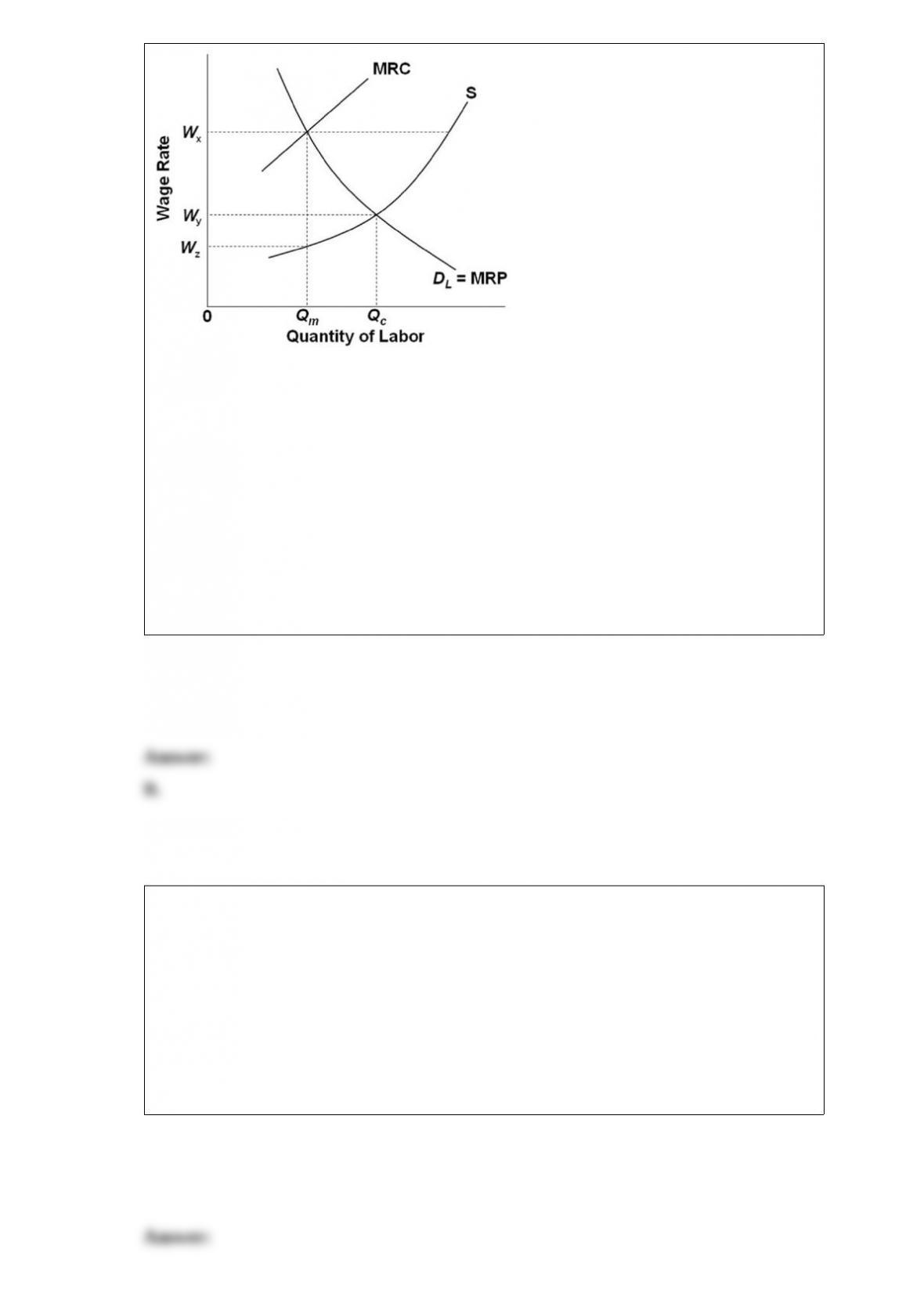
Refer to the above graph. An inclusive union or an industrial union will set the wage
rate at:
A. Wy.
B. Wx.
C. Wz.
D. Cannot be determined.
Economic theory predicts a monopolist will discontinue production in the short run if:
A. price is less than average total cost.
B. price is less than average variable cost.
C. marginal revenue is less than average total cost.
D. marginal revenue is less than average variable cost.

A cartel is formed among the major firms in an industry that maximizes joint profits of
the firms. Each firm:
A. will operate at the level of output associated with the kink in the demand curve.
B. will be protected from the economic effects of a recession.
C. has a perfectly elastic demand for its product.
D. has the incentive to cheat by cutting its price.
Aggregate demand decreases and real output falls but the price level remains the same.
Which factor would most likely contribute to downward price inflexibility?
A. Menu costs.
B. Lower interest rates.
C. The real-balances effect.
D. An increase in aggregate supply.
Which of the following is the best example of market failure?
A.Lucian wants more video games but doesn”t buy them because his willingness to pay
is less than the equilibrium price in the market.
B.Kara’s Kitten Shop won”t sell more purebred cats because the equilibrium price in the
market is less than it would cost her to provide more.
C.Alex and others in a community want a new outdoor soccer field and are willing to
pay to use it, but no private business is willing to build it.
D.Government fixes the price of gasoline, resulting in a shortage.
An oligopolistic firm finds that marginal revenue can range from $10 to $25 at an
output level of 2500 units. This information would suggest that the oligopolistic model
for this industry is most likely one of:
A. collusive pricing.
B. price leadership.
C. cost-plus pricing.
D. kinked demand.
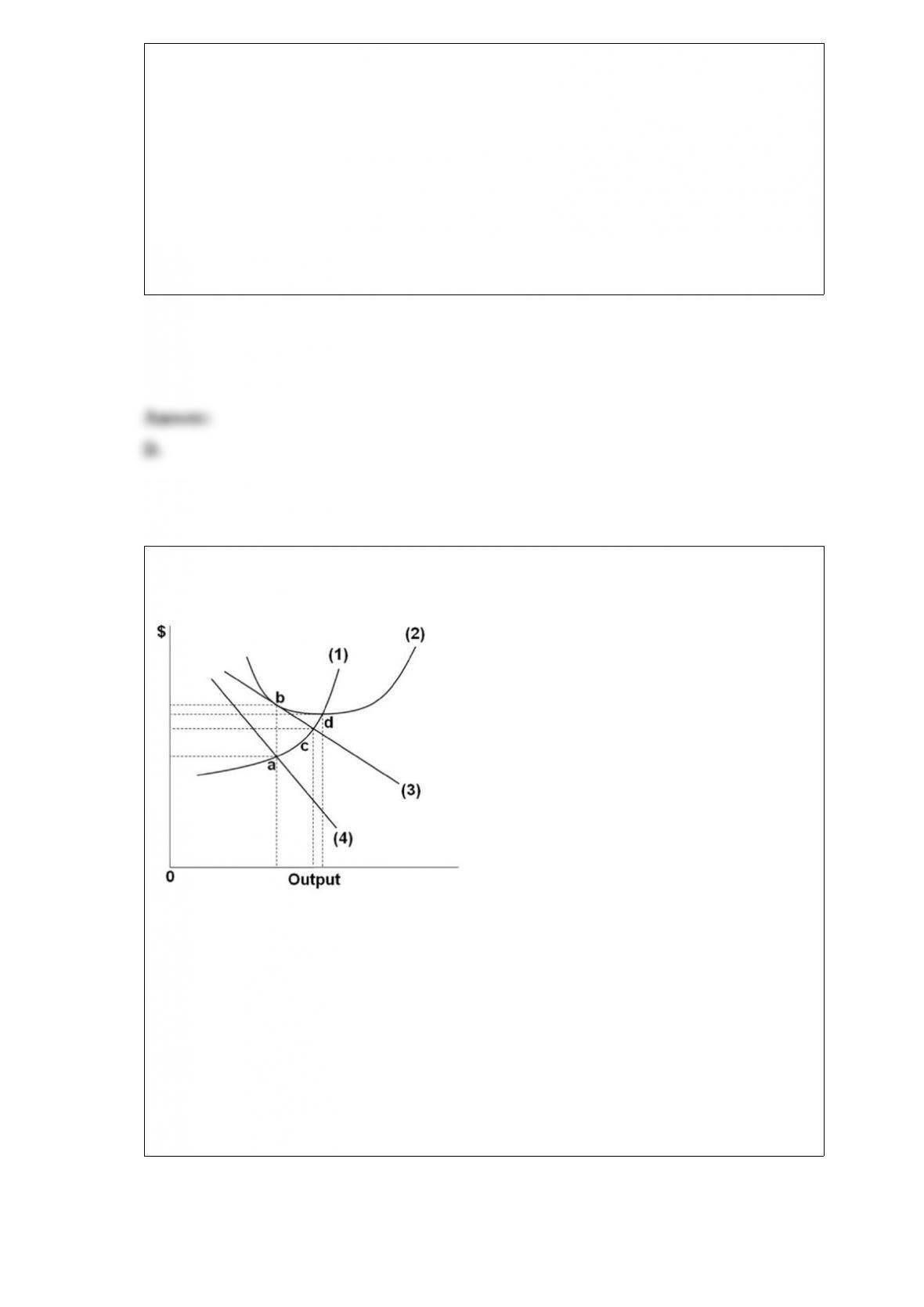
Refer to the table above. Which product is most responsive to a change in income?
A. Product W
B. Product X
C. Product Y
D. Product Z
Refer to the above graph of the representative firm in monopolistic competition.
Marginal revenue and marginal cost intersect at point:
A. a.
B. b.
C. c.
D. d.

Marginal cost is the:
A. rate of change in total fixed cost that results from producing one more unit of output.
B. change in total cost that results from producing one more unit of output.
C. change in average variable cost that results from producing one more unit of output.
D. change in average total cost that results from producing one more unit of output.
A worker would be hurt least by inflation when the:
A. worker anticipates inflation and increases savings at the bank.
B. worker is protected by a cost-of-living adjustment clause in an employment contract.
C. worker is protected by fixed annual increases in wages and benefits in an
employment contract.
D. government increases the level of social security retirement benefits to correct for
the effects of anticipated inflation.
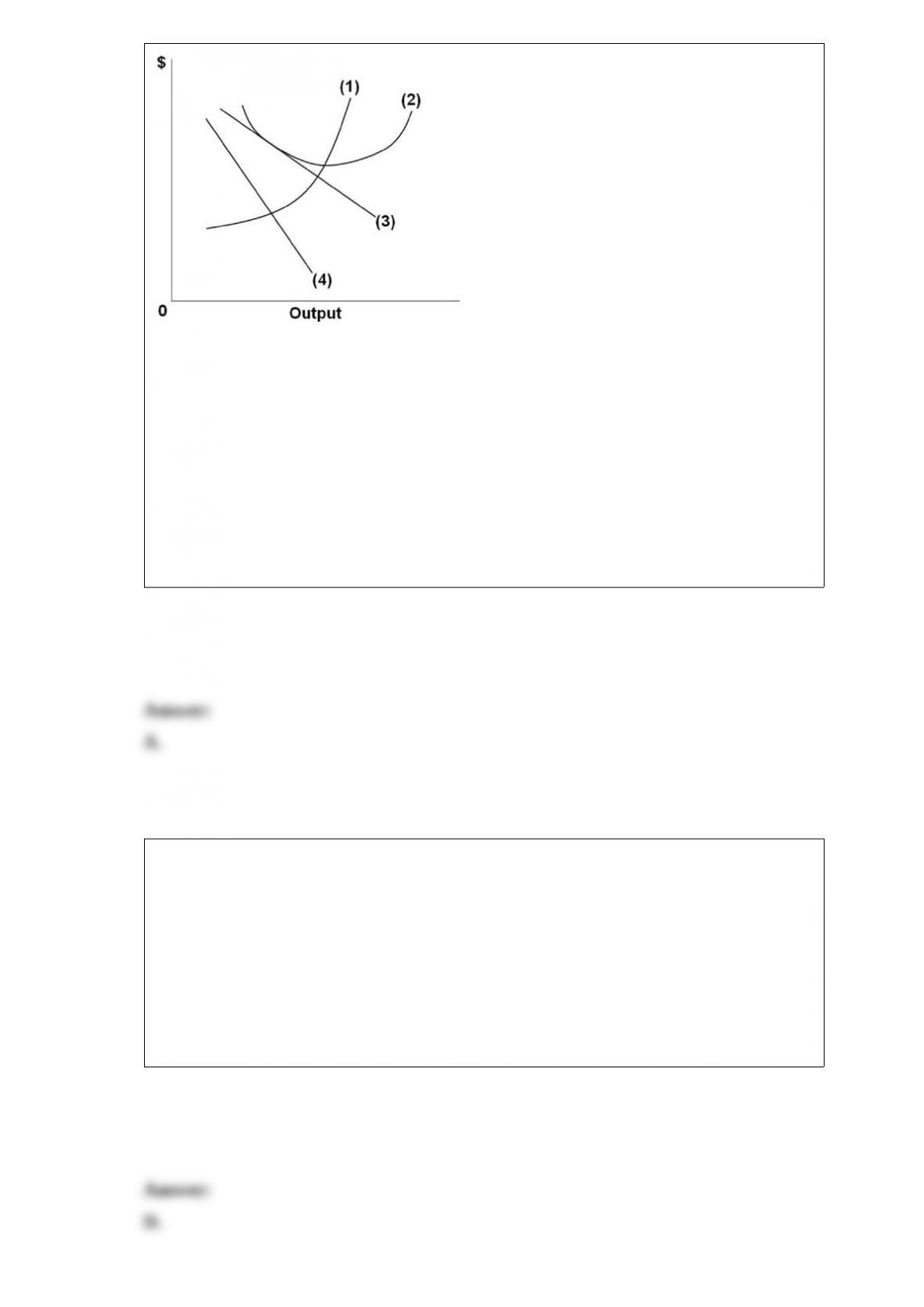
Refer to the above graph of a representative firm in monopolistic competition. What
does line 3 represent?
A. Demand
B. Marginal cost
C. Marginal revenue
D. Average total cost
If output is set at the kink of the kinked-demand model, then there:
A. is a strong incentive for rivals to decrease prices.
B. is a strong incentive for rivals to increase prices.
C. is one price at which marginal revenue equals marginal cost.
D. are several prices at which marginal revenue equals marginal cost.

The TANF program:
A. is a form of social insurance.
B. has been found to be unconstitutional by the Supreme Court.
C. limits total lifetime welfare benefits to five years and requires people to work after
receiving benefits for two years.
D. perpetuates the so-called culture of poverty.
A nation has a population of 300 million people. Of these, 80 million are retired, in the
military, in institutions, or under 16 years old. There are 210 million who are employed
and 10 million who are unemployed. What is the unemployment rate?
A. 3.3 percent
B. 3.6 percent
C. 4.3 percent
D. 5.2 percent

Which one of the following is true about the U.S. Federal Reserve System?
A. There are 10 regional Federal Reserve Banks.
B. The head of the U.S. Treasury also chairs the Federal Reserve Board.
C. There are seven members of the Federal Reserve Board of Governors.
D. The Federal Open Market Committee is smaller in size than the Federal Reserve
Board.
Suppose a commercial banking system has $100,000 of outstanding checkable deposits
and actual reserves of $35,000. If the reserve ratio is 20 percent, the banking system can
expand the supply of money by the maximum amount of:
A. $122,000.
B. $175,000.
C. $300,000.
D. $75,000.

One major advantage of limited liability is that it:
A. is not subject to a free-rider problem.
B. is not subject to a principal-agent problem.
C. has unlimited profit sharing among the firm’s owners.
D. shields the personal assets of owners from liability claims.
All coins in circulation within the United States are:
A. near monies.
B. checkable deposits.
C. token money.
D. time deposits.
Airlines charge business travelers more than leisure travelers because there is a more:
A. elastic supply of business travel.
B. inelastic supply of business travel.
C. elastic demand for business travel.
D. inelastic demand for business travel.

Average revenue is:
A. total revenue minus total cost.
B. marginal revenue minus marginal cost.
C. marginal revenue divided by the quantity of output.
D. total revenue divided by the quantity of output.
Economic cost can best be defined as:
A. any contractual obligation that results in a flow of money expenditures from an
enterprise to resource suppliers.
B. any contractual obligation to labor or material suppliers.
C. compensations that must be received by resource owners to ensure their continued
supply.
D. all costs exclusive of payments to fixed factors of production.

In an economy, the value of inventories fell from $75 billion in 2008 to $63 billion in
2009. In calculating total investment for 2009 compared to 2008, national income
accountants would:
A. decrease it by $75 billion.
B. increase it by $63 billion.
C. decrease it by $12 billion.
D. increase it by $138 billion.
In which instances will total revenues decline?
A. Price rises and Ed equals 0.41.
B. Price rises and demand is of unit elasticity.
C. Price falls and demand is elastic.
D. Price rises and Ed equals 2.47.
The kinked demand model of noncollusive oligopoly assumes that:
A. rivals will ignore price increases and match price cuts.
B. each firm is a least-cost producer of the product.
C. marginal revenue is greater than marginal cost at the kink.

D. demand is elastic throughout the range of production.