The downward-sloping demand curve of a monopolistic competitor:
A. reflects product differentiation.
B. becomes horizontal in the long run.
C. indicates collusion among the members of the product group.
D. ensures that the firm will produce at minimum average cost in the long run.
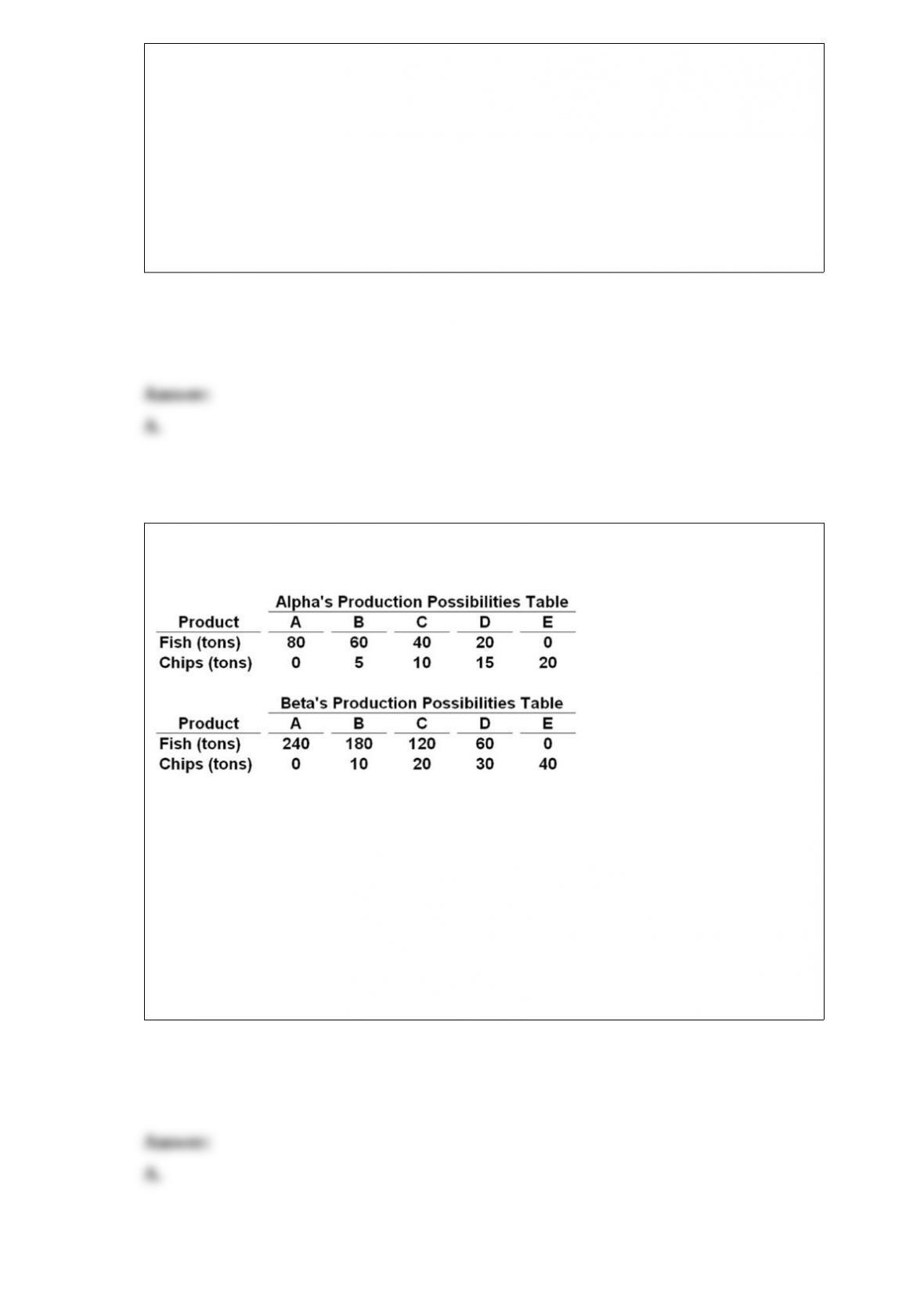
Answer the next question on the basis of the following production possibilities data for
two countries, Alpha and Beta, which have populations of equal size.
Beta:
A. should specialize in catching fish and trade with Alpha for chips.
B. should specialize in producing chips and trade with Alpha for fish.
C. will not realize gains from specialization and trade.
D. will export both fish and chips to Alpha.

An economist who favors smaller government would recommend:
A. tax cuts during recession and reductions in government spending during inflation.
B. tax increases during recession and tax cuts during inflation.
C. tax cuts during recession and tax increases during inflation.
D. increases in government spending during recession and tax increases during
inflation.
In the long run, profits for a monopolistic competitor will be:
A. the same as the profits for a monopolist.
B. slightly less than the profits of a monopolist.
C. the same as the profits for a purely competitive firm.
D. slightly more than the profits of a purely competitive firm.
A demand curve:

A. shows the relationship between price and quantity supplied.
B. indicates the quantity demanded at each price in a series of prices.
C. graphs as an upsloping line.
D. shows the relationship between income and spending.
The expenditures or output approach to GDP measures it by summing:
A. compensation of employees, rents, interest, dividends, undistributed corporate
profits, proprietors’ income, indirect business taxes paid, consumption of fixed capital,
and net foreign factor income earned in the United States.
B. compensation of employees, rents, interest, dividends, corporate profits, proprietors’
income, and indirect business taxes, and subtracting the consumption of fixed capital.
C. the total spending for consumption, investment, net exports, and government
purchases.
D. the total spending for consumption and government purchases, but subtracting public
and private transfer payments.
There is general agreement among economists that a proposed fiscal policy should be
evaluated for its:
A. contribution to the purpose of “fine-tuning” the economy.
B. contribution to the growth of exports and imports in the economy.

C. potential positive and negative effects on long-run productivity growth.
D. potential positive and negative effects on short-run business indebtedness.
In an economy, the price level has doubled in about 70 years. The approximate annual
percentage rate of increase in the price level over this period has been:
A. 1 percent.
B. 2 percent.
C. 3 percent.
D. 4 percent.
A nation can increase its production possibilities by:
A. shifting resources from investment good production to consumer good production.
B. shifting resources from private goods to public goods.
C. improving labor productivity.
D. reducing international trade.
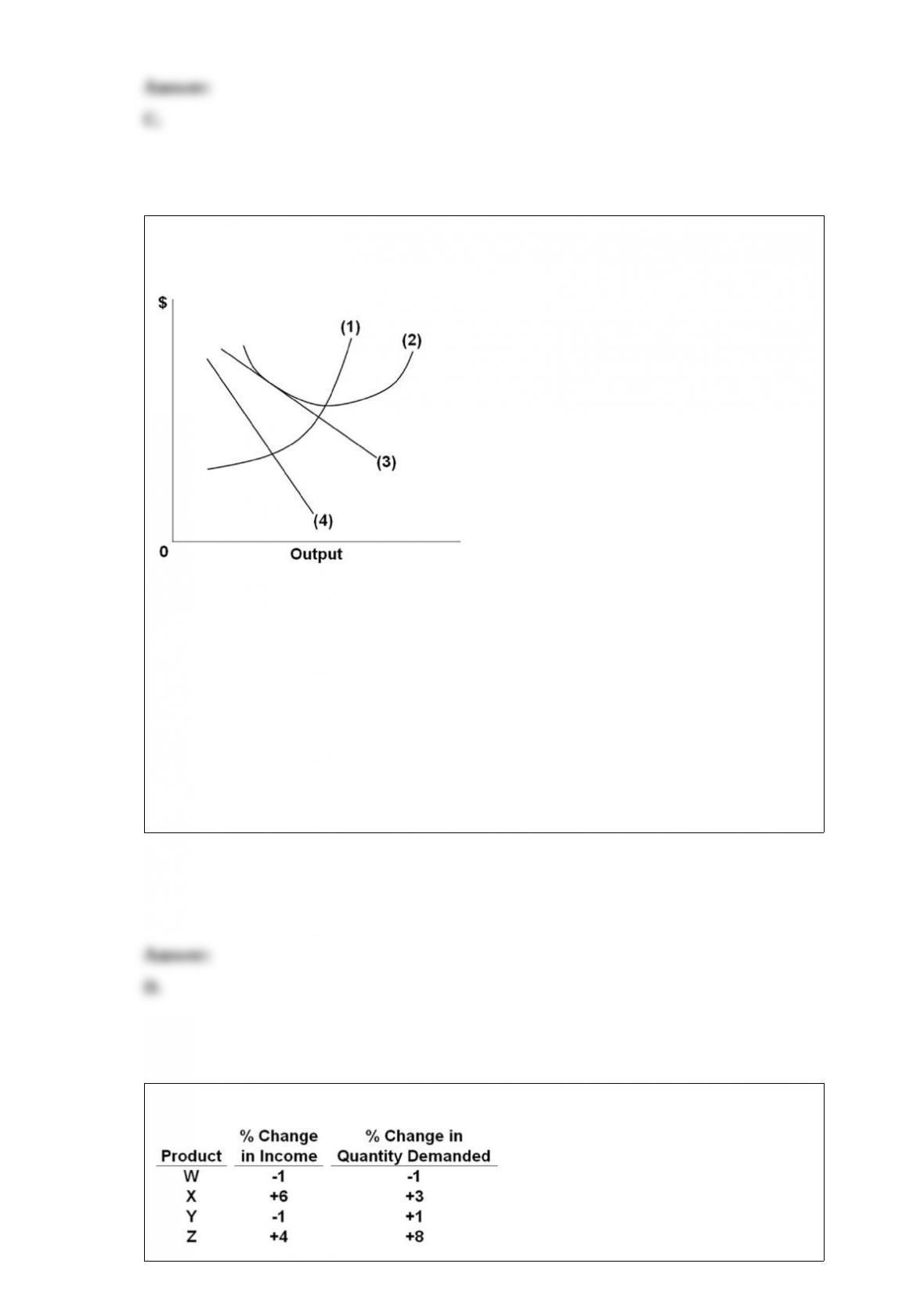
Refer to the above graph of a representative firm in monopolistic competition. What
does line 2 represent?
A. Demand
B. Marginal cost
C. Marginal revenue
D. Average total cost

Refer to the table above. Which product is an inferior good?
A. Product W
B. Product X
C. Product Y
D. Product Z
Inflationary pressure is a growing problem for the economy. Therefore, the Federal
Reserve decides to pursue a policy to reduce the inflationary pressure. Which policy
changes by the Fed would reinforce each other to achieve that objective?
A. Selling government securities and raising the discount rate.
B. Selling government securities and lowering the discount rate.
C. Buying government securities and lowering the discount rate.
D. Buying government securities and lowering the reserve ratio.
Discretionary fiscal policy is so named because it:
A. is undertaken at the option of the nation’s central bank.
B. occurs automatically as the nation’s level of GDP changes.
C. involves specific changes in T and G undertaken expressly for stabilization at the

option of Congress.
D. is invoked secretly by the Council of Economic Advisers.
Assume that a consumer purchases two products and the consumer’s money income
increases. All other things equal, the most likely effect is:
A. an outward shift in the production possibilities curve because the consumer can now
satisfy more wants.
B. an inward shift in the budget line because the consumer can now purchase less of
both products.
C. an outward shift in the budget line because the consumer can now purchase more of
both products.
D. no change in the consumer’s buying pattern.
The federal gasoline tax is assessed on a per-gallon basis and the proceeds are used for
highway maintenance and improvements. This tax is consistent with the:
A. ability-to-pay principle of taxation.
B. benefits-received principle of taxation.
C. single-tax theory of taxation.
D. pay-as-you go (“Paygo”) theory of taxation.
How is the public debt calculated?
A. By adding up consumption, investment, government purchases, and net exports and
then cumulating the annual totals over the years of the nation
B. By subtracting consumption and investment from government spending each year
and then cumulating the annual totals over the years of the nation
C. By subtracting current government spending from current government tax revenues
D. By computing the difference between annual government tax revenues and annual
government spending and cumulating the differences over the years of the nation
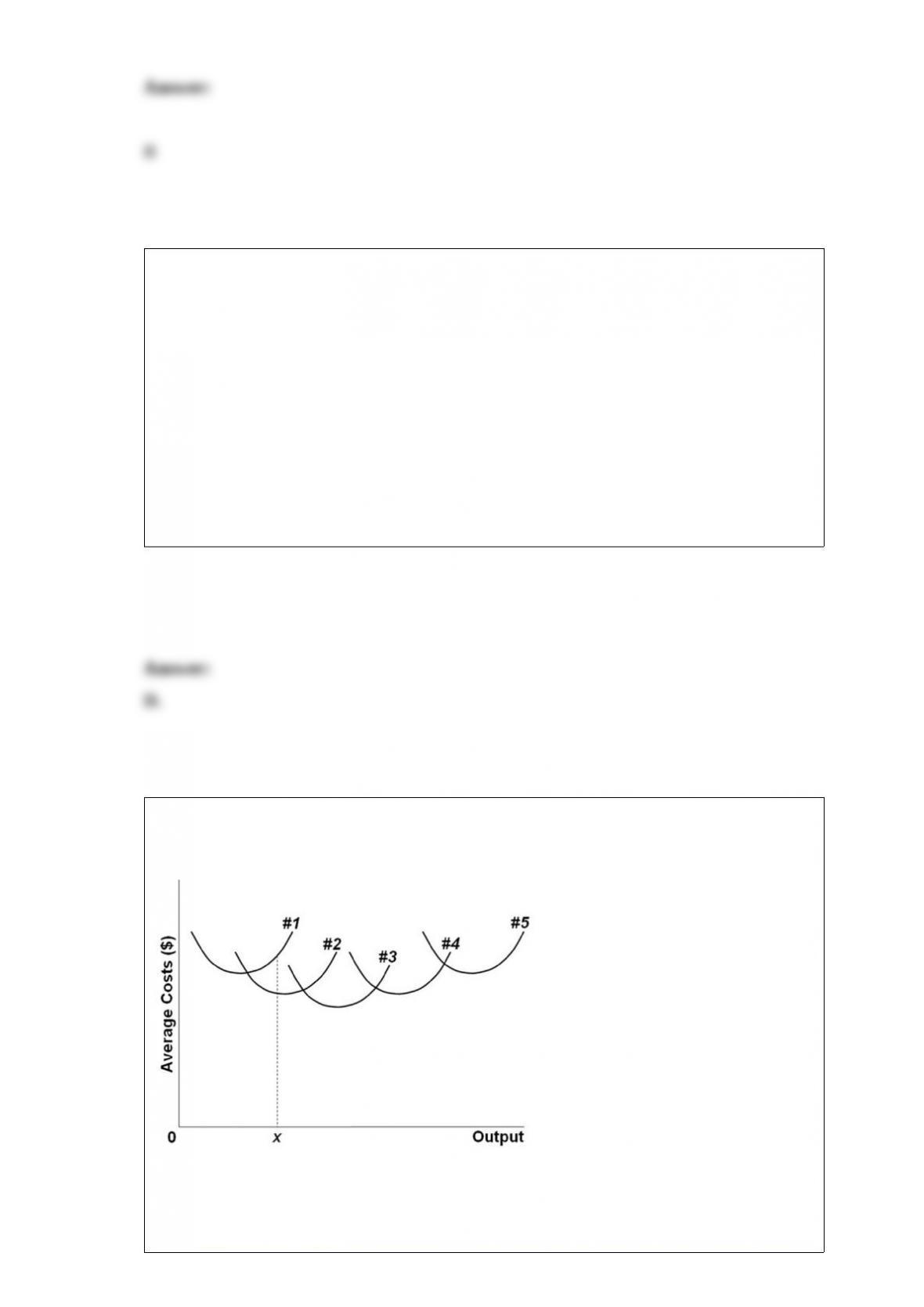
The above diagram shows the short-run average total cost curves for five different plant
sizes of a firm. The shape of each individual curve reflects:

A. increasing returns, followed by diminishing returns.
B. economies of scale, followed by diseconomies of scale.
C. constant costs.
D. increasing costs, followed by decreasing costs.
One of the potential problems with the public debt is that it may:
A. make income distribution more equitable.
B. increase the debt burden of foreign creditors.
C. lead to added taxes that reduce economic incentives.
D. decrease interest rates and increase investment spending.
Other things being equal, how would the market for personal computers be affected by
a large increase in productivity in the computer industry?
A. A decrease in price and a leftward movement along the supply curve.
B. A decrease in price and a rightward movement along the demand curve.
C. A decrease in price and a rightward movement along the supply curve.
D. An increase in price and a rightward movement along the demand curve.
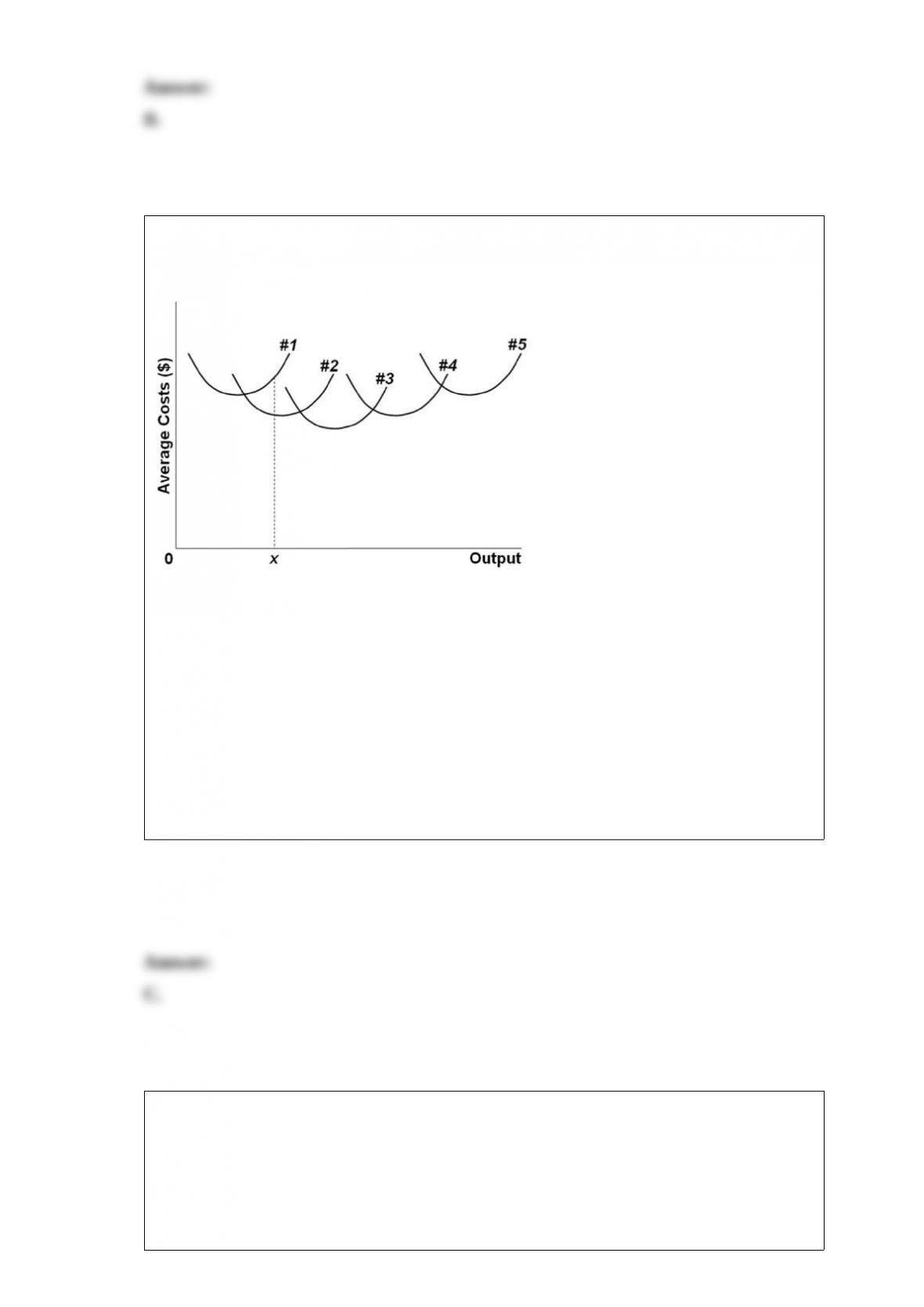
The above diagram shows the short-run average total cost curves for five different plant
sizes of a firm. In the long run the firm should produce output 0x with a plant of size:
A. #4.
B. #3.
C. #2.
D. #1.
The long-run supply curve under pure competition will be:
A. downsloping in a decreasing-cost industry and upsloping in an increasing-cost
industry.
B. horizontal in a constant-cost industry and downsloping in an increasing-cost
industry.
C. vertical in a constant-cost industry and upsloping in a decreasing-cost industry.
D. upsloping in an increasing-cost industry and vertical in a constant-cost industry.
If the price of K declines, the demand curve for the complementary product J will:
A. shift to the left.
B. shift to the right.
C. decrease.
D. remain unchanged.
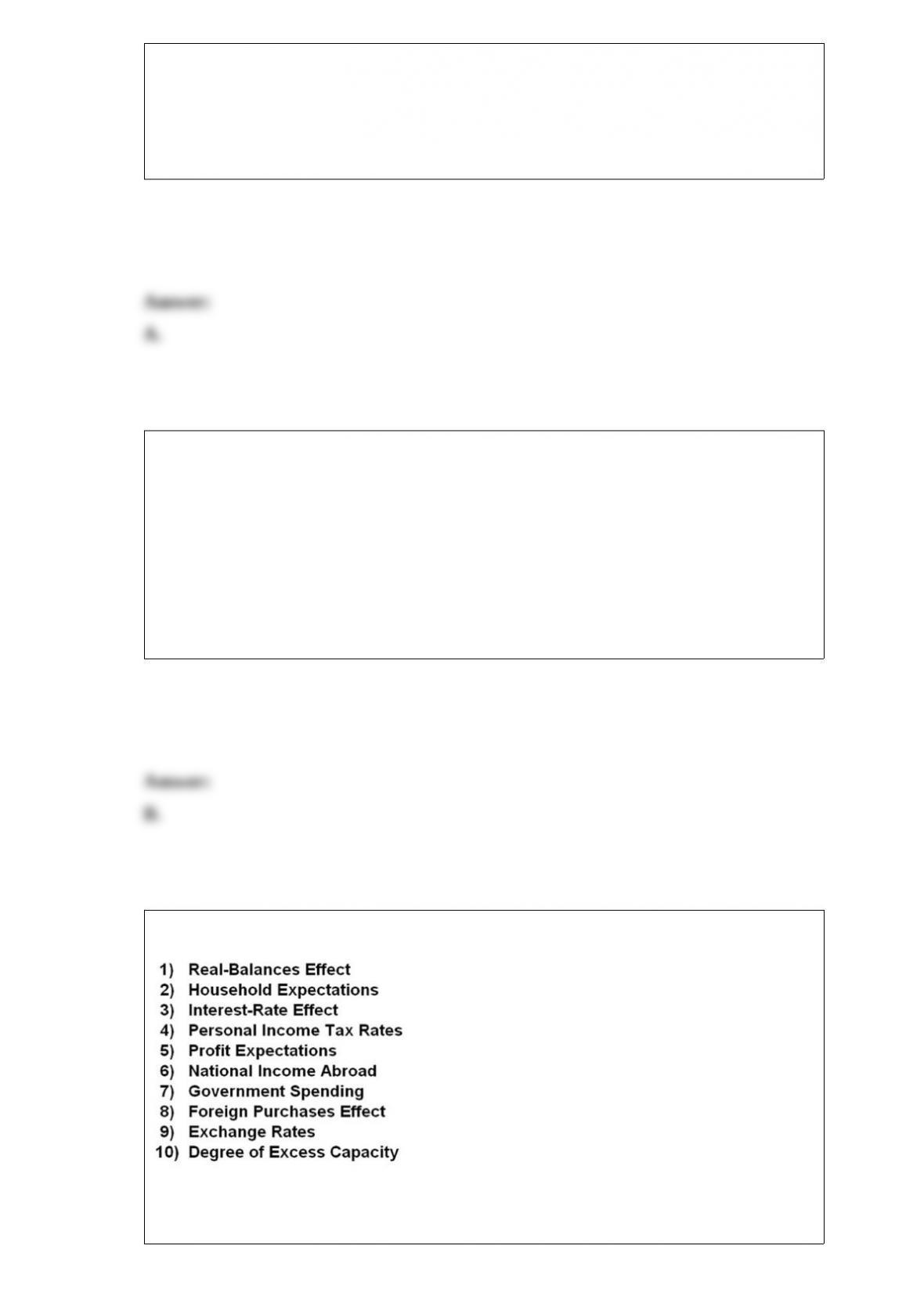
The following list contains factors that are related to the aggregate demand curve.
Changes in which two of the above factors would most likely cause a change in
consumer spending?

A. 1 and 3
B. 2 and 4
C. 5 and 10
D. 8 and 9
Ticket scalping is likely to:
A. produce a less interested audience.
B. reduce the well-being of ticket sellers.
C. reduce the well-being of ticket buyers.
D. produce a more interested audience.
One advantage of automatic fiscal policy over discretionary fiscal policy is that
automatic fiscal policy:
A. makes the actual budget a better reflection of the condition of the economy than the
standardized budget.
B. does not produce a cyclical deficit as discretionary policy does.
C. is not subject to the timing problems of discretionary policy.
D. has a greater multiplier effect than discretionary policy.

Which of the following formulas is correct? Percentage change in:
A. price level approximates percentage change in real income minus percentage change
in nominal income.
B. real income approximates percentage change in nominal income minus percentage
change in price level.
C. nominal income approximates percentage change in price level minus percentage
change in real income.
D. real income approximates percentage change in price level minus percentage change
in nominal income.
What would be an example of how pure luck contributes to income inequality?
A. Approval to receive unemployment benefits
B. Receipt of a government grant for housing
C. Selection as winner of a state lottery
D. Admission to a state university
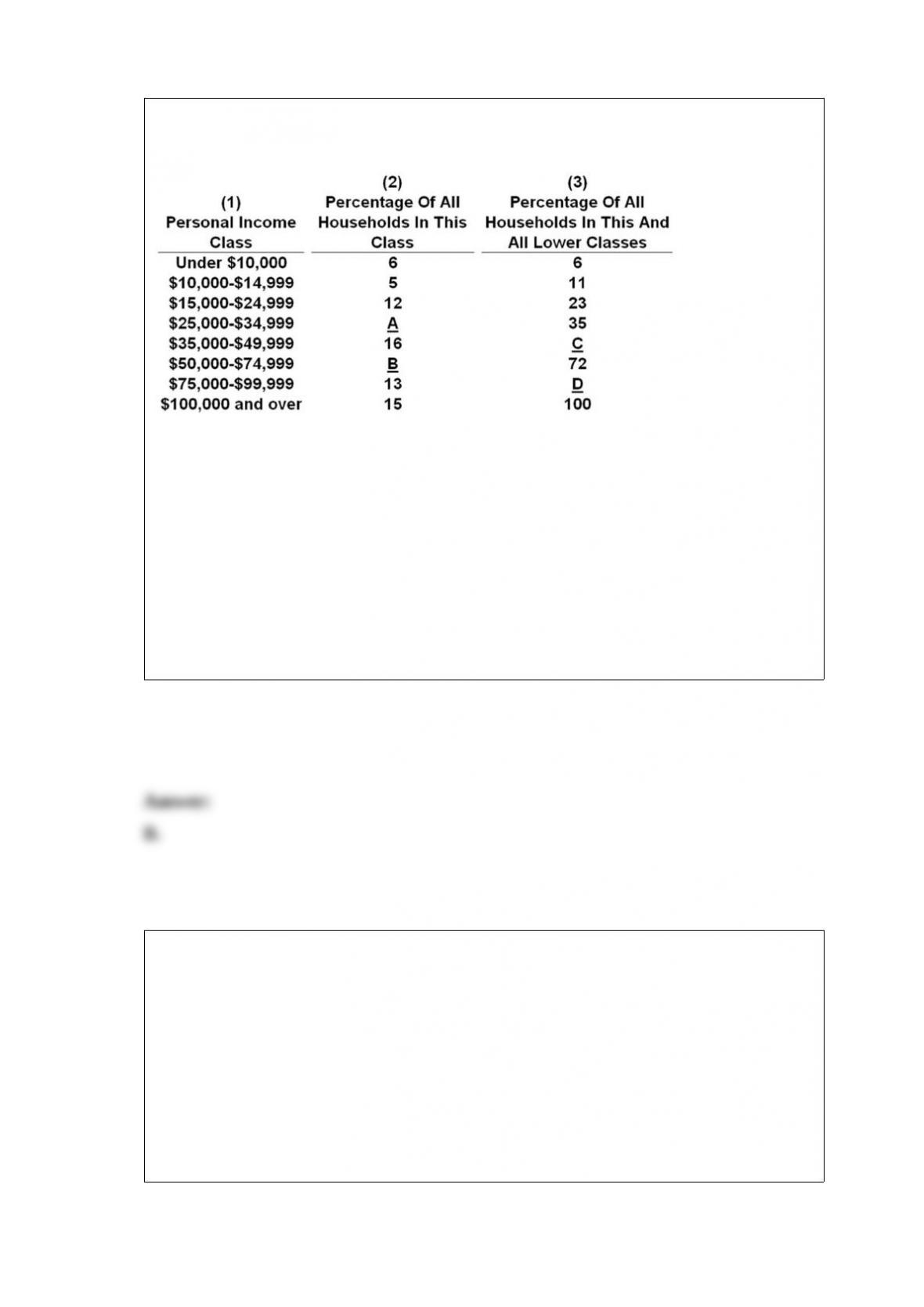
Using the data in the above table, what percentage of households made $100,000 or
more?
A. 13 percent
B. 15 percent
C. 72 percent
D. 85 percent
Which group has a direct responsibility for providing analysis, advice, and assistance to
the U.S. president on economic matters?
A. The Congressional Budget Office
B. The Council of Economic Advisors
C. The Joint Economic Committee
D. The Federal Reserve Board
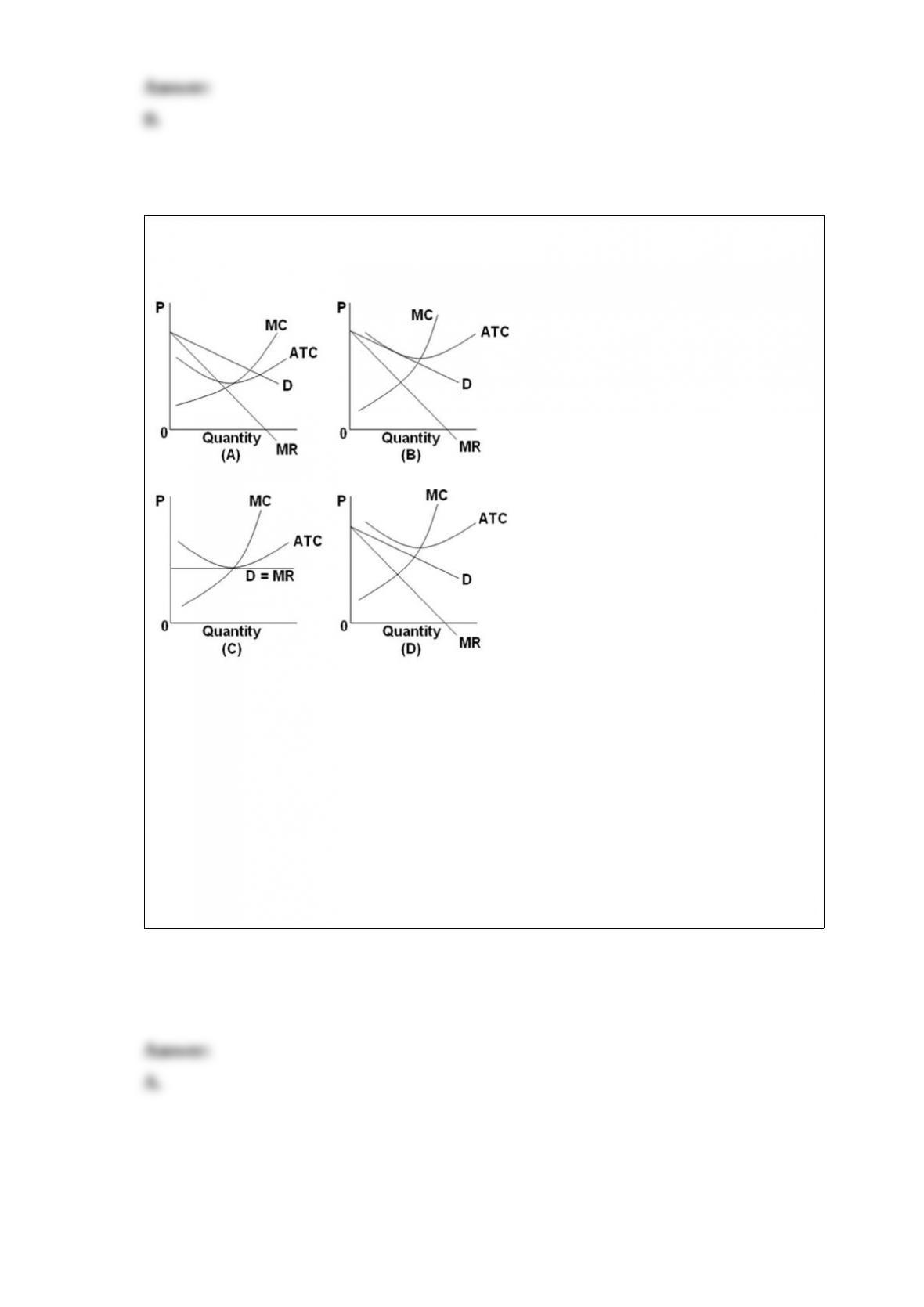
Refer to the above graphs. A short-run equilibrium that would produce profits for a
monopolistically competitive firm would be represented by graph:
A. A.
B. B.
C. C.
D. D.