
When the Federal Reserve acts to ease money and credit in the economy, then the
aggregate:
A. supply curve will shift to the right.
B. supply curve will shift to the left.
C. demand curve will shift to the right.
D. demand curve will shift to the left.
When nominal GDP is $800 billion and, on average, each dollar is spent four times in
the economy over a year, the quantity of money demanded for transactions purposes
will be:
A. $200 billion.
B. $400 billion.
C. $800 billion.
D. $3200 billion.
If average total cost is declining, then:
A. marginal cost must be greater than average total cost.

B. the average fixed cost curve must lie above the average variable cost curve.
C. marginal cost must be less than average total cost.
D. total cost must also be declining.
Suppose that a business incurred implicit costs of $200,000 and explicit costs of $1
million in a specific year. If the firm sold 4,000 units of its output at $300 per unit, its
accounting profits were:
A. $100,000 and its economic profits were zero.
B. $200,000 and its economic profits were zero.
C. $100,000 and its economic profits were $100,000.
D. zero and its economic loss was $200,000.
If an industry’s long-run average total cost curve has an extended range of constant
returns to scale, this implies that:
A. technology precludes both economies and diseconomies of scale.
B. the industry will be a natural monopoly.
C. both relatively small and relatively large firms can be viable in the industry.
D. the industry will be comprised of a very large number of small firms.
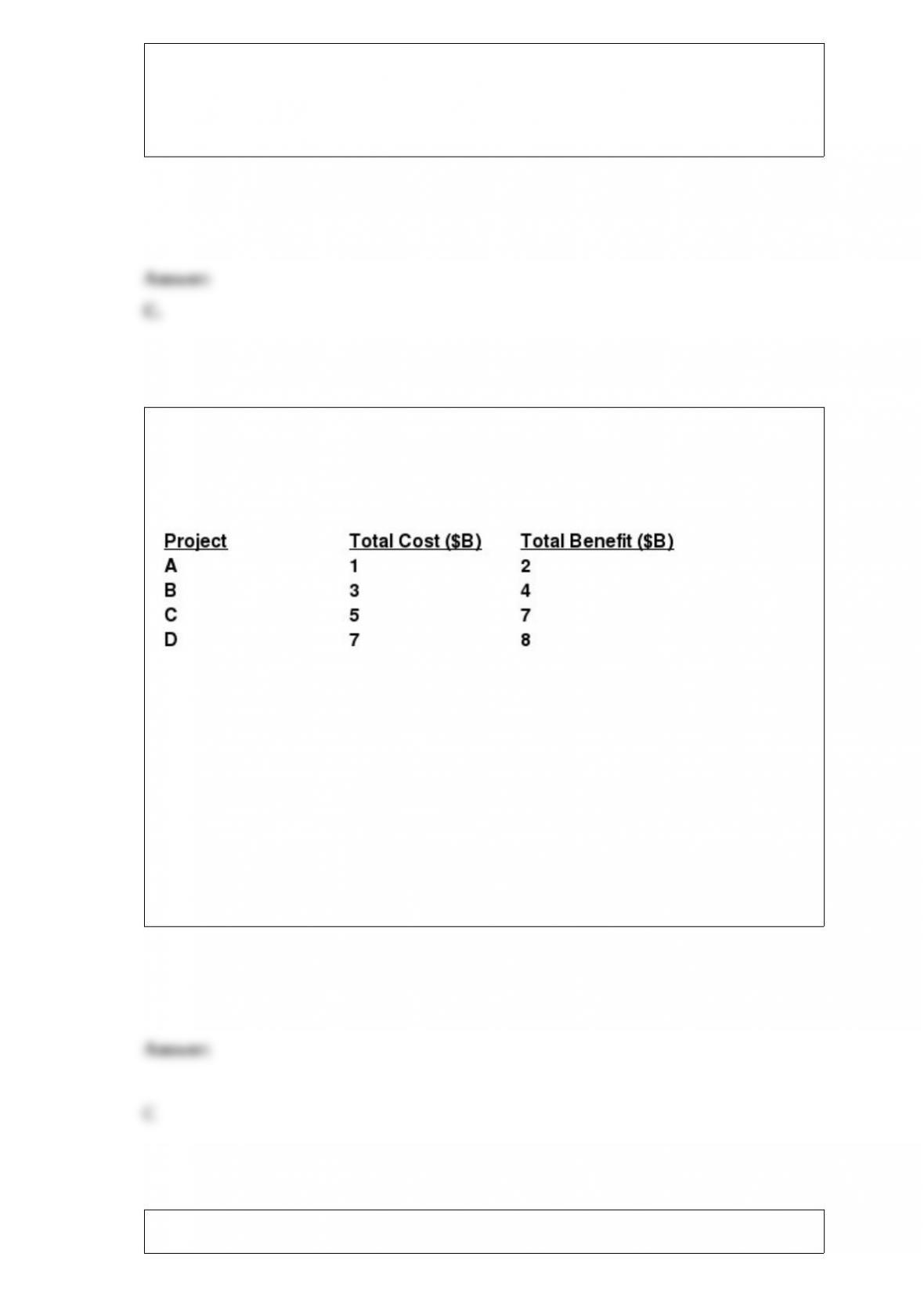
Assume that a government is considering a new social program and may choose to
include in this program any number of four progressively larger projects. The marginal
cost and the marginal benefit of each of the four projects is provided in the table.
Refer to the above table and information. What is the net benefit of undertaking all four
projects?
A.$2 billion
B.$3 billion
C.$4 billion
D.$5 billion
An oligopolistic price leader increases the price of its product. If all other firms follow

the leader’s example, the price leader will:
A. decrease its price.
B. increase its price.
C. maintain its new price.
D. increase its quantity of output.
A profit-maximizing firm should shut down in the short run if the average revenue it
receives is less than:
A. average variable cost.
B. average total cost.
C. average fixed cost.
D. marginal cost.
The Earned Income Tax Credit:
A. increases the personal income tax liability of low-income working families.
B. provides a cash payment to low-income working families if their tax credit exceeds
their tax liability.
C. is designed to make labor force employment less attractive.

D. was eliminated as part of welfare reform in 1996.
In a market system, well-defined property rights are important because they:
A. reduce unnecessary investment.
B. limit destructive economic growth.
C. create economic problems.
D. encourage economic activity.
Refer to the above table. In relation to column (3), a change from column (4) to column
(5) would most likely be caused by:
A. government placing an excise tax on the good.
B. an improvement in production technology.

C. an increase in consumer income.
D. an increase in input prices.
In which industry or sector of the economy is output least likely to be affected by the
business cycle?
A. Housing construction
B. Automobile production
C. Agricultural commodities
D. Capital goods production
Increasing marginal cost of production explains:
A. the law of demand.
B. the income effect.
C. why the supply curve is upsloping.
D. why the demand curve is downsloping.
The supply curve for a monopoly is:
A. the portion of the marginal cost curve that lies above the average variable cost curve.
B. the portion of the marginal cost curve that lies above the average total cost curve.
C. the portion of the marginal cost curve that lies above the average fixed cost curve.
D. not a curve but a single point.
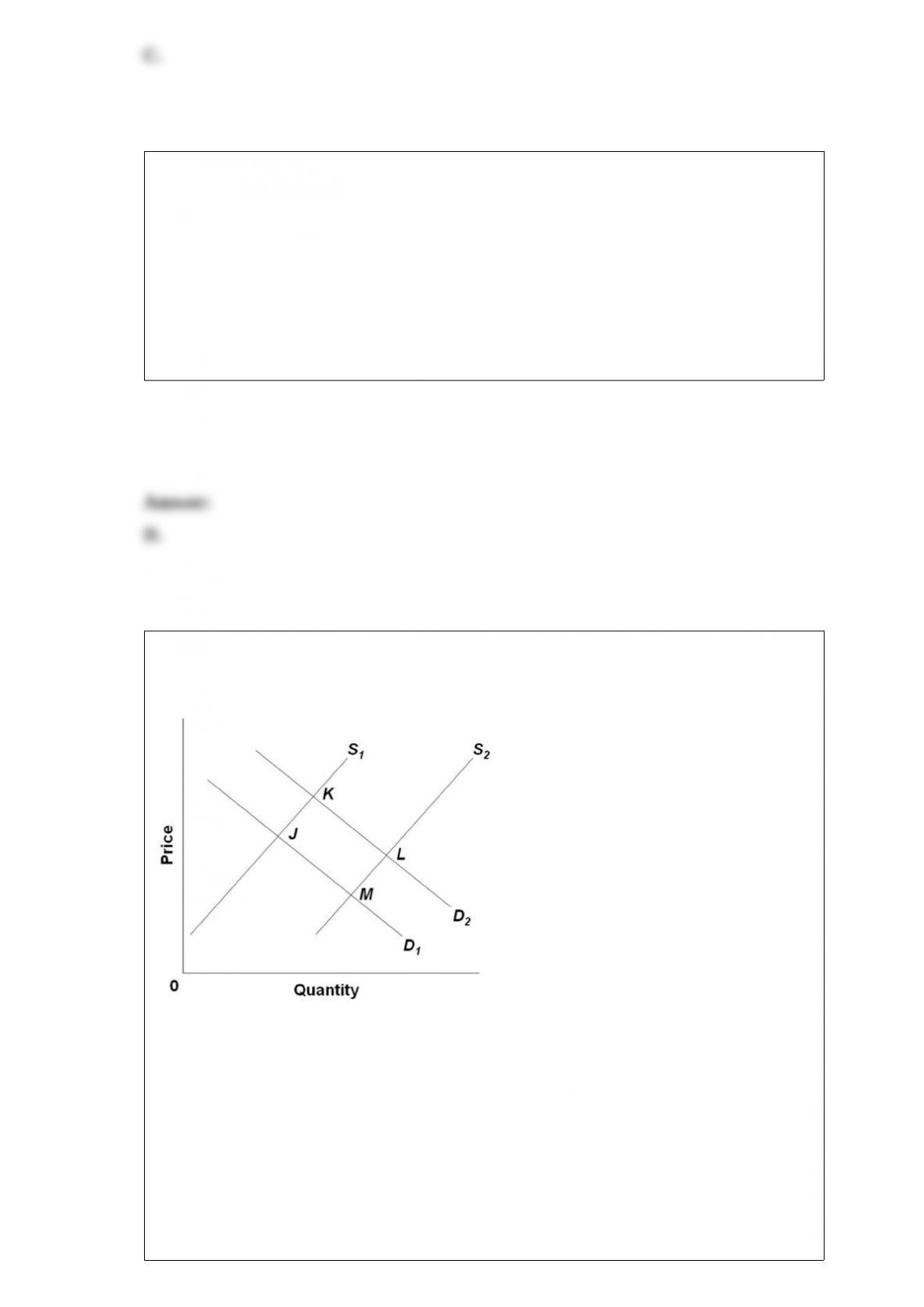
Refer to the above diagram, in which S1 and D1 represent the original supply and
demand curves and S2 and D2 the new curves. In this market:
A. supply has decreased and equilibrium price has increased.
B. demand has increased and equilibrium price has decreased.
C. demand has decreased and equilibrium price has decreased.
D. demand has increased and equilibrium price has increased.
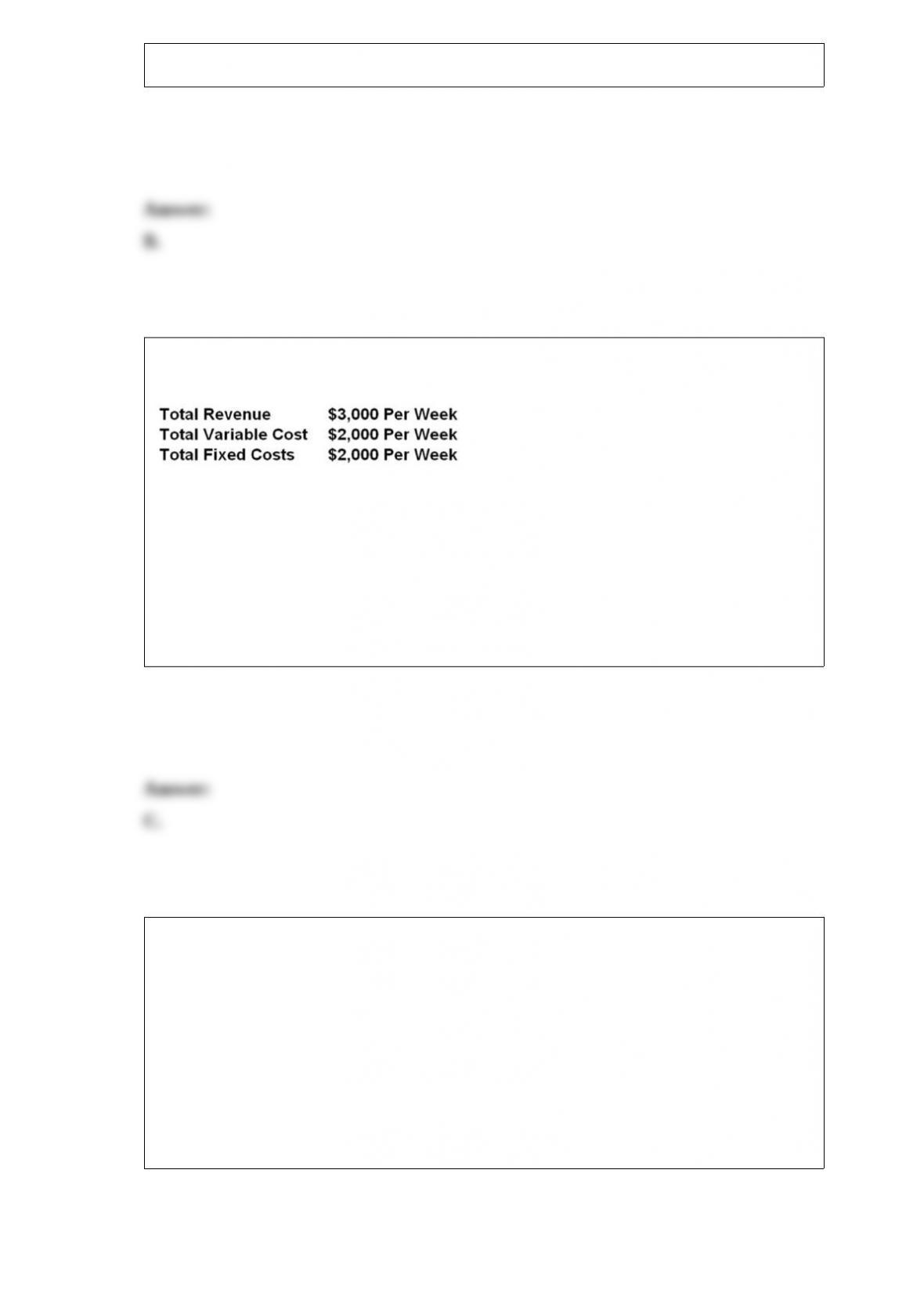
Let us suppose Harry’s, a local supplier of chili and pizza, has the following revenue
and cost structure:
A. Harry’s should stay open in the long run
B. Harry’s should shut down in the short run
C. Harry’s should stay open in the short run
D. Harry’s should shut down in the short run but reopen in the long run
If the Consumer Price Index was 166.6 in one year and 172.2 in the next year, then the
rate of inflation from one year to the next was:
A. 3.4 percent.
B. 4.1 percent.
C. 5.4 percent.
D. 6.0 percent.
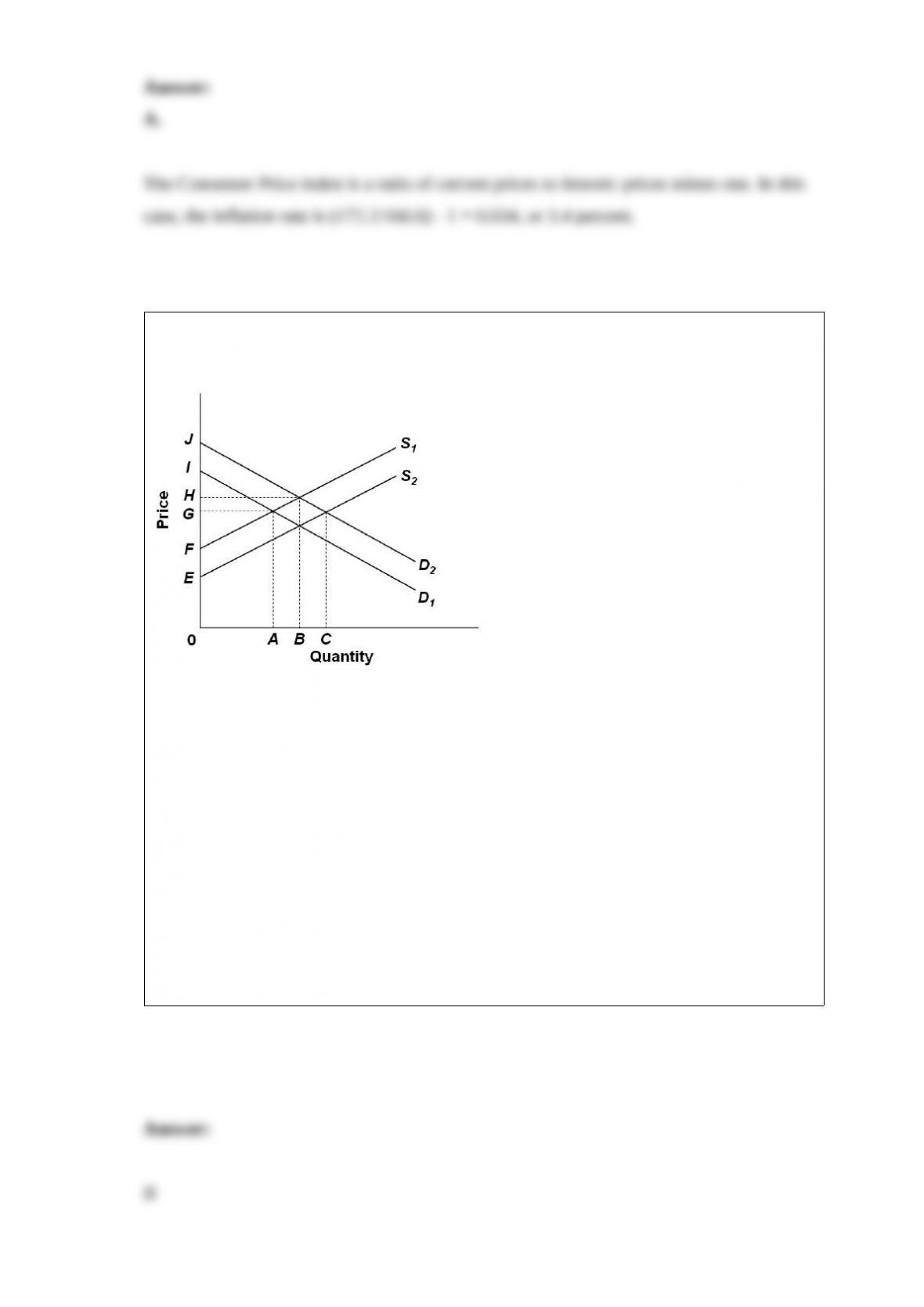
Refer to the above supply and demand graph. Point A represents the current equilibrium
level of output of this product and point B represents the optimal level of output from
society’s perspective. If government decides to correct this spillover problem by
subsidizing producers, then the:
A.demand curve will shift from D1 to D2.
B.supply curve will shift from S1 to S2.
C.supply curve will shift from S2 to S1.
D.demand curve will shift from D2 to D1.

Money is destroyed when:
A. loans are made.
B. checks written on one bank are deposited in another bank.
C. loans are repaid.
D. the net worth of the banking system declines.
Suppose the Northwestern Bank has excess reserves of $12,000 and outstanding
checkable deposits of $125,000. If the reserve requirement is 20 percent, what are the
bank’s actual reserves?
A. $25,000
B. $37,000
C. $44,000
D. $47,000
If the Consumer Price Index was 165 in one year and 175 in the next year, then the rate
of inflation from one year to the next was approximately:
A. 4.3 percent.
B. 5.7 percent.
C. 6.1 percent.

D. 7.5 percent.
A bank has excess reserves of $5000 and deposit liabilities of $50,000 when the
required reserve ratio is 20 percent. If the reserve ratio is raised to 25 percent, this bank
can lend a maximum of:
A. $1000.
B. $1500.
C. $2000.
D. $2500.
Cost-push inflation occurs because of a:
A. rightward shift in the aggregate demand curve.
B. leftward shift in the aggregate demand curve.
C. rightward shift in the aggregate supply curve.
D. leftward shift in the aggregate supply curve.

The immediate-short-run aggregate supply curve is:
A. vertical.
B. horizontal.
C. upward sloping.
D. downward sloping.
When a group of workers finds that their job skills and work experience have become
obsolete and are not needed by industry, this type of unemployment is:
A. search.
B. frictional.
C. structural.
D. cyclical.
An economist for a bicycle company predicts that, other things equal, a rise in
consumer incomes will increase the demand for bicycles. This prediction is based on
the assumption that:
A. there are many goods that are substitutes for bicycles.
B. there are many goods that are complementary to bicycles.
C. there are few goods that are substitutes for bicycles.
D. bicycles are normal goods.
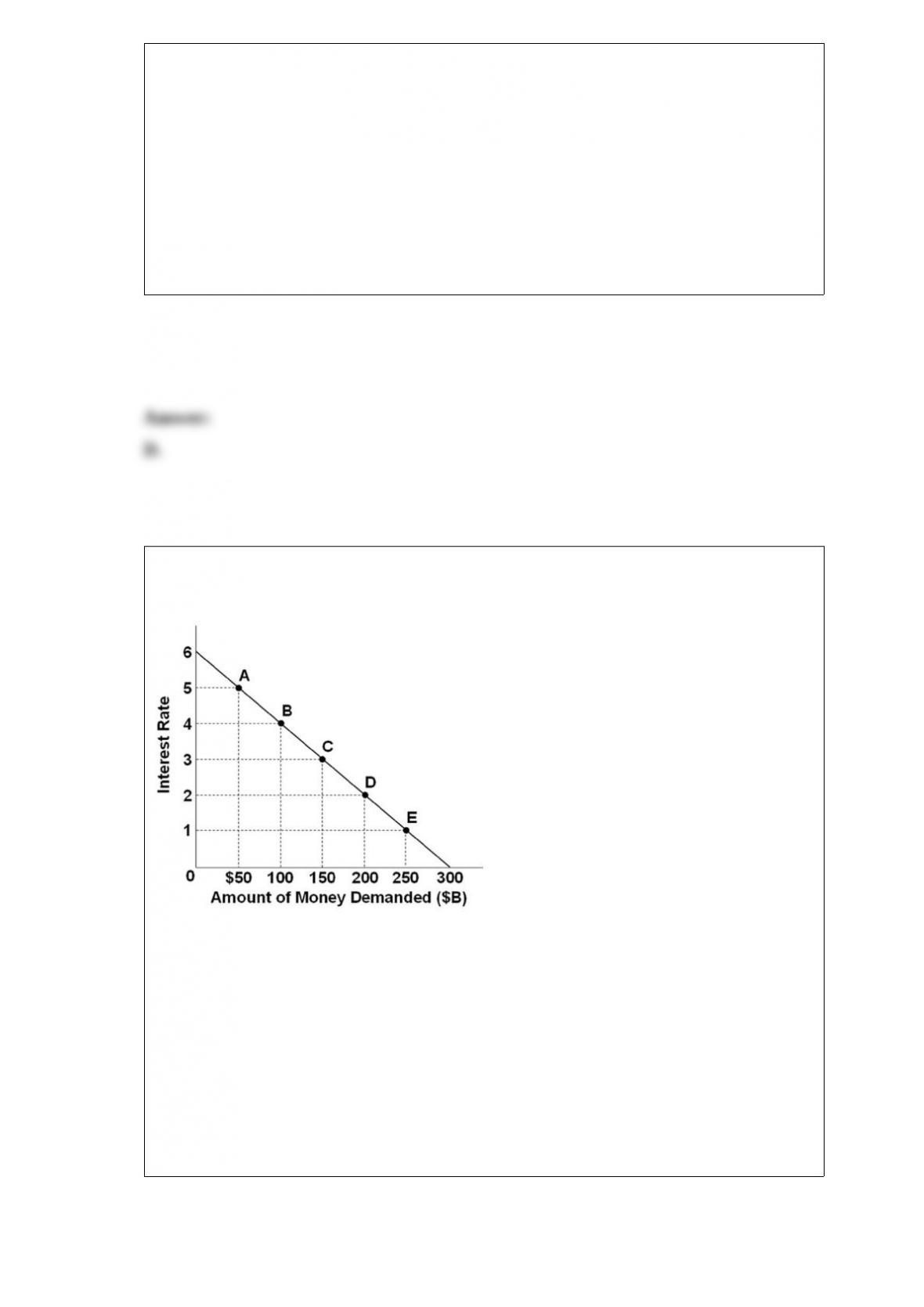
Refer to the above graph. If the supply of money was $250 billion, the interest rate
would be:
A. 1 percent.
B. 2 percent.
C. 3 percent.
D. 4 percent.
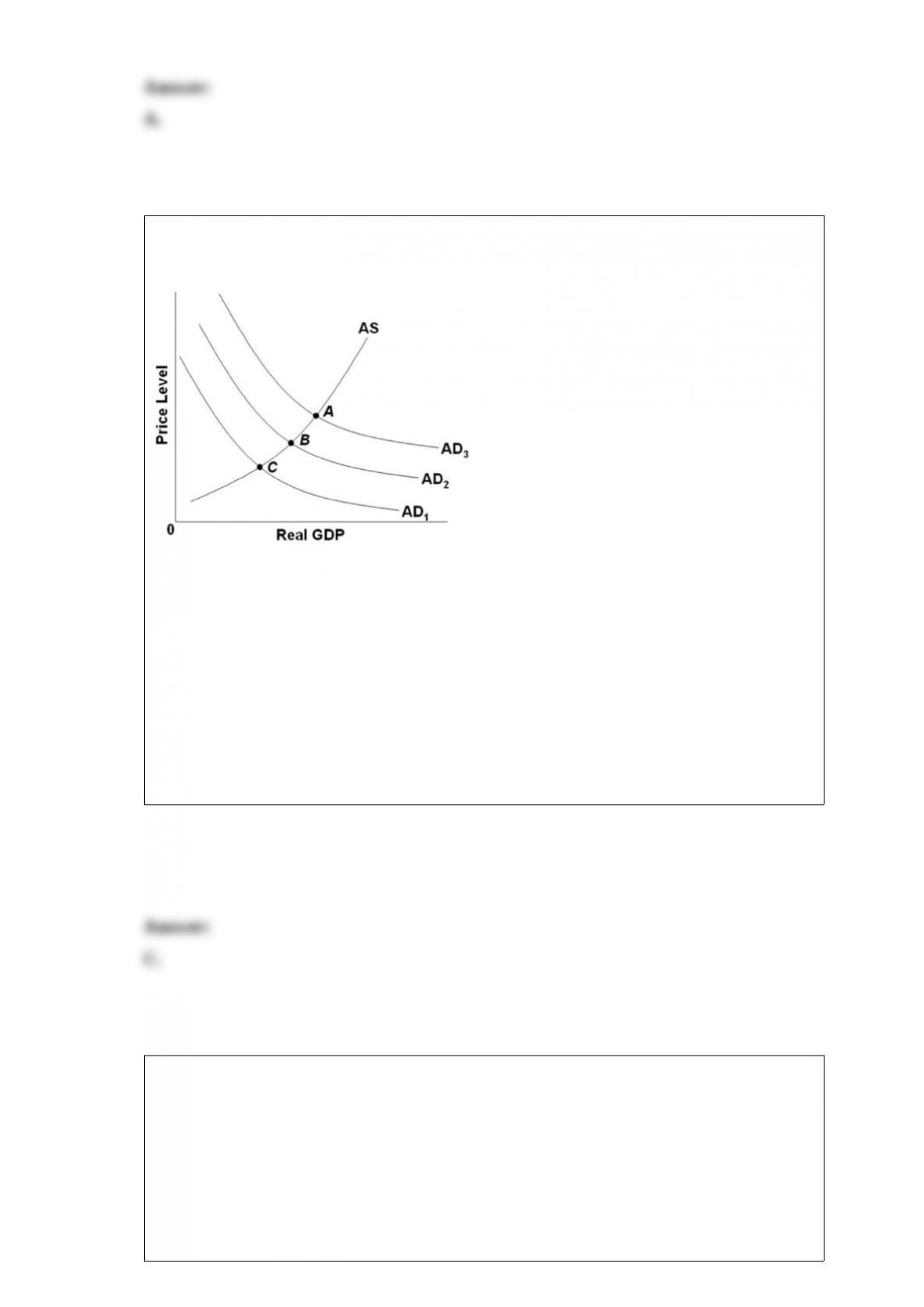
Refer to the above diagram. An expansionary fiscal policy can best be represented by a:
A. shift in the aggregate demand curve from AD2 to AD1.
B. shift in the aggregate demand curve from AD3 to AD2.
C. shift in the aggregate demand curve from AD1 to AD2.
D. movement along the aggregate demand curve.
A major reason that a public debt cannot bankrupt the federal government is because:
A. the public debt is mostly held by foreigners.
B. the federal government has the Social Security trust fund.
C. the public debt can be easily refinanced.

D. the federal government can draw on its gold reserves.
The maximization of profit and the minimization of losses is the primary factor
affecting the economic decision making of:
A. workers.
B. consumers.
C. public officials.
D. entrepreneurs.
If monopolistically competitive firms in an industry are making an economic profit,
then:
A. new firms will enter the industry and product demand will increase for the existing
firms.
B. firms will exit the industry and product demand will decrease for the firms that
remain.
C. firms will exit the industry and product demand will increase for the firms that
remain.
D. new firms will enter the industry and product demand will decrease for the existing
firms.
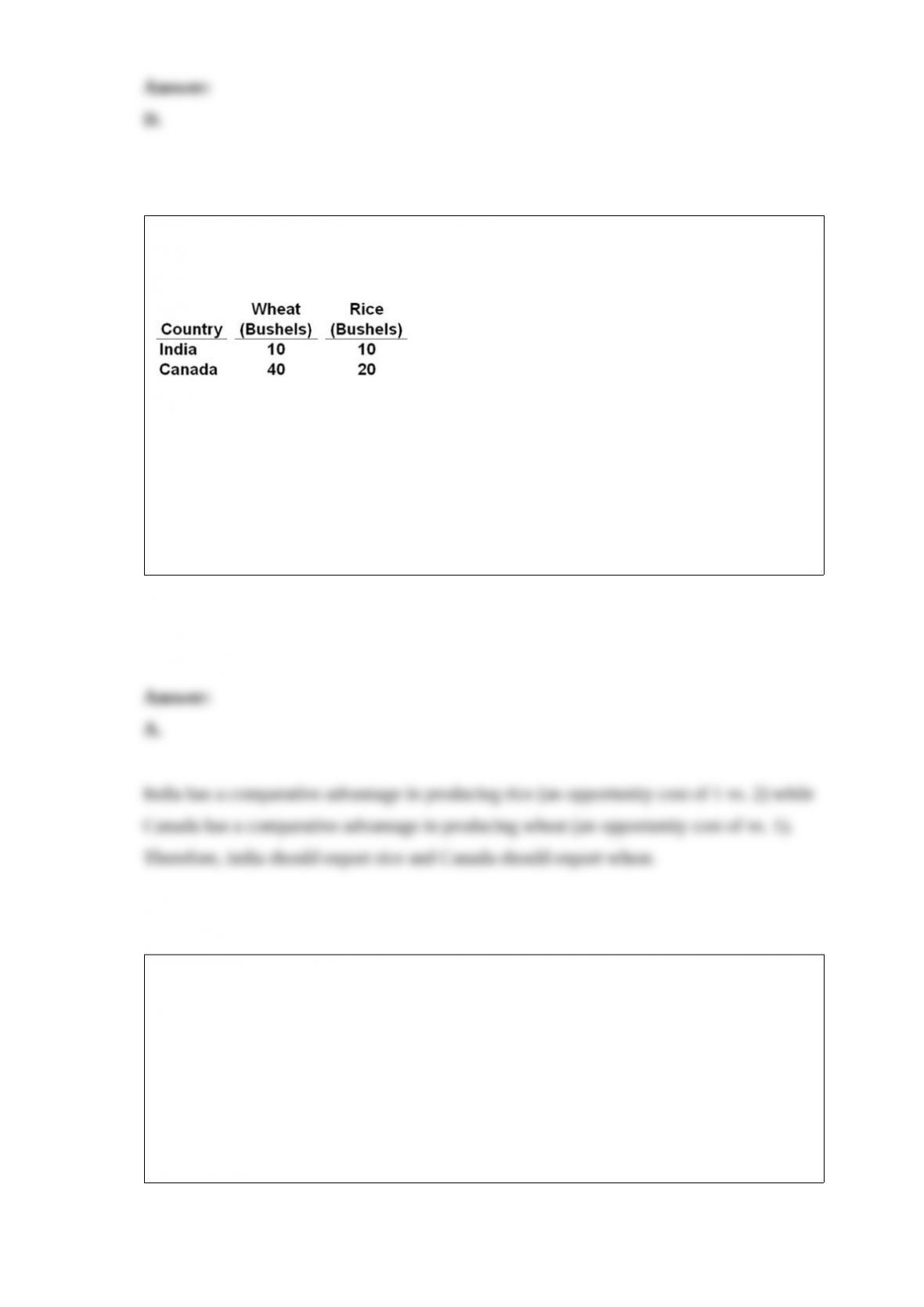
The production possibilities table given below shows how many bushels of either wheat
or rice can be produced in India and Canada with 1 unit of input. To achieve gains from
specialization:
A. India should export rice to Canada and import Canadian wheat.
B. India should export wheat to Canada and import Canadian rice.
C. Canada should produce both wheat and rice and not trade with India.
D. India should produce both wheat and rice and not trade with Canada.
A purely competitive firm will be willing to produce at a loss in the short run provided:
A. the loss is no greater than its total variable costs.
B. the loss is no greater than its marginal costs.
C. the loss is no greater than its total fixed costs.
D. price exceeds marginal costs.