
Which action taken by a worker would not be an investment in human capital?
A. Enrolling in college.
B. Enrolling in trade school.
C. Purchasing exercise equipment.
D. Purchasing stock in a pharmaceutical company.
A purely competitive firm’s output is currently such that its marginal cost is $4 and
marginal revenue is $5. Assuming profit maximization, the firm should:
A. cut its price and raise its output.
B. raise its price and cut output.
C. leave price unchanged and raise output.
D. leave price unchanged and cut output.
Unanticipated inflation tends to penalize:
A. people who save money in financial institutions.
B. individuals who borrow money from financial institutions.
C. businesses that borrow money from financial institutions.
D. governments that have a progressive personal income tax.

A market for pollution rights can be expected to:
A.eliminate all pollution.
B.produce a shortage of pollution.
C.encourage potential polluters to increase emissions.
D.provide potential polluters with a monetary incentive to reduce emissions.
If goods and services flow clockwise in a circular economic flow diagram, then
consumption expenditures flow:
A. clockwise and firm revenues flow clockwise.
B. clockwise and firm revenues flow counterclockwise.
C. counterclockwise and firm revenues flow clockwise.
D. counterclockwise and firm revenues flow counterclockwise.

Which is an expansionary money policy?
A. Increase the money supply to shift the aggregate demand curve rightward.
B. Increase the money supply to shift the aggregate demand curve leftward.
C. Increase the money supply to shift the aggregate supply curve leftward.
D. Decrease the money supply to shift the aggregate demand curve leftward.
An effective price floor on wheat will:
A. force otherwise profitable farmers out of business.
B. result in a shortage of wheat.
C. result in a surplus of wheat.
D. clear the market for wheat.
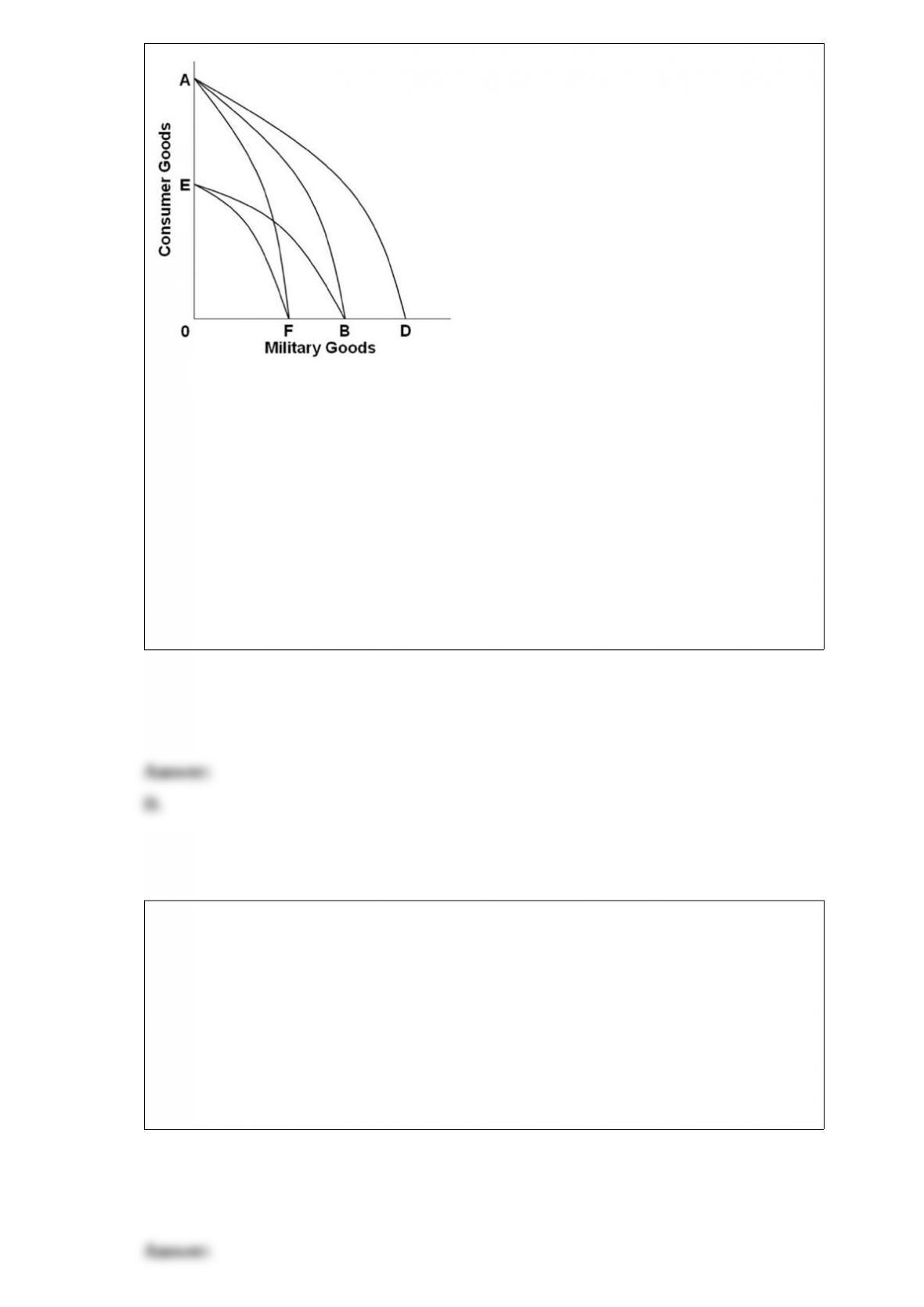
Refer to the above graph. Assume that before the Persian Gulf War, Iraq’s production
possibilities were represented by AB. Which line on the above graph would represent
the change in Iraq’s production possibilities after the war?
A. AB to BE
B. AB to AF
C. AB to AD
D. AB to EF
The Federal Reserve could increase the money supply by:
A. selling government bonds in the open market.
B. buying government bonds in the open market.
C. raising interest rates.
D. raising the discount rate.

An increase in government spending will cause a(n):
A. increase in aggregate supply.
B. decrease in aggregate supply.
C. decrease in aggregate demand.
D. increase in aggregate demand.
Drawing demand and supply curves assumes that the primary variable influencing
decisions to produce and purchase goods is:
A. price.
B. expectations.
C. preferences.
D. incomes.

Refer to the above table. In relation to column (3), a change from column (1) to column
(2) would mostly likely be caused by:
A. reduced taste for the good.
B. an increase in input prices.
C. consumers expecting that prices will be higher in the future.
D. government subsidizing production of the good.
In what circumstances would lenders most benefit?
A. When there is an unanticipated decrease in inflation.
B. When there is an anticipated increase in inflation.
C. When there is an unanticipated increase in inflation.
D. When there is an anticipated decrease in inflation.

Electric utilities sometimes charge higher prices for electricity used for illumination and
lower prices for electricity used for heat. These lower prices for electric heat result
primarily from:
A. the existence of good heating substitutes.
B. economies of scale in electric heat generation.
C. prices for electric heat being set at the socially optimal level.
D. strict government regulation of the price charged for electric heat.
The nondiscriminating pure monopolist’s demand curve:
A. is the industry demand curve.
B. shows a direct or positive relationship between price and quantity demanded.
C. tends to be inelastic at high prices and elastic at low prices.
D. is identical to its marginal revenue curve.
Suppose you are given the following data on demand for a product. The price elasticity
of demand when price decreases from $9 to $7 is:

A. 0.63.
B. 1.16.
C. 1.60.
D. 2.27.
In a production possibilities table, the most-valued or optimal point for society is
determined by:
A. a combination of products at the midpoint of the table.
B. a combination of products at the ends of the table.
C. the equality of marginal benefits and marginal costs.
D. the maximization of opportunity costs.
Efforts by corporate lobbyists to obtain a license that would give a firm a monopoly
over the making of a product would be an example of:
A. rent-seeking.
B. price discrimination.

C. X-efficiency.
D. network effects.
A person receives a paper asset from a corporation that is a promise from the
corporation to repay a loan at a fixed rate of interest. This type of asset is referred to as
a:
A. bank loan.
B. share.
C. stock.
D. bond.
Economists who believe in the permanence of the recent productivity acceleration say
that:
A. the United States is entering an era of high structural unemployment due to rapid
technological change.
B. technological advance creates its own supply, which in turn creates its own demand.
C. innovations in computers and communications, together with global capitalism, are
greatly boosting U.S. productivity and the economy’s potential growth rate.
D. technological change will require more central planning and government regulation.

The largest component of the money supply (M1) is:
A. currency.
B. checkable deposits.
C. small time deposits.
D. savings deposits.
In which industry is monopolistic competition most likely to be found?
A. Utilities
B. Agriculture
C. Retail trade
D. Mining

Appreciation of the Canadian dollar will:
A. intensify an existing disequilibrium in Canada’ balance of payments.
B. make Canada’s exports less expensive and its imports more expensive.
C. make Canada’s exports more expensive and its imports less expensive.
D. make Canada’s exports and imports both more expensive.
A major distinction between a monopolistically competitive firm and an oligopolistic
firm is that:
A. one is a price taker and the other is a price maker.
B. a recognized interdependence exists between firms in one industry but not in the
other.
C. one always produces differentiated products and the other always produces a
homogeneous product.
D. one necessarily faces a downward-sloping demand curve and the other a horizontal
demand curve.

Refer to the above figure. If flow (1) is the cost businesses pay to the resource market,
then:
A. (2) is the flow of productive resources.
B. (4) is the flow of goods and services.
C. (6) is the flow of money income.
D. (7) is the flow of revenue.
In a purely competitive industry, each firm:
A. is a price maker.
B. produces a differentiated product.
C. can easily enter or exit the industry.
D. engages in forms of nonprice competition.

The table below shows the cyclically adjusted budget surplus as a percentage of GDP
over a five-year period.
Refer to the above information. In which year was fiscal policy contractionary?
A. Year 2
B. Year 3
C. Year 4
D. Year 5
A Lorenz curve showing perfect equality in the distribution of income:
A. coincides with the horizontal axis.
B. coincides with the vertical axis.
C. is a straight line with a 45-degree angle.
D. is a curve bowed to the southwest.

The best example of a monopsonist is:
A. Microsoft.
B. Ford Motor Company.
C. the Teamsters Union.
D. a large army post located in a small community.
About what percentage of the public debt wass held by U.S. government agencies and
the Federal Reserve in 2010?
A. 20 percent
B. 39 percent
C. 61 percent
D. 53 percent
If the demand for steak (a normal good) shifts to the left, the most likely reason is that:
A. consumer incomes have fallen.
B. cattle production has declined.

C. the price of steak has risen.
D. the price of cattle feed has gone up.
Which would decrease a firm’s demand for a particular resource?
A. A decrease in the productivity of the resource.
B. A decrease in the price of the particular resource.
C. An increase in the demand for the firm’s product.
D. An increase in the price of the product the resource produces.