Archives: Quiz

978-0132357166
123 Test Item File 124 125 Chapter 1 – Experiencing Art Multiple Choice Questions 1. When first experiencing an unfamiliar work of art, start by asking questions about: a. expressive content, historical style, individual style. b. patrons, function, and collocation. […]
978-0132357166 Chapter 14
206 Chapter 14 – Art in the New Millennium Multiple Choice Questions 1. Cai Guo-qiang’s work makes use of: a. geography. b. medicine. c. history. d. Chinese philosophy. e. all of these. 2. What aspects of third millennium life meet […]
978-0132357166 Chapter 13
200 Chapter 13 – Art from 1950 to 1999 Multiple Choice Questions 1. Pollack’s method of painting is derived from: a. Picasso’s synthesis. b. Surrealist automatism. c. Cézanne. d. all of these. e. none of these. 2. In the style […]
978-0132357166 Chapter 12
195 Chapter 12 – Art from 1900 to 1949 Multiple Choice Questions 1. In Hopper’s Nighthawks the harsh interior light is used to: a. reveal the personalities of the sitters. b. encourage deep psychoanalysis. c. expose the lack of communication. […]
978-0132357166 Chapter 11
190 Chapter 11 – Nineteenth-Century Art Multiple Choice Questions 1. Delacroix’s revolutionary technique used in Liberty Leading the People is a reaction to the prevailing Neoclassicism in its: a. loose brushstrokes. b. blurred edges. c. strong colors. d. all of […]
978-0132357166 Chapter 10
184 Chapter 10 – Eighteenth-Century Art Multiple Choice Questions 1. Because of the web of gold woodwork, the stucco ornament, the rhythmic curving cornice, and the delicate arches, the effect of Boffrand’s Salon de la Princesse is: a. spiritual and […]
978-0132357166 Chapter 9
Chapter 9 – Seventeenth-Century Art Multiple Choice Questions 1. In his sculpture of David, Bernini chooses to portray the instant of: a. celebratory triumph. b. deepest thought. c. greatest action. d. all of these. e. none of these. Answer: c […]
978-0132357166 Chapter 8
173 Chapter 8 – Sixteenth-Century Art Multiple Choice Questions 1. In Soami’s Dry garden of the Daisenin of Daitokuji, the waterless boulders, stones, and gravel suggest a course of water: a. racing along a mountain riverbed. b. falling over a […]
978-0132357166 Chapter 7
Chapter 7 – Fifteenth-Century Art Multiple Choice Questions 1. Both della Francesca’s Resurrection and van der Weyden’s Deposition show a characteristic not seen in painting since Roman times, which is: a. abstract decoration. b. naturalism. c. miniaturization. d. all of […]
978-0132357166 Chapter 6
160 Chapter 6 – Art from 1000 to 1400 Multiple Choice Questions 1. The miniature Christian church functioning as a container for the bones of a holy person is called a(n): a. triad. b. iconograph. c. reliquary. d. all of […]
978-0132357166 Chapter 5
Chapter 5 – Art from 200 to 1000 Multiple Choice Questions 1. The term “Middle Ages” was invented during the Italian Renaissance to suggest that the period embracing these centuries was an interruption between the new golden age of the […]
978-0132357166 Chapter 4
146 Chapter 4 – Later Ancient Art Multiple Choice Questions 1. A Buddhist stupa, like the Great Stupa at Sanchi, acts to: a. be the symbol of nirvana. b. commemorate a sacred place. c. be a monumental burial mound. d. […]
978-0132357166 Chapter 3
Chapter 3 – Ancient Art Multiple Choice Questions 1. The Panathenaic Amphora with Runners reveals an interest in beauty because of the: a. patterned decoration. b. integration of the handles into the overall shape. c. manner in which it rises […]
978-0132357166 Chapter 2
133 Chapter 2 – Prehistoric Art Multiple Choice Questions 1. Prehistory is defined as the period before: a. architecture. b. domesticated animals. c. writing. d. all of these. e. none of these. 2. It is almost certain that the “Great […]
978-0132357166 Chapter 1
125 Chapter 1 – Experiencing Art Multiple Choice Questions 1. When first experiencing an unfamiliar work of art, start by asking questions about: a. expressive content, historical style, individual style. b. patrons, function, and collocation. c. historical significance and historical […]
978-0078029486 Chapter 12
Chapter 12 – Global Employee Benefits at a Glance 12-1 Chapter 12 Global Employee Benefits at a Glance True / False Questions 1. NAFTA regulates labor conditions in North America. (North America) FALSE 2. Canadian employment laws for the province […]
978-0078029486 Chapter 11
Chapter 11 – Nonqualified Deferred Compensation Plans for Executives Chapter 11 Nonqualified Deferred Compensation Plans for Executives True / False Questions 1. Excess benefit plans generally have longer vesting periods than SERPs. (Supplemental Executive Retirement Plans (SERPs)) FALSE 2. Corporate-owned […]
978-0078029486 Chapter 10
Chapter 10 – Managing the Employee-Benefits System Chapter 10 Managing the Employee-Benefits System True / False Questions 1. A summary of material modifications might include changes in plan eligibility rules. (Summary of Material Modification) TRUE 2. Utilization reviews are used […]
978-0078029486 Chapter 9
Chapter 09 – Accommodation and Enhancement Benefits 9-1 Chapter 09 Accommodation and Enhancement Benefits True / False Questions 1. Employers and employees both receive tax benefits on health risk appraisals. (Health Risk Appraisals) FALSE 2. Employers that use referral EAPs […]
978-0078029486 Chapter 8
Chapter 08 – Paid Time-Off and Flexible Work Schedules Chapter 08 Paid Time-Off and Flexible Work Schedules True / False Questions 1. FSLA requires employers to pay exempt status employees additional compensation for on-call time. (On-Call Time) FALSE 2. When […]
978-0078029486 Chapter 7
Chapter 07 – Government-Mandated Social Security Programs 7-1 Chapter 07 Government-Mandated Social Security Programs True / False Questions 1. The Social Security Act was amended in 1965 to create the Medicare program. (Medicare) TRUE 2. The net job gains between […]
978-0078029486 Chapter 6
Chapter 06 – Employer-Sponsored Disability Insurance, Life Insurance, and Workers’ Compensation Programs Chapter 06 Employer-Sponsored Disability Insurance, Life Insurance, and Workers‘ Compensation Programs True / False Questions 1. In short-term disability insurance plans, the exclusion period spans from the initial […]
978-0078029486 Chapter 5
Chapter 05 – Employer-Sponsored Health Insurance Programs Chapter 05 Employer-Sponsored Health Insurance Programs True / False Questions 1. Comprehensive major medical plans usually apply a single deductible for all covered services. (Major Medical Insurance Plans: Supplemental and Comprehensive) TRUE 2. […]
978-0078029486 Chapter 4
Chapter 04 – Employer-Sponsored Retirement Plans 4-1 Chapter 04 Employer-Sponsored Retirement Plans True / False Questions 1. Vesting rights focus on employer contributions. (Qualified Plans) TRUE 2. Forfeitures come from the accounts of employees who terminate their employment prior to […]
978-0078029486 Chapter 3
Chapter 03 – Regulating Employee Benefits Chapter 03 Regulating Employee Benefits True / False Questions 1. Employers can deduct the cost of the benefits they offer employees, from their annual income, as a business expense, if the cost is considered […]
978-0078029486 Chapter 2
Chapter 02 – The Psychology and Economics of Employee Benefits 2-1 Chapter 02 The Psychology and Economics of Employee Benefits True / False Questions 1. Employee benefits act as a tool for recruiting and retaining desired employees for companies. (How […]
978-0078029486 Chapter 1
Chapter 01 – Introducing Employee Benefits 1-1 Chapter 01 Introducing Employee Benefits True / False Questions 1. Cafeteria plans enable employees to choose from among a set of benefits and different levels of these benefits. (Basic Design Considerations for Discretionary […]
978-0073534343 Chapter 12
1. A content analysis of a discussion can be made of 2. An observer who helps participants in a discussion think of and apply beneficial small group communication principles and techniques is called a(n) ______________ observer. A. participant B. consultant […]
978-0073534343 Chapter 11
1. The purpose of starting a task conflict is to 2. A struggle for power and status in a small group would be classified as a(n) ______________ conflict. A. process B. intrinsic C. extrinsic D. task E. inequity Galanes – […]
978-0073534343 Chapter 10
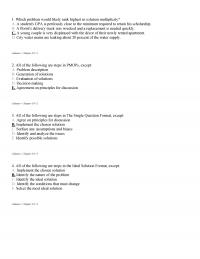
1. Which problem would likely rank highest in solution multiplicity? 2. All of the following are steps in PMOPs, except: A. Problem description B. Generation of solutions C. Evaluation of solutions D. Decision making E. Agreement on principles for discussion […]
978-0073534343 Chapter 9
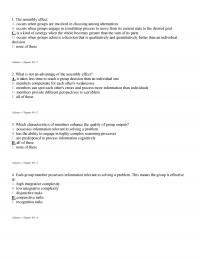
1. The assembly effect: 2. What is not an advantage of the assembly effect? A. it takes less time to reach a group decision than an individual one B. members compensate for each other’s weaknesses C. members can spot each […]
978-0073534343 Chapter 8
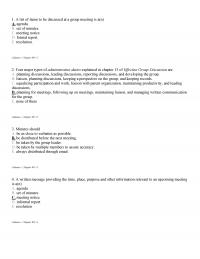
1. A list of items to be discussed at a group meeting is a(n) 2. Four major types of administrative duties explained in chapter 13 of Effective Group Discussion are A. planning discussions, leading discussions, reporting discussions, and developing the […]
978-0073534343 Chapter 7
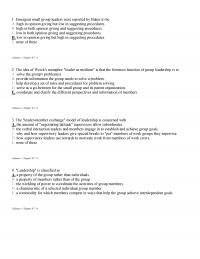
1. Emergent small group leaders were reported by Baker to be 2. The idea of Weick’s metaphor “leader as medium” is that the foremost function of group leadership is to A. solve the group’s problem(s). B. provide information the group […]
978-0073534343 Chapter 6
1. “Group culture” refers to: 2. Which pattern of behaviors occurs during initial primary tension? A. fidgeting, disagreeing, and loud voices B. exceptional politeness, long pauses, and little disagreeing C. low attendance, apathy, and failure to arrive at group decisions […]
978-0073534343 Chapter 5
1. “Forgetting” to carry out assignments and failing to come to meetings is often a form of ______________ behavior. 2. Rhetorically sensitive people A. express whatever is on their minds. B. try to say what they think others want to […]
978-0073534343 Chapter 4
1. “Culture” was defined in Effective Group Discussion as 2. A grouping that sees itself as distinct, yet part of a larger culture is termed which of the following? A. subculture. B. plural culture. C. monoculture. D. co-culture. E. none […]
978-0073534343 Chapter 3
1. General systems theory was developed from an analysis of 2. If a small group is an open system, then A. members are open-minded toward new ideas. B. nonmembers, such as reporters, may attend meetings. C. the group interacts freely […]
978-0073534343 Chapter 2
1. Communication is ______________ implies that participants in communication must cooperate and work together to achieve mutual meaning and understanding. 2. Every spoken message indicates meanings of two types (levels): A. verbal and reciprocal. B. signals and sign. C. small […]
978-0073534343 Chapter 1
1. Which of the following is NOT one of the important ideas about groups offered by your authors? 2. Schutz described three types of human needs for which small groups are a major source of satisfaction. These are: A. Inclusion, […]
978-0073526195 Chapter 18
1. Which medium may play the greatest role in socialization? 2. Children are likely to be most influenced by TV when: A. the content reflects stereotypes B. they are heavy viewers C. they have limited interaction with other socializing agents […]
978-0073526195 Chapter 17
1. Moderation is the key to moral virtue, according to the: 2. What ethical principle guides reporters who decide NOT to use a hidden camera-even though the story is of vital importance to national security-because using hidden cameras is deceitful? […]
978-0073526195 Chapter 16
1. In prior restraint cases, the courts tend to support the rights of: 2. Shield laws, designed to uphold reporters’ rights: A. vary from state to state B. have been enacted in all 50 states C. provide consistent protection against […]
978-0073526195 Chapter 15
1. Advertising serves a(n) _________ function in society. 2. An advertisement encouraging families to “take the kids bowling more often” (without saying exactly where to go bowling) is an example of ______________ advertising. A. primary demand B. selective demand C. […]
978-0073526195 Chapter 14
1. Public relations is best considered a __________ function. 2. Public relations is the same as: A. promotion B. press agentry C. advertising D. all of these E. none of these Dominick – Chapter 14 #2 3. The public relations […]
978-0073526195 Chapter 13
1. If a scheduled story about a boating accident on Monday gets pulled from Tuesday’s paper to make space for something else, that story might not run in Wednesday’s paper because of the _______ news value. 2. A TV news […]
978-0073526195 Chapter 12
1. MSO stands for: 2. Which of the following is possible with DBS? A. increased competition for cable B. sending signals from satellites directly to homes C. audiences can bypass the cable system altogether D. all of these E. none […]
978-0073526195 Chapter 11
1. The structure of early television was similar to that of: 2. VHF (very high frequency) TV stations: A. have higher numbers than UHF stations B. include channels 23 and 50 C. have signals that travel further than do UHF […]
978-0073526195 Chapter 10
1. Probably the first practical motion camera and viewer, the _______, was developed in the Edison Labs. 2. The MPPC controlled film exhibitors by: A. taking over their segment of the industry B. charging a tax for using MMPC-patented equipment […]
978-0073526195 Chapter 9
1. The gramophone recorded onto a disk; its predecessor (the graphophone) recorded onto a: 2. At the dawn of the 1900s, visitors to penny arcades and amusement parks could pay five cents and listen to a brief recording through a […]
978-0073526195 Chapter 8
1. ________ built a wireless communication device that could send Morse code and started a wireless telegraphy company. 2. The first network was A. ABC (American Broadcasting Company) B. CBS (Columbia Broadcasting System) C. RCA (Radio Corporation of America) D. […]