Archives: Quiz
SED AP 74417
Based on the most common organizational pattern for social studies, American history would be treated in all of the years below except A. Grade 5 B. Grade 8 C. Grade 11 D. Grade 12 Which one of the statements below […]
EDUC 60578
True or False. Adaptive models of instruction can be used equally effective in educating the gifted and talented. a. true b. false Which of the activities described below might exemplify self-directed learning? A. Class Field Trips B. Participation in seminars […]
EDU 92020
Which is the true item type for the sample design question? a. What type of services do clients receive from the agency? ” Likert scale b. What are the clients’ opinions of the agency? ” Likert scale c. What type […]
SED DS 17408
To classify the different evaluation approaches, which of the following factors guide the research? a. Use of participatory evaluation to promote stakeholders’ participation. b. Provide information to improve the quality of decisions that impact programming. c. Design questions that focus […]
EDUC 64876
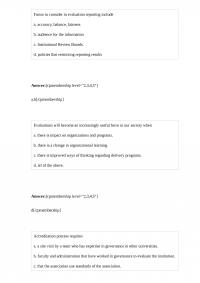
Factor to consider in evaluation reporting include a. accuracy, balance, fairness b. audience for the information c. Institutional Review Boards. d. policies that restricting reporting results Evaluations will become an increasingly useful force in our society when a. there is […]
SED CE 98303
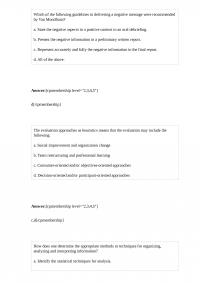
Which of the following guidelines in delivering a negative message were recommended by Van Mondfrans? a. State the negative aspects in a positive context in an oral debriefing. b. Present the negative information in a preliminary written report. c. Represent […]
EDUK 22971
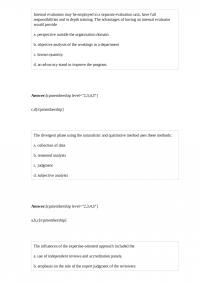
Internal evaluators may be employed in a separate evaluation unit, have full responsibilities and in depth training. The advantages of having an internal evaluator would provide a. perspective outside the organization domain. b. objective analysis of the workings in a […]
SED CE 16879
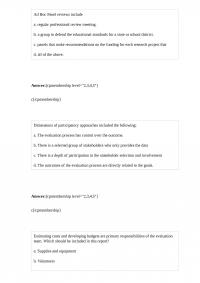
Ad Hoc Panel reviews include a. regular professional review meeting. b. a group to defend the educational standards for a state or school district. c. panels that make recommendations on the funding for each research project that d. all of […]
SED LR 83589
Essential competencies for program evaluators include a. interpersonal competence b. reflective practice c. situational analysis d. systematic inquiry The following categorizations of evaluation approaches or theories provided insights into evaluation history and practice. Stufflebeam’s method was examined by: a. reducing […]
EDU 53930
Esteem for and respect of others begins and is rooted in one’s own self-esteem. When ____________________ are made, some materials or combinations of materials are glued onto a surface. Answer: collages List five examples of body instruments. Answer: whistling, humming, […]
SED AP 64413
Young children cannot understand the concept of gravity. When children write and read about their own experiences, it is referred to as the________. Answer: language experience approach (LEA) In addition to the formal, scheduled parent-teacher conferences, teachers should also take […]
SED LR 71101
Teachers need special training to include music and movement in the early childhood classroom. What are some specific benefits of parent involvement in the school and classroom? Answer: Parents become better acquainted with the school’s programs and curriculum. Teachers become […]
SED DS 63980
By third grade, children can read fluently and enjoy reading. What are five different ways to explore walking? Answer: 1) fast, slow, sideways 2) heels in, heels out 3) barefoot, high, low 4) eyes closed, Like 5) short, long, backwards […]
SED CE 14056
How can teachers help children develop science and critical thinking skills? How can they ignite a child’s sense of curiosity with science? Describe at least two process skills and how they would be used or applied in early childhood science. […]
SED EM 13498
As teachers, we should be more concerned about getting the right answer than the process of arriving at an answer. Children should be exposed to standard units of metric measurement. Answer: T _______is the capability to recover or bounce back […]
SED AP 97787
Children’s initial experiences with color should be in _________ by color. Tests used primarily to identify potential problem areas with young children are called_____________ Answer: screening Warm and loving approval of others is not essential to the development of positive […]
SED CE 10669
Dramatic play helps children develop interpersonal skills of conflict resolution and cooperation and improve their problem-solving and language abilities. The educational system has the responsibility to adjust to the developmental needs and abilities of the children it serves; this includes […]
SED AP 25887
Teachers need to encourage children to be curious because it does not come naturally. All early childhood physical science activities/experiments warrant in-depth study and exploration. Answer: F The teacher’s example can be most important in building respect and tolerance for […]
SED DS 89519
How would you teach the growth cycle of plants? Suggest one science activity that could be set up as a cooperative learning activity. Describe your procedures and how you would organize it with a cooperative approach. Answer:(no answer provided) Children […]
SED EM 84394
In order for a teacher to engage children in musical activities and experiences, the key is a. the child’s interest. b. for the teacher to have a background in music. c. the child’s background with music in his or her […]
SED LR 77579
The following are concept or ideas relating to the sun: I. It is a source of light, heat, and energy. II. At the end of our day, it is making light and day for people on another part of Earth. […]
SED CE 51926
A great way to teach math is through childrens everyday experiences. Early childhood teachers should use play money instead of real money because the children may lose the real money. Answer: F Television, movies, and media can create stress in […]
SED CE 62622
What is involved in the second phase of the Integrative model? a. Students describe, compare, and search for patterns in the content that represents an organized body of knowledge. b. Students make broad generalizations about the content, and form synthesizing […]
SED EM 63317
Which of the following is a question to consider in the Develop phase of the ADDIE model? a. How much growth occurred from the beginning to end of instruction? b. What must I teach to fulfill state, district, and local […]
SED AP 17191
Divergent thinking complements convergent thinking in the Inductive model in that a. divergent thinking tends to move toward one focused concluding point. b. divergent thinking allows a creative search that uncovers several possible answers. c. divergent thinking is associated with […]
SED AP 51278
Mary is a 9th grade math teacher who has employed the Concept Development Model for many years. She is ready to refine and strengthen her use of this instructional model. Teaching Models: Designing Instruction for 21stCentury Learnerscan help Mary transform […]
SED LR 90539
Scaffolding learning in a Problem-Based Learning lesson: a. is not important to student learning. b. should not involve the teacher. c. involves crafting questions to foster student thinking. d. does not involve documenting progress toward learning goals. The Direct Instruction […]
SED AP 86080
The Inductive model a. is based on a kind of thinking that focuses primarily on general conclusions. b. involves making generalizations through examination and analysis of particular examples. c. is commonly associated with the visual and performing arts. d. is […]
SED LR 66945
Key ways in which globalization has impacted the field of education include which of the following? a. More homogenous classrooms, broader teacher and student perspectives, more global social networks, and more rigorous education standards b. More diverse classrooms, more traditional […]
SED EM 44445
Recognizing that a donkey is not an example of a horse represents the process of: a. generalization b. discrimination of a far out nonexample c. discrimination of a close in nonexample d. creation of a rational set of purposefully selected […]
SED CE 46177
Inquiry in which students confirm a principle via a prescribed activity when the results are known is: a. Confirmation/Verification Inquiry b. Structured Inquiry c. Guided Inquiry d. Open Inquiry In the Socratic Seminar model, the students are viewed as: a. […]
EDUK 15608
Objectives in the psychomotor domain are best evaluated by: a. oral exams administered to individuals b. actual performance of the skill being taught c. written tests given to a group d. all of the above The model presented in the […]
SESP 12691
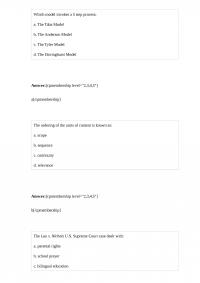
Which model invokes a 5 step process: a. The Taba Model b. The Anderson Model c. The Tyler Model d. The Havinghurst Model The ordering of the units of content is known as: a. scope b. sequence c. continuity d. […]
EDU 60815
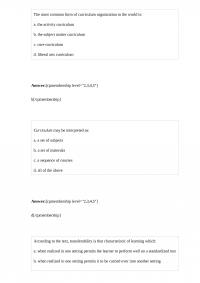
The most common form of curriculum organization in the world is: a. the activity curriculum b. the subject matter curriculum c. core curriculum d. liberal arts curriculum Curriculum may be interpreted as: a. a set of subjects b. a set […]
SED LR 79464
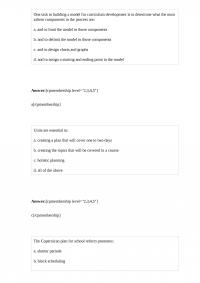
One task in building a model for curriculum development is to determine what the most salient components in the process are: a. and to limit the model to those components b. and to delimit the model to those components c. […]
EDUK 88765
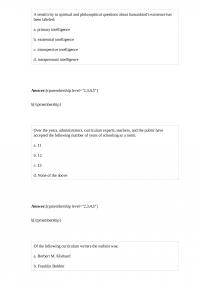
A sensitivity to spiritual and philosophical questions about humankind’s existence has been labeled: a. primary intelligence b. existential intelligence c. introspective intelligence d. intrapersonal intelligence Over the years, administrators, curriculum experts, teachers, and the public have accepted the following number […]
SESP 65730
Two types of preassessment are suggested: a. one to determine if the content of the class was learned by the pupil and whether the teachers needs to reteach the concepts b. one to evaluate the pupils’ possession of prerequisite knowledge […]
SESP 92196
The senior high school is involved in efforts to establish: a. a quality comprehensive model b. a number of alternatives both within and outside the school system c. higher requirements for graduation d. all of the above Allan C. Ornstein […]
EDUC 82233
When should ‘signal interference” be used with children who are impulsive? a. Before the behavior begins b. As the behavior escalates c. When the child is in a tantrum d. After the child has calmed down P.L. 105-17 (1997 Amendments […]
SED AP 81305
Most children fall within the “easy” category: adaptable, approachable, and positive in mood. Good behavior modification relies primarily on punishers. Answer: F The onset of ADHD is before the age of 5. Answer: T Constantly repeating key phrases is a […]
SED LR 93924
Growth and development tend to proceed from the outer extremities to the spine. The best intervention strategies evolve around activities within the context of daily living. Answer: T Low vision has a corrected visual acuity of no better than 20/70. […]
SED CE 57171
Anything that happens after a behavior is called a. Consequences b. Contingencies c. Antecedents d. Reinforcers According to Erikson’s stages of psychosocial development, when do children begin to develop a conscience? a. One b. Two c. Five d. Seven Answer: […]
SED DS 11340
Who develops the standards that describe what children might be reasonably expected to know and do at different ages or in different grades? Provide at least three sources. Describe the benefits of observational assessment. Answer: It is non-intrusive; yields instant […]
SED EM 43952
What does the adult do in the summing up phase of conflict mediation? a. Define the problem in mutual terms. b. Gain control of the disputed object. c. Summarize all different solutions suggested so far. d. Suggest ways for children […]
EDUC 18567
What is the primary reason for teachers to collect assessment data? a. Add to a child’s portfolio b. Prevent children from dropping out of school c. Inform instruction d. Preserve cultural bias. What statement best describes the role of families […]
SED CE 59027
Which of the following statements is true about techniques used in art, music, dance and drama? a. They are determined by the topic or theme of the activity. b. They are ways in which elements are manipulated and combined. c. […]
EDUK 92915
Which child is engaged in the most complex form of pretend play? a. Karen is making a nurses cap so that she can play nurse with other children as patients. b. Jacquel is quietly talking to herself as if she […]
SESP 83732
The teacher is planning a group time around the concept of leaves. The best approach would be to do which of the following things? a. Have real leaves for the children to look at and handle. b. Use a large […]
EDU 38681
Four-year-old Maureen points to a blue block and calls it green. According to your text, an appropriate response would be which of the following? a. “No, that’s not right. Try it again.” b. “You think that block is green. That […]
EDUK 98344
Which of the following is a gene that stimulates synapses to transmit signals? a. Axon b. CREB c. myelin d. neuron The 3-year-olds in Mrs. Mezga’s class at Missouri Central School are asked to create an Eskimo village out of […]