Archives
978-1506315133 Chapter 1 Discussion Question
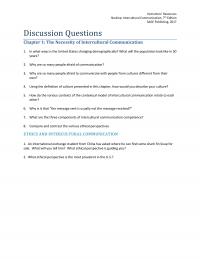
Discussion Questions Chapter 1: The Necessity of Intercultural Communication 1. In what ways is the United States changing demographically? What will the population look like in 50 years? 2. Why are so many people afraid of communication? 3. Why are […]
978-1506315133 Chapter 1 Lecture Note
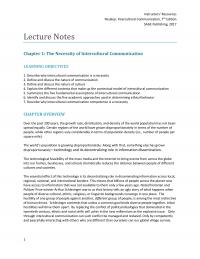
1 Lecture Notes Chapter 1: The Necessity of Intercultural Communication LEARNING OBJECTIVES 1. Describe why intercultural communication is a necessity 2. Define and discuss the nature of communication 3. Define and discuss the nature of culture 4. Explain the different […]
978-1506315133 Chapter 10 Discussion Question
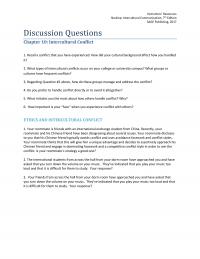
Discussion Questions Chapter 10: Intercultural Conflict 1. Recall a conflict that you have experienced. How did your cultural background affect how you handled it? 2. What types of intercultural conflicts occur on your college or university campus? What groups or […]
978-1506315133 Chapter 10 Lecture Note
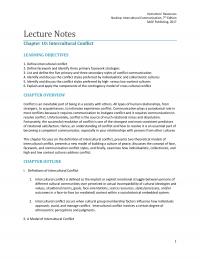
Instructors’ Resources Neuliep: Intercultural Communication, 7th Edition SAGE Publishing, 2017 1 Lecture Notes Chapter 10: Intercultural Conflict LEARNING OBJECTIVES 1. Define intercultural conflict 2. Define facework and identify three primary facework strategies 3. List and define the five primary and […]
978-1506315133 Chapter 11 Discussion Question
Discussion Questions Chapter 11: Intercultural Communication in Business, Health Care, and Educational Settings 1. How are the dominant cultural values of the United States reflected in U.S. management styles and U.S. company policies? 2. How might the U.S. management style […]
978-1506315133 Chapter 11 Lecture Note
Lecture Notes Chapter 11: Intercultural Communication in Business, Health Care, and Educational Settings LEARNING OBJECTIVES 1. Discuss how dimensions of the cultural context affect organizations across cultures 2. Compare managerial styles of Japanese, Germans, Mexicans, and Chinese 3. Compare the […]
978-1506315133 Chapter 12 Discussion Question
Discussion Questions Chapter 12: Acculturation, Culture Shock, and Intercultural Competence 1. What factors do you think would most affect you if you were to travel to another culture? 2. Which of the five modes of acculturation best describes your group? […]
978-1506315133 Chapter 12 Lecture Note
Instructors’ Resources Neuliep: Intercultural Communication, 7th Edition SAGE Publishing, 2017 1 Lecture Notes Chapter 12: Acculturation, Culture Shock, & Intercultural Competence LEARNING OBJECTIVES 1. Identify and discuss the factors that facilitate or hinder acculturation 2. Recognize and discuss the causes […]
978-1506315133 Chapter 2 Discussion Question
Discussion Questions Chapter 2: The Cultural Context 1. Do you feel that you belong to an individualistic or collectivistic culture? Why? What are the signs? 2. What are some of the ways that you use high-context communication? What are some […]
978-1506315133 Chapter 2 Lecture Note
Instructors’ Resources Neuliep: Intercultural Communication, 7th Edition SAGE Publishing, 2017 1 Lecture Notes Chapter 2: The Cultural Context LEARNING OBJECTIVES 1. Recognize that no culture is purely individualistic or purely collectivistic 2. Discuss the research behind the notion of a […]
978-1506315133 Chapter 3 Discussion Question
Discussion Questions Chapter 3: The Microcultural Context 1. To what microcultural groups do you belong? 2. What are the distinguishing characteristics of microcultures? 3. Who do you know who is a member of a microcultural group? 4. How are microcultural […]
978-1506315133 Chapter 3 Lecture Note
1 Lecture Notes Chapter 3: The Microcultural Context LEARNING OBJECTIVES 1. Define and explain the concept of a microculture and the criteria for membership 2. Recount the fundamental assumptions of the muted group theory 3. Provide examples of the various […]
978-1506315133 Chapter 4 Discussion Question
Discussion Questions Chapter 4: The Environmental Context 1. How does the information load of your classrooms change throughout the semester? 2. How does your perception of time (i.e., monochronic or polychronic) affect your daily life? Your study schedule? Your free […]
978-1506315133 Chapter 4 Lecture Note
Instructors’ Resources Neuliep: Intercultural Communication, 7th Edition SAGE Publishing, 2017 1 Lecture Notes Chapter 4: The Environmental Context LEARNING OBJECTIVES 1. Compare and contrast high– and low-load environments 2. Discuss the relationship between culture and the natural environment 3. Discuss […]
978-1506315133 Chapter 5 Discussion Question
Discussion Questions Chapter 5: The Perceptual Context 1. What are your initial impressions when you think about people from different cultures? 2. When you meet someone from a different culture, what do you remember about him/her? 3. Although difficult to […]
978-1506315133 Chapter 5 Lecture Note
Instructors’ Resources Neuliep: Intercultural Communication, 7th Edition SAGE Publishing, 2017 1 Lecture Notes Chapter 5: The Perceptual Context LEARNING OBJECTIVES 1. Discuss cross-cultural differences in perception 2. Define and discuss racial and ethnic stereotypes across cultures 3. Define and discuss […]
978-1506315133 Chapter 6 Discussion Question
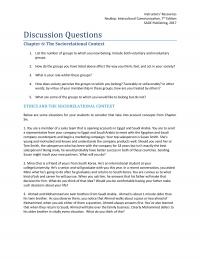
Discussion Questions Chapter 6: The Sociorelational Context 1. List the number of groups to which you now belong. Include both voluntary and involuntary groups. 2. How do the groups you have listed above affect the way you think, feel, and […]
978-1506315133 Chapter 6 Lecture Note
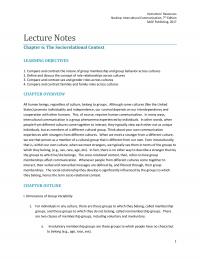
Instructors’ Resources Neuliep: Intercultural Communication, 7th Edition SAGE Publishing, 2017 1 Lecture Notes Chapter 6: The Sociorelational Context LEARNING OBJECTIVES 1. Compare and contrast the nature of group membership and group behavior across cultures 2. Define and discuss the concept […]
978-1506315133 Chapter 7 Discussion Question
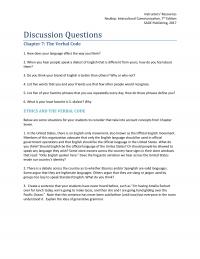
Discussion Questions Chapter 7: The Verbal Code 1. How does your language affect the way you think? 2. When you hear people speak a dialect of English that is different from yours, how do you feel about them? 3. Do […]
978-1506315133 Chapter 7 Lecture Note
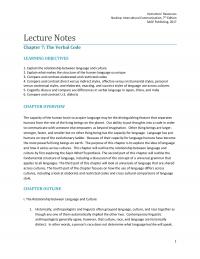
Instructors’ Resources Neuliep: Intercultural Communication, 7th Edition SAGE Publishing, 2017 1 Lecture Notes Chapter 7: The Verbal Code LEARNING OBJECTIVES 1. Explain the relationship between language and culture 2. Explain what makes the structure of the human language so unique […]
978-1506315133 Chapter 8 Discussion Question
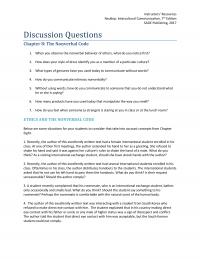
Discussion Questions Chapter 8: The Nonverbal Code 1. When you observe the nonverbal behavior of others, what do you notice first? 2. How does your style of dress identify you as a member of a particular culture? 3. What types […]
978-1506315133 Chapter 8 Lecture Note
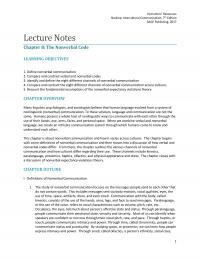
Instructors’ Resources Neuliep: Intercultural Communication, 7th Edition SAGE Publishing, 2017 1 Lecture Notes Chapter 8: The Nonverbal Code LEARNING OBJECTIVES 1. Define nonverbal communication 2. Compare and contrast verbal and nonverbal codes 3. Identify and define the eight different channels […]
978-1506315133 Chapter 9 Discussion Question
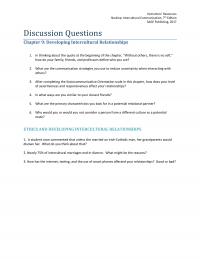
Discussion Questions Chapter 9: Developing Intercultural Relationships 1. In thinking about the quote at the beginning of the chapter, “Without others, there is no self,” how do your family, friends, and professors define who you are? 2. What are the […]
978-1506315133 Chapter 9 Lecture Note
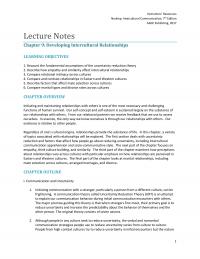
Instructors’ Resources Neuliep: Intercultural Communication, 7th Edition SAGE Publishing, 2017 1 Lecture Notes Chapter 9: Developing Intercultural Relationships LEARNING OBJECTIVES 1. Recount the fundamental assumptions of the uncertainty reduction theory 2. Describe how empathy and similarity affect intercultural relationships 3. […]
978-1506315133 Test Bank Chapter 01
Test Bank Chapter 1: The Necessity of Intercultural Communication Multiple Choice 1. Communicating and establishing relationships with people from different cultures can lead to a number of benefits, including healthier communities, increased commerce, reduced conflict, and ______. a. personal growth […]
978-1506315133 Test Bank Chapter 02
Test Bank Chapter 2: The Cultural Context Multiple Choice 1. Which of the following types of cultures emphasize individual goals over group goals? a. individualistic cultures b. large power distance cultures c. small power distance cultures d. high-context cultures Ans: […]
978-1506315133 Test Bank Chapter 03
Test Bank Chapter 3: The Microcultural Context Multiple Choice 1. In many cultures, microcultural group status is often determined by one’s membership in ______. a. sex and racial groups b. educational classes c. political organizations d. family clans Ans: A […]
978-1506315133 Test Bank Chapter 04
Test Bank Chapter 4: The Environmental Context Multiple Choice 1. The amount of information contained or perceived in the environment per some unit of time is also referred to as ______. a. the built environment b. one’s monochronic time orientation […]
978-1506315133 Test Bank Chapter 05
Test Bank Chapter 5: The Perceptual Context Multiple Choice 1. Perception is defined as ______. a. the long-term cognitive processing of information b. the short-term cognitive processing of information c. the mental interpretation of external stimuli via sensation d. the […]
978-1506315133 Test Bank Chapter 06
Test Bank Chapter 6: The Sociorelational Context Multiple Choice 1. Which of the following is an example of an involuntary membership group? a. age b. religion c. occupation d. education Ans: A Answer Location: Dimensions of Group Variability Learning Objective: […]
978-1506315133 Test Bank Chapter 07
Test Bank Chapter 7: The Verbal Code Multiple Choice 1. Which of the following statements best characterizes the Sapir-Whorf hypothesis? a. A person’s race and language are inherently linked. b. The language of a particular culture is innately “hard-wired” in […]
978-1506315133 Test Bank Chapter 08
Test Bank Chapter 8: The Nonverbal Code Multiple Choice 1. Which of the following terms refers to the study of communication with the body, including the use of hands, arms, legs, and face, to send messages? a. paralanguage b. haptics […]
978-1506315133 Test Bank Chapter 09
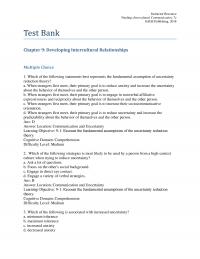
Test Bank Chapter 9: Developing Intercultural Relationships Multiple Choice 1. Which of the following statements best represents the fundamental assumption of uncertainty reduction theory? a. When strangers first meet, their primary goal is to reduce anxiety and increase the uncertainty […]
978-1506315133 Test Bank Chapter 10
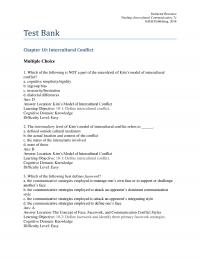
Test Bank Chapter 10: Intercultural Conflict Multiple Choice 1. Which of the following is NOT a part of the microlevel of Kim’s model of intercultural conflict? a. cognitive simplicity/rigidity b. ingroup bias c. insecurity/frustration d. dialectal differences Ans: D Answer […]
978-1506315133 Test Bank Chapter 11
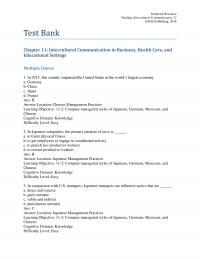
Test Bank Chapter 11: Intercultural Communication in Business, Health Care, and Educational Settings Multiple Choice 1. In 2015, this country surpassed the United States as the world’s largest economy. a. Germany b. China c. Japan d. France Ans: B Answer […]
978-1506315133 Test Bank Chapter 12
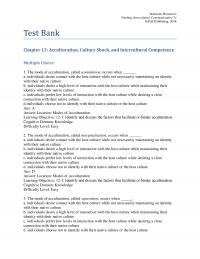
Test Bank Chapter 12: Acculturation, Culture Shock, and Intercultural Competence Multiple Choice 1. The mode of acculturation, called assimilation, occurs when ______. a. individuals desire contact with the host culture while not necessarily maintaining an identity with their native culture […]