Archives
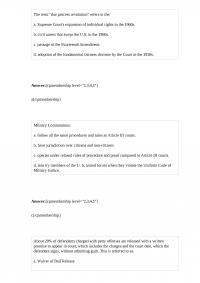
CCJ 45160
The term “due process revolution” refers to the: a. Supreme Court’s expansion of individual rights in the 1960s. b. civil unrest that swept the U.S. in the 1960s. c. passage of the Fourteenth Amendment. d. adoption of the fundamental fairness […]
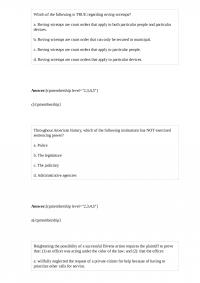
CCJ 50539
Which of the following is TRUE regarding roving wiretaps? a. Roving wiretaps are court orders that apply to both particular people and particular devices. b. Roving wiretaps are court order that can only be secured in municipal. c. Roving wiretaps […]
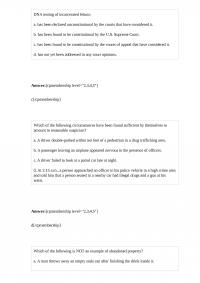
CCJ 51074
DNA testing of incarcerated felons: a. has been declared unconstitutional by the courts that have considered it. b. has been found to be constitutional by the U.S. Supreme Court. c. has been found to be constitutional by the courts of […]
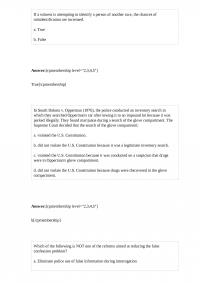
CCJ 63700
If a witness is attempting to identify a person of another race, the chances of misidentification are increased. a. True b. False In South Dakota v. Opperman (1976), the police conducted an inventory search in which they searched Opperman’s car […]

Chapter 1 Procedure Road Map Learning Objectives Crprsama15010 The
1. In a constitutional democracy: a. the majority could authorize the police to arrest an individual based on the hunch that he/she committed a crime. b. the majority has total power to determine how much authority the police have. c. […]

Chapter 10 Justifications The Exclusionary Rule Learning
1. What is another term used to describe probative evidence, or evidence that proves (or helps to prove) defendants committed the crimes they are charged with? a. Bad evidence b. Good evidence c. Bad methods d. Exclusionary evidence ANSWER: b […]

Chapter 11 Law Enforcement Duty Protect Learning
1. The U.S. government can be sued for the constitutional torts of federal law enforcement officers who have the authority to search and arrest under: a. the Bivens rule. b. the Federal Tort Claims Act. c. Section 1983. d. state […]

Chapter 12 The First Appearance Learning Objectives
1. In _______________ cases, prosecutors agree to drop the case before formal judicial proceedings begin, on the condition that suspects participate in and complete a program. a. diversion b. validated c. discretion-laden d. selective ANSWER: a REFERENCES: The Decision to […]

Chapter 13 Concerning the functioning of twelve member juries, social
1. Regarding the right to a public trial, which of the following is FALSE? a. It is a personal right that only defendants may invoke. b. The press and public have a right of access to criminal trials. c. The […]

Chapter 14 Supreme Court Review Lower Court Decision Called
True / False 1. After conviction, a criminal defendant is still presumed not guilty during the appeal process. a. True b. False ANSWER: False REFERENCES: Sentencing LEARNING OBJECTIVES: CRPR.SAMA.15.14.06 – 06 CRPR.SAMA.15.15.01 – 01 2. Throughout history, fixed sentences have […]

Chapter 15 Patriot Act The Crime Control And Safe
1. Thegovernment’suseofextraordinarypower: a. is only limited by necessity. b. is unlimited and can be used for any length of time. c. can be used only when it is absolutely necessary and must be given up when the emergency is over. […]

Chapter 2 Us Constitution Binding On All Lower Federal
1. The Sixth Amendment guarantees which of the following? a. The right to be free from unreasonable searches. b. The right against double jeopardy. c. The right to an impartial jury. d. The right to due process of law. ANSWER: […]

Chapter 3 Supreme Court Ruled On Stop And Frisk
1. Until 1967, the U.S. Supreme Court defined searches mainly according to property law. According to the ____________, to qualify as a search, officers had to invade physically a“constitutionallyprotected area.” a. constitutionality doctrine b. privacy doctrine c. trespass doctrine d. […]

Chapter 4 Stops And The Fourth Amendment
1. The objective basis for stops and frisks is: a. the same as for arrests. b. higher than for arrests. c. lower than for arrests. d. the same as for full searches of a person. ANSWER: c REFERENCES: Stop and […]

Chapter 5 Police Dog Grabbed And Held Defendants Arm
1. Stops differ from arrests in that: a. they always lead to a frisk or more invasive search. b. they produce written records of the police action. c. they occur in public places and are shorter in duration. d. they […]

Chapter 6 Consent Searches Learning Objectives Crprsama
1. WhichofthefollowingisNOToneoftherequirementstosatisfytheFourthAmendment’swarrantrequirement? a. Reasonable suspicion b. Particularity requirement c. Probable cause affidavit d. Knock-and-announce rule ANSWER: a REFERENCES: Searches with Warrants LEARNING OBJECTIVES: CRPR.SAMA.15.06.02 – 02 2. The Fourth Amendment particularity requirement for search warrants: a. does not require a […]

Chapter 7 The Supreme Court Decided That The Search
1. The Fourth Amendment: a. applies only to criminal cases. b. protects just those in criminal cases. c. limits the right to search to the gathering and use of evidence in criminal cases. d. includes searches which go beyond the […]

Chapter 8 In screening the police procedures that are used during the accusatory stage
Chapter 08: SELF-INCRIMINATION SELF-INCRIMINATION Powered by Cognero Page 1 ANSWER: False REFERENCES: Miranda v. Arizona LEARNING OBJECTIVES: CRPR.SAMA.15.08.04 – 04 True / False 1. The right to remain silent is an ancient right. a. True b. False ANSWER: True REFERENCES: […]

Chapter 9 accidental show-ups are preferably to organized line-ups
1. Which of the following are major procedures used by the police to help eyewitnesses identify suspects? a. A confrontation, a photo identification, a lineup, and/or a show-up. b. A photo identification, a lineup, and/or a show-up. c. A confrontation, […]
CRIM 54111
According to the Supreme Court in Ballewv.Georgia: a. a five person jury satisfies the Sixth Amendment b. a five person jury does not satisfy the Sixth Amendment c. it’s not clear whether a five person jury is constitutional d. a […]
CRIM 58953
One of the primary differences between interrogating criminal suspects and suspected terrorists, which impacts whether the interrogation techniques are legal is: a. the suspected terrorist will most likely be a noncitizen and the criminal suspect most likely be a citizen. […]
CRIM 63116
Prosecutors and defense attorneys can remove potential jurors without having a reason using the: a. peremptory challenge. b. challenge for cause. c. voir dire. d. exemption from service objection. The US Supreme Court has held that a citizen can have […]
EDU 50039
Research indicates that most eye witnesses to crimes are very good at acquiring accurate information while the crime is being committed. a. True b. False Research indicates that mandatory minimum sentences actually introduce disparity in sentencing. a. True b. False […]
EDUC 28082
The court’s holding is: a. also called a judgment. b. found in the case’s procedural history. c. the legal rule the court applied to the facts of the case. d. the also called the majority opinion. Research by psychologists shows […]
EDUC 37717
In which of the following situations have the courts found a use of unreasonable force? a. Police dog grabbed and held a defendant’s arm until the police arrived. b. Use of pepper spray on an armed suspect. c. Binding a […]
EDUC 74840
By the early 1970s, there was a consensus among law enforcement officials, prisoners’ groups, reformers, and bureaucrats that indeterminate sentencing should be replaced with a more determinate sentencing system. a. True b. False According to research by sociologist Richard Leo, […]
EDUC 81130
An appeal from a trial court’s judgment of conviction: a. is considered a direct attack. b. can be taken multiple times. c. can only be taken if the trial court certifies there are important issues for the higher court to […]
LAWS 37407
The court considered all of the following in Board of Education v Earls(2002) except: a. the ramifications of a failed UA on the student (for example, legal sanctions, academic discipline). b. the type of extra-curricular activity the tested students wanted […]
MET CJ 22655
According to Justice William Brennan, by the 1970s, the incorporation doctrine had virtually no impact on law. a. True b. False The U.S. Supreme Court has used the due process clause of the Fifth Amendment to extend most of the […]
MET CJ 38405
Which of the following is TRUE? a. Every state and the federal government now have statutes that mandate DNA testing of all incarcerated felons. b. Every state and the federal government now have statutes that mandate DNA testing of all […]
MET CJ 93299
Although it is the highest court in the land, the U.S. Supreme Court depends on local courts and the police to apply its decisions to daily situations. a. True b. False There is consensus today that it is possible to […]
MET CJ 98799
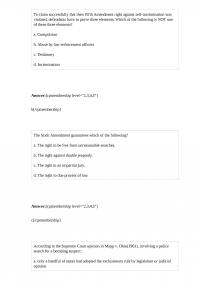
To claim successfully that their Fifth Amendment right against self-incrimination was violated, defendants have to prove three elements. Which of the following is NOT one of these three elements? a. Compulsion b. Abuse by law enforcement officers c. Testimony d. […]
MET UA 21045
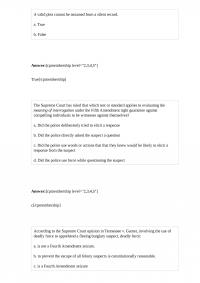
A valid plea cannot be assumed from a silent record. a. True b. False The Supreme Court has ruled that which test or standard applies to evaluating the meaning of interrogation under the Fifth Amendment right guarantee against compelling individuals […]
MET UA 23168
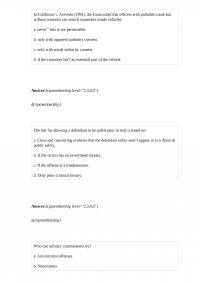
In California v. Acevedo (1991), the Court ruled that officers with probable cause but without warrants can search containers inside vehicles: a. never ” this is not permissible. b. only with apparent authority consent. c. only with actual authority consent. […]
MET UA 53554
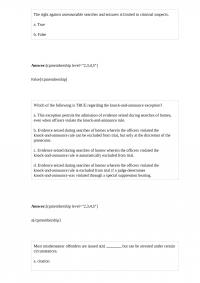
The right against unreasonable searches and seizures is limited to criminal suspects. a. True b. False Which of the following is TRUE regarding the knock-and-announce exception? a. This exception permits the admission of evidence seized during searches of homes, even […]
MET UA 94020
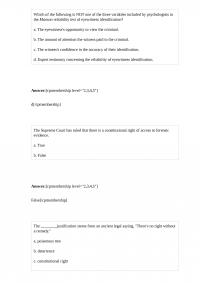
Which of the following is NOT one of the three variables included by psychologists in the Manson reliability test of eyewitness identification? a. The eyewitness’s opportunity to view the criminal. b. The amount of attention the witness paid to the […]
SED LR 37370
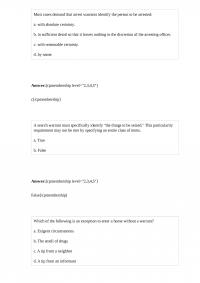
Most cases demand that arrest warrants identify the person to be arrested: a. with absolute certainty. b. in sufficient detail so that it leaves nothing to the discretion of the arresting officer. c. with reasonable certainty. d. by name. A […]
SED LR 94702
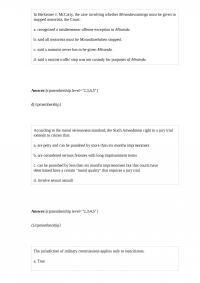
In Berkemer v. McCarty, the case involving whether Mirandawarnings must be given to stopped motorists, the Court: a. recognized a misdemeanor offense exception to Miranda. b. said all motorists must be Mirandizedwhen stopped. c. said a motorist never has to […]
SESP 10623
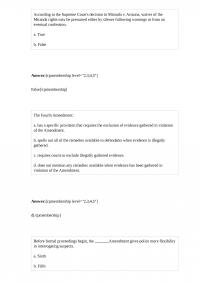
According to the Supreme Court’s decision in Miranda v. Arizona, waiver of the Miranda rights may be presumed either by silence following warnings or from an eventual confession. a. True b. False The Fourth Amendment: a. has a specific provision […]