True / False
1. After conviction, a criminal defendant is still presumed not guilty during the appeal process.
a. True
b. False
2. Throughout history, fixed sentences have totally dominated criminal sentencing.
a. True
b. False
3. Bytheearly1970s,therewasaconsensusamonglawenforcementofficials,prisoners’groups,reformers,and
bureaucrats that indeterminate sentencing should be replaced with a more determinate sentencing system.
a. True
b. False
4. Fixedsentencinghastwoprimaryforms–sentencingguidelinesanddiscretion.
a. True
b. False
5. Indeterminate sentencing requires a judge to impose a nondiscretionary minimum period of incarceration that
everyone convicted of that crime must serve.
a. True
b. False
Chapter 14: AFTER CONVICTION
AFTER CONVICTION
6. Research indicates that mandatory minimum sentences actually introduce disparity in sentencing.
a. True
b. False
7. Mandatory minimum sentences shift discretion from judges to prosecutors.
a. True
b. False
8. Every state jurisdiction has created a statutory right to appeal.
a. True
b. False
9. Justices on the U.S. Supreme Court are divided on whether the proportionality principle applies to sentences of
imprisonment.
a. True
b. False
10. In the case Lockyer v. Andrade (2003), the Supreme Court ruled that it was a violation of the Eighth
Amendment’scruelandunusualpunishmentclausetosentenceAndradeto25yearstolifeimprisonmentforpetty
theftunderthestate’sthreestrikeslaw.
a. True
b. False
11. Not every state has created a statutory right to appeal a criminal conviction.
a. True
b. False
12. According to the broad view of habeas corpus, the 1867 Habeas Corpus Act authorizes courts to review the
entirestateproceedingtodetermineiftherewasaviolationofadefendant’sconstitutionalrights.
a. True
b. False
13. The criminal process is a blend of the formal law of criminal procedure and the informal influences that enter the
process by way of discretion.
a. True
b. False
14. A proceeding to review the constitutionality of detention or imprisonment is referred to as stare decisis.
a. True
b. False
15. A discretionary order of the Supreme Court to review a lower court decision is called a writ of review or a writ of
certiorari.
a. True
b. False
Multiple Choice
16. Which of the following is FALSE about the history of sentencing?
a. The concern over judicial discretion in sentencing has an ancient heritage.
b. Fixed sentencing prevailed from the 1600s until the latter part of the 1800s.
c. A shift toward indeterminate sentences began in the latter part of the 1800s.
d. In the 20th century, fixed sentences totally dominated criminal sentencing.
17. In the U.S., indeterminate sentencing was the dominant form of sentencing until the 1970s, when several forces
came together to oppose it. These forces included all of the following, EXCEPT:
a. reformers concerned about harsh, fixed sentences.
b. public discontent with rehabilitation.
c. individual rights advocates who opposed the informal discretionary power of judges.
d. increased demands for formal accountability throughout the criminal justice system.
18. Throughout American history, which of the following institutions has NOT exercised sentencing power?
a. Police
b. The legislature
c. The judiciary
d. Administrative agencies
19. By 1970, which of the following ideas did NOT dominate thinking about sentencing?
a. Sentencing should have rehabilitation of the offender at least as a partial goal.
b. Repeat career criminals require severe punishment to incapacitate them.
c. Many offenders deserve severe punishment because they have committed serious crimes.
d. All crimes deserve some punishment to retain the deterrent potency of the criminal law.
Chapter 14: AFTER CONVICTION
AFTER CONVICTION
20. Fixed (determinate) sentencing:
a. is currently the only form of sentencing in all jurisdictions in the U.S.
b. is currently not in favor in any U.S. jurisdiction.
c. shares the stage with indeterminate sentencing but is being adopted by more and more jurisdictions.
d. is only found in mandatory minimum statutes.
21. Which types of crimes are the main targets of mandatory minimum sentencing?
a. Sex offenses.
b. Theft offenses.
c. Regulatory crimes.
d. Drug offenses and crimes committed with a weapon.
22. Sentencing guidelines are a response to demands from both experts and the public for all of the following
EXCEPT:
a. uniformity in sentencing.
b. certainty and truth in sentencing.
c. increased rehabilitation of offenders.
d. retribution, deterrence, and incapacitation.
23. Sentences determined under sentencing guidelines are based primarily on a combination of the:
a. seriousnessofthecrimeandtheoffender’sage.
b. seriousness of the crime and the harm caused to the victim.
c. offender’scriminalhistoryandwhetherthecrimewasviolent.
d. seriousnessofthecrimeandtheoffender’scriminalhistory.
24. ____________ sentencing is tailoring punishment to suit the criminal and puts the power to sentence in the hands
of judges and parole boards.
a. Fixed
b. Determinate
c. Indeterminate
d. Presumptive
25. In the administrative sentencing model, who prescribes the range of allowable prison times for particular crimes?
a. Judges and the legislature
b. The legislature
c. Judges
d. Only the judge that hears the case
26. Which of the following was NOT among the reasons for repeal of mandatory minimum sentences for drug
offenses in the early 1970s?
a. Alienation of youth from general society
b. Belief that the war on drugs was ending
c. Hampering the rehabilitation of drug offenders
d. Reduction of the deterrent of drug laws, because even prosecutors thought the penalties were too harsh
27. Which of the following is NOT one of the aims of criminal punishment that mandatory minimum sentences attempt
to satisfy?
a. Retribution
b. Rehabilitation
c. Incapacitation
d. Deterrence
28. Concerning mandatory minimum sentencing laws, evaluations conducted by the U.S. Sentencing Commission
found that:
a. mandatory minimum sentences eliminate discretion.
b. mandatory minimum sentences actually introduce disparity in sentencing.
c. mandatory minimum sentencing provisions are used in almost all cases for sentencing.
d. offenders sentenced to mandatory minimum sentences have higher recidivism rates.
29. A majority of the U.S. Supreme Court Justices agree that the principle of proportionality applies to:
a. death sentences.
b. sentences leading to imprisonment.
c. death sentences and sentences leading to imprisonment.
d. sentencing leading to imprisonment and probation.
30. In Lockyer v. Andrade (2003), the Supreme Court held that a 25-year to life sentence for petty theft under the
state’sthreestrikeslaw:
a. violatedtheConstitutionbecauseitwasdisproportionatetoAndrade’scrime.
b. didnotviolatetheConstitutionandwasjustifiedbythestate’sinterestinincapacitatinganddeterringrepeat
offenders.
c. violated the Constitution because it was cruel and unusual punishment.
d. didnotviolatetheConstitutionbecausetheEighthAmendmentdoesn’tapplytostatesentences.
31. The Boggs Act (1951) signaled a shift to what type of sentences?
a. Sentences based on sentencing guidelines
b. Indeterminate sentences
c. Mandatory minimum sentences
d. Determinate sentences
32. Which court case ruled that the U.S. Sentencing Guidelines are advisory but that they enjoy the presumption of
reasonableness?
a. U.S. v. Booker
b. Rita v. U.S.
c. Apprendi v. New Jersey
d. Gall v. U.S.
33. According to the U.S. Supreme Court, the death penalty is not cruel and unusual punishment if:
a. it is automatically applied to all murderers.
b. aggravating circumstances can support it.
c. there is a review procedure to ensure against discriminatory application.
d. judges and juries both agree in a particular case that death is appropriate.
34. Which of the following would NOT be considered an aggravating factor in a death penalty case?
a. Prior conviction of a misdemeanor
b. Killing to avoid arrest
c. Felony murder
d. Killing during escape from lawful custody
35. Which of the following is NOT considered a mitigating circumstance in a death penalty case?
a. Killing to avoid arrest
b. No significant prior criminal record
c. Minor participant in the murder
d. Youth at the time of the murder
36. Research shows that:
a. Whites who kill blacks are more likely to receive the death penalty.
b. Blacks and Whites who kill Whites are more likely to receive the death penalty than either Blacks who kill
Blacks or Whites who kill Blacks.
c. Blacks who kill Blacks are just as likely to receive the death penalty as Whites who kill Blacks.
d. The race of the victim does not affect the likelihood of an offender receiving the death penalty.
37. According to the Supreme Court with regard to appeals, states:
a. must allow one appeal as a matter of right in all criminal cases.
b. must allow one appeal as a matter of right in all felony cases.
c. must allow one appeal as a matter of right in all criminal cases to which the right to a jury trial attaches.
d. need not provide any appeal at all.
38. The writ of certiorari:
a. requires the Supreme Court to hear and decide a case.
b. isarequesttoacourttodecideonthelegalityofaprisoner’sincarceration.
c. is a discretionary writ, which allows the Supreme Court to either agree or not agree to hear and decide a
case.
d. mandates a party to turn over evidence to the other party in the case.
39. Which of the following is NOT a legitimate sentencing model?
a. Administrative Sentencing Model
b. Police Sentencing Model
c. Legislative Sentencing Model
d. Judicial Sentencing Model
40. The U.S. Supreme Court has increasingly denied petitions for writ of certiorari thus reducing the number of cases
it will review. The following two doctrines limit the scope of state appellate review:
a. the raise-or-waive doctrine and the collateral consequences doctrine.
b. the mootness doctrine and the collateral doctrine.
c. the mootness doctrine and the raise or waive doctrine.
d. the mootness doctrine and the plain-error rule.
41. According to the raise or waive doctrine, a defendant must make objections at trial in order to preserve those
issues for appeal. This is called the _________ doctrine.
a. judicial economy
b. collateral consequences
c. habeas corpus
d. mootness
42. Anappealfromatrialcourt’sjudgmentofconviction:
a. is considered a direct attack.
b. can be taken multiple times.
c. can only be taken if the trial court certifies there are important issues for the higher court to hear.
d. is the equivalent of habeas corpus.
43. Lockyer v. Andrade (2003) dealt with which of the following constitutional questions?
a. Proportionality of a death sentence in a child rape and assault case
b. Acceptability of sentencing a convicted felon in absentia
c. Permissibilityofa50yearsentenceforshopliftingundera“threestrikes”law
d. Denial of a duly filed habeas corpus petition seeking judicial relief
44. During the Warren Court era of the Supreme Court, the Court:
a. took a narrow view of the Habeas Corpus Act of 1867.
b. took a broad view of the Habeas Corpus Act of 1867.
c. declared the Habeas Corpus Act of 1867 unconstitutional.
d. did not decide any cases dealing with the Habeas Corpus Act of 1867 .
45. In Blakely v. Washington the U.S. Supreme Court:
a. inessenceupheldWashingtonState’ssentencingguidelinescheme.
b. upheldthedefendant’ssentence,statingitcompliedwiththerulingsetforthinApprendi v. New Jersey.
c. inessence,struckdownWashingtonState’ssentencingguidelinescheme.
d. heldthatWashingtonState’ssentencingguidelineschemewasnotimplicatedunderthefactsofthiscasein
that it dealt only with a maximum not a minimum sentence.
46. _________ are vested with the sole authority in determinate sentencing schemes.
a. Legislators
b. Judges
c. Police officers
d. Prosecutors
47. The writ of habeas corpus:
a. dates back to the 1867 Habeas Corpus Act.
b. is not mentioned in the U.S. Constitution.
c. has a long and distinguished history and protected Englishmen from tyrannical English kings.
d. has not been addressed by the U.S. Supreme Court in many opinions.
Chapter 14: AFTER CONVICTION
AFTER CONVICTION
48. In Booker v. U.S., the Supreme Court ruled that the Federal Sentencing Guidelines:
a. are advisory, but enjoy a presumption of reasonableness.
b. are advisory and judges can depart without explanation.
c. are mandatory for all federal crimes.
d. are mandatory for certain serious felonies.
49. A state prisoner who seeks review of his case under a writ of habeas corpus in federal court can obtain review
only if his claim:
a. is that he is innocent of the crime of which he was convicted.
b. is based on an alleged violation of a federal constitutional or statutory right.
c. is a search and seizure claim.
d. is a claim of ineffective assistance of counsel.
50. A habeas corpus proceeding which is a separate civil action that does not challenge the guilt of the defendant, but
insteadthelawfulnessofthedefendant’simprisonmentisreferredtoasa(n):
a. collateral attack.
b. writ of error
c. injunction
d. collateral estoppel
51. Parole boards and prison administrators determine the exact release date within sentences prescribed by judges
and legislatures in the __________ _____________ model.
Chapter 14: AFTER CONVICTION
AFTER CONVICTION
52. _________ __________ demands that the government justify the detention and incarceration of prisoners.
53. __________ __________ relies heavily on the discretion of judges and parole boards in exercising sentencing
authority.
54. Judges prescribe sentences within broad formal contours set by legislative acts in the __________ ___________
model.
55. Legislatures prescribe specific penalties that judges and administrative agencies cannot alter in the __________
___________ model.
56. A type of fixed sentence that prescribes a non-discretionary amount of prison time that all offenders convicted of
the offense must serve is a _____________ ______________ sentence.
57. The traditional legal doctrine which held that criminal cases could not be appealed if the sentence had been
satisfied is called the __________ doctrine.
Chapter 14: AFTER CONVICTION
AFTER CONVICTION
58. The rule that an alleged error at trial may be raised on appeal even if the error was not objected to at trial so long
as it was a clear error affecting substantial rights and causing manifest injustice is called the __________
__________ rule.
59. The ______________ of 1996 substantially amends and narrows the federal habeas corpus rights of both state
and federal prisoners.
60. Proceedingswhichattackthetrialcourt’sjudgmentofconvictionaspartofthesamecaseare__________
__________.
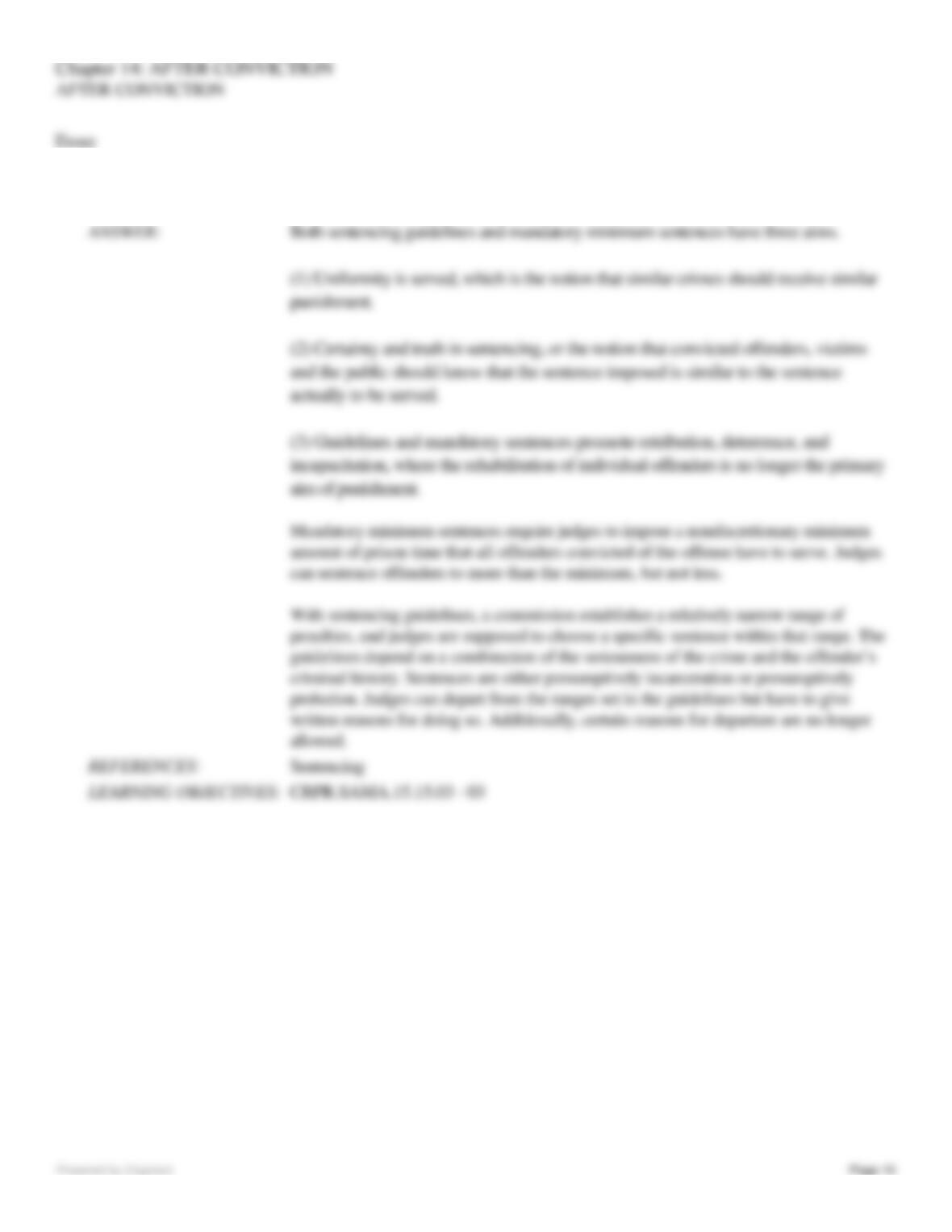
61. Compare and contrast sentencing guidelines and mandatory minimum sentences, and identify three aims of each
type of sentence.
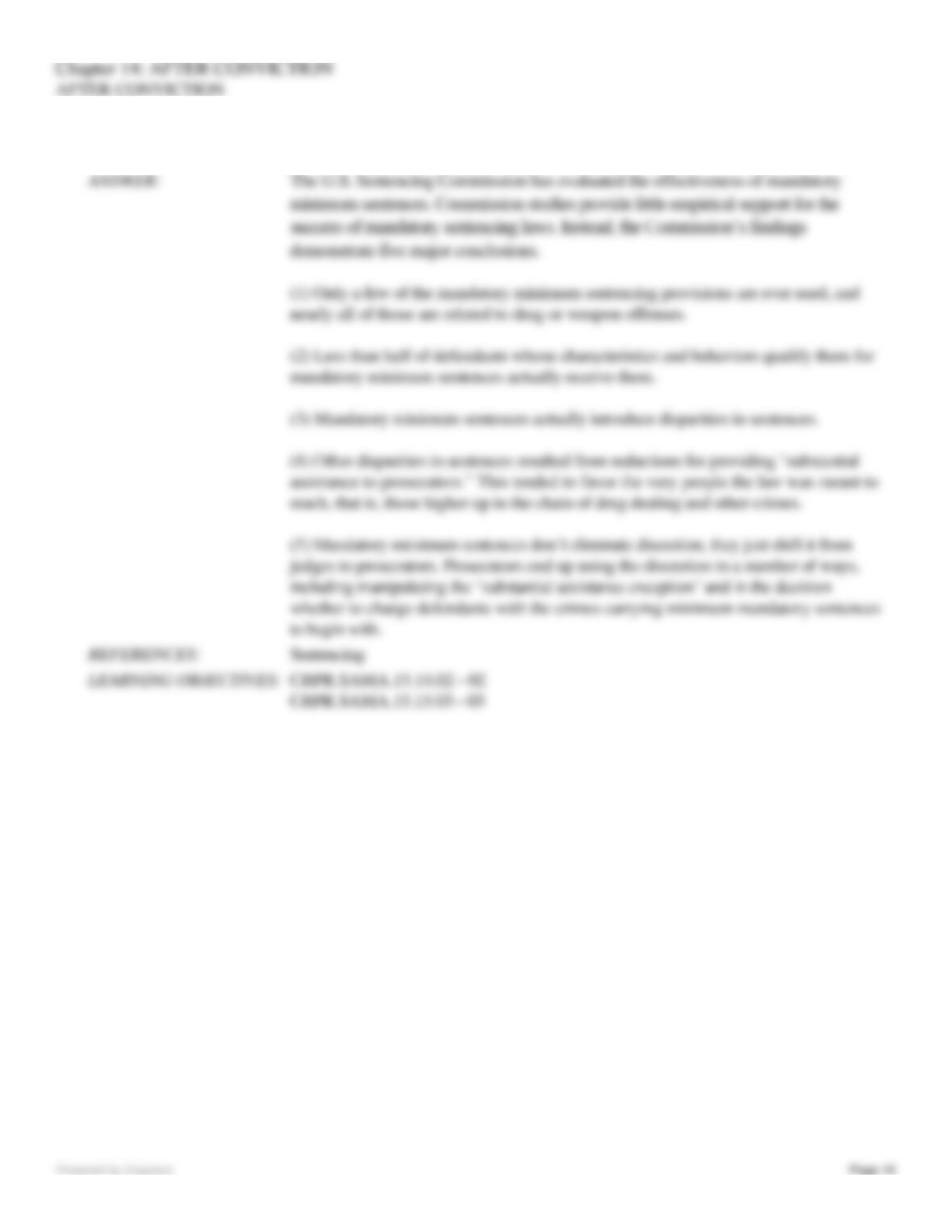
62. Summarize the five main empirical findings on the effectiveness of mandatory minimum sentences.
63. Summarize the limits on the rights of offenders at sentencing, and explain the reasons for the limits.
64. Identify the nature and circumstances of the right to appeal a conviction.
65. Describe the progress through direct appeal and collateral attack.