1. The Sixth Amendment guarantees which of the following?
a. The right to be free from unreasonable searches.
b. The right against double jeopardy.
c. The right to an impartial jury.
d. The right to due process of law.
2. Criminal procedure refers to the methods the government can use to:
a. investigate criminals.
b. investigate and prosecute criminals.
c. investigate, prosecute, and convict criminals.
d. investigate, prosecute, convict, and punish criminals.
3. The sources of American criminal procedure law include:
a. the U.S. Constitution.
b. federal rules of criminal procedure and state court opinions.
c. U.S. Supreme Court decisions and federal rules of criminal procedure.
d. the U.S. Constitution, U.S. Supreme Court decisions, federal rules of criminal procedure, and state court
opinions.
4. Which of the following is NOT a source of criminal procedural law?
a. State court opinions
b. Model Code of Pre-Arraignment Procedure
c. Administrative agency regulations
d. State rules of criminal procedure
Chapter 02: CRIMINAL PROCEDURE AND THE CONSTITUTION
CRIMINAL PROCEDURE AND THE CONSTITUTION
5. Accordingtothe_____________,theU.S.SupremeCourt’sinterpretationtrumpstheinterpretationofallother
courts, federal and local, and of Congress and all state and local legislatures.
a. Supremacy clause
b. Principle of judicial review
c. Supervisory power clause
d. Supreme review clause
6. The due process revolution occurred:
a. during the 16th and 17th centuries.
b. between 1781 and 1900.
c. in the new era of crime control between 1900 and 1960.
d. between 1960 and 1969.
7. The Supremacy Clause of the U.S. Constitution:
a. explicitly provides for judicial review.
b. vests final government authority in the U.S. Constitution.
c. only applies to the federal government.
d. does not apply to state court decisions.
8. The U.S. Supreme Court has the power to manage how the lower federal courts conduct their business. This is
calledtheCourt’s:
a. power of judicial review.
b. due process standard.
c. supreme power.
d. supervisory power.
Chapter 02: CRIMINAL PROCEDURE AND THE CONSTITUTION
CRIMINAL PROCEDURE AND THE CONSTITUTION

9. A decision of the U.S. Supreme Court that is based on an interpretation of a provision of the U.S. Constitution is
binding on:
a. all lower federal courts only.
b. state courts only.
c. both state courts and lower federal courts.
d. all other U.S. courts, but only for the next twenty years.
10. The U.S. Constitution:
a. sets minimum national constitutional standards.
b. sets the highest possible constitutional standards, but only for the federal government.
c. sets the highest possible constitutional standards, both for state and national governments.
d. prescribes detailed rules for police officers to follow when arresting citizens.
11. Theterm“parallelrights”refersto:
a. rights guaranteed by a state constitution that are similar to the rights guaranteed by the U.S. Constitution.
b. rights guaranteed by a state constitution that include rights not guaranteed by the U.S. Constitution.
c. rights guaranteed by state statute that are similar to the rights included in the state constitution.
d. state rights that have been replaced by federal rights.
12. The Fourteenth Amendment:
a. was enacted after the Civil War and helped establish federal supremacy over states’ rights.
b. contains a due process clause.
c. embodied the idea that all are entitled to equal rights.
d. was enacted after the Civil War, helped establish federal supremacy over states’ rights, embodied the idea
that all are entitled to equal rights, and contains a due process clause.
Chapter 02: CRIMINAL PROCEDURE AND THE CONSTITUTION
CRIMINAL PROCEDURE AND THE CONSTITUTION

13. With respect to the Fourteenth Amendment due process clause:
a. the Supreme court has defined it differently over time.
b. it applied initially to the federal government only.
c. courts did not extend its protection to state criminal justice during the 20th century.
d. due process is synonymous with equal protection.
14. Theterm“dueprocessrevolution”referstothe:
a. SupremeCourt’sexpansionofindividualrightsinthe1960s.
b. civil unrest that swept the U.S. in the 1960s.
c. passage of the Fourteenth Amendment.
d. adoption of the fundamental fairness doctrine by the Court in the 1930s.
15. According to your text, which of the following subjects is not a primary object of study in a criminal procedure
course?
a. Equal protection of the law
b. Criminal law
c. Procedural due process
d. Fundamental fairness
16. In Hurtado v. California(1884),involvingthemurderbyHurtadoofhiswife’slover,theSupremeCourtruled
that the Fourteenth Amendment due process clause:
a. requires jury trials in all state courts.
b. requires states to provide a grand jury indictment in capital cases.
c. doesnotforbidstatestousethedeathpenaltybecauseitdoesnotdefinedefendantsofa“fundamental
right”incapitalcases.
d. does not require states to provide a grand jury indictment in capital cases.
Chapter 02: CRIMINAL PROCEDURE AND THE CONSTITUTION
CRIMINAL PROCEDURE AND THE CONSTITUTION

17. The First World War and the rise of fascism:
a. gave rise to a stronger faith in government in America.
b. had little or no effect on American criminal procedure.
c. led to calls for the abolition of the Fourteenth Amendment.
d. revived traditional American fears of arbitrary government.
18. According to the Supreme Court in Powell v. Alabama,thefamous“ScottsboroCase”of1932involvingseveral
black youths accused of raping two white girls on a train:
a. the entire Bill of Rights applies to state criminal procedure.
b. thedueprocessclauserequiresstatestofollowallofthefederalgovernment’srulesofcriminalprocedure.
c. all criminal defendants are entitled to a lawyer in every criminal case free of charge.
d. in the severe circumstances of this case, the state was required under the federal Constitution to provide
counsel for the defendants.
19. The fundamental fairness doctrine of due process requires states to provide:
a. notice to defendants of the charges against them, an attorney at state expense if they cannot afford one, and a
hearing on the facts before conviction and punishment.
b. notice to defendants of the charges against them and hearing on the facts before conviction and punishment.
c. a grand jury proceeding only.
d. notice to defendants of the charges against them, a grand jury proceeding, and a hearing on the facts before
conviction and punishment.
Chapter 02: CRIMINAL PROCEDURE AND THE CONSTITUTION
CRIMINAL PROCEDURE AND THE CONSTITUTION
20. In Hurtado v. California the defendant complained that his Fifth Amendment rights were violated because he
was not properly indicted by a grand jury. The Supreme Court ruled against him because:
a. hiscrimewasn’tacapitalorotherwiseinfamouscrime.
b. California, unlike the federal government, could use an information rather than a grand jury indictment to
charge Hurtado.
c. he confessed, so due process was irrelevant.
d. the California grand jury had properly indicted him.
21. The Eighth Amendment guarantees which of the following?
a. The right to be free from unreasonable searches.
b. The right against double jeopardy.
c. The right to an impartial jury.
d. The right against cruel and unusual punishment.
22. In which case did the court say that regarding selective enforcement of drug laws the majority of elevated penalties
fall on Blacks while the majority of users were white?
a. Miranda v Arizona
b. Terry v Ohio
c. U.S. v Armstrong
d. U.S. v Weeks
23. Constitutionalism assumes which of the following statements to be TRUE?
a. Laws and constitutions are both considered to be sets of guidelines for behavior.
b. Constitutions can never be changed under any circumstances once created.
c. The constitution is never considered to be binding on the government in any way.
d. Constitutions embody the core values and collective will of the people.
Chapter 02: CRIMINAL PROCEDURE AND THE CONSTITUTION
CRIMINAL PROCEDURE AND THE CONSTITUTION

24. The Supreme Court in Rochin v. California, involving police officers who forced a stomach pumping in order to
retrieve swallowed narcotics,held that the:
a. Fifth Amendment applies to the states.
b. Fourth Amendment applies to the states.
c. Fifth Amendment due process clause does not apply to the states.
d. police conduct shocked the conscience and violated due process.
25. Although he concurred with the result in Rochin v. California,JusticeBlackdisagreedwiththemajority’s
approach to deciding what constitutes due process because he felt:
a. that the conviction should have stood.
b. themajority’sapproachgaveindividualjusticestoomuchleewaytoenforcetheirownnotionsofjusticeon
the states.
c. it was too rigid and unbending.
d. the Court had no business reviewing state court convictions.
26. Selective incorporation means:
a. the state legislatures can select which provisions in the Bill of Rights to incorporate.
b. only some of the Bill of Rights are incorporated into the due process clause of the Fourteenth Amendment.
c. only the Fourth and Fifth Amendments are incorporated into the due process clause of the Fourteenth
Amendment.
d. state supreme courts shall decide which provisions in the Bill of Rights their states should incorporate.
Chapter 02: CRIMINAL PROCEDURE AND THE CONSTITUTION
CRIMINAL PROCEDURE AND THE CONSTITUTION
27. In Palko v. Connecticut (1937), what procedural issue is referenced by Justice Cardozo in his opinion
concerning the applicability of the Bill of Rights to the states?
a. Excessive bail
b. Double jeopardy
c. Fundamental fairness
d. Ineffective counsel
28. The total incorporation doctrine:
a. leaves the states more freedom to determine their own procedures than the fundamental fairness doctrine.
b. means that the equal protection clause incorporates the provisions in all of the Bill of Rights relating to
criminal procedure.
c. wouldincorporateintotalthoserightsintheBillofRightsthatare“implicitintheconceptofordered
liberty.”
d. means that the due process clause of the Fourteenth Amendment incorporates the provisions in all of the
Bill of Rights relating to criminal procedure.
29. Criticism of the incorporation doctrine is particularly harsh when the national standards established in the
incorporation doctrine are applied to:
a. local police.
b. local prosecutors.
c. state supreme courts.
d. federal law enforcement agencies.
Chapter 02: CRIMINAL PROCEDURE AND THE CONSTITUTION
CRIMINAL PROCEDURE AND THE CONSTITUTION
30. The presumption of __________ assumes that the government is acting lawfully unless there is clear evidence to
the contrary.
a. regularity
b. infallibility
c. enforceability
d. innocence
31. In order to claim a violation of the equal protection clause, a claimant must prove:
a. the official government action had a discriminatory effect.
b. the official intended to discriminate.
c. that the government action had a discriminatory effect and a discriminatory purpose.
d. that the government action treated him/her differently than other people.
32. The“presumptionofregularity”positsthat:
a. most people who claim a violation of the equal protection clause have been discriminated against.
b. most people who allege due process violations have been harmed.
c. there is a set of due process requirements that apply in regular criminal cases.
d. government actions are presumed lawful unless there is clear evidence to the contrary.
33. In Mapp v. Ohio (1961) the court articulated:
a. the right of self-incrimination.
b. the exclusionary rule applied to state searches and seizures.
c. the right to assistance of counsel.
d. the right to a speedy trial.
Chapter 02: CRIMINAL PROCEDURE AND THE CONSTITUTION
CRIMINAL PROCEDURE AND THE CONSTITUTION
34. Besides notification of charges against the accused, what is the other procedural element that was required to
satisfythedefinitionofa‘fairtrial’undertheFundamentalFairnessDoctrine?
a. Hearing of the facts before sentencing.
b. Presence of effective defense counsel at trial
c. Timely sentencing upon conviction
d. Right to appeal if found guilty
35. A motion for discovery asks the:
a. court to consider new evidence in the case.
b. judgetoinvestigatetheopposingparty’sevidence.
c. court to allow the defendant additional time to gather more evidence.
d. court to order the opposing party to turn over information they have gathered to the party making the
motion.
36. The Constitution is a different type of document than a statute, because it expresses the will of the people as a
whole.
a. True
b. False
37. The Constitution always binds the government.
a. True
b. False
Chapter 02: CRIMINAL PROCEDURE AND THE CONSTITUTION
CRIMINAL PROCEDURE AND THE CONSTITUTION
38. Criminal procedures are the rules government must follow in enforcing the criminal law.
a. True
b. False
39. Although it is the highest court in the land, the U.S. Supreme Court depends on local courts and the police to
apply its decisions to daily situations.
a. True
b. False
40. The United States Supreme Court has no authority to interpret a state constitution as long as state constitutional
provisions and the decisions interpreting them meet the standards set by the United States Constitution.
a. True
b. False
41. According to Justice William Brennan, by the 1970s, the incorporation doctrine had virtually no impact on law.
a. True
b. False
42. Some state constitutions provide rights not mentioned in the U.S. Constitution
a. True
b. False
Chapter 02: CRIMINAL PROCEDURE AND THE CONSTITUTION
CRIMINAL PROCEDURE AND THE CONSTITUTION

43. The U.S. Supreme Court has used the due process clause of the Fifth Amendment to extend most of the
protections in the Bill of Rights to state criminal proceedings.
a. True
b. False
44. The early Roman republic had virtually no safeguards for individuals against government power in its law of
criminal procedure.
a. True
b. False
45. The Articles of Confederation were written by former British colonists in response to British tyranny.
a. True
b. False
46. The conflict over the fundamental fairness and incorporation doctrines were clear in Rochin v. California (1952).
a. True
b. False
47. According to the Fundamental Fairness Doctrine, due process is a general command, requiring states to provide
the rudiments of a fair trial.
a. True
b. False
Chapter 02: CRIMINAL PROCEDURE AND THE CONSTITUTION
CRIMINAL PROCEDURE AND THE CONSTITUTION
48. MostoftheBillofRights’guaranteeshavenowbeenmadeapplicabletoandbindingonthestatesthroughthe
due process clause of the Fourteenth Amendment.
a. True
b. False
49. The total incorporation doctrine has been accepted by the majority of the Supreme Court.
a. True
b. False
50. Equal protection of the law means that states must treat everybody alike.
a. True
b. False
51. The U.S. Constitution is the highest authority in criminal procedure; it is what is called a court of ______
_______.
52. Detailed, constantly changing rules passed by legislatures are called ________.
53. The idea that due process guarantees fair procedures for deciding cases is called _______ _______ ________.
Chapter 02: CRIMINAL PROCEDURE AND THE CONSTITUTION
CRIMINAL PROCEDURE AND THE CONSTITUTION

54. In place of the fundamental fairness doctrine, some on the Court argued for the _________ doctrine.
55. Rights every state guarantees its citizens similar to those in the United States Constitution and Bill of Rights are
referred to as ________ rights.
56. The final authority on interpreting the U.S. Constitution is the U.S. _________ _____________.
57. The power of courts to declare laws and government actions unconstitutional is called ________ _________.
58. Final government authority rests in the U.S. Constitution by virtue of the ____________ __________.
59. The right to a speedy trial is guaranteed in the _______ Amendment.
60. The right against cruel and unusual punishment is guaranteed by the ______ Amendment.
Chapter 02: CRIMINAL PROCEDURE AND THE CONSTITUTION
CRIMINAL PROCEDURE AND THE CONSTITUTION
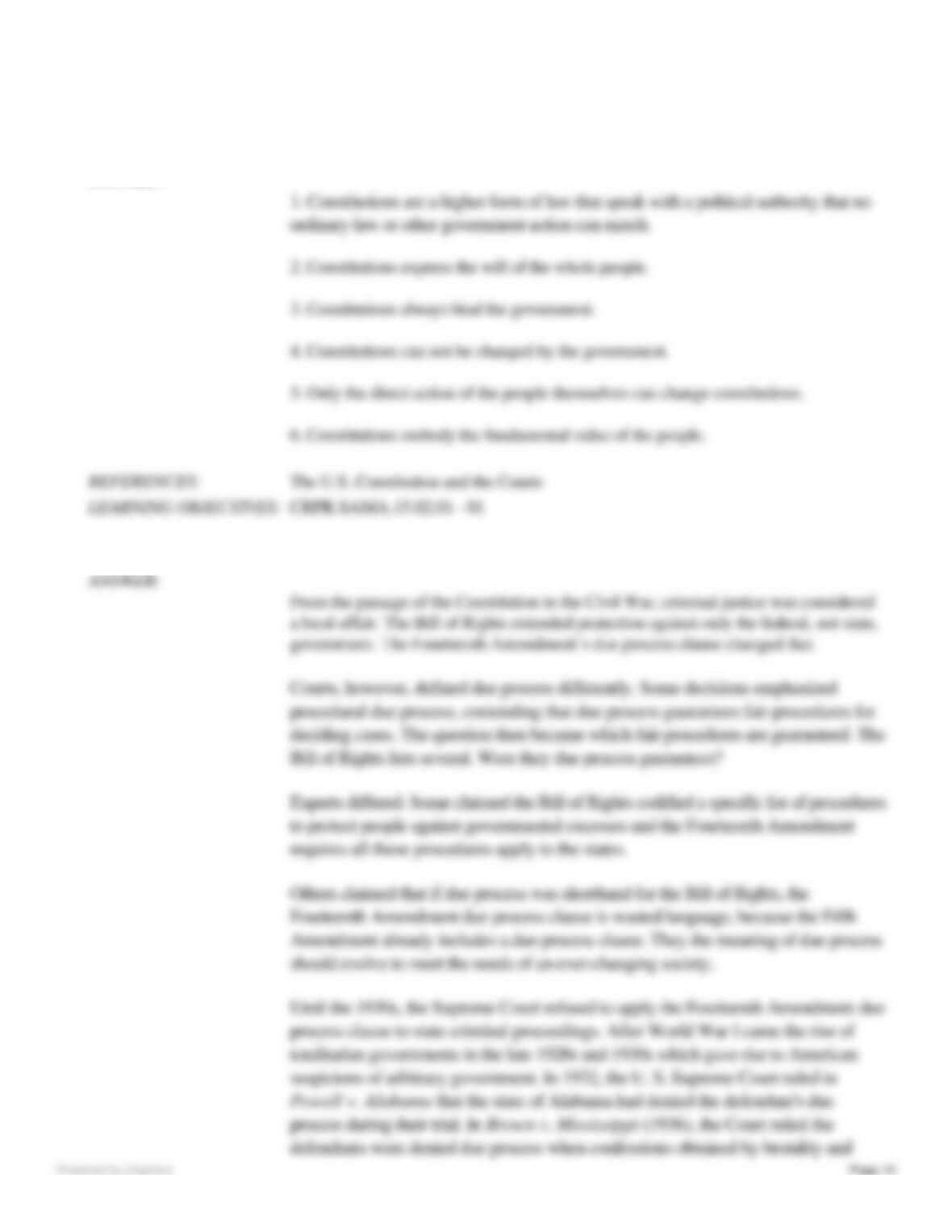
61. List six characteristics of constitutionalism.
ANSWER:
62. Briefly trace the history of due process from the adoption of the U.S. Constitution to the present.
Chapter 02: CRIMINAL PROCEDURE AND THE CONSTITUTION
CRIMINAL PROCEDURE AND THE CONSTITUTION
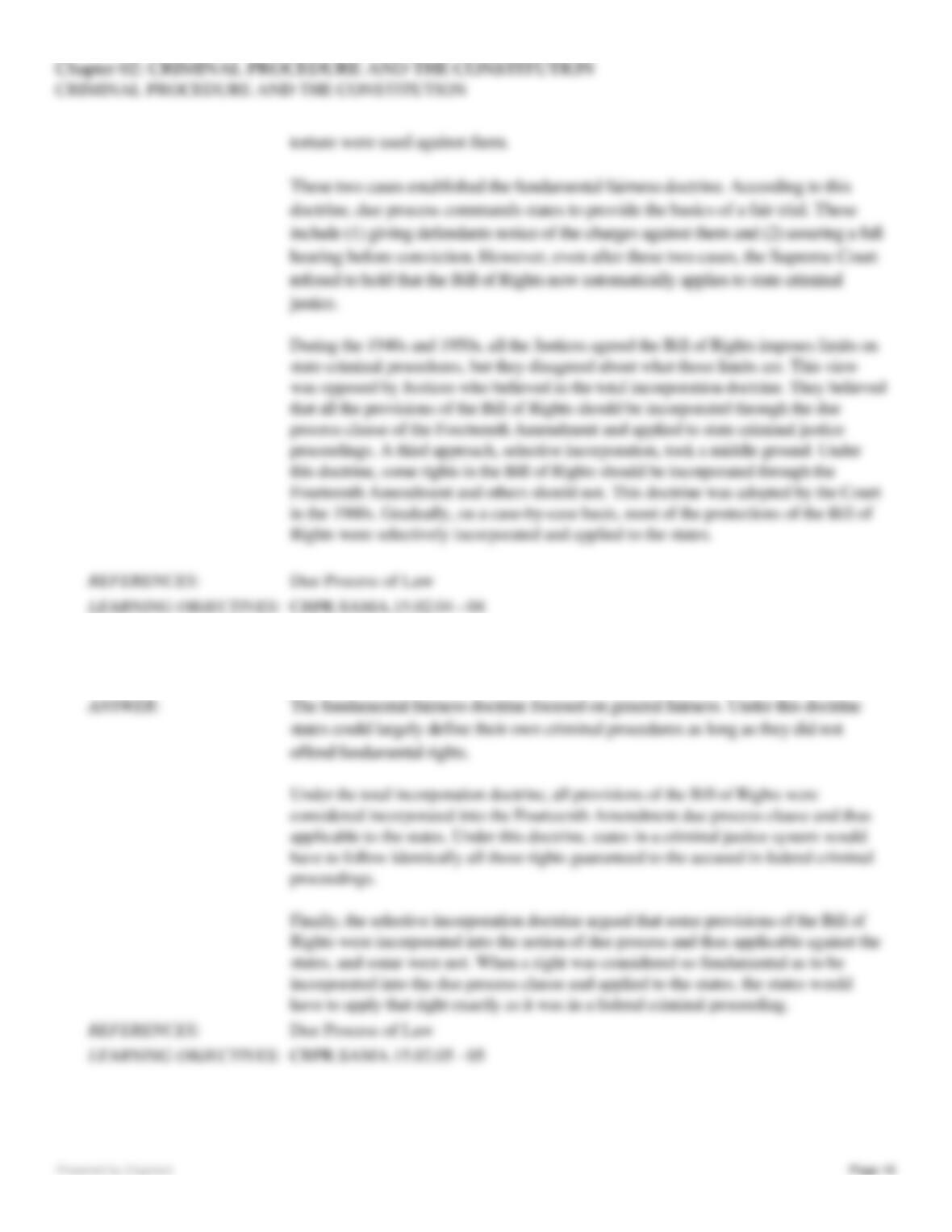
63. Summarize the differences among the fundamental fairness, total incorporation, and selective incorporation
doctrines as they influence state criminal procedures.
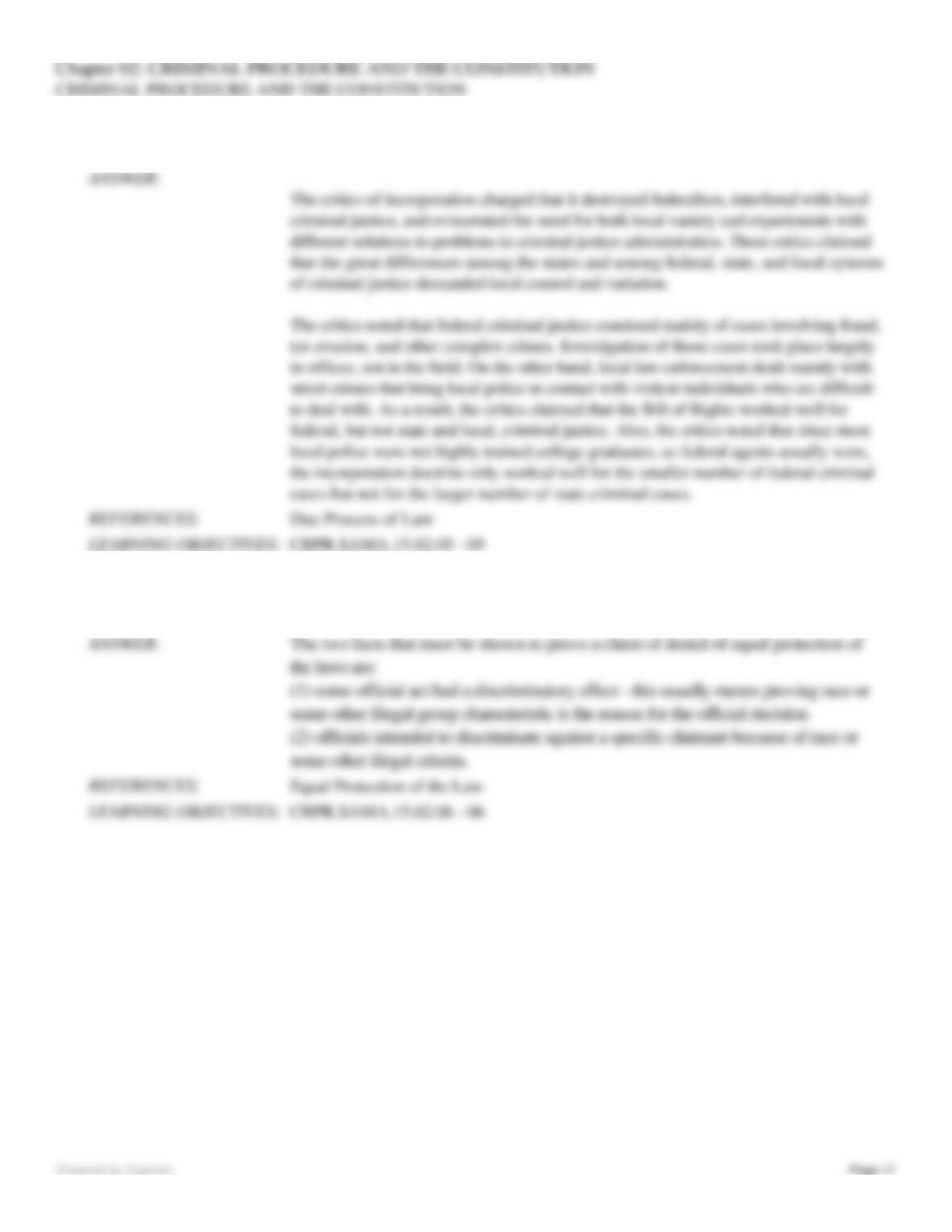
64. SummarizethecontroversygeneratedbytheU.S.SupremeCourt’s1960sincorporationdecisions.
65. Identify the two elements individuals must prove to succeed in a claim that government denied them equal
protection of the law.