1. Stops differ from arrests in that:
a. they always lead to a frisk or more invasive search.
b. they produce written records of the police action.
c. they occur in public places and are shorter in duration.
d. they are always shorter in duration.
2. When an official takes a person into custody and holds him for anywhere between a few hours to a few days to
answer for a criminal charge, the official has conducted:
a. a stop.
b. a detention.
c. a custodial arrest.
d. imprisonment.
3. Whether Fourth Amendment seizures are stops or arrests depends on:
a. duration, invasiveness, location, the officer’s subjective intent.
b. duration, invasiveness, and location.
c. duration and invasiveness.
d. invasiveness and the officer’s subjective intent.
4. Which of the following is NOT a requirement of obtaining a warrant to arrest a suspect in his/her home?
a. A neutral magistrate
b. An affidavit
c. The name of the person to be arrested
d. The suspect’s criminal history
Chapter 05: SEIZURES OF PERSONS: ARREST
SEIZURES OF PERSONS: ARREST
5. Which of the following represents first-hand information immediately available to officers trying to establish
probable cause?
a. Tips from a usually reliable informant
b. A finger print match from the crime lab
c. An anonymous call to a police hotline
d. Discussions between police officers
6. Who determines the ultimate legitimacy of a request for an arrest warrant?
a. A neutral magistrate
b. The officer making the arrest
c. The chief of police
d. The district attorney
7. According to the Supreme Court in Draper v. U.S., involving a narcotics arrest based on an informant’s
description of a suspect:
a. hearsay cannot be used to determine probable cause.
b. magistrates must determine probable cause before officers make arrests.
c. police officers must have warrants in order to make arrests.
d. hearsay can be used to determine probable cause.
8. Probable cause deals with:
a. hunches and suspicions.
b. an exact degree of probability.
c. factual and practical considerations of everyday life.
d. having a specified number of facts.
Chapter 05: SEIZURES OF PERSONS: ARREST
SEIZURES OF PERSONS: ARREST
9. In which of the following situations have the courts found a use of unreasonable force?
a. Policedoggrabbedandheldadefendant’sarmuntilthepolicearrived.
b. Use of pepper spray on an armed suspect.
c. Bindingasuspect’sanklestohiswristsbehindhisback(hogtying).
d. Using a single application of the taser gun.
10. In Graham v Conner (1989), Graham was a diabetic who was essentially stopped and arrested after police
thought something was wrong when Graham left a convenience store abruptly. As it turned out, he was trying to
find some sugar for his diabetic condition, but the line was too long, so he left. Appearing drunk (due to the
hypoglycemic condition), he was arrested and denied sugar or orange juice, and was basically “roughed up” by
the police. The court said:
a. The use of force was not excessive and upheld the conviction for being drunk in public.
b. The police were justified in using force but should have given him the juice. However, the conviction stood.
c. The use of force was excessive and the case was remanded back to the lower court.
d. Thepolicewerejustifiedin“roughingup”Grahamanddenyinghimanysugarororangejuicebecauseit
would have been “unreasonable” for the police to stop in the middle of an arrest and get him relief.
11. In building probable cause, police officers may rely on what they:
a. see and hear only.
b. see, hear, and smell only.
c. see, hear, and taste only.
d. see, hear, smell, and taste.
Chapter 05: SEIZURES OF PERSONS: ARREST
SEIZURES OF PERSONS: ARREST
12. In building probable cause, police officers may rely on:
a. direct information and hearsay only.
b. direct information, hearsay, and corroborated anonymous tips only.
c. direction information only.
d. direct information, hearsay, corroborated anonymous tips, and tips from informants.
13. Examples of direct evidence that police can use to build probable cause include:
a. a DNA profile, a suspect fleeing an office, and a suspect making furtive movements.
b. a suspect fleeing an officer and a suspect making furtive movements.
c. a DNA profile.
d. a tip from a reliable informant and a suspect fleeing an officer.
14. The U.S. Supreme Court decided in Tennessee v. Garner (1985) that:
a. police cannot shoot a fleeing suspect if he poses no imminent danger.
b. suspects can be engaged with deadly force in the presence of bystanders who could possibly be harmed.
c. lethal force can be applied against non-dangerous criminal suspects.
d. lethal force is permitted against misdemeanor offenders.
15. The majority of arrests:
a. do not require a warrant to make the arrest reasonable as long as there is probable cause to arrest.
b. require a warrant based on probable cause.
c. occur in the home but still do not require a warrant.
d. occur after stops and frisks
Chapter 05: SEIZURES OF PERSONS: ARREST
SEIZURES OF PERSONS: ARREST
16. In regard to seizures, the Supreme Court in Payton v. New York held that the Fourth Amendment:
a. requires an arrest warrant to enter a home in exigent circumstances.
b. requires an arrest warrant to enter a home when officers are in hot pursuit.
c. usually requires a warrant to enter a private home to arrest a citizen.
d. requires a warrant to arrest a suspect in a public place.
17. Payton v. New York ruled which of the following is NOT a restriction on home arrests?
a. Knock and announce rules
b. Reliable informants
c. Felonies and arrests made during the daytime
d. Stringent probable cause
18. In developing probable cause, officers rely on their ________ to make decisions regarding arrests without
warrants.
a. training and experience
b. luck and intuition
c. good intentions
d. reasonableness and good faith
19. Draper v. U.S. established that an anonymous tip can _______ be used in and of itself to establish probable
cause.
a. selectively
b. never
c. sometimes
d. always
Chapter 05: SEIZURES OF PERSONS: ARREST
SEIZURES OF PERSONS: ARREST
20. Which of the following is an exception to enter a home without a warrant?
a. Exigent circumstances
b. The smell of drugs
c. A tip from a neighbor
d. A tip from an informant
21. Commonwealth v Dunlap (2007) dealt with which of the following issues?
a. The collateral verification of hearsay evidence
b. The totality of the circumstances test
c. The reliability of anonymous tips to police officers
d. The validity of suspect statements in building probable cause
22. Federal law enforcement officers can phone or radio their affidavits seeking warrants to federal magistrates under
the:
a. Federal Criminal Code.
b. Federal Rules of Evidence.
c. Federal Code of Regulations.
d. Federal Rules of Criminal Procedure.
23. Most cases demand that arrest warrants identify the person to be arrested:
a. with absolute certainty.
b. in sufficient detail so that it leaves nothing to the discretion of the arresting officer.
c. with reasonable certainty.
d. by name.
Chapter 05: SEIZURES OF PERSONS: ARREST
SEIZURES OF PERSONS: ARREST
24. The vast majority of arrests are made:
a. with deadly force.
b. without the use of any force.
c. with the use of nondeadly force.
d. with the use of unreasonable force.
25. According to the Supreme Court opinion in Tennessee v. Garner, involving the use of deadly force to apprehend
a fleeing burglary suspect, deadly force:
a. is not a Fourth Amendment seizure.
b. to prevent the escape of all felony suspects is constitutionally reasonable.
c. is a Fourth Amendment seizure
d. can never be used for a property crime.
26. The landmark Supreme Court case of Tennessee v. Garner (1985) involved the authority of police to use deadly
force to stop fleeing felons. In this case, the Supreme Court held that:
a. deadly force could be used only if the officer using deadly force had probable cause to believe the fleeing
felon posed a physical danger to himself or others.
b. the Constitution does not address such a situation.
c. deadly force could be used only if the officer using it had reasonable suspicion that the fleeing felon posed a
physical danger to himself or others.
d. deadly force could be used by the officer only if there was no other means reasonably available to stop the
fleeing felon.
Chapter 05: SEIZURES OF PERSONS: ARREST
SEIZURES OF PERSONS: ARREST
27. In Tennessee v. Garner, involving the death of a citizen due to the use of deadly force by the police, the Supreme
Court ruled that:
a. evidence seized from illegal use of deadly force is admissible in criminal cases.
b. apprehension by the use of deadly force is a seizure subject to the reasonableness requirement of the
Fourth Amendment and a police officer may not seize an unarmed, non-dangerous suspect by shooting him
dead.
c. evidence seized from illegal use of deadly force is not admissible in criminal cases.
d. the use of deadly for to prevent the escape of all felony suspect, whatever the circumstances, in
constitutionally unreasonable.
28. In Graham v. O’Connor (1989), involving the arrest of a diabetic who was suffering from an insulin reaction, the
Supreme Court held that claims of excessive force in the course of making an arrest are to be analyzed under:
a. a substantive due process standard.
b. theFourthAmendment’s“objectivereasonableness”standard.
c. a“maliciousandsadistic”standard.
d. a subjective standard that focuses on the intentions of the officer making the arrest.
29. In Grahamv.O’Connor (1989), involving the arrest of a diabetic who was suffering from an insulin reaction, the
Supreme Court indicated that:
a. the use of excessive, non-deadly force in making arrests is not covered by the Constitution.
b. the reasonableness of a particular use of force must be judged based on the benefit of hindsight.
c. thequestioninexcessiveforcecasesiswhetheranofficer’sactionsareobjectivelyreasonableinlightofthe
facts and circumstances confronting them, without regard to his underlying intent.
d. askingwhetheranofficer’sactionswere“maliciousandsadistic”isanimportantinquiry.
Chapter 05: SEIZURES OF PERSONS: ARREST
SEIZURES OF PERSONS: ARREST
30. In Brigham City Utah v. Charles Stuart and Others (2006), involving police entering a home without a warrant
where teenagers were partying, drinking, and officers observed an altercation occurring inside the home, the
Supreme Court ruled that:
a. theofficers’entryofthehomewithoutawarrantviolatedtheFourthAmendment.
b. the officers had a right to enter without a warrant because they feared the teens would flee from the house if
they waited.
c. the officers had the right to enter without a warrant because they had an objectively reasonable basis for
believing someone in the home was seriously injured or being threatened with imminent injury.
d. the officers should have called an ambulance and let the EMTs enter without a warrant.
31. Most misdemeanor offenders are issued a(n) ________, but can be arrested under certain circumstances.
a. citation
b. indictment
c. writ of appearance
d. injunction
32. After an arrest, which of the following do the police NOT commonly do?
a. take DNA samples from the arrested person
b. fingerprint the suspect
c. interrogate the suspect
d. search the suspect
33. In the U.S. Supreme Court case Atwater v. City of Lago Vista, the Court decided that the:
a. arrest was reasonable because the offense was repeated and serious.
b. arrest was unreasonable because the offense was not serious.
c. decision to arrest should be left to officer discretion.
d. arrest was unreasonable since Atwater was not a flight risk.
34. In the U.S. Supreme Court case Atwater v. City of Lago Vista, the Court held that:
a. citations are the sole way for law enforcement to deal with misdemeanor offenders.
b. arrests are permitted only for felony offenses, with no exceptions.
c. the Fourth Amendment authorized a police officer to make a full custodial arrest for committing a fine-only
criminal offense in his presence.
d. deadly force can be used for misdemeanor offenders.
35. In Atwater v. City of Lago Vista, the Supreme Court ruled that:
a. the Fourth Amendment does not prohibit a warrantless arrest for a minor offense, including a traffic
misdemeanor violation.
b. the Fourth Amendment prohibits a warrantless arrest for a minor offense, including a traffic misdemeanor
violation.
c. the Fourth Amendment prohibits a warrantless arrest for a traffic misdemeanor violation.
d. the Fourth Amendment requires that in order to effect an arrest for a traffic misdemeanor violation there
should be reasonable suspicion that the suspect has also committed a felony.
36. Arrestsproducewrittendocumentsthatbecomepartofaperson’srecord.
a. True
b. False
37. Arrests are usually shorter in duration than stops.
a. True
b. False
Chapter 05: SEIZURES OF PERSONS: ARREST
SEIZURES OF PERSONS: ARREST
38. Full custodial arrest is not the most invasive type of arrest.
a. True
b. False
39. Anofficer’ssubjective,honestbeliefthatacrimehasbeencommittedisenoughtosupportprobablecauseto
arrest.
a. True
b. False
40. Police can never arrest someone for a minor traffic offense.
a. True
b. False
41. In determining probable cause, police officers must rely solely on direct information.
a. True
b. False
42. Victims and witnesses are the source of most hearsay information the police obtain.
a. True
b. False
Chapter 05: SEIZURES OF PERSONS: ARREST
SEIZURES OF PERSONS: ARREST
43. In Draper v. United States, the Supreme Court determined that information that may not be admissible at trial to
prove guilt could still be used to establish probable cause.
a. True
b. False
44. There is a bright line difference between an arrest and a stop.
a. True
b. False
45. Probable cause alone is not enough to make an arrest a reasonable Fourth Amendment seizure.
a. True
b. False
46. Deadly force can never be used to make an arrest.
a. True
b. False
47. The Fourth Amendment requires that magistrates base their probable cause determination on information sworn to
under oath.
a. True
b. False
Chapter 05: SEIZURES OF PERSONS: ARREST
SEIZURES OF PERSONS: ARREST
48. According to the U.S. Supreme Court, so long as officers have probable cause, they do not need to obtain prior
judicial approval to make an arrest in a public place.
a. True
b. False
49. Unless the police are in hot pursuit of a suspect, the Fourth Amendment usually requires a warrant to enter a
private home to make arrests.
a. True
b. False
50. Whether police used excessive force in making a nondeadly force arrest is measured by an objective standard.
a. True
b. False
51. The objective basis necessary for a police officer to make an arrest is ____________ ____________.
52. Information received by the police from third persons is called ______________.
53. A written, sworn statement submitted to a magistrate by a police officer seeking an arrest or search warrant is
called a(n) __________.
Chapter 05: SEIZURES OF PERSONS: ARREST
SEIZURES OF PERSONS: ARREST
54. The main sources of hearsay information used to establish probable cause in most arrests that rely on hearsay are
___________ _____________.
55. The ________ of the person to be arrested must be listed on the arrest warrant.
56. Kuha v. Minnetonka (2003) held that a dog trained only in the ______ and _____ technique met the requirements
of the objective standard of reasonable force test.
57. Information known by police based on what they see, hear and smell is ______________ information.
58. The reasonableness of an arrest depends on the existence of probable cause and the __________ in which the
arrest is made.
59. Policecanarrestasuspectinthesuspect’shomewithoutawarrantifthereare__________circumstancesthat
would justify such an arrest.
60. The U.S. Supreme Court has ruled that a __________ is necessary to effect a routine arrest of a suspect in their
home.
Chapter 05: SEIZURES OF PERSONS: ARREST
SEIZURES OF PERSONS: ARREST
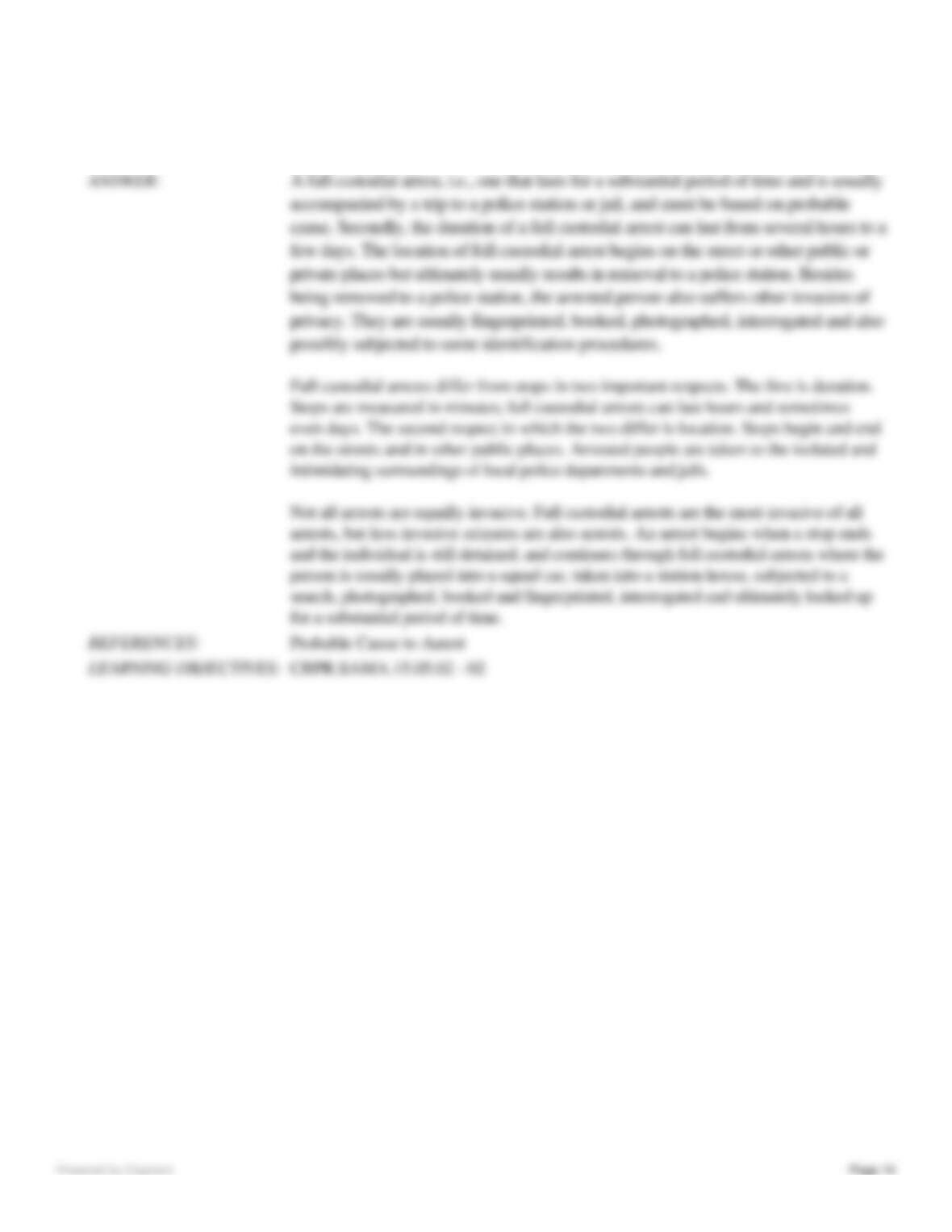
61. Identify the characteristics of a full custodial arrest and contrast it with a stop.
Chapter 05: SEIZURES OF PERSONS: ARREST
SEIZURES OF PERSONS: ARREST
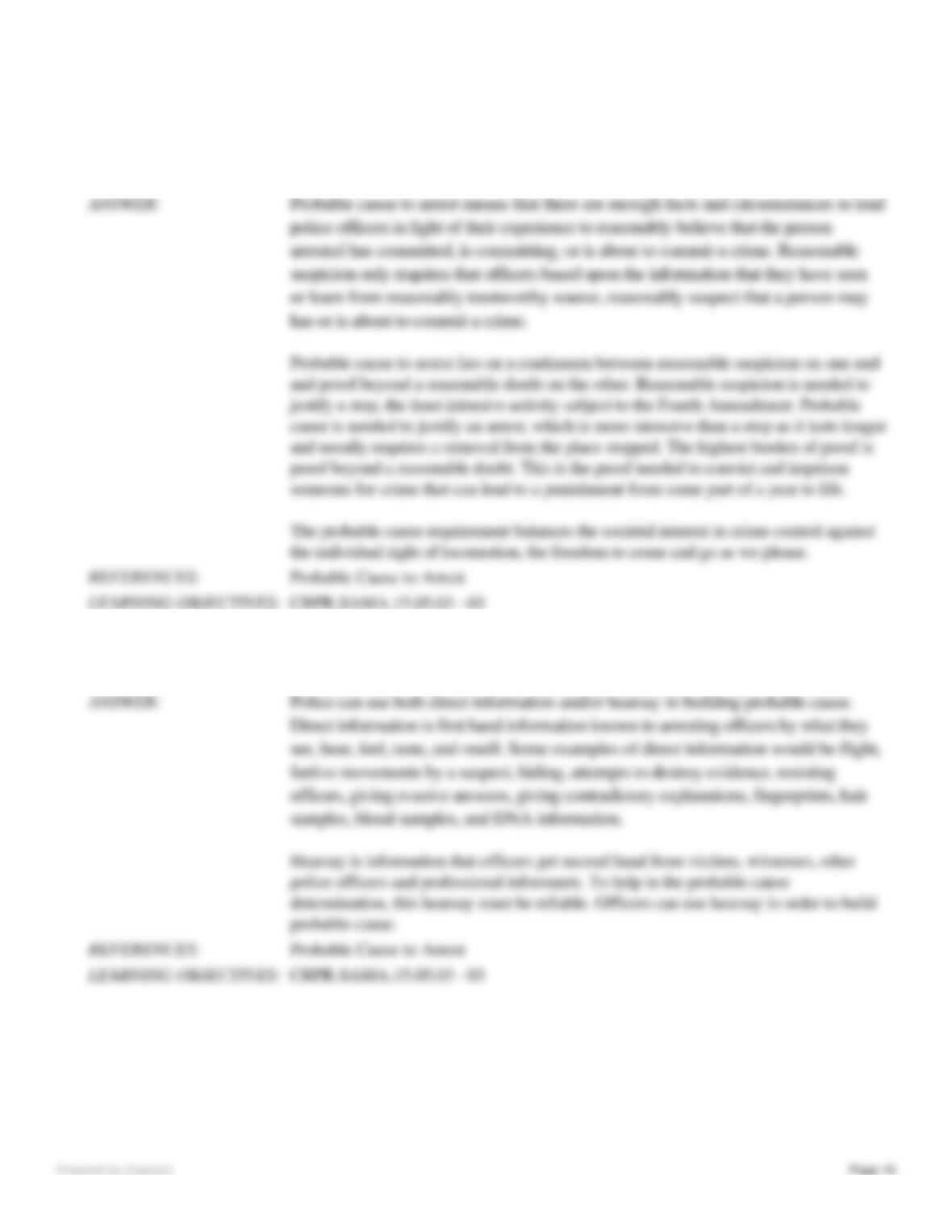
62. Compare the definition of reasonable suspicion with probable cause. What two interests does probable cause
balance?
63. Make a list of facts officers can take into account in building probable cause. What use can officers make of
hearsay in building probable cause?
Chapter 05: SEIZURES OF PERSONS: ARREST
SEIZURES OF PERSONS: ARREST
64. Identify and provide details about the three elements of arrest warrants that satisfy the requirements of the Fourth
Amendment warrant clause.
65. When an officer arrests a suspect for a felony, what are the steps that typically occur after the arrest?
Chapter 05: SEIZURES OF PERSONS: ARREST
SEIZURES OF PERSONS: ARREST