Archives
ANT 11413
Which of the following is true of DNA transcription/translation? a. A codon corresponds to an amino acid. b. A DNA sequence codes for a protein. c. A protein consists of a series of codons. d. Both a and b are […]
ANT 20952
Most mammals and birds attain appropriate behaviors matched to their environment through a. personal experience alone. b. information passed on from other individuals alone. c. information encoded in their genes alone. d. a combination of innate, genetic behaviors and personal […]
ANT 25664
Genetic variation within local groups around the world contains about ________ of the genetic variation in the human species. a. 5% b. 35% c. 85% d. 95% Taphonomists believe that the Olduvai bone and stone-tool sites were not the result […]
ANT 33830
For most of the last 130,000 years, the global climate has almost always been a. hotter than at present. b. colder than at present. c. about the same as at present. d. sometimes much hotter and sometimes about the same […]
ANT 41032
Crossing over a. can occur between loci on nonhomologous chromosomes. b. can occur between alleles on the same chromosome. c. increases genetic variation. d. decreases genetic variation. Why does natural selection favor alleles that kill individuals late in life? a. […]
ANT 44995
If you have two parents with the genotype Aa, what is the chance that they will have an offspring with the genotype AA? a. 1/8 b. 1/2 c. 1/4 d. 1/16 Altruism at first was a puzzle to evolutionary biologists […]
ANT 46646
The presence of repressors and activators in regulatory genes means that there is ________ of gene expression. a. translation b. combinatorial control c. a biochemical pathway d. primary structure Neanderthals are known to have used a. only Oldowan tools. b. […]
ANT 70034
What does the Grants’ study of medium ground finches tell us about evolution by means of natural selection? a. New species cannot form. b. A new species can form only when natural selection operates consistently in one direction for a […]
ANT 73634
In the opinion of the textbook authors, race is a. a meaningful biological concept. b. a biological reality only when the distribution of many genetic traits is considered. c. a culturally constructed category. d. an important tool for understanding human […]
ANT 95482
The evolution of lactase persistence in Africa and Europe was the result of a. convergent adaptation. b. drift acting on isolated populations. c. gene flow between Africans and Europeans. d. the retention of an ancestral trait. To understand third-party relationships, […]
ANT 97976
What genotype do true-breeding plants bearing green seeds have? a. aa b. aA c. Aa d. AA Derived characters are traits that a. characterize the last common ancestor that a particular collection of species share. b. evolved after the last […]
CGS SS 19029
To better understand primate societies, we need to investigate the way primates find mates and care for their offspring. This is known as their a. social organization. b. social system. c. mating system. d. reproductive strategy. Intersexual selection a. favors […]
CGS SS 42450
Phenotypic traits result a. from learning. b. from genes. c. from an interaction of genes and environment. d. either from learning or from genetic programs. Why was natural selection difficult for Darwin to fully explain? a. Natural selection reduces variation. […]

CGS SS 61551
Evolutionary psychologists believe the human mind evolved to solve the challenges that confront food foragers because a. foraging is more time-consuming than agriculture. b. humans have practiced foraging for most of our evolutionary history. c. sexual division of labor is […]
SOC 16647
Characters are more likely to exhibit continuous variation when a. there are no environmental effects. b. they are affected by alleles at more than one locus. c. inheritance is blending rather than particulate. d. there are only two alleles. Which […]
SOC 29984
Homo ergaster possessed some primitive characteristics of earlier hominids, including a. a chin. b. a high forehead. c. large browridges. d. postorbital constriction. Dominance hierarchies are seen in multimale, multifemale groups because hierarchies a. give low-ranking males a chance to […]
SOC 39971
Homo ergaster males were a. twice as large as females. b. 20% to 30% larger than females. c. about the same size as females. d. smaller than females. Which of the following statements is true concerning human foraging groups? a. […]
SOC 55244
Members of the order Primate are very diverse in behavior and morphology. Much of this diversity may be understood as adaptations to particular environments. Using this knowledge to gain insight into human behavior and morphology is an example of a. […]
SOC 85330
In the language of adaptive explanations, cost and benefit refer to the impact of behaviors on the animal’s a. overall health. b. reproductive success. c. foraging success. d. social relationships. The Laetoli footprints show that Australopithecus afarensis was a. an […]
SOC 87949
Offspring of outbred matings have ________ offspring of inbred matings. a. lower fitness than b. the same fitness as c. higher fitness than d. more variable fitness than Features showing that Australopithecus afarensis is a hominin include a. a large […]
SSCI 11584
It is likely that Australopithecus afarensis a. matured more slowly than chimpanzees. b. had a brain size three to four times bigger than those of chimpanzees. c. made and used stone tools to scavenge meat. d. lived throughout West, Central, […]
SSCI 26833
Large body sizes that require more energy and weaponry that can cause severe injury demonstrate that a. sexual selection is stronger than natural selection. b. natural selection is stronger than sexual selection. c. male reproductive success varies less than female […]
SSCI 33472
Imagine a scenario where a lake dries up enough to become two separate lakes, dividing a population of fish into two daughter populations. This is an example of a. allopatric speciation. b. sympatric speciation. c. both allopatric and sympatric speciation. […]
SSCI 54187
Multiple hypotheses seek to explain how New World monkeys arrived in South America. According to the chapter, what are some of these hypotheses? Which of the following best describes a particular primate mating system and reproductive behavior? a. In baboons […]
SSCI 57702
Baboon females a. have strong affinities for both maternal and paternal half sisters. b. are not able to distinguish maternal and paternal half sisters from unrelated females. c. prefer maternal half sisters over paternal half sisters. d. prefer paternal half […]
SSCI 78772
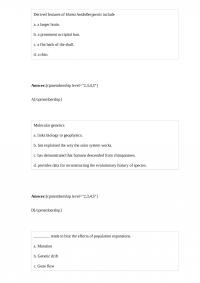
Derived features of Homo heidelbergensis include a. a larger brain. b. a prominent occipital bun. c. a flat back of the skull. d. a chin. Molecular genetics a. links biology to geophysics. b. has explained the way the solar system […]
SSCI 91672
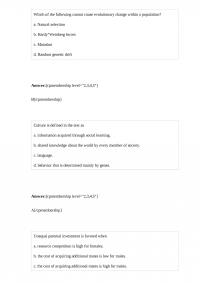
Which of the following cannot cause evolutionary change within a population? a. Natural selection b. Hardy”Weinberg forces c. Mutation d. Random genetic drift Culture is defined in the text as a. information acquired through social learning. b. shared knowledge about […]