Archives
BI 106
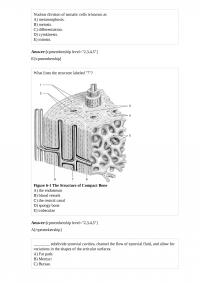
Nuclear division of somatic cells is known as A) metamorphosis. B) meiosis. C) differentiation. D) cytokinesis. E) mitosis. What lines the structure labeled “7”? Figure 6-1 The Structure of Compact Bone A) the endosteum B) blood vessels C) the central […]
BI 107
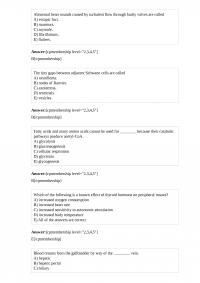
Abnormal heart sounds caused by turbulent flow through faulty valves are called A) ectopic foci. B) murmurs. C) asystole. D) fibrillations. E) flutters. The tiny gaps between adjacent Schwann cells are called A) neurillema. B) nodes of Ranvier. C) axolemma. […]
BI 199 Quiz 1
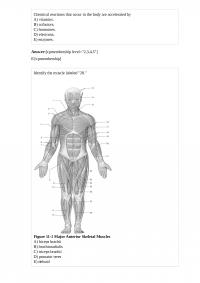
Chemical reactions that occur in the body are accelerated by A) vitamins. B) cofactors. C) hormones. D) electrons. E) enzymes. Identify the muscle labeled “20.” Figure 11-1 Major Anterior Skeletal Muscles A) biceps brachii B) brachioradialis C) triceps brachii D) […]
BI 281 Midterm 2
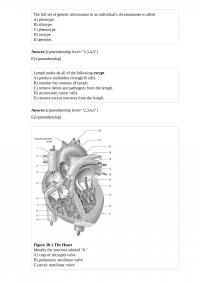
The full set of genetic information in an individual’s chromosomes is called A) pleiotype. B) allotype. C) phenotype. D) isotype. E) genome. Lymph nodes do all of the following except A) produce antibodies through B cells. B) monitor the contents […]
BI 361 Test 2
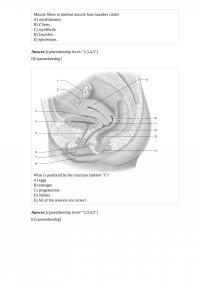
Muscle fibers in skeletal muscle form bundles called A) myofilaments. B) Z lines. C) myofibrils. D) fascicles. E) epimesium. What is produced by the structure labeled “1”? A) eggs B) estrogen C) progesterone D) inhibin E) All of the answers […]
BI 447 Midterm 1
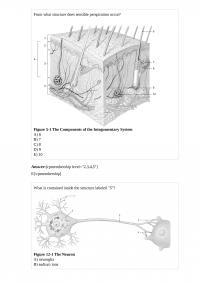
From what structure does sensible perspiration occur? Figure 5-1 The Components of the Integumentary System A) 6 B) 7 C) 8 D) 9 E) 10 What is contained inside the structure labeled “5”? Figure 12-1 The Neuron A) neuroglia B) […]
BI 501
The adrenal glands receive a blood supply from the ________ arteries. A) renal B) perirenal C) epirenal D) adrenal E) infrarenal In most cases, the general interpretive center and the speech center are located in A) the left cerebral hemisphere. […]
BI 533 Quiz 1
Arterioles feed blood into A) arteriovenous anastomoses. B) thoroughfare channels. C) arches. D) capillaries. E) venules. The superior part of the sternum is called the A) apex. B) xiphoid. C) coccyx. D) manubrium. E) head. Answer: D When potassium channels […]
BI 557
Interneurons are organized into functional groups called A) neuronal pools. B) plexi. C) rami. D) spindles. E) perineuria. The amount of blood remaining in the ventricle when the semilunar valve closes is the A) ejection fraction. B) end-diastole volume. C) […]
BI 590
The movement of the forearm while twisting a doorknob is A) protraction and retraction. B) abduction and adduction. C) flexion and extension. D) lateral rotation and medial rotation. E) supination and pronation. When doing squat exercises, rising up from the […]
BI 662 Midterm 2
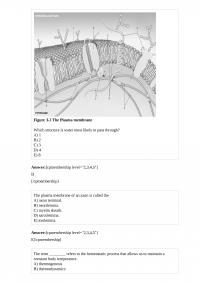
Figure 3-2 The Plasma membrane Which structure is water most likely to pass through? A) 1 B) 2 C) 3 D) 4 E) 8 The plasma membrane of an axon is called the A) axon terminal. B) neurilemma. C) myelin […]
BI 738
When calcium ion binds to troponin, A) tropomyosin rolls away from the active site. B) active sites on the myosin are exposed. C) actin heads will bind to myosin. D) muscle relaxation occurs. E) myosin shortens. The cardioacceleratory center activates […]
BIO 154
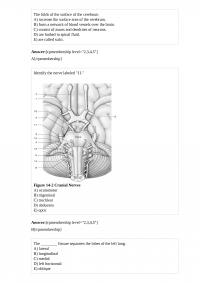
The folds of the surface of the cerebrum A) increase the surface area of the cerebrum. B) form a network of blood vessels over the brain. C) consist of axons and dendrites of neurons. D) are bathed in spinal fluid. […]
BIO 273 Test 2
The thoracic duct originates from an expanded chamber called the A) thoracic sinus. B) cisterna chyli. C) thoracic trunk. D) hilum. E) thoracic ventricle. Cross bridge detachment is caused by ________ binding to the myosin head. A) ATP B) calcium […]
BIO 283
The ________ is the part of the sperm that contains the DNA. A) head B) neck C) acrosome D) zona pellucida E) corona radiata The blood vessel that carries oxygenated blood away from the placenta is the A) umbilical vein. […]
BIO 316
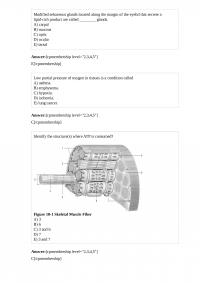
Modified sebaceous glands located along the margin of the eyelid that secrete a lipid-rich product are called ________ glands. A) carpal B) mucous C) optic D) ocular E) tarsal Low partial pressure of oxygen in tissues is a condition called […]
BIO 341 Homework
The primary function of the lymphatic system is A) the transport of hormones. B) circulation of nutrients and dissolved gases. C) defending the body against both external and internal threats. D) the production and distribution of plasma proteins. E) the […]
BIO 382 Final
Lymphocytes can develop into cells that secrete defense proteins against disease. These cells are termed ________, while these proteins are called antibodies. A) T cells B) B cells C) plasma cells D) immunocytes E) phagocytes Pronation is defined as A) […]
BIO 413 Midterm 2
Stem cells that can differentiate into osteoblasts are called ________ cells. A) osteopropagator B) osteoforming C) osteocreator D) osteotrophic E) psteoprogenitor The period of gestation that is characterized by rapid fetal growth and fat deposition is the ________ trimester. A) […]
BIO 431 Midterm 2
Figure 19-1 The Origins and Differentiation of Formed Elements Identify the cell labeled “6.” A) erythrocyte B) lymphocyte C) eosinophil D) basophil E) monocyte Skin can regenerate effectively even after considerable damage has occurred because A) the epidermis of the […]
BIO 450
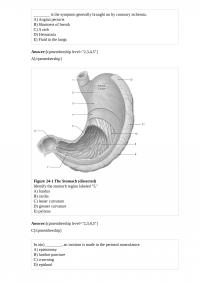
________ is the symptom generally brought on by coronary ischemia. A) Angina pectoris B) Shortness of breath C) A rash D) Hematuria E) Fluid in the lungs Figure 24-1 The Stomach (dissected) Identify the stomach region labeled “5.” A) fundus […]
BIO 522 Final
The shaft of long bones is called the A) epiphysis. B) metaphysis. C) diaphysis. D) paraphysis. E) endophysis. The process of lactation (milk production) depends on both merocrine and ________ secretion by mammary gland epithelial cells. A) epicrine B) eccrine […]
BIO 535 Final
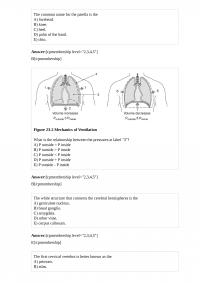
The common name for the patella is the A) forehead. B) knee. C) heel. D) palm of the hand. E) chin. Figure 23-2 Mechanics of Ventilation What is the relationship between the pressures at label “3”? A) P outside = […]
BIO 574 Final
The movement of rotating a limb outward is called ________ rotation. A) lateral B) internal C) medial D) superficial E) abductive In a ________ fracture one side of the shaft is split and the other side is bent. A) comminuted […]
BIO 659 Quiz
The coronary sinus drains the ________ into the ________. A) coronary arteries; left ventricle B) cardiac veins; right atrium C) interventricular artery; left ventricle D) right atrium; right ventricle E) cardiac vein; right ventricle The end of a muscle that […]
BIO 703 Final
The white ramus and the gray ramus collectively are called the A) spinal nerve. B) rami communicantes. C) meninges. D) ganglia. E) ascending tracts. The orbicularis oculi origin has its origin on the A) angle of the mouth. B) skin […]
BIOL 111 Midterm 2
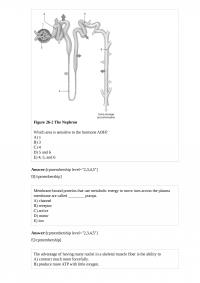
Figure 26-2 The Nephron Which area is sensitive to the hormone ADH? A) 1 B) 3 C) 4 D) 5 and 6 E) 4, 5, and 6 Membrane-bound proteins that use metabolic energy to move ions across the plasma membrane […]
BIOL 123
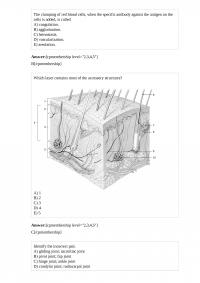
The clumping of red blood cells, when the specific antibody against the antigen on the cells is added, is called A) coagulation. B) agglutination. C) hemostasis. D) vascularization. E) areolation. Which layer contains most of the accessory structures? A) 1 […]
BIOL 170
Impotence is defined as an inability to achieve or maintain A) an erection. B) an emission. C) ejaculation. D) a normal sperm count. E) blood flow. The pineal gland is part of the A) hypothalamus. B) diencephalon. C) midbrain. D) […]
BIOL 188 Quiz 3
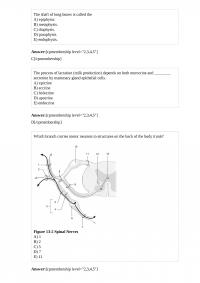
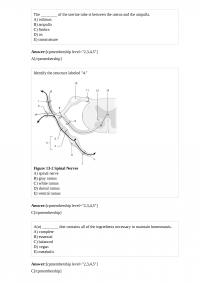
The ________ of the uterine tube is between the uterus and the ampulla. A) isthmus B) ampulla C) fimbra D) os E) commissure Identify the structure labeled “4.” Figure 13-2 Spinal Nerves A) spinal nerve B) gray ramus C) white […]
BIOL 190
Lipoproteins that are formed within the intestinal epithelium to transfer dietary fats into circulation are called A) chylomicrons. B) very-low-density lipoproteins. C) intermediate-density lipoproteins. D) low-density lipoproteins. E) high-density lipoproteins. In the condition known as erythema, the skin takes on […]
BIOL 210 Test 2
The term ________ refers to antibodies found in body fluids. A) plasma proteins B) cytosolic factors C) interleukins D) interferons E) immunoglobulins The main portion of the uterus is called the corpus or A) fundus. B) cervix. C) horn. D) […]
BIOL 303 Test 1
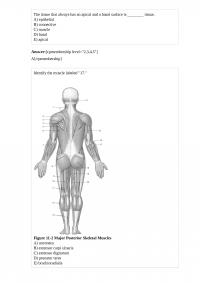
The tissue that always has an apical and a basal surface is ________ tissue. A) epithelial B) connective C) muscle D) basal E) apical Identify the muscle labeled “17.” Figure 11-2 Major Posterior Skeletal Muscles A) anconeus B) extensor carpi […]
BIOL 335 Final
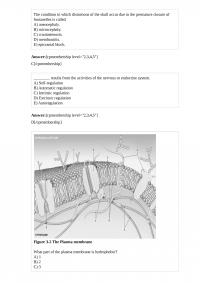
The condition in which distortions of the skull occur due to the premature closure of fontanelles is called A) anencephaly. B) microcephaly. C) craniostenosis. D) membranitis. E) epicranial block. ________ results from the activities of the nervous or endocrine system. […]
BIOL 355
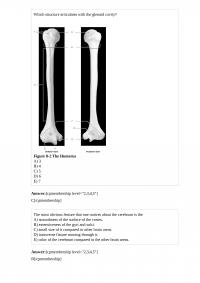
Which structure articulates with the glenoid cavity? Figure 8-2 The Humerus A) 3 B) 4 C) 5 D) 6 E) 7 The most obvious feature that one notices about the cerebrum is the A) smoothness of the surface of the […]
BIOL 505 Midterm 2
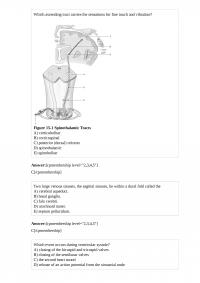
Which ascending tract carries the sensations for fine touch and vibration? Figure 15-1 Spinothalamic Tracts A) corticobulbar B) corticospinal C) posterior (dorsal) column D) spinothalamic E) spinobulbar Two large venous sinuses, the sagittal sinuses, lie within a dural fold called […]
BIOL 540 Test 2
A(n) ________ acid is an acid that cannot leave solution and enter the atmosphere. A) fixed B) volatile C) respiratory D) organic E) inorganic The complex structures of DNA and protein found in the cell nucleus are A) nucleoplasm. B) […]
BIOL 554 Quiz 1
The physical process by which a single animal cell separates into two cells is called A) cytosis. B) mitosis. C) cytokinesis. D) phoresis. E) meiosis. Which of the following imaging techniques is used to monitor blood flow through specific organs, […]
BIOL 569 Test
While volunteering in an outpatient clinic for underprivileged families in your neighborhood, you observe the nurse assessing an infant. The mother had complained about the baby not eating and having several episodes of diarrhea lasting 3 days. You know the […]
BIOL 743
The period of gestation when organs and organ systems complete most of their development and the fetus looks distinctly human is the ________ trimester. A) first B) second C) third During the postabsorptive state, ________ stimulate(s) lipid catabolism. A) glucocorticoids […]
BIOL 823
The ________ is an elastic epithelial layer between the vagina and vestibule, which, if present, is often torn during first intercourse. A) zona pellucida B) prepuce C) isthmus D) fornix E) hymen The vein in the arm commonly sampled for […]
BIOL 841 Quiz 1
Identify the incorrect descriptor of congenital talipes equinovarus (club foot). A) due to inappropriately developed arches B) may involve one or both feet C) may affect the tibia, ankle, and foot D) feet are turned laterally and everted E) may […]
Biology 103 Test 1
The hydrolysis of ATP yields ADP, phosphate ion, and A) AMP. B) H2O. C) energy. D) adenosine E) nuclease. The term ________ refers to certain amino acids, which can have both a positive charge and a negative charge. A) anion […]
Biology 178 Test
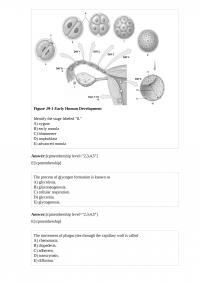
Figure 29-1 Early Human Development Identify the stage labeled “8.” A) zygote B) early morula C) blastomere D) trophoblast E) advanced morula The process of glycogen formation is known as A) glycolysis. B) gluconeogenesis. C) cellular respiration. D) glycemia. E) […]
Biology 250 Test 1
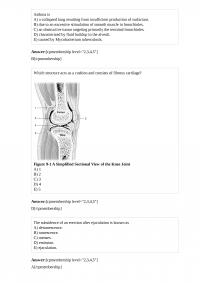
Asthma is A) a collapsed lung resulting from insufficient production of surfactant. B) due to an excessive stimulation of smooth muscle in bronchioles. C) an obstructive tumor targeting primarily the terminal bronchioles. D) characterized by fluid buildup in the alveoli. […]
Biology 286 Quiz
A general term for pain and stiffness that affects the skeletal or muscular system is A) rheumatism. B) atherosclerosis. C) bursitis. D) bunions. E) arthritis. The ongoing process of tearing down and rebuilding bone matrix is called A) restoration. B) […]
Biology 367
The folds of the cerebrum are called A) sulci. B) arachnoid granulations. C) cortical folds. D) gyri. E) dural sinuses. Bile salts aid in the digestion of fats by ________ large fat droplets. A) dehydrating B) anabolizing C) binding D) […]
Biology 380
The cell of the retina that produces an action potential that goes to the brain is a(n) A) bipolar cell. B) photoreceptor. C) ganglion cell. D) amacrine cell. E) horizontal cell. Circular folds are A) ridges in the wall of […]
Biology 536 Test
All of the following are true of epidermal ridges except that they A) extend into the hypodermis. B) increase surface area and friction on fingertips. C) cause ridge patterns on the surface of the skin. D) produce patterns that are […]
Biology 545
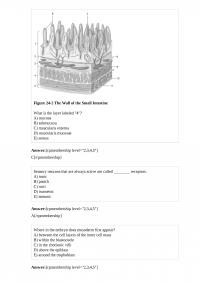
Figure 24-2 The Wall of the Small Intestine What is the layer labeled “4”? A) mucosa B) submucusa C) muscularis externa D) muscularis mucosae E) serosa Sensory neurons that are always active are called ________ receptors. A) tonic B) pasich […]
Biology 568 Test 2
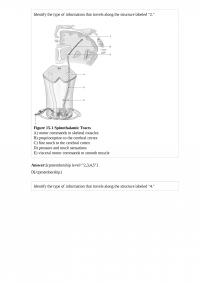
Identify the type of information that travels along the structure labeled “2.” Figure 15-1 Spinothalamic Tracts A) motor commands to skeletal muscles B) proprioception to the cerebral cortex C) fine touch to the cerebral cortex D) pressure and touch sensations […]
Biology 618 Homework
During ________ sleep, dreaming occurs. A) REM B) deep C) beta D) stage 1 E) stage 2 Chambers within the brain that contain cerebrospinal fluid are called A) plexuses. B) ganglia. C) sinuses. D) aqueducts. E) ventricles. Answer: E The […]
Biology 629 Quiz
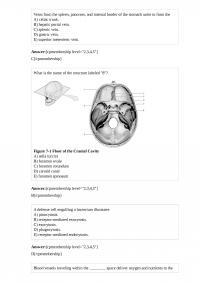
Veins from the spleen, pancreas, and internal border of the stomach unite to form the A) celiac trunk. B) hepatic portal vein. C) splenic vein. D) gastric vein. E) superior mesenteric vein. What is the name of the structure labeled […]
Biology 794 Quiz 3
The following are major steps in the process of intramembranous ossification: 1. Clusters of osteoblasts form osteoid that becomes mineralized. 2. Osteoblasts differentiate within mesenchymal connective tissue. 3. Spicules of bone radiate out from the ossification centers. 4. Mesenchymal cells […]
Biology 866 Midterm 2
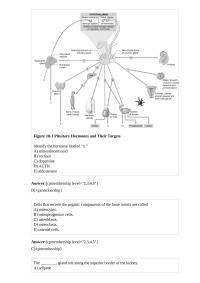
Figure 18-1 Pituitary Hormones and Their Targets Identify the hormone labeled “1.” A) mineralocorticoid B) cortisol C) dopamine D) ACTH E) aldosterone Cells that secrete the organic components of the bone matrix are called A) osteocytes. B) osteoprogenitor cells. C) […]
BISC 102
The small, semisolid mass of food formed during mastication is called a A) chunk. B) chime. C) morsel. D) bolus. E) pill. A small white blood cell with a large round nucleus would be a A) neutrophil. B) lymphocyte. C) […]
BISC 140
Damage to the glossopharyngeal nerve would likely cause A) increase in heart rate. B) problems in sexual arousal. C) a reduction in saliva. D) visual problems. E) urine retention. The nasal cavity opens into the nasopharynx through a connection known […]
BISC 189 Test
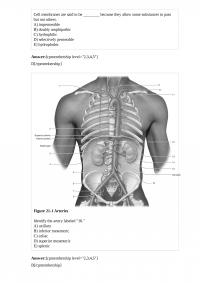
Cell membranes are said to be ________ because they allow some substances to pass but not others. A) impermeable B) doubly amphipathic C) hydrophilic D) selectively permeable E) hydrophobic Figure 21-1 Arteries Identify the artery labeled “16.” A) axillary B) […]
BISC 254
The inherited metabolic disorder that results from the accumulation of phenylketones from phenylalanine is A) ketosis. B) acidosis. C) marasmus. D) phenylketonuria. E) kwashiorkor. Gland cells produce A) mesenchyme. B) antibodies. C) secretions. D) phagocytes. E) fibers. Answer: C When […]
BISC 260 Final
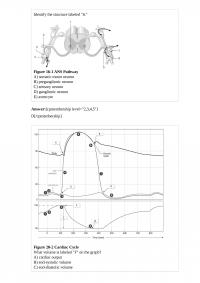
Identify the structure labeled “6.” Figure 16-1 ANS Pathway A) somatic motor neuron B) preganglionic neuron C) sensory neuron D) ganglionic neuron E) astrocyte Figure 20-2 Cardiac Cycle What volume is labeled “F” on the graph? A) cardiac output B) […]
BISC 321 Final
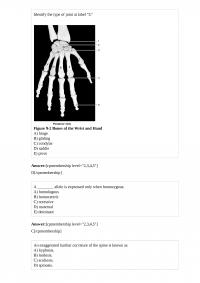
Identify the type of joint at label “3.” Figure 9-2 Bones of the Wrist and Hand A) hinge B) gliding C) condylar D) saddle E) pivot A ________ allele is expressed only when homozygous. A) homologous B) homocentric C) recessive […]
BISC 340 Quiz 2
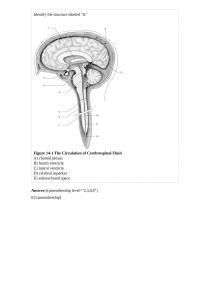
Identify the structure labeled “6.” Figure 14-1 The Circulation of Cerebrospinal Fluid A) choroid plexus B) fourth ventricle C) lateral ventricle D) cerebral aqueduct E) subarachnoid space Answer: E Figure 24-2 The Wall of the Small Intestine What is the […]
BISC 379 Quiz 1
Visceral reflex arcs can bypass CNS neurons in ________ reflexes. A) short B) intermediate C) long D) hyper E) spinal Type 2 diabetes A) can usually be controlled by diet and exercise rather than with medication. B) is associated with […]
BISC 411 Quiz
The movement of rotating a limb toward the anterior surface of the body is called ________ rotation. A) frontal B) external C) lateral D) outward E) medial A layer of glycoproteins that prevents leakage of materials from connective tissues into […]
BISC 431 Quiz 3
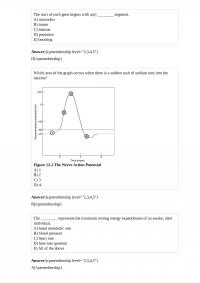
The start of each gene begins with a(n) ________ segment. A) neocodon B) intron C) histone D) promotor E) boosting Which area of the graph occurs when there is a sudden rush of sodium ions into the neuron? Figure 12-2 […]
BISC 456 Final
A fibrin clot that is formed over a skin wound is called a A) scar. B) keloid. C) graft. D) scab. E) plug. The insertion end of the biceps brachii muscle of the anterior upper arm is A) at the […]
BISC 492 Final
You ________ your mandible when you grasp your upper lip with your lower teeth. A) rotate B) extend C) pivot D) protract E) pronate Which statement is true regarding the somatic nervous system as compared to the autonomic nervous system? […]
BISC 613 Test 1
Homeostatic mechanisms that monitor and adjust the composition of body fluids respond to changes in the ________ fluid. A) lymphatic B) intracellular C) plasma D) extracellular E) cerebrospinal A person whose platelet count is 40,000/µl is suffering from A) thrombocytosis. […]
BISC 629 Test 2
Neuron cell bodies in the PNS are clustered together in masses called A) fibers. B) tracts. C) nerves. D) nuclei. E) ganglia. The alternative pathway of complement activation is sometimes called the ________ pathway. A) properdin B) interferon C) inflammatory […]
BISC 762
In areolar connective tissue, ________ cells release histamine. A) plasma B) mast C) mesenchymal D) gland E) goblet To defend blood volume against dehydration, the body A) reduces reabsorption of water at the kidneys. B) experiences an increase of interstitial […]
BISC 782
A muscle produces its highest tension when in complete A) recovery. B) treppe. C) wave summation. D) aerobic metabolism. E) tetanus. A man can get testosterone injections to increase sexual drive, muscle mass, and overall mood. These symptoms can occur […]
BISC 899
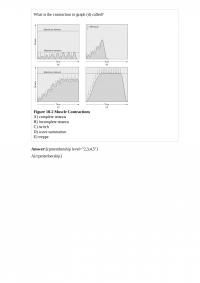
What is the contraction in graph (d) called? Figure 10-2 Muscle Contractions A) complete tetanus B) incomplete tetanus C) twitch D) wave summation E) treppe Answer: A Figure 21-2 Veins Identify the vein labeled “10.” A) inferior vena cava B) […]
CAS BI 139 Quiz 2
The term immunological ________ refers to the ability to demonstrate an immune response upon exposure to an antigen. A) determination B) readiness C) competence D) potency E) drive Hormones that regulate the activity of B cells and T cells and […]
CAS BI 146 Final
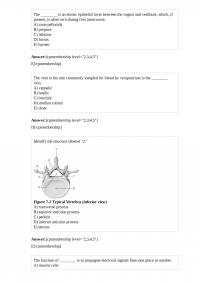
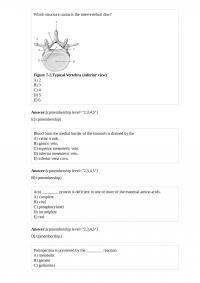
Which structure contacts the intervertebral disc? Figure 7-2 Typical Vertebra (inferior view) A) 2 B) 3 C) 4 D) 5 E) 6 Blood from the medial border of the stomach is drained by the A) celiac trunk. B) gastric vein. […]
CAS BI 176 Final
Successive vertebrae articulate at facets on the inferior articular processes of the superior vertebra and facets on the ________ of the adjacent inferior vertebrae. A) dens B) pedicles C) lamellae D) transverse processes E) superior articular processes The enzyme ________ […]
CAS BI 228 Test 2
Anatomy uses a special language, called ________ terminology, which involves the use of word roots, prefixes, suffixes, and combining forms to construct terms related to the body in health and disease. A) clinical B) pathological C) medical D) anatomical E) […]
CAS BI 248
Menstruation is the process of sloughing off the old functional layer of the A) perimetrium. B) endometrium. C) epimetrium. D) myometrium. E) exometrium. Give the clinical term for the condition in which the vertebral laminae fail to unite during development. […]
CAS BI 268 Test 1
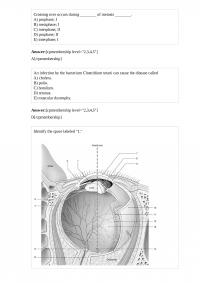
Crossing over occurs during ________ of meiosis ________. A) prophase; I B) metaphase; I C) interphase; II D) prophase; II E) interphase; I An infection by the bacterium Clostridium tetani can cause the disease called A) cholera. B) polio. C) […]
CAS BI 282
Phagocytic cells that are permanent residents of specific tissues and organs are called A) monocytes. B) neutrophils. C) leukocytes. D) fixed macrophages. E) local macrophages. Which of the following is true about the atrial reflex? A) also called Bainbridge reflex […]
CAS BI 295 Quiz 1
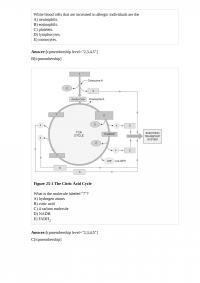
White blood cells that are increased in allergic individuals are the A) neutrophils. B) eosinophils. C) platelets. D) lymphocytes. E) monocytes. Figure 25-1 The Citric Acid Cycle What is the molecule labeled “7”? A) hydrogen atoms B) citric acid C) […]
CAS BI 304
The hormone that stimulates spermatogenesis in males is A) PTH. B) FSH. C) LH. D) GH. E) MSH. ________ will raise blood pH. A) Strenuous exercise B) Hyperventilation C) Diabetes mellitis D) Stomach ulcers E) Smoking Answer: B The pancreas […]
CAS BI 316 Final
Which of the following statements is false regarding micturition? A) When you relax the external urethral sphincter, the internal sphincter will relax. B) Urination will be completed despite voluntary opposition. C) Parasympathetic nervous control is involved with the micturition reflex. […]
CAS BI 317 Quiz
Endothelial cells release ________ that stimulate smooth muscle contraction and accelerate the repair process. A) platelets B) endothelins C) histamines D) CSFs E) heparins Hypogonadism could be caused by an insufficiency of hormones from the A) ovaries. B) anterior pituitary […]
CAS BI 468 Final
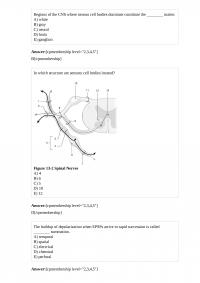
Regions of the CNS where neuron cell bodies dominate constitute the ________ matter. A) white B) gray C) neural D) brain E) ganglion In which structure are sensory cell bodies located? Figure 13-2 Spinal Nerves A) 4 B) 6 C) […]
CAS BI 475 Quiz 2
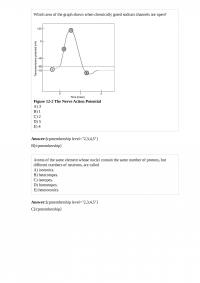
Which area of the graph shows when chemically gated sodium channels are open? Figure 12-2 The Nerve Action Potential A) 3 B) 1 C) 2 D) 5 E) 4 Atoms of the same element whose nuclei contain the same number […]
CAS BI 503
How is the kidney involved with normal bone ossification and development? A) Growth hormone is produced by the kidneys. B) Osteoblasts migrate from the kidney into the bone. C) Growth factors from the kidney direct the growth the epiphyseal cartilage […]
CAS BI 533 Test
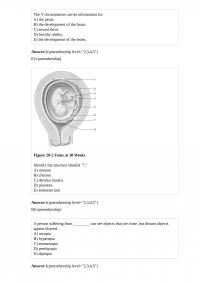
The Y chromosome carries information for A) the penis. B) the development of the brain. C) sexual drive. D) fertility ability. E) the development of the testes. Figure 29-2 Fetus at 10 Weeks Identify the structure labeled “7.” A) amnion […]
CAS BI 653
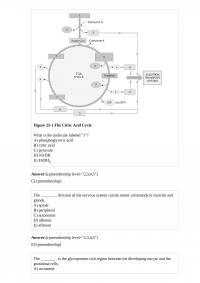
Figure 25-1 The Citric Acid Cycle What is the molecule labeled “1”? A) phosphoglyceric acid B) citric acid C) pyruvate D) NADH E) FADH2 The ________ division of the nervous system carries motor commands to muscles and glands. A) spinal […]
CAS BI 675 Homework
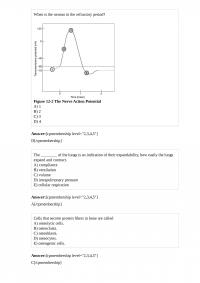
When is the neuron in the refractory period? Figure 12-2 The Nerve Action Potential A) 1 B) 2 C) 3 D) 4 The ________ of the lungs is an indication of their expandability, how easily the lungs expand and contract. […]
CAS BI 745 Homework
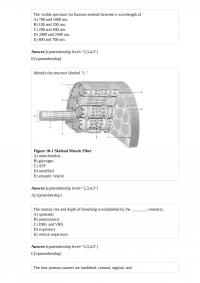
The visible spectrum for humans extends between a wavelength of A) 700 and 1000 nm. B) 100 and 200 nm. C) 200 and 400 nm. D) 2000 and 2500 nm. E) 400 and 700 nm. Identify the structure labeled “1.” […]
CAS BI 809 Test 1
________ monitor the digestive, respiratory, cardiovascular, urinary, and reproductive systems. A) Spinal nerves B) Unipolar neurons C) Internoceptors D) Exteroceptors E) Proprioceptors ________, or pinkeye, results from damage to or irritation of the conjunctival surface. A) Fuch’s dystrophy B) Conjunctivitis […]
CAS BI 811
The three categories of connective tissues are A) connective tissue proper, fluid connective tissue, and supporting connective tissue. B) epithelial connective tissue, muscle connective tissue, and neural connective tissue. C) glandular connective tissue, exocrine connective tissue, and endocrine connective tissue. […]
CAS BI 813 Quiz 1
The blood vessel that supplies blood to the head and neck is the ________ artery. A) brachiocephalic B) vertebral C) subclavian D) common carotid E) cervical Two hormones that have additive effects are called A) antagonists. B) agonists. C) resistors. […]