________ monitor the digestive, respiratory, cardiovascular, urinary, and reproductive
systems.
A) Spinal nerves
B) Unipolar neurons
C) Internoceptors
D) Exteroceptors
E) Proprioceptors
________, or pinkeye, results from damage to or irritation of the conjunctival surface.
A) Fuch’s dystrophy
B) Conjunctivitis
C) Glaucoma
D) Myopia
E) Uveitis
________ is when the heart can’t maintain adequate cardiac output.
A) Heart failure
B) Fibrillation
C) Flutter
D) Murmur
E) Coronary heart disease
The partial pressure of oxygen in atmospheric air at sea level is
A) greater than the partial pressure of oxygen in atmospheric air at the top of Mt.
Everest.
B) less than the partial pressure of oxygen in atmospheric air at the top of Mt. Everest.
C) equal to the partial pressure of oxygen in atmospheric air at the top of Mt. Everest.
D) equal to the sum of partial pressures from carbon dioxide and nitrogen.
E) None of the answers is correct.
Put the following steps of stomach acid production in the correct order starting with the
reaction that requires an enzyme.

1. H2CO3 dissociates.
2. Chloride ion combines with H+ in the gastric lumen.
3. Water and CO2 combine to form carbonic acid.
4. H+ and bicarbonate ion are transported into the gastric lumen.
5. Cl- diffuses into the gastric lumen.
A) 3, 1, 2, 5, 4
B) 1, 3, 5, 2, 4
C) 4, 5, 3, 1, 2
D) 4, 5, 1, 2, 3
E) 3, 1, 4, 5, 2
The role(s) of the sinuses include(s)
A) making the skull lighter.
B) production of mucus that moistens and cleans the air.
C) increasing surface area for gas exchange.
D) extra source of air and increasing surface area for gas exchange.
E) making the skull lighter and production of mucus that moistens and cleans the air.
A substance that provokes an immune response is called an
A) allergen.
B) antihistamine.
C) antibody.
D) antigen.
E) allopath.
In which of the following would the rate of impulse conduction be the greatest?
A) a myelinated fiber of 10-µm diameter
B) a nonmyelinated fiber of 20-µm diameter
C) a myelinated fiber of 1-µm diameter
D) a nonmyelinated fiber of 10-µm diameter
E) It would be the same in all because of the all-or-none principle.
Sensory information from all parts of the body is routed to
A) the prefrontal cortex.
B) the cerebellum.
C) the primary motor cortex.
D) the somatosensory cortex.
E) Broca’s area.
A ________ is a rigid structure that moves on a fixed point.
A) lever
B) fulcrum
C) force
D) load
E) resistance
A cut parallel to the midsagittal plane would produce a(n) ________ section.
A) frontal
B) transverse
C) oblique
D) parasagittal
E) coronal
If the adenyl cyclase activity of liver cells were missing, which of these hormones could
no longer stimulate release of glucose?
A) growth hormone
B) glucagon
C) cortisol
D) thyroxine
E) leptin
Fixed macrophages that are found in the central nervous system are called
A) astrocytes.
B) oligodendrocytes.
C) microglia.
D) Kupffer cells.
E) ventricular macrophages.
The ________ principle states that the size and speed of the action potential are
independent of the stimulus strength.
A) threshold
B) all-or-none
C) summation
D) polarization
E) potential
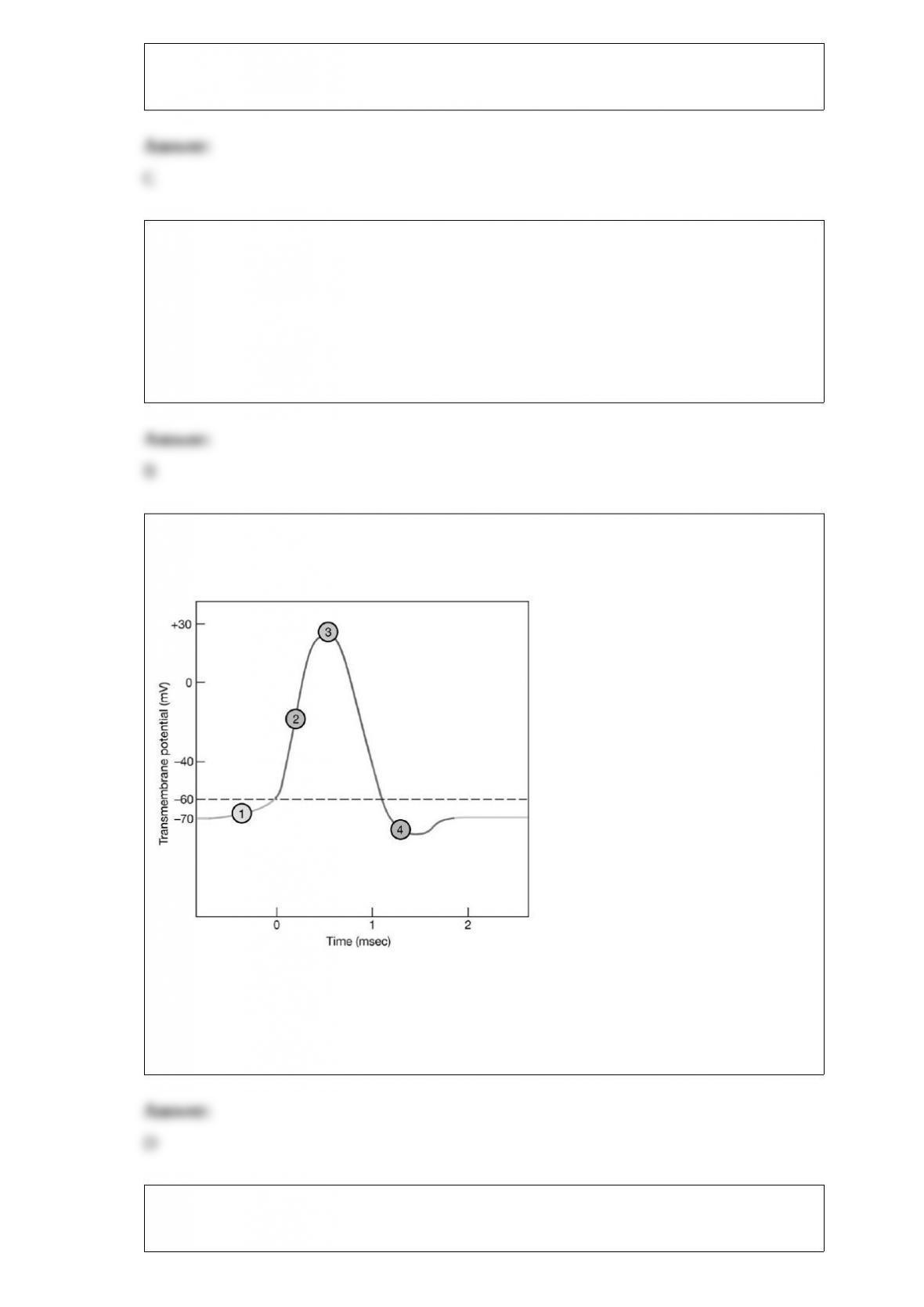
Which area of the graph shows when membrane potential approaches the potassium
equilibrium potential?
Figure 12-2 The Nerve Action Potential
A) 1
B) 2
C) 3
D) 4
A ________ potential is a depolarization of a sensory dendrite that can lead to an
afferent nerve impulse if strong enough.

A) resting
B) refractory
C) postsynaptic
D) generator
E) receptor
________ cells enable the immune system to respond quickly and robustly if the same
antigen is encountered a second time.
A) Secondary
B) Primary
C) Memory
D) Responder
E) Transponder
Thick filaments are made of the protein
A) actin.
B) titin.
C) myosin.
D) tropomyosin.
E) nebulin.