Archives
978-0134527604 Chapter 1
Copyright © 2018 Pearson Education, Inc. 1 Chapter 1 Managers and You in the Workplace In this introductory chapter, your students will explore the concepts of management, manager skills, and organizations in today’s dynamic business environment. LEARNING OBJECTIVES 1. Tell […]
978-0134527604 Chapter 10
Copyright © 2018 Pearson Education, Inc. 144 Chapter 10 Entrepreneurial Ventures How many of your students dream of starting a new business someday? When you ask this question in class, you may be surprised and impressed by the number of […]
978-0134527604 Chapter 10A
Part 3: Management Practice A Manager’s Dilemma Pretend you’re part of that management team. Using what you’ve learned in the chapters on planning and strategic management in Part 3, what five things would you suggest the team focus on? Think […]
978-0134527604 Chapter 11
Copyright © 2018 Pearson Education, Inc. 157 Chapter 11 Designing Organizational Structure Once managers are done planning, then what? This is when managers need to begin to “work the plan.” And the first step in doing that involves designing an […]
978-0134527604 Chapter 12
Copyright © 2018 Pearson Education, Inc. 171 Chapter 12 Managing Human Resources Once an organization’s structure is in place, it’s time to find the people to fill the jobs that have been created. That’s where human resource management comes in. […]
978-0134527604 Chapter 13
Copyright © 2018 Pearson Education, Inc. 185 Chapter 13 Creating and Managing Teams Few trends have influenced how work gets done in organizations as much as the use of work teams. Organizations are increasingly structuring work around teams rather than […]
978-0134527604 Chapter 13A
197 Part 4: Management Practices A Manager’s Dilemma Suppose you’re a manager at Google’s Hyderabad facility. How would you gauge a potential hire’s ability to work as a team member, and how would you maintain your team’s innovation when new […]
978-0134527604 Chapter 14
Copyright © 2018 Pearson Education, Inc. 203 Chapter 14 Managing Communication Without communication, nothing would ever get done in organizations. Managers are concerned with two types of communic9ation: interpersonal and organizational. We look at both in this chapter and the […]
978-0134527604 Chapter 15
Copyright © 2018 Pearson Education, Inc. 218 Chapter 15 Understanding and Managing Individual Behavior Have you ever wondered why the people around you are behaving the way they are? People differ in their behaviors, and even the same person can […]
978-0134527604 Chapter 16
Copyright © 2018 Pearson Education, Inc. 232 Chapter 16 Motivating Employees Motivating and rewarding employees is one of the most important and challenging activities that managers do. To get employees to put forth maximum work effort, managers need to know […]
978-0134527604 Chapter 17
Copyright © 2018 Pearson Education, Inc. 248 Chapter 17 Being an Effective Leader Leaders in organizations make things happen. But what makes leaders different from nonleaders? What’s the most appropriate style of leadership? What can you do to be seen […]
978-0134527604 Chapter 17A
Copyright © 2018 Pearson Education, Inc. 263 Part 5: Management Practices A Manager’s Dilemma Put yourself in Glen’s shoes. Using what you’ve learned in Part 5 about individual behavior, communication, employee motivation, and leadership, how would you handle this situation? […]
978-0134527604 Chapter 18
Copyright © 2018 Pearson Education, Inc. 270 Chapter 18 Monitoring and Controlling Managers must monitor whether goals that were established as part of the planning process are being accomplished efficiently and effectively. That’s what they do when they control. Appropriate […]
978-0134527604 Chapter 18A
Copyright © 2018 Pearson Education, Inc. 283 Planning and Control Techniques Module In the study of this module, students will have an opportunity to learn essential knowledge about the planning tools and techniques that can help any business to reach […]
978-0134527604 Chapter 18B
Copyright © 2018 Pearson Education, Inc. 289 Managing Operations Module Every organization “produces” something, whether it’s a good or a service. This module focuses on how organizations do that through a process called operations management. We also look at the […]
978-0134527604 Chapter 18C
294 Part 6: Management Practice A Manager’s Dilemma Pretend you’re part of the management team. Using what you’ve learned in this Part on monitoring and controlling, what five things would you suggest the team focus on? Think carefully about your […]
978-0134527604 Chapter 1A
Management History Module In this chapter, we’re going to take a trip back in time to see how the field of study called management has evolved. What you’re going to find out is that today’s managers still use many elements […]
978-0134527604 Chapter 2
Copyright © 2018 Pearson Education, Inc. 22 Chapter 2 Making Decisions In this chapter, students will explore the importance of decision-making to managers and learn how to make effective decisions. LEARNING OBJECTIVES 1. Describe the eight steps in the decision-making […]
978-0134527604 Chapter 2A
Copyright © 2018 Pearson Education, Inc. 35 Part 1: Management Practice A Manager’s Dilemma Suppose you’re a recruiter for a large retail chain and want to get college graduates to consider store management as a career option. Using what you […]
978-0134527604 Chapter 3
Copyright © 2018 Pearson Education, Inc. 42 Chapter 3 Managing the External Environment and the Organization’s Culture The components of an organization’s culture are as complex as the different aspects of an individual’s personality. Today’s managers must understand how the […]
978-0134527604 Chapter 4
Copyright © 2018 Pearson Education, Inc. 56 Chapter 4 Managing in a Global Environment Every organization is affected in some way by the global environment. In this chapter, you will learn what managers need to know about managing globally, including […]
978-0134527604 Chapter 5
Copyright © 2018 Pearson Education, Inc. 71 Chapter 5 Managing Diversity Employing and properly managing a diverse workforce is a challenge for most organizations. In the United States, we are faced with a growingly diverse population, which has necessitated changes […]
978-0134527604 Chapter 6
Copyright © 2018 Pearson Education, Inc. 85 Chapter 6 Managing Social Responsibility and Ethics How important is it for organizations and managers to be socially responsible and ethical? In this chapter, we’re going to look at what it means to […]
978-0134527604 Chapter 7
Copyright © 2018 Pearson Education, Inc. 98 Chapter 7 Managing Change and Disruptive Innovation Change is a constant for organizations and thus for managers. Because change can’t be eliminated, managers must learn how to manage it successfully. Because innovation is […]
978-0134527604 Chapter 7A
Copyright © 2018 Pearson Education, Inc. 111 Part 2: Management Practices A Manager’s Dilemma Using what you learned in Part 2, especially Chapter 6, what would you do in this situation? Jim has a difficult decision to make and his […]
978-0134527604 Chapter 8
Copyright © 2018 Pearson Education, Inc. 119 Chapter 8 Planning Work Activities In this chapter, we begin our study of the first of the management functions: planning. Planning is important because it establishes what an organization is doing. We’ll look […]
978-0134527604 Chapter 9
Copyright © 2018 Pearson Education, Inc. 131 Chapter 9 Managing Strategy In this chapter, we look at an important part of the planning that managers do: developing organizational strategies. Every organization has strategies for doing what it’s in business to […]
978-0134527604 Test Bank Chapter 1 Part 1
1 Management, 14e (Robbins/Coulter) Chapter 1 Managers and You in the Workplace 1) Time should be considered a(n) ________ resource. A) abundant B) diminishing C) limited D) renewable Answer: C Diff: 2 AACSB: Analytical thinking Learning Obj: LO 1.1: Tell […]
978-0134527604 Test Bank Chapter 10 Part 1
Management, 14e (Robbins/Coulter) Chapter 10 Entrepreneurial Ventures 1) Arthur has an idea. After performing a SWOT, he has identified a market that is not being served so he is planning to start a new business and introduce a new product. […]
978-0134527604 Test Bank Chapter 10 Part 2
53) Gaston knows he cannot be physically present at his new restaurant every hour it is open, so he has decided to share management responsibility and profits equally with two others. Gaston has formed a ________. A) joint proprietorship B) […]
978-0134527604 Test Bank Chapter 11 Part 1
Management, 14e (Robbins/Coulter) Chapter 11 Designing Organizational Structure 1) ________ is the formal arrangement of jobs within an organization. A) Departmentalization B) Organizational design C) Organizational structure D) Work specialization Answer: C Diff: 2 AACSB: Reflective thinking Learning Obj: LO […]
978-0134527604 Test Bank Chapter 11 Part 2
67) A(n) ________ organization is highly formalized and centralized. A) organic B) mechanistic C) complex D) learning Answer: B Diff: 2 AACSB: Reflective thinking Learning Obj: LO 11.2: Contrast mechanistic and organic structures Classification: Concept 68) Which of the following […]
978-0134527604 Test Bank Chapter 12 Part 1
Management, 14e (Robbins/Coulter) Chapter 12 Managing Human Resources 1) Which of the following is true of high-performance work practices? A) It is easier to implement in organizations with centralized structures. B) It involves well-structured job responsibilities as opposed to flexible […]
978-0134527604 Test Bank Chapter 12 Part 2
63) Application forms ________. A) are most useful for gathering information B) include personality and interest forms C) use actual job behaviors D) are not used for managerial positions Answer: A Diff: 2 AACSB: Reflective thinking Learning Obj: LO 12.3: […]
978-0134527604 Test Bank Chapter 13 Part 1
Management, 14e (Robbins/Coulter) Chapter 13 Creating and Managing Teams 1) It is Black Friday. Several people are waiting outside the popular electronics store for someone to unlock the doors. These people constitute a(n) ________. A) formal group B) informal group […]
978-0134527604 Test Bank Chapter 13 Part 2
61) Odill intentionally included in his team individuals with opposing views, believing that a variety of opinions made for better decisions. Odill has a(n) ________ view of conflict. A) human relations B) liberal C) traditional D) interactionist Answer: D Diff: […]
978-0134527604 Test Bank Chapter 14 Part 1
Management, 14e (Robbins/Coulter) Chapter 14 Managing Communication 1) For communication to be successful, meaning must be imparted and ________. A) received by the other person B) acknowledged by the receiver C) feedback must be sent back to the sender D) […]
978-0134527604 Test Bank Chapter 14 Part 2
75) A person who is upset is more likely to get the message right than one who is calm. Answer: FALSE Diff: 1 AACSB: Reflective thinking; Written and oral communication Learning Obj: LO 14.2: Describe methods and challenges of interpersonal […]
978-0134527604 Test Bank Chapter 14 Part 3
114) In the wheel network, the leader serves as the hub through which all communication passes. Answer: TRUE Diff: 1 AACSB: Reflective thinking; Written and oral communication Learning Obj: LO 14.3: Explain how communication can flow most effectively in organizations […]
978-0134527604 Test Bank Chapter 15 Part 1
Management, 14e (Robbins/Coulter) Chapter 15 Understanding and Managing Individual Behavior 1) Individual behavior in organizations includes ________. A) strategies, norms, and roles B) attitudes, learning, and motivation C) structure, culture, and team building D) policies and procedures Answer: B Diff: […]
978-0134527604 Test Bank Chapter 15 Part 2
76) ________ is a personality trait that measures an individual’s ability to adjust his or her behavior according to external situational factors. A) Self-awareness B) Self-esteem C) Self-monitoring D) Self-management Answer: C Diff: 3 AACSB: Reflective thinking Learning Obj: LO […]
978-0134527604 Test Bank Chapter 16 Part 1
Management, 14e (Robbins/Coulter) Chapter 16 Motivating Employees 1) The ________ element in the definition of motivation is a measure of intensity, drive, and vigor. A) persistence B) effort C) energy D) direction Answer: C Diff: 2 AACSB: Reflective thinking Learning […]
978-0134527604 Test Bank Chapter 16 Part 2
66) ________ refers to the degree of control employees have over their work. A) Task identity B) Task significance C) Job scope D) Job depth Answer: D Diff: 2 AACSB: Reflective thinking Learning Obj: LO 16.3: Compare and contrast contemporary […]
978-0134527604 Test Bank Chapter 17 Part 1
Management, 14e (Robbins/Coulter) Chapter 17 Being an Effective Leader 1) Persons who are able to influence others and who possess managerial authority are termed ________. A) entrepreneurs B) leaders C) managers D) visionaries Answer: B Diff: 2 AACSB: Reflective thinking […]
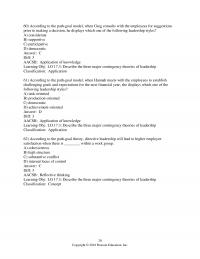
978-0134527604 Test Bank Chapter 17 Part 2
60) According to the path-goal model, when Greg consults with the employees for suggestions prior to making a decision, he displays which one of the following leadership styles? A) considerate B) supportive C) participative D) democratic Answer: C Diff: 3 […]
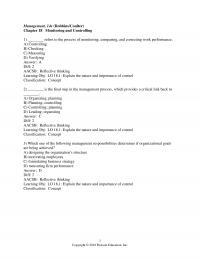
978-0134527604 Test Bank Chapter 18 Part 1
Management, 14e (Robbins/Coulter) Chapter 18 Monitoring and Controlling 1) ________ refers to the process of monitoring, comparing, and correcting work performance. A) Controlling B) Checking C) Measuring D) Verifying Answer: A Diff: 2 AACSB: Reflective thinking Learning Obj: LO 18.1: […]
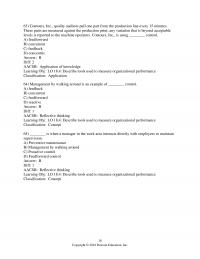
978-0134527604 Test Bank Chapter 18 Part 2
63) Contours, Inc., quality auditors pull one part from the production line every 15 minutes. These parts are measured against the production print; any variation that is beyond acceptable levels is reported to the machine operators. Contours, Inc., is using […]
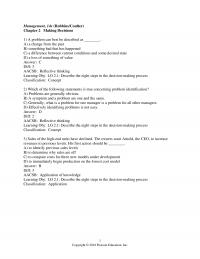
978-0134527604 Test Bank Chapter 2 Part 1
Management, 14e (Robbins/Coulter) Chapter 2 Making Decisions 1) A problem can best be described as ________. A) a change from the past B) something bad that has happened C) a difference between current conditions and some desired state D) a […]
978-0134527604 Test Bank Chapter 2 Part 2
68) A(n) ________ typically contains an ambiguous term that leaves interpretation up to the decision maker. A) rule B) procedure C) edict D) policy Answer: D Diff: 1 AACSB: Reflective thinking Learning Obj: LO 2.3: Classify decisions and decision-making conditions […]
978-0134527604 Test Bank Chapter 3 Part 1
Management, 14e (Robbins/Coulter) Chapter 3 Managing the External Environment and the Organization’s Culture 1) Which one of the following represents the two views of managerial impact on the success or failure of the organization? A) omnipotent and symbolic B) omnipotent […]
978-0134527604 Test Bank Chapter 3 Part 2
58) Which one of the following statements highlights the shared aspect of culture? A) Organizational culture is concerned with how members perceive the culture and describe it, not with whether they like it. B) Organizational culture is not something that […]
978-0134527604 Test Bank Chapter 4 Part 1
Management, 14e (Robbins/Coulter) Chapter 4 Managing in a Global Environment 1) Employers in the global marketplace look for which one of the following? A) a college degree in multicultural awareness B) critical thinking skills C) multi-lingual skills D) respect for […]
978-0134527604 Test Bank Chapter 4 Part 2
64) A global company reflects the ________. A) pancentric attitude B) ethnocentric attitude C) geocentric attitude D) polycentric attitude Answer: B Diff: 2 AACSB: Diverse and multicultural work environments Learning Obj: LO 4.3: Describe the structures and techniques organizations use […]
978-0134527604 Test Bank Chapter 5 Part 1
Management, 14e (Robbins/Coulter) Chapter 5 Managing Diversity 1) The ways in which people in an organization are different from and similar to one another is known as ________. A) business etiquette B) work culture C) workplace diversity D) organizational democracy […]
978-0134527604 Test Bank Chapter 5 Part 2
59) Which of the following managerial styles is traditionally considered to be masculine? A) agreeable B) leading by example C) collaborative D) inclusive Answer: B Diff: 2 AACSB: Diverse and multicultural work environments Learning Obj: LO 5.3: Explain the different […]
978-0134527604 Test Bank Chapter 6 Part 1
Management, 14e (Robbins/Coulter) Chapter 6 Managing Social Responsibility and Ethics 1) Social obligation is the obligation of a business to meet its ________. A) social and legal responsibilities B) economic and social responsibilities C) social and economic responsibilities D) economic […]
978-0134527604 Test Bank Chapter 6 Part 2
63) At the ________ level of moral development, ethical decisions rely on maintaining expected standards and living up to the expectations of others. A) preconventional B) conventional C) principled D) post-conventional Answer: B Diff: 2 AACSB: Ethical understanding and reasoning […]
978-0134527604 Test Bank Chapter 7 Part 1
Management, 14e (Robbins/Coulter) Chapter 7 Managing Change and Innovation 1) Organizational change can best be defined as ________. A) rethinking the organization’s target markets B) innovation that affects employees and customers C) a “cleaning house” of the top executives D) […]
978-0134527604 Test Bank Chapter 7 Part 2
68) Shelly was the most senior employee in the department and knew just about everything about everyone else’s job. If all employees in the department were cross-trained, Shelly would no longer have an advantage that brought with it special privileges. […]
978-0134527604 Test Bank Chapter 7 Part 3
108) Cultural change is easier when the organizational culture is strong. Answer: FALSE Diff: 1 AACSB: Reflective thinking Learning Obj: LO 7.5: Discuss contemporary issues in managing change Classification: Concept 109) Cultural change is likely to take place when a […]
978-0134527604 Test Bank Chapter 8 Part 1
Management, 14e (Robbins/Coulter) Chapter 8 Planning Work Activities 1) ________ involves defining the organization’s goals, establishing strategies for achieving those goals, and developing plans to integrate and coordinate work activities. A) Execution B) Logistics C) Planning D) Operations Answer: C […]
978-0134527604 Test Bank Chapter 8 Part 2
54) In a short essay, describe the different classifications of plans. Answer: Strategic plans are plans that apply to the entire organization, establish the organization’s overall goals, and seek to position the organization in terms of its environment. Plans that […]
978-0134527604 Test Bank Chapter 9 Part 1
Management, 14e (Robbins/Coulter) Chapter 9 Managing Strategy 1) The CEO is meeting with his top managers to determine how best to compete successfully in the company’s market. This group is developing the company’s ________. A) strategy B) competitive advantage C) […]
978-0134527604 Test Bank Chapter 9 Part 2
69) AI Rubber is one of four suppliers of molded rubber products and has a 45% market share. The market for its products is shrinking. AI Rubber is part of a larger corporation that includes a total of seven different […]
Chapter 1 Conceptual Skills Involve
60) Mark is vice president of finance. At his level of management, he is more likely to use the role of ________ than ________. A) leader; disseminator B) spokesperson; negotiator C) figurehead; liaison D) disseminator; leader Answer: D Diff: 3 […]