Archives: Solution Manual
978-1118808948 Chapter 11 Solution Manual
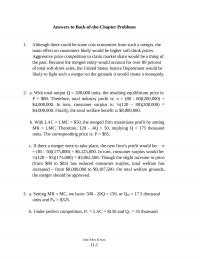
Answers to Back-of-the-Chapter Problems 1. Although there could be some cost economies from such a merger, the main effect on consumers likely would be higher soft-drink prices. 2. a. With total output Q = 200,000 units, the resulting equilibrium price […]
978-1118808948 Chapter 11 Lecture Note Part 2
Automobiles and Safety Since the late 1960’s, the National Highway Traffic Safety Administration has set increasingly stringent standards for automobile safety. Accident avoidance standards (pertaining to brake systems, tires, and steering mechanisms) have been effective in reducing fatalities at relatively […]
978-1118808948 Chapter 11 Lecture Note Part 1
CHAPTER ELEVEN REGULATION, PUBLIC GOODS, AND BENEFIT-COST ANALYSIS OBJECTIVES 1. To examine various market failures due to: monopoly, externalities, and imperfect information (Market Failures and Regulation). 2. To identify the class of public goods and to determine the optimal amount […]
978-1118808948 Chapter 10 Solution Manual
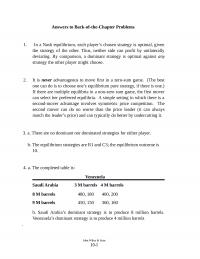
Answers to Back-of-the-Chapter Problems 1. In a Nash equilibrium, each player’s chosen strategy is optimal, given 2. It is never advantageous to move first in a zero-sum game. (The best one can do is to choose one’s equilibrium pure strategy, […]
978-1118808948 Chapter 10 Lecture Note
CHAPTER TEN GAME THEORY AND COMPETITIVE STRATEGY OBJECTIVES 1. To identify the similarities and differences among competitive situations. (Sizing up Competitive Situations) 2. To introduce game-theoretic analysis: payoff tables and equilibrium strategies. (Analyzing Payoff Tables) 3. To explore competitive strategies: […]
978-1118808948 Chapter 9 Solution Manual
Answers to Back-of-the-Chapter Problems 1. The conventional wisdom points to entry in loose oligopolies for two reasons: i) the market offers positive economic profits (unlike a 2. a. Before the acquisition, the top four firms accounted for 82% of the […]
978-1118808948 Chapter 9 Lecture Note
CHAPTER NINE OLIGOPOLY OBJECTIVES 1. To provide an overview of Porter’s Five-Forces Framework. (Oligopoly) 2. To compare market structures in terms of degree of concentration. (Industry Concentration) 3. To present the basic models of quantity competition and price competition. 4. […]
978-1118808948 Chapter 8 Solution Manual
Answers to Back-of-the-Chapter Problems 1. a. The merger should mean the end of the prevailing cutthroat competition. The b. Formerly, cutting rates made sense in order to claim additional clients from one’s rival. After the merger, the newspapers will raise […]
978-1118808948 Chapter 8 Lecture Note
CHAPTER EIGHT MONOPOLY OBJECTIVES 1. To examine price and output decisions under pure monopoly. (Pure Monopoly) 2. To explore how monopolies are maintained through barriers to entry. (Barriers to Entry) 3. To contrast competitive and monopolistic outcomes. (Perfect Competition versus […]
978-1118808948 Chapter 7 Solution Manual
Answers to Back-of-the-Chapter Problems 1. a. According to the “law” of supply and demand, the existence of a large b. If demand for Picasso’s work is inelastic, increasing the number of pieces sold (by driving down prices) will reduce total […]
978-1118808948 Chapter 7 Lecture Note
CHAPTER SEVEN PERFECT COMPETITION OBJECTIVES 1. To examine supply and demand under perfect competition. (The Basics of Supply and Demand) 2. To examine equilibrium in the short run and long run and the dynamics of entry and exit. (Competitive Equilibrium) […]
978-1118808948 Chapter 6 Solution Manual
Answers to Back-of-the-Chapter Problems 1. The fact that the product development was lengthier and more expensive than initially anticipated is no reason to charge a higher price. These 2. This statement confuses average quantities and marginal quantities. Though average total […]
978-1118808948 Chapter 6 Lecture Note
CHAPTER SIX COST ANALYSIS OBJECTIVES 1. To explain relevant costs and related concepts. In particular, to contrast opportunity cost and fixed costs and to contrast accounting profits and economic profits. (Relevant Costs) 2. To explain the relationship between production and […]
978-1118808948 Chapter 5 Solution Manual
Answers to Back-of-the-Chapter Problems 1. Maximizing average output is typically non-optimal. First, we should emphasize that maximizing total output and maximizing average output are two different things. For instance, in Table 5.2, the firm’s maximum 2. The production function, Q […]
978-1118808948 Chapter 5 Lecture Note
CHAPTER FIVE PRODUCTION OBJECTIVES 1. To introduce the concept of production and to lay the groundwork for the later discussion about cost. (Basic Production Concepts) 2. To explain short-run concepts including fixed inputs, marginal product, and diminishing marginal returns. (Production […]
978-1118808948 Chapter 4 Solution Manual
Answers to Back-of-the-Chapter Problems 1. Survey methods are relatively inexpensive but are subject to potential problems: sample bias, response bias, and response accuracy. Test marketing avoids these problems by providing data on actual consumer 2. a. Coca Cola’s management is […]
978-1118808948 Chapter 4 Lecture Note Part 3
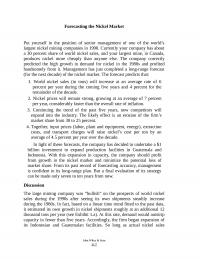
Forecasting the Nickel Market Put yourself in the position of senior management of one of the world’s largest nickel mining companies in 1990. Currently your company has about a 30 percent share of world nickel sales, and your largest mine, […]

978-1118808948 Chapter 4 Lecture Note Part 2
III. Cases Good Belly (1-429-252), University of Michigan, 2012. (Using regression analysis for marketing decisions.) Nils Baker (QA-0793), Darden Business Publishing, University of Virginia, 2012. Pilgrim Bank (A) (9-602-104), Harvard Business School, 2003. Teaching Note (5-602-131). Reyem Affiar (9-895-009), Harvard […]
978-1118808948 Chapter 4 Lecture Note Part 1
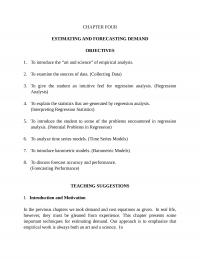
CHAPTER FOUR ESTIMATING AND FORECASTING DEMAND OBJECTIVES 1. To introduce the “art and science” of empirical analysis. 2. To examine the sources of data. (Collecting Data) 3. To give the student an intuitive feel for regression analysis. (Regression Analysis) 4. […]
978-1118808948 Chapter 3 Solution Manual
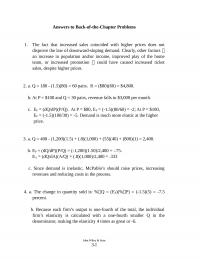
Answers to Back-of-the-Chapter Problems 1. The fact that increased sales coincided with higher prices does not disprove the law of downward-sloping demand. Clearly, other factors c. EP = (dQ/dP)(P/Q). At P = $80, EP = (-1.5)(80/60) = -2; At […]
978-1118808948 Chapter 3 Lecture Note
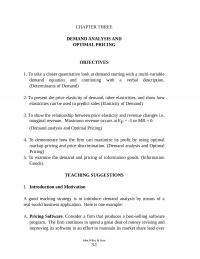
CHAPTER THREE DEMAND ANALYSIS AND OPTIMAL PRICING OBJECTIVES 1. To take a closer quantitative look at demand starting with a multi-variable demand equation and continuing with a verbal description. (Determinants of Demand) 2. To present the price elasticity of demand, […]
978-1118808948 Chapter 2 Solution Manual
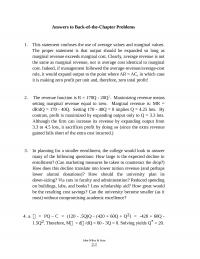
Answers to Back-of-the-Chapter Problems 1. This statement confuses the use of average values and marginal values. The proper statement is that output should be expanded so long as marginal revenue exceeds marginal cost. Clearly, average revenue is not 2. The […]
978-1118808948 Chapter 2 Lecture Note
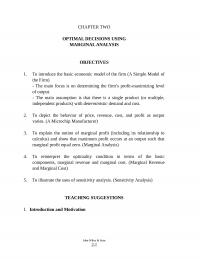
CHAPTER TWO OPTIMAL DECISIONS USING MARGINAL ANALYSIS OBJECTIVES 1. To introduce the basic economic model of the firm (A Simple Model of the Firm) – The main focus is on determining the firm’s profit-maximizing level of output. – The main […]

978-1118808948 Chapter 1 Solution Manual
Answers to Back-of-the-Chapter Problems 1. Managerial economics is the analysis of important management 2. i) Multinational Production and Pricing. The global automobile company needs information on demand (how many vehicles can be sold in each market at different prices) and […]
978-1118808948 Chapter 1 Lecture Note
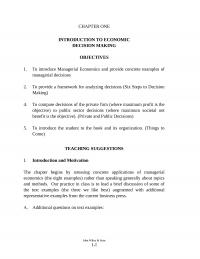
CHAPTER ONE INTRODUCTION TO ECONOMIC DECISION MAKING OBJECTIVES 1. To introduce Managerial Economics and provide concrete examples of managerial decisions 2. To provide a framework for analyzing decisions (Six Steps to Decision Making) 4. To compare decisions of the private […]
978-1111826925 Chapter 25 Solution Manual
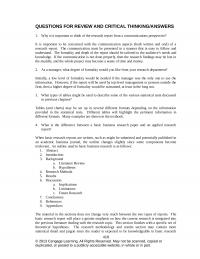
QUESTIONS FOR REVIEW AND CRITICAL THINKING/ANSWERS 1. Why is it important to think of the research report from a communications perspective? It is important to be concerned with the communication aspects (both written and oral) of a 2. As a […]
978-1111826925 Chapter 25 Lecture Note
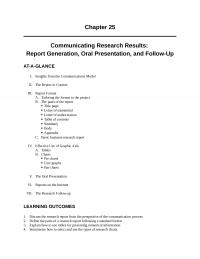
Chapter 25 Communicating Research Results: Report Generation, Oral Presentation, and Follow-Up AT-A-GLANCE I. Insights from the Communications Model II. The Report in Context III. Report Format A. Tailoring the format to the project B. The parts of the report Title […]
978-1111826925 Chapter 24 Solution Manual
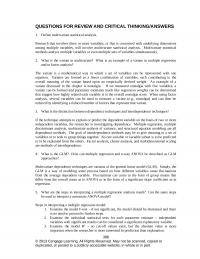
QUESTIONS FOR REVIEW AND CRITICAL THINKING/ANSWERS 1. Define multivariate statistical analysis. Research that involves three or more variables, or that is concerned with underlying dimensions 2. What is the variate in multivariate? What is an example of a variate in […]
978-1111826925 Chapter 24 Lecture Note
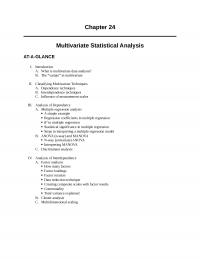
Chapter 24 Multivariate Statistical Analysis AT-A-GLANCE I. Introduction A. What is multivariate data analysis? B. The “variate” in multivariate II. Classifying Multivariate Techniques A. Dependence techniques B. Interdependence techniques C. Influence of measurement scales III. Analysis of Dependence A. Multiple […]
978-1111826925 Chapter 23 Solution Manual
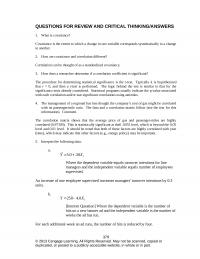
QUESTIONS FOR REVIEW AND CRITICAL THINKING/ANSWERS 1. What is covariance? 2. How are covariance and correlation different? Correlation can be thought of as a standardized covariance. 3. How does a researcher determine if a correlation coefficient is significant? The procedure […]
978-1111826925 Chapter 23 Lecture Note
Chapter 23 Bivariate Statistical Analysis: Measures of Association AT-A-GLANCE I. The Basics II. Simple Correlation Coefficient A. An example B. Correlation, covariance and causation C. Coefficient of determination D. Correlation matrix III. Regression Analysis A. The regression equation B. Parameter […]
978-1111826925 Chapter 22 Solution Manual
QUESTIONS FOR REVIEW AND CRITICAL THINKING/ANSWERS 1. What tests of difference are appropriate in the following situations? a. Average campaign contributions (in $) to a marketing campaign for healthy living for men and women are to be compared. b. Average […]
978-1111826925 Chapter 22 Lecture Note
Chapter 22 Bivariate Statistical Analysis: Differences Between Two Variables AT-A-GLANCE I. What Is the Appropriate Test of Difference? II. Cross-Tabulation Tables: The 2 Test for Goodness of Fit III. The t-Test for Comparing Two Means A. Independent samples t-Test Independent […]
978-1111826925 Chapter 21 Solution Manual
QUESTIONS FOR REVIEW AND CRITICAL THINKING/ANSWERS 1. What is the purpose of a statistical hypothesis? Hypotheses were defined in Chapter 3 as formal statements of explanations stated in a testable form. Generally, hypotheses should be stated in concrete fashion so […]
978-1111826925 Chapter 21 Lecture Note
Chapter 21 Univariate Statistical Analysis AT-A-GLANCE I. Introduction II. Hypothesis Testing A. The hypothesis-testing procedure Process Significance levels and p-values B. An example of hypothesis testing C. Type I and Type II errors Type I error Type II error III. […]
978-1111826925 Chapter 20 Solution Manual
QUESTIONS FOR REVIEW AND CRITICAL THINKING/ANSWERS 1. What are five descriptive statistics used to describe the basic properties of variables? 2. What is a histogram? What is the advantage of overlaying a normal distribution over a histogram? A histogram is […]
978-1111826925 Chapter 20 Lecture Note
Chapter 20 Basic Data Analysis: Descriptive Statistics AT-A-GLANCE I. The Nature of Descriptive Statistics II. Tabulation III. Cross Tabulation A. Contingency table B. Percentage cross-tabulations C. Elaboration and refinement D. How many cross-tabulations? E. Quadrant analysis IV. Data Transformations A. […]
978-1111826925 Chapter 19 Solution Manual
QUESTIONS FOR REVIEW AND CRITICAL THINKING/ANSWERS 1. What is the purpose of editing? Provide some examples of questions that might need editing. Editing is the process of checking and adjusting data for completeness, consistency, and legibility. The example given in […]
978-1111826925 Chapter 19 Lecture Note
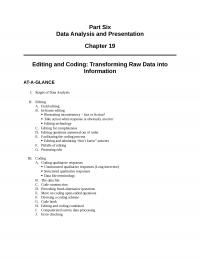
Part Six Data Analysis and Presentation Chapter 19 Editing and Coding: Transforming Raw Data into Information AT-A-GLANCE I. Stages of Data Analysis II. Editing A. Field editing B. In-house editing Illustrating inconsistency – fact or fiction? Take action when response […]
978-1111826925 Chapter 18 Solution Manual
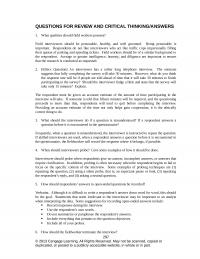
QUESTIONS FOR REVIEW AND CRITICAL THINKING/ANSWERS 1. What qualities should field workers possess? Field interviewers should be personable, healthy, and well groomed. Being personable is 2. [Ethics Question] An interviewer has a rather long telephone interview. The estimate suggests that […]
978-1111826925 Chapter 18 Lecture Note
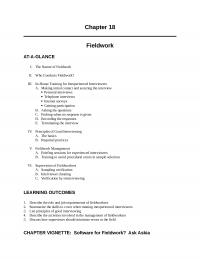
Chapter 18 Fieldwork AT-A-GLANCE I. The Nature of Fieldwork II. Who Conducts Fieldwork? III. In-House Training for Inexperienced Interviewers A. Making initial contact and securing the interview Personal interviews Telephone interviews Internet surveys Gaining participation B. Asking the questions C. […]
978-1111826925 Chapter 17 Solution Manual
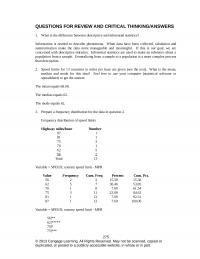
QUESTIONS FOR REVIEW AND CRITICAL THINKING/ANSWERS 1. What is the difference between descriptive and inferential statistics? Information is needed to describe phenomena. When data have been collected, tabulation and 2. Speed limits for 13 countries in miles per hour are […]
978-1111826925 Chapter 17 Lecture Note Part 2
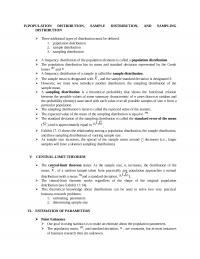
IV.POPULATION DISTRIBUTION, SAMPLE DISTRIBUTION, AND SAMPLING DISTRIBUTION Three additional types of distribution must be defined: 1. population distribution 2. sample distribution 3. sampling distribution A frequency distribution of the population elements is called a population distribution. The population distribution has […]
978-1111826925 Chapter 17 Lecture Note Part 1
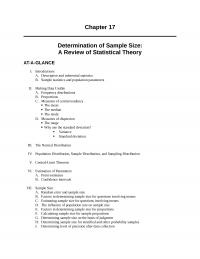
Chapter 17 Determination of Sample Size: A Review of Statistical Theory AT-A-GLANCE I. Introductions A. Descriptive and inferential statistics B. Sample statistics and population parameters II. Making Data Usable A. Frequency distributions B. Proportions C. Measures of central tendency The […]
978-1111826925 Chapter 16 Solution Manual
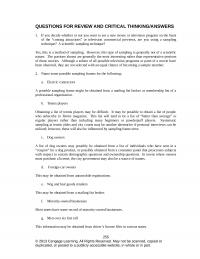
QUESTIONS FOR REVIEW AND CRITICAL THINKING/ANSWERS 1. If you decide whether or not you want to see a new movie or television program on the basis of the “coming attractions” or television commercial previews, are you using a sampling technique? […]
978-1111826925 Chapter 16 Lecture Note Part 2
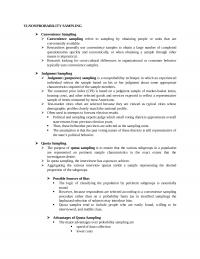
VI.NONPROBABILITY SAMPLING Convenience Sampling Convenience sampling refers to sampling by obtaining people or units that are conveniently available. Researchers generally use convenience samples to obtain a large number of completed questionnaires quickly and economically, or when obtaining a sample through […]
978-1111826925 Chapter 16 Lecture Note Part 1
Part Five Sampling and Fieldwork Chapter 16 Sampling Designs and Sampling Procedures AT-A-GLANCE I. Sampling Terminology II. Why Sample? A. Pragmatic reasons B. Accurate and reliable results C. Destruction of test units III. Practical Sampling Concepts A. Defining the target […]
978-1111826925 Chapter 15 Solution Manual
QUESTIONS FOR REVIEW AND CRITICAL THINKING/ANSWERS 1. Evaluate and comment on the following questions, taken from several different questionnaires. Do they follow the rules discussed in the chapter? See the textbook for the actual questions. a. The fixed alternative responses […]
978-1111826925 Chapter 15 Lecture Note
Chapter 15 Questionnaire Design AT-A-GLANCE I. Questionnaire Quality and Design: Basic Considerations A. What should be asked? B. Questionnaire relevancy C. Questionnaire accuracy II. Wording Questions A. Open-ended response versus fixed-alternative questions Using open-ended response questions Using fixed-alternative questions B. […]

978-1111826925 Chapter 14 Solution Manual
QUESTIONS FOR REVIEW AND CRITICAL THINKING/ANSWERS 1. What is an attitude? Is there a consensus concerning its definition? For social scientists, an attitude as an enduring disposition to consistently respond in a given manner to various aspects of the world, […]