Archives: Quiz
978-0133075229 Chapter 21
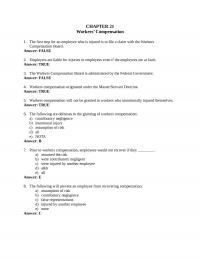
CHAPTER 21 Workers’ Compensation 1. The first step for an employee who is injured is to file a claim with the Workers Compensation Board. 2. Employers are liable for injuries to employees even if the employees are at fault. Answer: […]
978-0133075229 Chapter 20
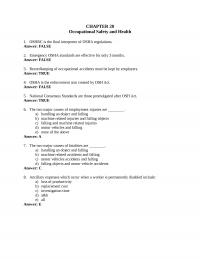
CHAPTER 20 Occupational Safety and Health 1. OSHRC is the final interpreter of OSHA regulations. 2. Emergency OSHA standards are effective for only 3 months. Answer: FALSE 3. Recordkeeping of occupational accidents must be kept by employers. Answer: TRUE 4. […]
978-0133075229 Chapter 19
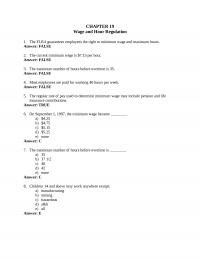
CHAPTER 19 Wage and Hour Regulation 1. The FLRA guarantees employees the right to minimum wage and maximum hours. 2. The current minimum wage is $7.15 per hour. Answer: FALSE 3. The maximum number of hours before overtime is 35. […]
978-0133075229 Chapter 18
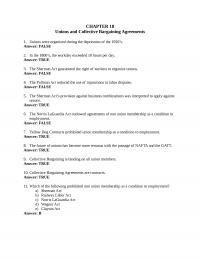
CHAPTER 18 Unions and Collective Bargaining Agreements 1. Unions were organized during the depression of the 1920’s. 2. In the 1800’s, the workday exceeded 10 hours per day. Answer: TRUE 3. The Sherman Act guaranteed the right of workers to […]
978-0133075229 Chapter 17
CHAPTER 17 Disability Discrimination 1. Disability discrimination is covered under the Civil Rights Act. 2. Drug addicts are not covered under the ADA. Answer: FALSE 3. Cancer is a disability. Answer: TRUE 1. The ADA applies to all employers. Answer: […]
978-0133075229 Chapter 16
CHAPTER 16 Age Discrimination 1. Age discrimination is protected under the Civil Rights Act. 2. The mandatory retirement age is 65. Answer: FALSE 3. An employee must be at least 50 to claim age discrimination. Answer: FALSE 4. A young […]
978-0133075229 Chapter 15
CHAPTER 15 National Origin Discrimination 1. National Origin can be a BFOQ. 2. Discrimination against non citizens is permissible under the Civil Rights Act. Answer: TRUE 3. Title VII does not apply to American citizens working abroad for a foreign […]
978-0133075229 Chapter 14
CHAPTER 14 Religious Discrimination 1. Freedom of Religion is guaranteed by each state under the 1st Amendment. 2. Religion can be a BFOQ. Answer: TRUE 3. Accommodating religious beliefs is required unless it presents an undue burden to the employer. […]
978-0133075229 Chapter 13
CHAPTER 13 Sexual Orientation 1. Sexual orientation is protected under Title VII as sex discrimination. 2. The Model Employment Termination Act would protect homosexuals because they could only be terminated for cause. Answer: TRUE 3. Sexual orientation is not a […]
978-0133075229 Chapter 12
CHAPTER 12 Pregnancy Discrimination and Family and Medical Leave 1. Employees are entitled to up to 10 weeks of Family Leave. 2. Family leave can be taken to care for a parent who has a serious health condition. Answer: TRUE […]
978-0133075229 Chapter 11
CHAPTER 11 Sexual Harassment 1. The “reasonable woman test” is the main test used for quid pro quo harassment. 2. Sexual harassment can involve employees of the same sex. Answer: TRUE 3. Men can be victims of sexual harassment. Answer: […]
978-0133075229 Chapter 10
CHAPTER 10 Sex Discrimination 1. In the past, gender was generally considered a BFOQ. 2. Comparable worth involves assigning values to male dominated and female dominated occupations. Answer: TRUE 3. Gender discrimination applies only to women. Answer: FALSE 4. Selecting […]
978-0133075229 Chapter 09
CHAPTER 9 Racial Discrimination 1. The 15 employee requirement was set forth in the Reconstruction Era Act. 2. The main reason why cases are not brought under the Reconstruction Era Act is the requirement of intent. Answer: TRUE 3. Congress […]
978-0133075229 Chapter 08
CHAPTER 8 Affirmative Action 1. A quota is a permissible form of affirmative action. 2. The concept of affirmative action arose out of an executive order in 1964. Answer: TRUE 3. Affirmative action programs are instituted by court order where […]
978-0133075229 Chapter 07
CHAPTER 7 Civil Rights Act 1. The first law regarding civil rights was the Civil Rights Act. 2. The first case addressing equal facilities was Brown v. Board of Ed. Answer: FALSE 3. The segregation of minorities and whites in […]
978-0133075229 Chapter 06
CHAPTER 6 Alternative Dispute Resolution 1. Arbitration is an expeditious alternative to a lawsuit. 2. Employers favor arbitration because juries are removed from the decision-making process. Answer: TRUE 3. The case which sanctioned mandatory arbitration of statutory rights was EEOC […]
978-0133075229 Chapter 05
CHAPTER 5 Termination 1. An employer may dismiss an employee at will. 2. An employer is guilty of wrongful discharge where its motivation for termination is discriminatory. Answer: TRUE 3. The Model Employment Termination Act was designed to permit employers […]
978-0133075229 Chapter 04
CHAPTER 4 Privacy, Theft, and Whistle-Blowing 1. Libel is oral defamation. 2. Truth is an absolute defense to slander, but not libel. Answer: FALSE 3. Publication of private matters that are newsworthy is privileged as long as it does not […]
978-0133075229 Chapter 03
CHAPTER 3 Testing 1. Gender aptitude tests may be safely used by all employers. 2. Aptitude tests may be biased against minorities, but not women. Answer: FALSE 3. Pre-employment medical exams are invalid because of the ADA. Answer: TRUE 4. […]
978-0133075229 Chapter 02
CHAPTER 2 Selection 1. Discrimination is possible in the selection process. 2. An employer can be guilty of negligent hiring. Answer: TRUE 3. Nepotism is not permissible. Answer: FALSE 4. Promotions from within the company can not be considered discriminatory. […]
978-0133075229 Chapter 01
CHAPTER 1 Employment Relationship 1. A lawyer who has his/her own practice would be regarded as an independent contractor. 2. An employer has direct control over the work performed by an independent contractor. Answer: FALSE 3. An employee and an […]
978-0133020267 online only
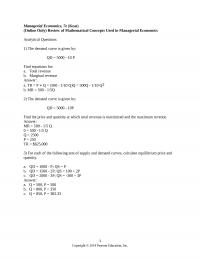
Managerial Economics, 7e (Keat) (Online Only) Review of Mathematical Concepts Used in Managerial Economics Analytical Questions 1) The demand curve is given by: QD = 5000 – 10 P Find equations for: a. Total revenue b. Marginal revenue 2) The […]
978-0133020267 Chapter 15
Managerial Economics, 7e (Keat) Chapter 15 The Global Soft Drink Industry Multiple-Choice Questions 1) Which of the following best describes the entire U. S. refreshment beverage market? A) monopoly B) oligopoly C) monopolistic competition D) perfect competition 2) Demand in […]
978-0133020267 Chapter 14
Managerial Economics, 7e (Keat) Chapter 14 Government and Industry: Challenges and Opportunities for Today’s Manager Multiple-Choice Questions 1) Which of the following is not considered a rationale for the intervention of government in the market process in the United States? […]
978-0133020267 Chapter 13
Managerial Economics, 7e (Keat) Chapter 13 The Multinational Corporation in a Global Setting Multiple-Choice Questions 1) Which of the following are risks for multinational corporations but not risks for domestic corporations? A) changes in government rules and regulations B) capital […]
978-0133020267 Chapter 12 Part 2
39) In evaluating the required rate of return for equity financing of a capital project, the Beta value is A) the expected rate of growth in a firm’s profits. B) the expected future value of a firm’s stock. C) the […]
978-0133020267 Chapter 12 Part 1
Managerial Economics, 7e (Keat) Chapter 12 Capital Budgeting and Risk (Appendix 12A) Multiple-Choice Questions 1) The term capital budgeting refers to decisions A) which are made in the short run. B) which concern the spreading of expenditures over a period […]
978-0133020267 Chapter 11
Managerial Economics, 7e (Keat) Chapter 11 Game Theory and Asymmetric Information Multiple-Choice Questions 1) Asymmetric information represents a market situation in which A) all parties to a transaction possess less than full information. B) one party in a transaction has […]
978-0133020267 Chapter 10 Part 2
36) When a firm prices its goods below the marginal cost to drive away competitors, it is referred as A) price skimming. B) limit pricing. C) penetration pricing. D) predatory pricing. 37) A firm uses ________ for goods which the […]
978-0133020267 Chapter 10 Part 1
Managerial Economics, 7e (Keat) Chapter 10 Special Pricing Practices Multiple-Choice Questions 1) A cartel is defined to be A) any oligopolistic industry with fewer than 4 firms. B) a form of oligopoly in which firms agree to sell at different […]
978-0133020267 Chapter 09
Managerial Economics, 7e (Keat) Chapter 9 Pricing and Output Decisions: Monopolistic Competition and Oligopoly (Appendix 9A) Multiple-Choice Questions 1) Which of the following industries is most likely to represent the monopolistic competition market structure? A) automobiles B) tobacco products C) […]
978-0133020267 Chapter 08 Part 2
31) Which of the following is true for a monopoly? A) P = MC B) P = MR C) P > MR D) P < MR 32) Which of the following is true about a monopoly? A) Its demand curve […]
978-0133020267 Chapter 08 Part 1
Managerial Economics, 7e (Keat) Chapter 8 Pricing and Output Decisions: Perfect Competition and Monopoly (Appendices 8A and 8B) Multiple-Choice Questions 1) Which of the following markets comes closes to the model of perfect competition? A) automobile industry B) information technology […]
978-0133020267 Chapter 07 Part 2
41) Assuming the existence of economies of scale, if a firm finds that it can reduce its unit cost by decreasing its scale of production, it means that A) it has too much production capacity relative to its demand. B) […]
978-0133020267 Chapter 07 Part 1
Managerial Economics, 7e (Keat) Chapter 7 The Theory and Estimation of Cost (Appendices 7A, 7B, and 7C) Multiple-Choice Questions 1) To an economist, total costs include A) explicit, but not implicit costs. B) implicit, but not explicit costs. C) explicit […]
978-0133020267 Chapter 06 Part 2
35) A major advantage of the ________ production function is that it can be easily transformed into a linear function, and thus can be analyzed with the linear regression method. A) cubic B) power C) quadratic D) None of the […]
978-0133020267 Chapter 06 Part 1
Managerial Economics, 7e (Keat) Chapter 6 The Theory and Estimation of Production (Appendices 6A, 6B, and 6C) Multiple-Choice Questions 1) The term Production Function refers to the A) use of machinery and equipment in production. B) relationship between costs and […]
978-0133020267 Chapter 05 Part 2
43) Quantitative forecasting that projects past data without explaining the reasons for future trends is called A) scientific forecasting. B) dumb forecasting. C) empirical forecasting. D) naïve forecasting. 44) Which of the following is not a drawback of forecasting using […]
978-0133020267 Chapter 05 Part 1
Managerial Economics, 7e (Keat) Chapter 5 Demand Estimation and Forecasting (Appendices 5A and 5B) Multiple-Choice Questions 1) Regression analysis can best be described as A) a statistical technique for estimating the best relationship between one variable and a set of […]
978-0133020267 Chapter 04 Part 2
30) If the price elasticity of supply of a good is elastic and the good price increases, then the increase in the good’s supply should be A) greater than the increase in price. B) less than the increase in price. […]
978-0133020267 Chapter 04 Part 1
Managerial Economics, 7e (Keat) Chapter 4 Demand Elasticity (Appendix 4A) Multiple-Choice Questions 1) The price elasticity of demand is a measure of A) the responsiveness of the quantity demanded to price changes. B) the quantity demanded at a given price. […]
978-0133020267 Chapter 03 Part 2
30) Which of the following would lead to a short-run market surplus for tomatoes? A) The price of tomatoes increases. B) A new government study shows that tomatoes have a greater risk of contamination from salmonella. C) An increase in […]
978-0133020267 Chapter 03 Part 1
Managerial Economics, 7e (Keat) Chapter 3 Supply and Demand (Appendix 3A) Multiple-Choice Questions 1) How long is the “short-run” time period in the economic analysis of the market? A) three months or one business quarter B) total time in which […]
978-0133020267 Chapter 02
Managerial Economics, 7e (Keat) Chapter 2 The Firm and Its Goals Multiple-Choice Questions 1) Transaction costs include A) costs of negotiating contracts with other firms. B) cost of enforcing contracts. C) the existence of asset-specificity. D) All of the above […]
978-0133020267 Chapter 01
Managerial Economics, 7e (Keat) Chapter 1 Introduction Multiple-Choice Questions 1) The best definition of economics is A) how choices are made under conditions of scarcity. B) how money is used. C) how goods and services are produced. D) how businesses […]
978-0132971270 Part 7
a. How you initially address the receiver of the telephone call. b. The conciseness of the message; avoid rambling to get your message across. c. Vocal quality. d. None of the above, it is based on the words spoken. 14.Which […]
978-0132971270 Part 6
ANSWER: A 18. In the United States women earn ___ cents for every dollar that men make. a. $.59 b. $.77 c. $.84 d. $.91 19. Cultural diversity includes which of the following? a. Age b. Religion c. Socioeconomic background […]
978-0132971270 Part 5
42. Which of the following does not fit the typical stereotype of the Asian culture? a. intelligent b. xenophobic c. group-oriented d. individualistic 43. Which of the following does not illustrate a global mindset? a. trained against surprises b. teamwork […]

978-0132971270 Part 4
c. Integrative agreements are more stable and mutually rewarding. d. Each party makes concessions on high-priority issues in exchange for concessions on low-priority issues. Answer: C 1. Negotiation protocol is different for different cultures. 3. Predicting how the opponent will […]
978-0132971270 Part 3
b. is about the same length as those in Germany. c. resembles those in Spain in length and format. d. is similar to the résumé in France. 28. In which country is a photograph of the applicant typically included with […]