Archives: Quiz
MSC 561 Test
You are the manager of a monopoly that faces a demand curve described by P = 85 – 5Q. Your costs are C = 20 + 5Q. The profit-maximizing price is: A. 45 B. 55 C. 60 D. 50 Suppose […]
Business 214 Quiz
Which of the following is an example of monopoly? A. Shoe industry in the United States B. Local utility industry in a small town C. Newspaper industry in New York City D. Bread industry in New York City The inverse […]
MOB 208 Test 2
The domestic demand and supply for sugar are Qd = 700 – 2P and QSD = 100 + 4P. The foreign supply is QSF = 150 + 3P. Suppose an import quota of 100 is imposed in the domestic market. […]
Business 875 Test 2
The demand function A. describes how much of good X will be purchased at the alternative price of good X, given all the other variables being constant. B. recognizes that the quantity of a good consumed depends on its price […]
GP 500 Midterm 1
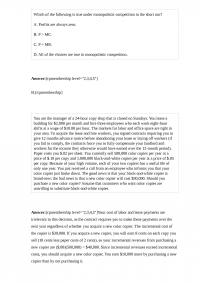
Which of the following is true under monopolistic competition in the short run? A. Profits are always zero. B. P > MC. C. P = MR. D. All of the choices are true in monopolistic competition. You are the manager […]
Business 400 Test 2
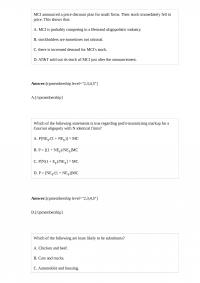
MCI announced a price discount plan for small firms. Their stock immediately fell in price. This shows that: A. MCI is probably competing in a Bertrand oligopolistic industry. B. stockholders are sometimes not rational. C. there is increased demand for […]
MG 226 Midterm 1
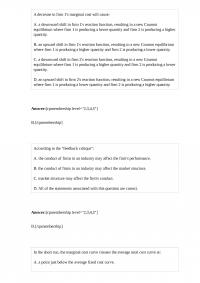
A decrease in firm 1’s marginal cost will cause: A. a downward shift in firm 1’s reaction function, resulting in a new Cournot equilibrium where firm 1 is producing a lower quantity and firm 2 is producing a higher quantity. […]
Business 343 Test 1
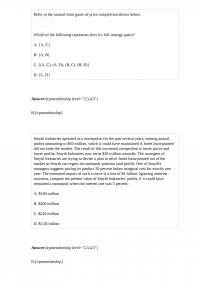
Refer to the normal-form game of price competition shown below. Which of the following represents firm A’s full strategy space? A. {A, C} B. {A, B} C. {(A, C), (A, D), (B, C), (B, D)} D. {C, D} Smyth Industries […]
GSM 466 Quiz 3
Consumer-consumer rivalry: A. increases the negotiating power of consumers in the marketplace. B. reduces the negotiating power of producers in the marketplace. C. reduces the negotiating power of consumers in the marketplace. D. increases the likelihood of government intervention in […]
MG 227 Midterm 2
If a firm’s production function is Leontief and the wage rate goes up, the: A. firm must use more labor in order to minimize the cost of producing a given level of output. B. firm must use more capital in […]
MSC 518 Midterm 2
If a firm manager has a base salary of $100,000 and also receives 5 percent of all profits, what percentage of his/her final income will be from a profit-sharing plan when profit equals $1,500,000? A. 51 percent B. 27 percent […]
Business 795
Firm 1 and firm 2 compete as a Cournot oligopoly. There is an increase in marginal cost for firm 1. Which of the following is NOT true? A. Firm 1 will produce less. B. Firm 2 will produce more. C. […]
MG 441
Game theory is best applied to the analysis of: A. perfect competition. B. oligopoly. C. monopoly. D. All of the statements associated with this question are correct. If the price of good X increases, what will happen to the budget […]
BUS 228
Given the Leontief production function Q = min{5.5K, 6.7L}, how much output is produced when K = 40 and L = 35? A. 220 B. 234.5 C. 192.5 D. 268 Firms 1 and 2 compete in a Cournot duopoly. If […]
BUS 187 Test
Which of the following is NOT a measure of market structure? A. Entry conditions B. Four-firm concentration ratio C. Herfindahl-Hirschman index D. Pricing behavior Scarce resources are ultimately allocated toward the production of goods most wanted by society because: A. […]
BUS 742 Midterm
Consider a market characterized by the following inverse demand and supply functions: PX = 10 – 2QX and PX = 2 + 2QX. Compute the surplus consumers receive when an $8 per unit price floor is imposed on the market. […]
MSC 124 Quiz 2
Producer and consumer surpluses are measures of: A. industry performance. B. market structure. C. firm conduct. D. None of the answers are correct. Kate’s money income is $350, the price of X is $4, and the price of Y is […]
Business 180 Test
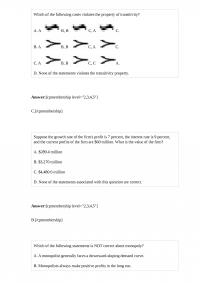
Which of the following cases violates the property of transitivity? A. A B, B C, A C. B. A B, B C, A C. C. A B, B C, C A. D. None of the statements violates the transitivity property. […]
MG 321 Quiz 3
An isoquant defines the combination of inputs that yield the producer: A. higher levels of output than the desired level of output. B. lower levels of output than the desired level of output. C. the same level of output. D. […]
MOB 661
In a competitive market, the market demand is Qd = 150 – 2P and the market supply is Q = 30 + 4P. A price ceiling of $16 will result in a A. shortage of 24 units. B. shortage of […]
GSM 293
An apple farmer must decide how many apples to harvest for the world apple market. He knows that there is a one-third probability that the world price will be $1, a one-third probability that it will be $1.50, and a […]
GP 169
“An oligopoly is an oligopoly. Firms behave the same no matter what type of oligopoly it is.” This statement is: A. true. B. false. C. true of homogeneous product industries. D. None of the answers is correct. If a firm’s […]
MG 306
Many tout that the Internet has lowered consumers’ search costs. If this is true, ceteris parabis, the consumer reservation price should: A. be higher. B. be lower. C. remain the same. D. There is insufficient information to determine the impact […]
Business 792
In the presence of large sunk costs, which of the following market structures generally leads to the highest price? A. Stackelberg B. Cournot C. Bertrand D. Monopoly Nonrivalry, as it relates to public goods, means that: A. consumer rivalry does […]
MSC 102 Midterm
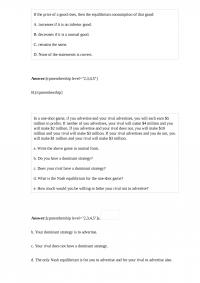
If the price of a good rises, then the equilibrium consumption of that good: A. increases if it is an inferior good. B. decreases if it is a normal good. C. remains the same. D. None of the statements is […]
MSC 237 Final
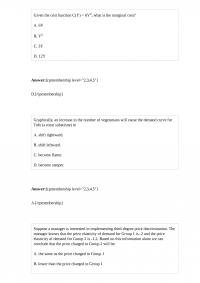
Given the cost function C(Y) = 6Y2, what is the marginal cost? A. 6Y B. Y2 C. 3Y D. 12Y Graphically, an increase in the number of vegetarians will cause the demand curve for Tofu (a meat substitute) to A. […]
MSC 130 Midterm
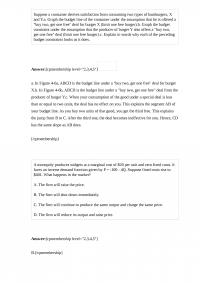
Suppose a consumer derives satisfaction from consuming two types of hamburgers, X and Y.a. Graph the budget line of the consumer under the assumption that he is offered a “buy two, get one free” deal for burger X (limit one […]
MSC 332 Midterm
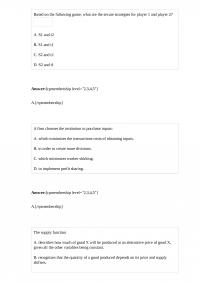
Based on the following game, what are the secure strategies for player 1 and player 2? A. S1 and t2 B. S1 and t1 C. S2 and t2 D. S2 and t1 A firm chooses the institution to purchase inputs: […]
Business 633 Quiz 2
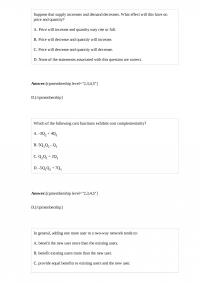
Suppose that supply increases and demand decreases. What effect will this have on price and quantity? A. Price will increase and quantity may rise or fall. B. Price will decrease and quantity will increase. C. Price will decrease and quantity […]
GP 278 Final
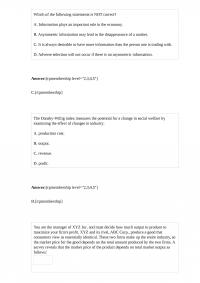
Which of the following statements is NOT correct? A. Information plays an important role in the economy. B. Asymmetric information may lead to the disappearance of a market. C. It is always desirable to have more information than the person […]
MSC 500
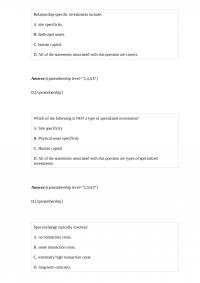
Relationship-specific investments include: A. site specificity. B. dedicated assets. C. human capital. D. All of the statements associated with this question are correct. Which of the following is NOT a type of specialized investment? A. Site specificity B. Physical-asset specificity […]
GSM 753 Quiz 3
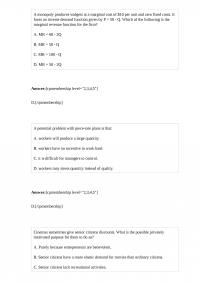
A monopoly produces widgets at a marginal cost of $10 per unit and zero fixed costs. It faces an inverse demand function given by P = 50 – Q. Which of the following is the marginal revenue function for the […]
Business 717 Test
Consider a market consisting of two firms where the inverse demand curve is given by P = 500 – 2Q1 – 2Q2. Each firm has a marginal cost of $50. Based on this information, we can conclude that aggregate quantity […]
GSM 615 Test
A monopoly produces widgets at a marginal cost of $10 per unit and zero fixed costs. It faces an inverse demand function given by P = 50 – Q. What are the profits of the monopoly in equilibrium? A. $300 […]
BUS 288 Test 2
Suppose the long-run average cost curve is U-shaped. When LRAC is in the increasing stage, there exist: A. economies of scope. B. diseconomies of scope. C. economies of scale. D. diseconomies of scale. Two firms compete in a Stackelberg fashion. […]
GSM 105 Quiz 3
Generally, revenue-based incentive schemes: A. reduce incentives to produce low-quality products. B. increase incentives to minimize costs. C. reduce worker productivity. D. reduce incentives to produce low-quality products and increase incentives to minimize costs. In a competitive industry with identical […]
MSC 834
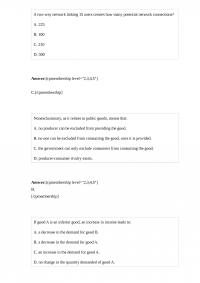
A two-way network linking 15 users creates how many potential network connections? A. 225 B. 100 C. 210 D. 300 Nonexclusionary, as it relates to public goods, means that: A. no producer can be excluded from providing the good. B. […]
GP 174 Quiz 1
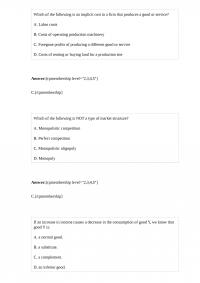
Which of the following is an implicit cost to a firm that produces a good or service? A. Labor costs B. Costs of operating production machinery C. Foregone profits of producing a different good or service D. Costs of renting […]
Business 703 Homework
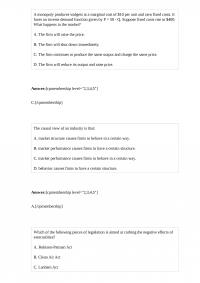
A monopoly produces widgets at a marginal cost of $10 per unit and zero fixed costs. It faces an inverse demand function given by P = 50 – Q. Suppose fixed costs rise to $400. What happens in the market? […]
GSM 619 Midterm 1
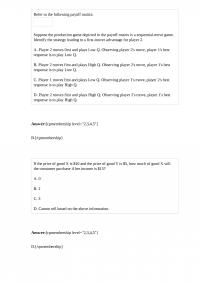
Refer to the following payoff matrix: Suppose the production game depicted in the payoff matrix is a sequential-move game. Identify the strategy leading to a first-mover advantage for player 2. A. Player 2 moves first and plays Low Q. Observing […]
BUS 732
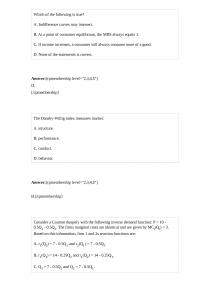
Which of the following is true? A. Indifference curves may intersect. B. At a point of consumer equilibrium, the MRS always equals 1. C. If income increases, a consumer will always consume more of a good. D. None of the […]
MOB 588 Quiz
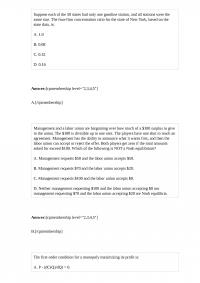
Suppose each of the 50 states had only one gasoline station, and all stations were the same size. The four-firm concentration ratio for the state of New York, based on the state data, is: A. 1.0 B. 0.08 C. 0.32 […]
GSM 459 Quiz 2
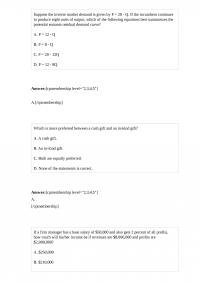
Suppose the inverse market demand is given by P = 20 – Q. If the incumbent continues to produce eight units of output, which of the following equations best summarizes the potential entrants residual demand curve? A. P = 12 […]
BUS 276 Quiz
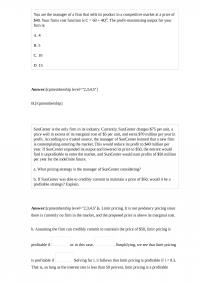
You are the manager of a firm that sells its product in a competitive market at a price of $40. Your firms cost function is C = 60 + 4Q2. The profit-maximizing output for your firm is: A. 4 B. […]
Business 719
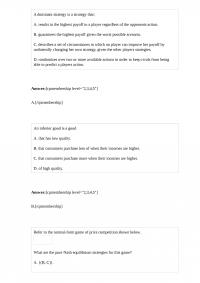
A dominant strategy is a strategy that: A. results in the highest payoff to a player regardless of the opponents action. B. guarantees the highest payoff given the worst possible scenario. C. describes a set of circumstances in which no […]
Business 358
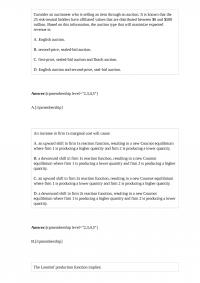
Consider an auctioneer who is selling an item through an auction. It is known that the 25 risk-neutral bidders have affiliated values that are distributed between $0 and $500 million. Based on this information, the auction type that will maximize […]
MSC 521 Test 1
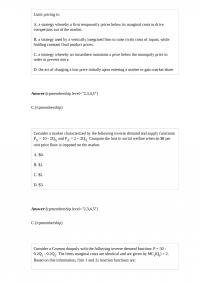
Limit pricing is: A. a strategy whereby a firm temporarily prices below its marginal costs to drive competitors out of the market. B. a strategy used by a vertically integrated firm to raise rivals costs of inputs, while holding constant […]
GP 630
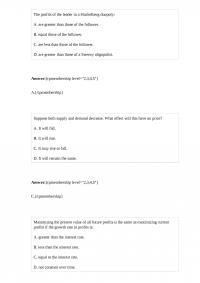
The profits of the leader in a Stackelberg duopoly: A. are greater than those of the follower. B. equal those of the follower. C. are less than those of the follower. D. are greater than those of a Sweezy oligopolist. […]
GSM 897 Quiz 1
Which of the following is true for a monopoly? A. A monopoly always makes a positive profit. B. A price ceiling on a monopoly is always desirable. C. Price does not equal marginal cost. D. A price ceiling on a […]
BUS 586 Midterm 1
Which of the following statements is true regarding a simple pricing rule for monopoly and monopolistic competition? A. P[EF/(1 + EF)] = MC B. P = [(1 + EF)/EF]MC C. P[(1 + EF)/EF] = MC D. All of the statements […]