
In a competitive market, the market demand is Qd = 150 – 2P and the market supply is
Q = 30 + 4P. A price ceiling of $16 will result in a
A. shortage of 24 units.
B. shortage of 34 units.
C. surplus of 58 units.
D. surplus of 34 units.
The first-order conditions for a monopoly to maximize profits are:
A. dR(Q)/dQ = dC(Q)/dQ.
B. MR(Q) = MC(Q).
C. d€(Q)/dQ = 0.
D. All of the statements associated with this question are correct.
The second-order condition for a firm maximizing its profits operating in a perfectly
competitive market is:
A. (d2/dQ2) < 0.
B. – (d2C(Q)/dQ2) < 0.
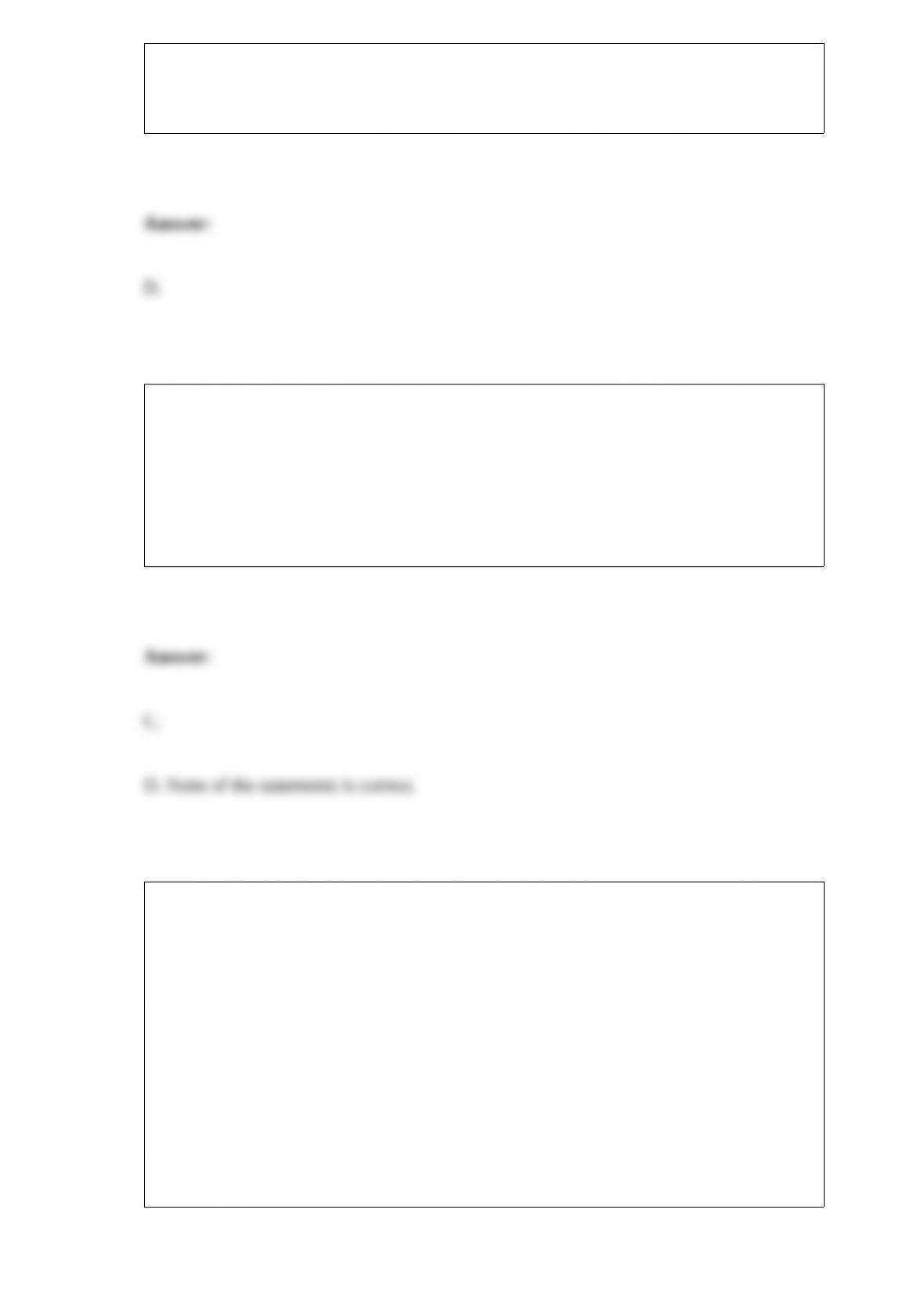
C. – (dMC/dQ) < 0.
D. All of the statements associated with this question are correct.
The average product of labor depends on how many units of:
A. labor are used.
B. capital are used.
C. labor and capital are used.
An apple farmer must decide how many apples to harvest for the world apple market.
He knows that there is a one-third probability that the world price will be $1, a
one-third probability that it will be $1.50, and a one-third probability that it will be $2.
His cost function is C(Q) = 0.01Q2. What is the expected price in the world apple
market?
A. $1.50
B. $1.80
C. $2.00
D. $1.40

A firm has a marginal cost of $200 and charges a price of $500. The Lerner index for
this firm is:
A. 0.20
B. 0.50
C. 1.50
D. 0.60
Suppose that 20 percent of the firms selling good X charge the low price. If the
remaining 80 percent of firms charge $80 per unit and the expected benefit of an
additional search is $5, then the lowest price in the market for good X is:
A. $73.75.
B. $55.
C. $5.
D. $0.

If the production function is Q = K.5L.5 and capital is fixed at 1 unit, then the average
product of labor when L = 36 is:
A. 1/3.
B. 1/6.
C. 2/3.
D. None of the answers are correct.
The opportunity cost of receiving $10 in the future as opposed to getting that $10 today
is:
A. the foregone interest that could be earned if you had the money today.
B. the taxes paid on any earnings.
C. the value of $10 relative to the total income of that person.
D. the value of $10 relative to the total income of all persons.
Consider the following entry game: Here, firm B is an existing firm in the market, and
firm A is a potential entrant. Firm A must decide whether to enter the market (play
“enter”) or stay out of the market (play “not enter”). If firm A decides to enter the
market, firm B must decide whether to engage in a price war (play “hard”), or not (play
‘soft”). By playing “hard,” firm B ensures that firm A makes a loss of $1 million, but
firm B only makes $1 million in profits. On the other hand, if firm B plays ‘soft,” the
new entrant takes half of the market, and each firm earns profits of $5 million. If firm A
stays out, it earns zero while firm B earns $10 million. Which of the following are
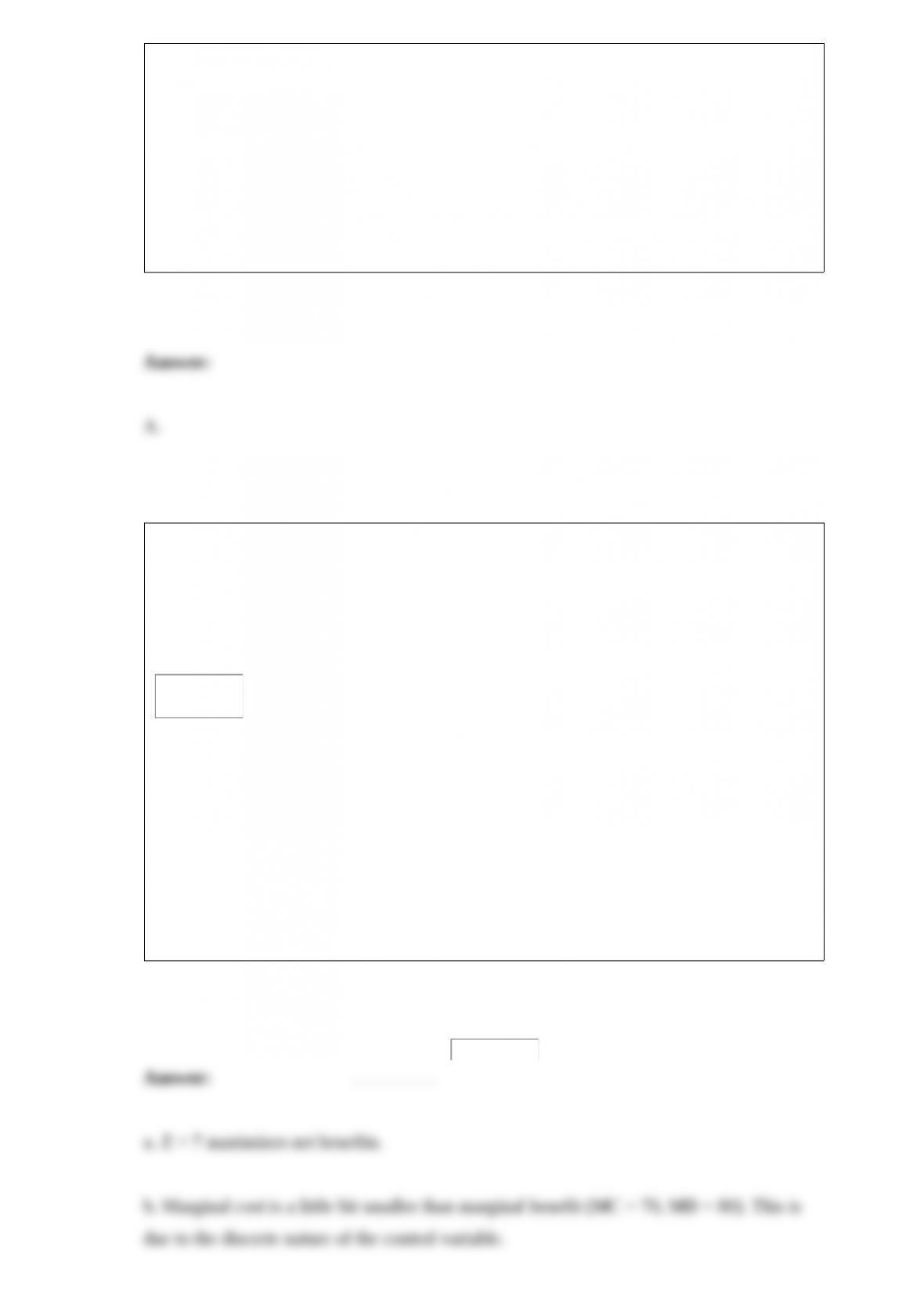
perfect equilibrium strategies?
A. (enter, soft)
B. (not enter, soft)
C. (enter, hard)
D. (not enter, hard)
You are the manager of a firm that specializes in selling exotic animals to zoos around
the world. Your goal is to determine the number of baby zebras (Z) that must be born on
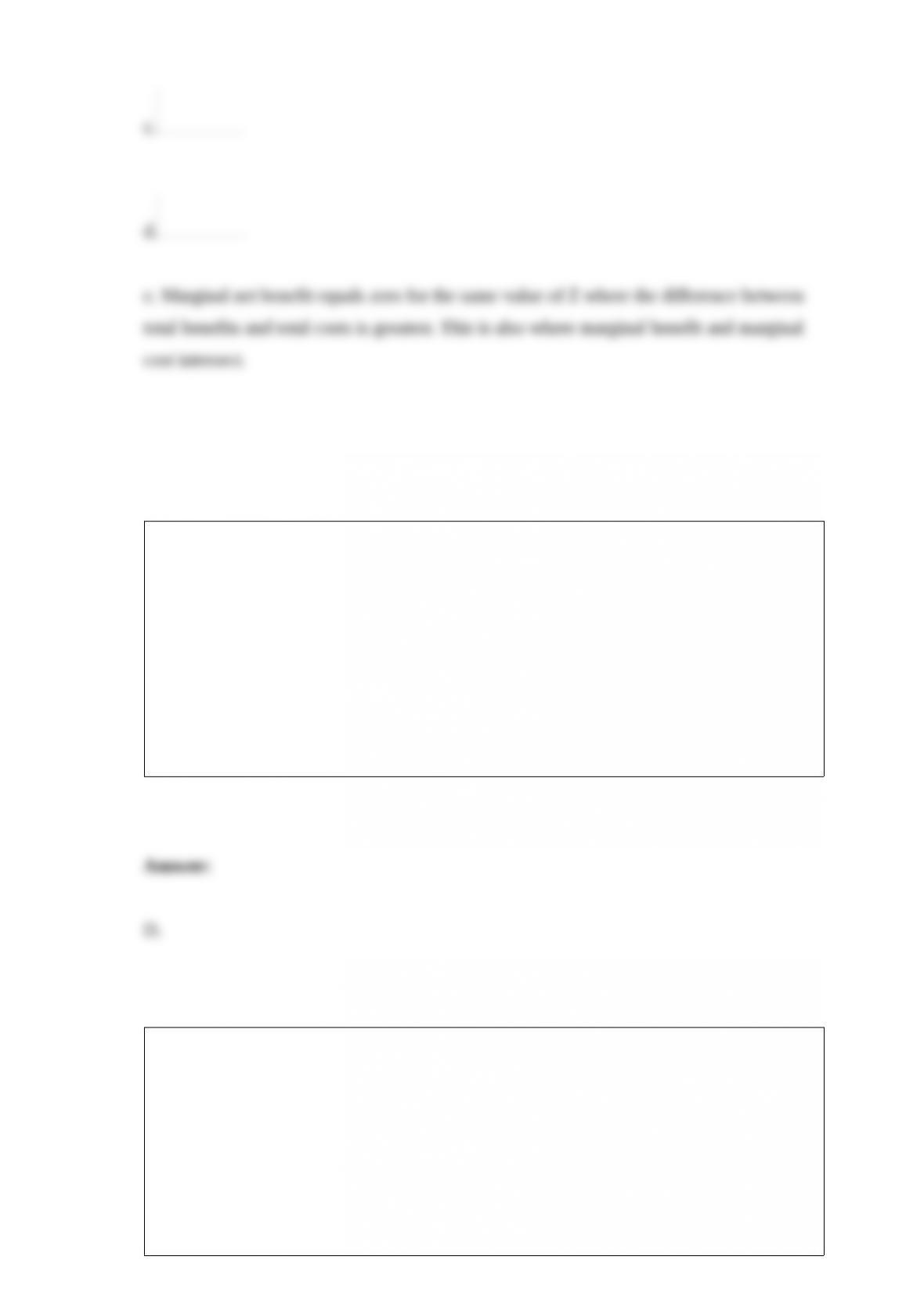
your firm’s farm each month in order to maximize profits. The total benefits (revenues)
and costs to your firm of producing various quantities of zebras are given in the first
three columns of the following table. Based on this scenario, complete the table and
answer the accompanying questions:
a. What level of zebra births maximizes net benefits?b. What is the relation between
marginal benefit and marginal cost at this level of Z?
c. Graph the total cost and total benefit curves.
d. On another graph, plot the points for the marginal cost, marginal benefit, and
marginal net benefit.
e. Show how the two graphs relate to each other.
For the cost function C(Q) = 75 + 4Q + 2Q2, the marginal cost of producing 5 units of
output is:
A. 4
B. 54
C. 20
D. 24
According to the Clean Air Act, a new firm in the covered industry is required to:
A. obtain a permit to pollute.
B. at least match the most effective system existing in the industry.
C. obtain a permit to pollute and at least match the most effective system existing in the
industry.

D. None of the statements are correct.