
MCI announced a price discount plan for small firms. Their stock immediately fell in
price. This shows that:
A. MCI is probably competing in a Bertrand oligopolistic industry.
B. stockholders are sometimes not rational.
C. there is increased demand for MCI’s stock.
D. AT&T sold out its stock of MCI just after the announcement.
Which of the following statements is true regarding profit-maximizing markup for a
Cournot oligopoly with N identical firms?
A. P[NEF/(1 + NEF)] = MC
B. P = [(1 + NEF)/NEF]MC
C. P[N(1 + EF)/NEF] = MC
D. P = [NEF/(1 + NEF)]MC
Which of the following are least likely to be substitutes?
A. Chicken and beef.
B. Cars and trucks.
C. Automobile and housing.

D. Automobile and gasoline.
Which of the following methods might be an efficient way of obtaining inputs when
specialized investments are not important?
A. Spot exchange
B. Vertical integration
C. Profit-sharing
D. Long-term contracts
Profits are higher as isoprofit curves move closer to the:
A. monopoly output, QM.
B. Cournot output, QCournot.
C. Bertrand output, QBertrand.
D. peak of each isoprofit curve.

Compute the present value of a perpetual bond that pays a monthly cash flow of $1,000
at an annual interest rate of 12 percent.
A. $8,333.33
B. $9,333.33
C. $100,000
D. $101,000
If you advertise and your rival advertises, you each will earn $4 million in profits. If
neither of you advertises, you will each earn $10 million in profits. However, if one of
you advertises and the other does not, the firm that advertises will earn $1 million and
the non-advertising firm will earn $5 million. If you and your rival plan to hand your
business down to your children (and this “bequest” goes on forever), then a Nash
equilibrium is for each firm to:
A. not advertise until the rival does, and then to advertise forever.
B. never advertise.
C. always advertise.
D. advertise until the rival does not advertise, and then not advertise forever.

The substitution effect reflects how a consumer will react to a different:
A. marginal rate of substitution.
B. market rate of substitution.
C. level of real income.
D. level of nominal income.
Your firm’s research department has estimated your total revenues to be R(Q) = 3,000 –
8Q2 and your total costs to be C(Q) = 100 + 2Q2. (Note that MB = 3,000 – 16Q and MC
= 4Q.)
a. What level of Q maximizes net benefits?
b. What is marginal benefit at this level of Q?
c. What is marginal cost at this level of Q?
d. What is the maximum level of net benefits?
e. What is another word for net benefits in this example?

The domestic demand and supply for sugar are Qd = 700 – 2P and QSD = 100 + 4P. The
foreign supply is QSF = 150 + 3P. Suppose an import quota of 100 is imposed in the
domestic market. What will be the new market price of sugar?
A. 62.50
B. 90
C. 100
D. 110
The following provides information for a one-shot game.
What are the Nash equilibrium strategies for this game?
A. (low price, low price)
B. (high price, high price)
C. (low price, low price) and (high price, high price)
D. None of the answers is correct.
The curve which summarizes the total quantity producers are willing and able to
produce at differing prices is the:
A. market demand curve.
B. consumer surplus curve.
C. average cost curve.
D. market supply curve.
You are the manager of a firm that sells output at a price of $40 per unit. You are
interested in hiring a new worker who will increase your firm’s output by 2,000 units
per year. Several other firms also are interested in hiring this worker.
a. What is the highest annual salary you should be willing to pay this worker to come to
your firm?
b. What will determine whether or not you actually have to offer this much to the
worker to induce him to join your firm?
You are the CEO of ClipIt, a paper clip manufacturer. Your company enjoys a patented
technology that allows it to produce paper clips faster and at a lower cost than your only
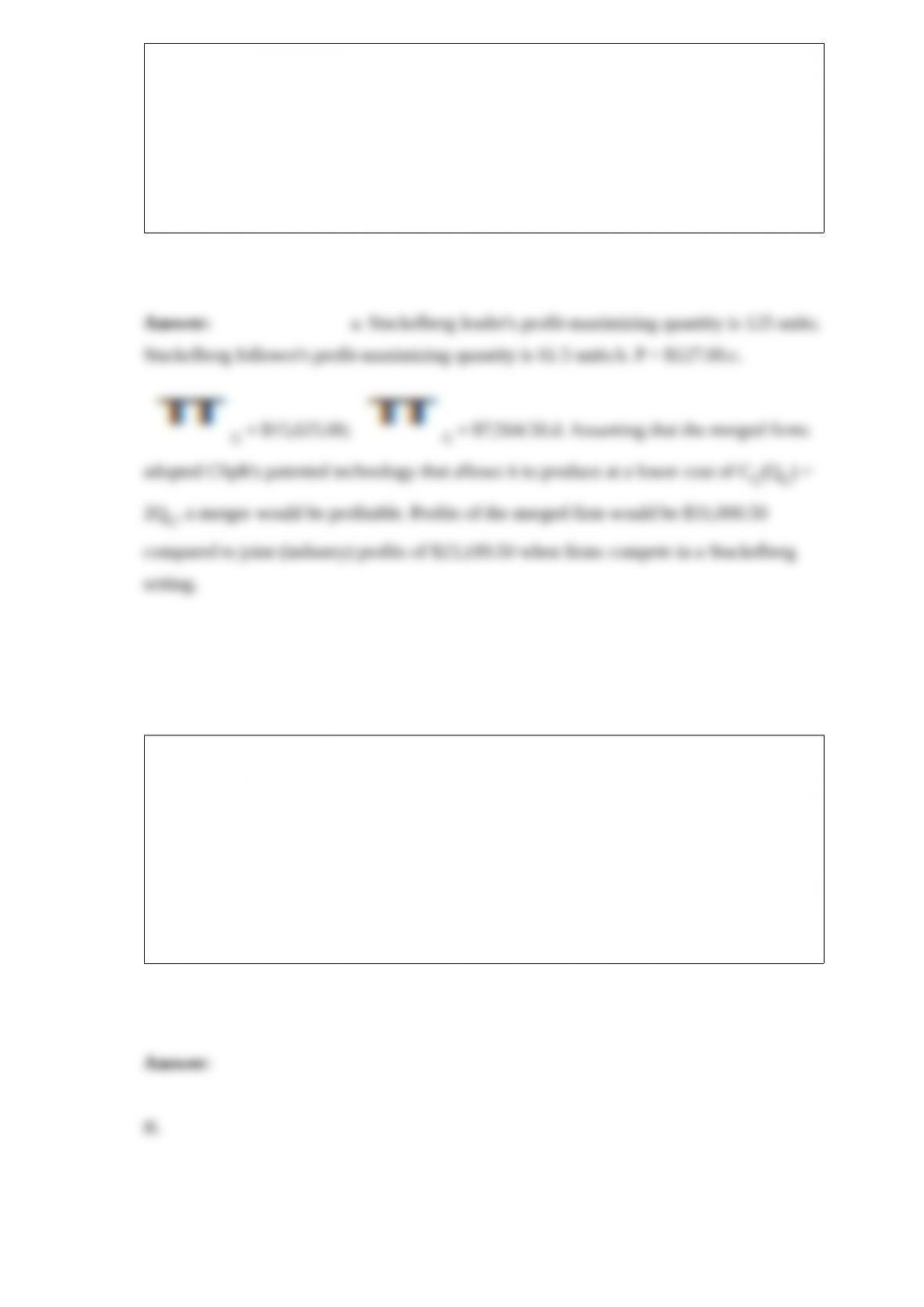
rival, FastenIt. Clipit uses this advantage to be the first to choose its profit-maximizing
output level in the market. The inverse demand function for paper clips is P = 500 – 2Q,
ClipIt’s costs are CC(QC) = 2QC, and FastenIt’s costs are CF(QF) = 4QF.a. What is
ClipIt’s profit-maximizing output level? FastenIt’s?b. What is the market’s equilibrium
price?c. How much profit does each firm earn?d. Ignoring antitrust considerations,
would it be profitable for your firm to merge with FastenIt? If not, explain why not; if
so, put together an offer that would permit you to profitably complete the merger.
The problem with spot exchange in the presence of specific assets is that both parties:
A. have incentives to behave as principals.
B. have incentives to behave opportunistically.
C. take the risk of price fluctuations.
D. do not take advantage of the economies of scope.