
Which of the following is true?
A. Indifference curves may intersect.
B. At a point of consumer equilibrium, the MRS always equals 1.
C. If income increases, a consumer will always consume more of a good.
D. None of the statements is correct.
The Dansby-Willig index measures market:
A. structure.
B. performance.
C. conduct.
D. behavior.
Consider a Cournot duopoly with the following inverse demand function: P = 10 –
0.5Q1 – 0.5Q2. The firms marginal costs are identical and are given by MCi(Qi) = 3.
Based on this information, firm 1 and 2s reaction functions are:
A. r1(Q2) = 7 – 0.5Q1 and r2(Q1) = 7 – 0.5Q2.
B. r1(Q2) = 14 – 0.25Q2 and r1(Q2) = 14 – 0.25Q1.
C. Q1 = 7 – 0.5Q2 and Q2 = 7 – 0.5Q1.
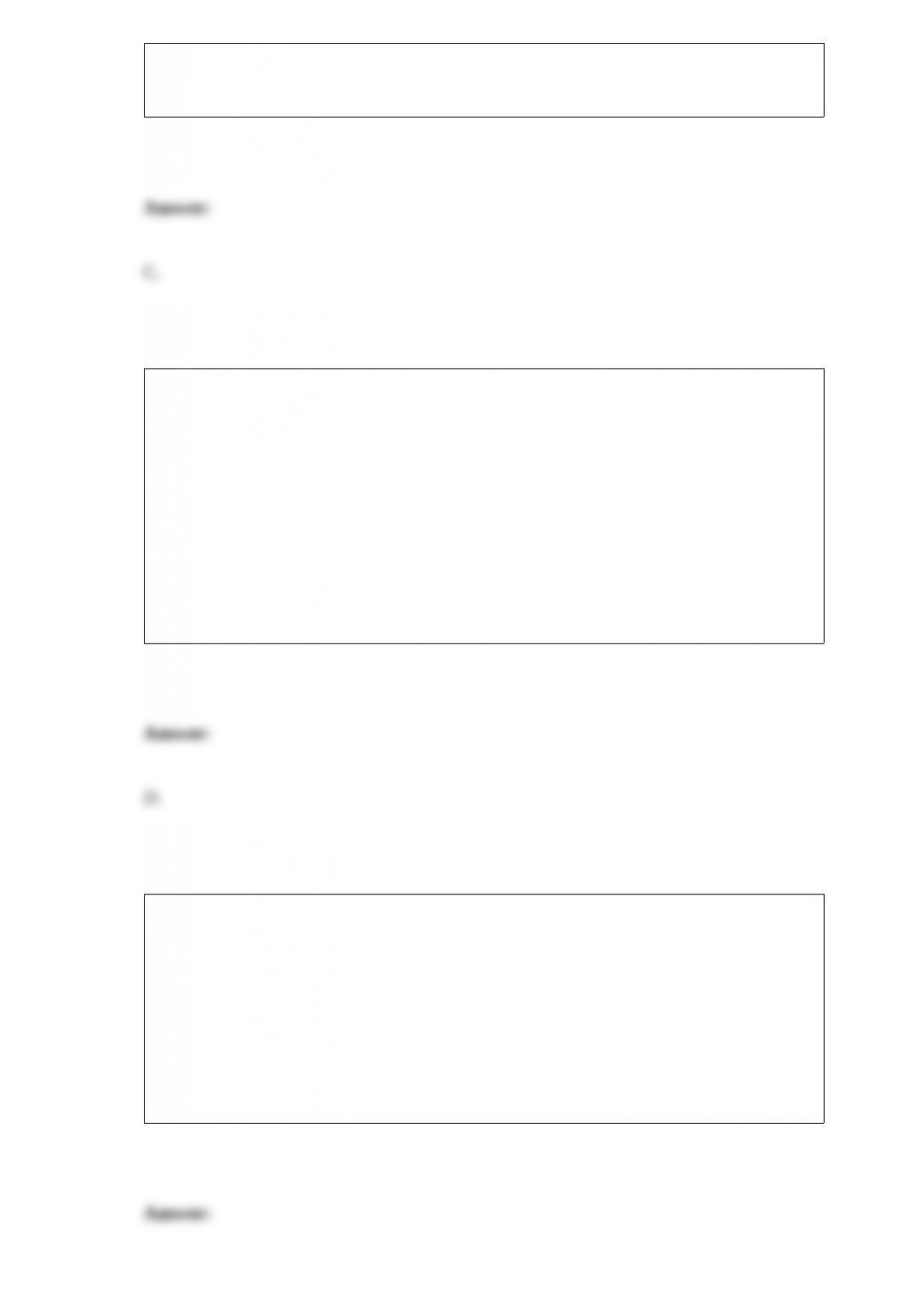
D. Q1 = 14 – 0.25Q2 and Q2 = 14 – 0.25Q1.
Suppose earnings are given by E = $50 + $20(24 – L), where E is earnings and L is the
hours of leisure. What is the price to the worker of consuming an additional hour of
leisure?
A. $30
B. $26
C. $24
D. $20
The affordable bundle that yields the greatest satisfaction to the consumer is:
A. the maximum bundle.
B. the equilibrium consumption bundle.
C. the allowable purchasing bundle.
D. the most popular bundle.

Suppose total benefits and total costs are given by B(Y) = 100Y – 8Y2 and C(Y) =
10Y2. Then marginal benefits are:
A. 100 – 16Y.
B. 100Y – 8Y2.
C. 50 – 4Y.
D. 200Y – 10Y.
If the price of good X decreases, what will happen to the budget line?
A. It will have a parallel shift inward.
B. It will have a parallel shift outward.
C. It will become steeper.
D. It will become flatter.
Costs that change as output changes are:
A. variable costs.

B. fixed costs.
C. sunk costs.
D. None of the statements is correct.
A two-way network linking nine users creates how many potential network
connections?
A. 72
B. 56
C. 90
D. 18
Consider a two-way network with 1,000 users. The number of potential connections is:
A. 999.
B. 1,000.
C. 2,000.
D. 999,000.
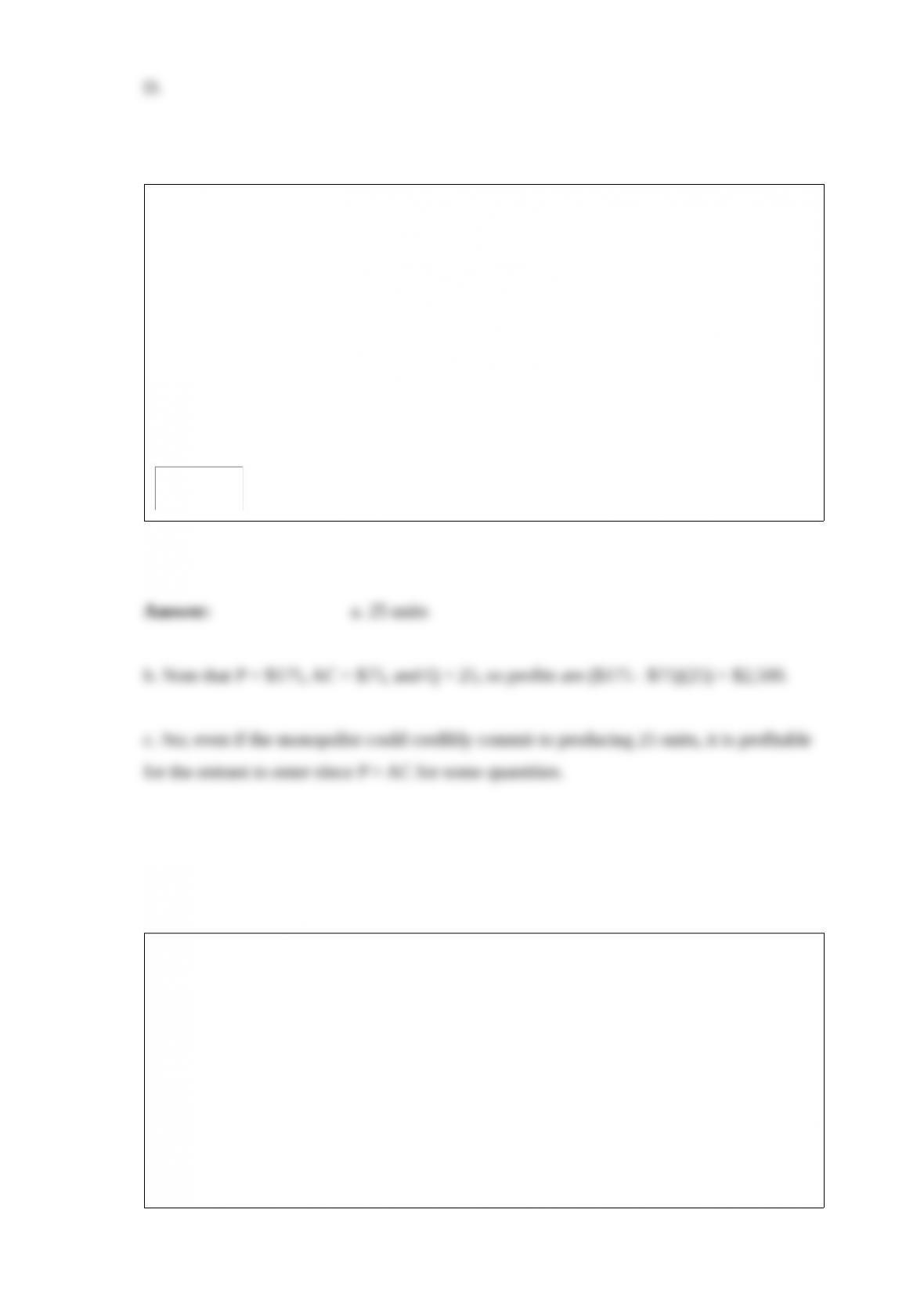
A monopolists demand curve is given by DM and its average cost curve is AC in Figure
13-1. Suppose a potential entrant can produce at the same cost as the monopolist.
a. What level of output does the monopolist have to produce in order for the entrant to
face the residual demand curve, DR?
b. How much profit will the monopolist earn if it commits to the output that generates
the residual demand curve, DR?
c. Is the level of output that generates the residual demand curve, DR, enough for the
monopolist to deter entry?
You are the manager of a Mom and Pop store that can buy milk from a supplier at $3.00
per gallon. If you believe the elasticity of demand for milk by customers at your store is
-4, then your profit-maximizing price is:
A. $2.00.
B. $2.50.
C. $4.00.
D. $5.00.
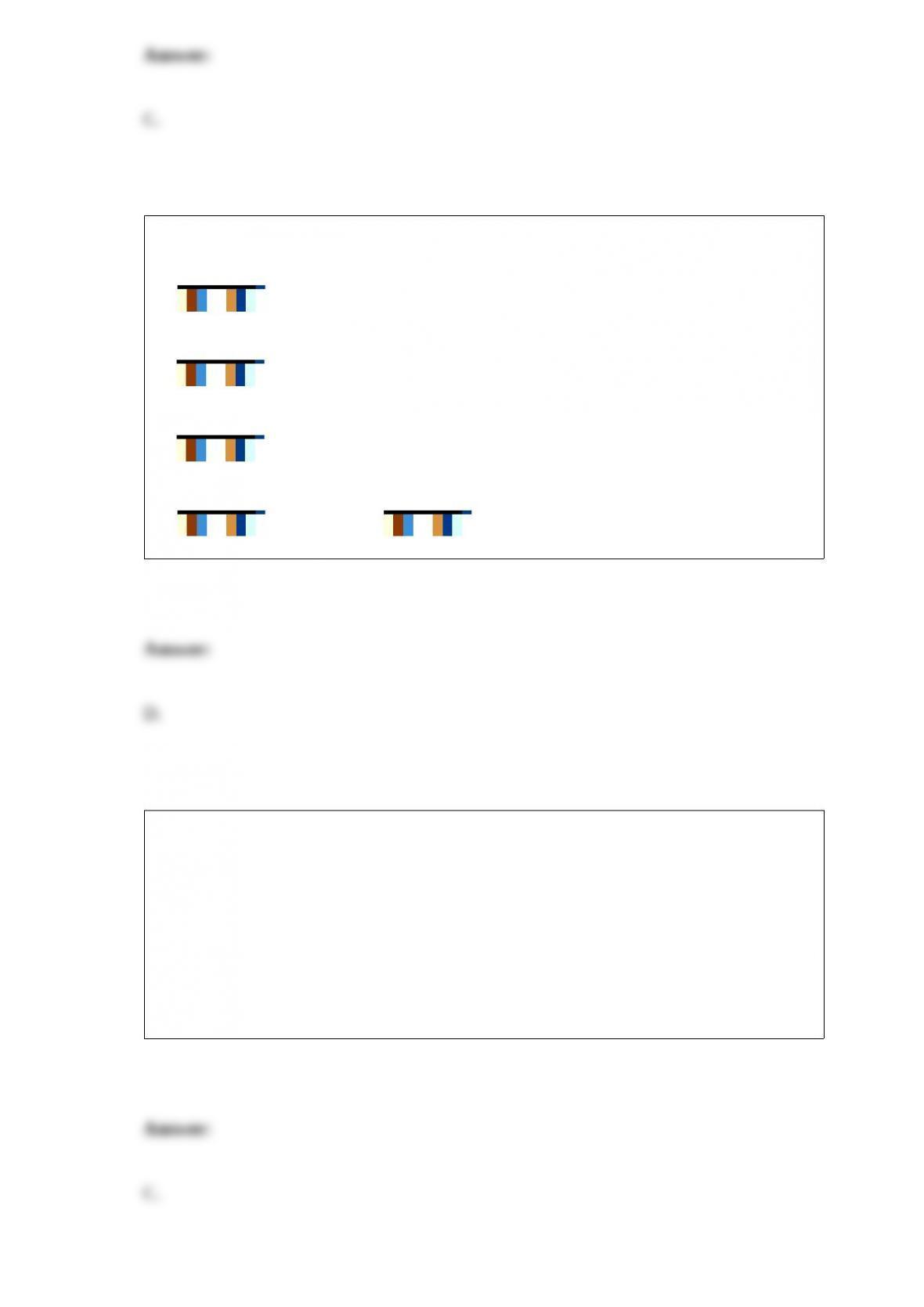
Which of the following formulas correctly measures the profit of a monopoly?
A. = TR – TC
B. = (P – ATC)Q
C. = (P – AVC)Q
D. = TR – TC and = (P – ATC)Q
If marginal costs exceed marginal benefits, then:
A. the firm ends up with a net loss.
B. the firms average costs exceed average benefits.
C. the firm should decrease its production level.
D. None of the statements associated with this question are correct.

If a manager wishes to produce a large level of output, which compensation mechanism
is most effective?
A. Spot check
B. Piece rate
C. Revenue sharing
D. Profit sharing