
Consider a market characterized by the following inverse demand and supply functions:
PX = 10 – 2QX and PX = 2 + 2QX. Compute the surplus consumers receive when an $8
per unit price floor is imposed on the market.
A. $0.
B. $1.
C. $3.
D. $5.
Individuals who purchase services and goods for the purpose of consumption are:
A. consumers.
B. managers.
C. workers.
D. agents.
Refer to the following payoff matrix:
Suppose the production game depicted in the payoff matrix is a sequential-move game.
Identify the strategy leading to a first-mover advantage for player 2.

A. Player 2 moves first and plays High Q. Observing player 2’s move, player 1’s best
response is to play Low Q.
B. Player 2 moves first and plays Low Q. Observing player 2’s move, player 1’s best
response is to play Low Q.
C. Player 2 moves first and plays High Q. Observing player 2’s move, player 1’s best
response is to play High Q.
D. Player 2 moves first and plays Low Q. Observing player 2’s move, player 1’s best
response is to play High Q.
Refer to the normal-form game of bargaining shown below.
Suppose that management and the union are bargaining over how much of a $500
surplus to give to the union. It is assumed that the surplus can only be split into $250
increments. Furthermore, negotiations are set up such that management and the union
must simultaneously and independently write down the amount of surplus to allocate to
the union. The payoff structure to this one-shot bargaining game is listed in Figure
10-16. Find the Nash equilibrium(ia) to this game.
A. Union write down $0 and management write down $500.
B. Union write down $250 and management write down $250.
C. Union write down $500 and management write down $0.
D. All of the statements associated with this question constitute Nash equilibria.

Joe consumes 10 units of food and 12 units of clothing. Since food is an inferior good, a
gift to Joe of a $12 gift certificate at a clothing store will:
A. induce Joe to eat more than 10 units of food.
B. definitely make Joe better off than a gift of $12 in cash.
C. definitely make Joe worse off than a gift of $12 in cash.
D. None of the statements is correct.
The absolute value of the slope of the isoquant is the:
A. marginal rate of technical substitution.
B. marginal product of capital.
C. marginal rate of substitution.
D. value marginal product of labor.
Which of the following is NOT a means of acquiring product and process innovations?
A. Independent research and development
B. Mass production of the existing product
C. Reverse engineering
D. Hiring employees of innovating firms

The domestic demand and supply for sugar are Qd = 700 – 2P and QSD = 100 + 4P. The
foreign supply is QSF = 150 + 3P. What is the total supply of sugar in the domestic
market?
A. Q = 250 + 7P
B. Q = 800 + 2P
C. Q = 850 + P
D. Q = 150 + 3P
Consider a monopoly where the inverse demand for its product is given by P = 50 – 2Q.
Total costs for this monopolist are estimated to be C(Q) = 100 + 2Q + Q2. At the
profit-maximizing combination of output and price, consumer surplus is:
A. $32.
B. $64.
C. $128.
D. cannot be determined with the given information.

What is/are the important things that must be developed when characterizing consumer
behavior?
A. Individual goals of the firm
B. Consumer opportunities
C. Individual goals of the firm and consumer opportunities
D. Consumer preferences and consumer opportunities
The difference between average total costs and average variable costs is:
A. marginal cost.
B. average fixed cost.
C. fixed cost.
D. None of the statements is correct.
A farm must decide whether or not to purchase a new tractor. The tractor will reduce
costs by $2,000 in the first year, $2,500 in the second, and $3,000 in the third and final
year of usefulness. The tractor costs $9,000 today, while the above cost savings will be
realized at the end of each year. If the interest rate is 7 percent, what is the net present
value of purchasing the tractor?

A. $6,764
B. $9,362
C. $18,362
D. None of the statements associated with this question are correct.
Which of the following forms of payment is NOT an incentive plan?
A. Commission plans for salesmen
B. Flat salary for a plant manager
C. Bonuses for managers that increase as profits increase
D. None of the statements is correct.
You are a hotel manager considering four projects that yield different payoffs,
depending upon whether there is an economic boom or a recession. The potential
payoffs and corresponding payoffs are summarized in the following table.
If a manager adopted both project A and project B simultaneously, the expected value of
this joint project would be:
A. $20.
B. $30.

C. $40.
D. None of the statements are correct.
If you include in your offerings some inferior goods, the demand for these products will
increase:
A. during bad economic times.
B. during economic booms.
C. when incomes are high.
D. All of the statements associated with this question are correct.
Given a cost function C(Q) = 200 + 14Q + 8Q2, what is the marginal cost function?
A. 14 + 16Q
B. 14Q + 8Q2
C. 200 + 8Q2
D. 14 + 16Q2
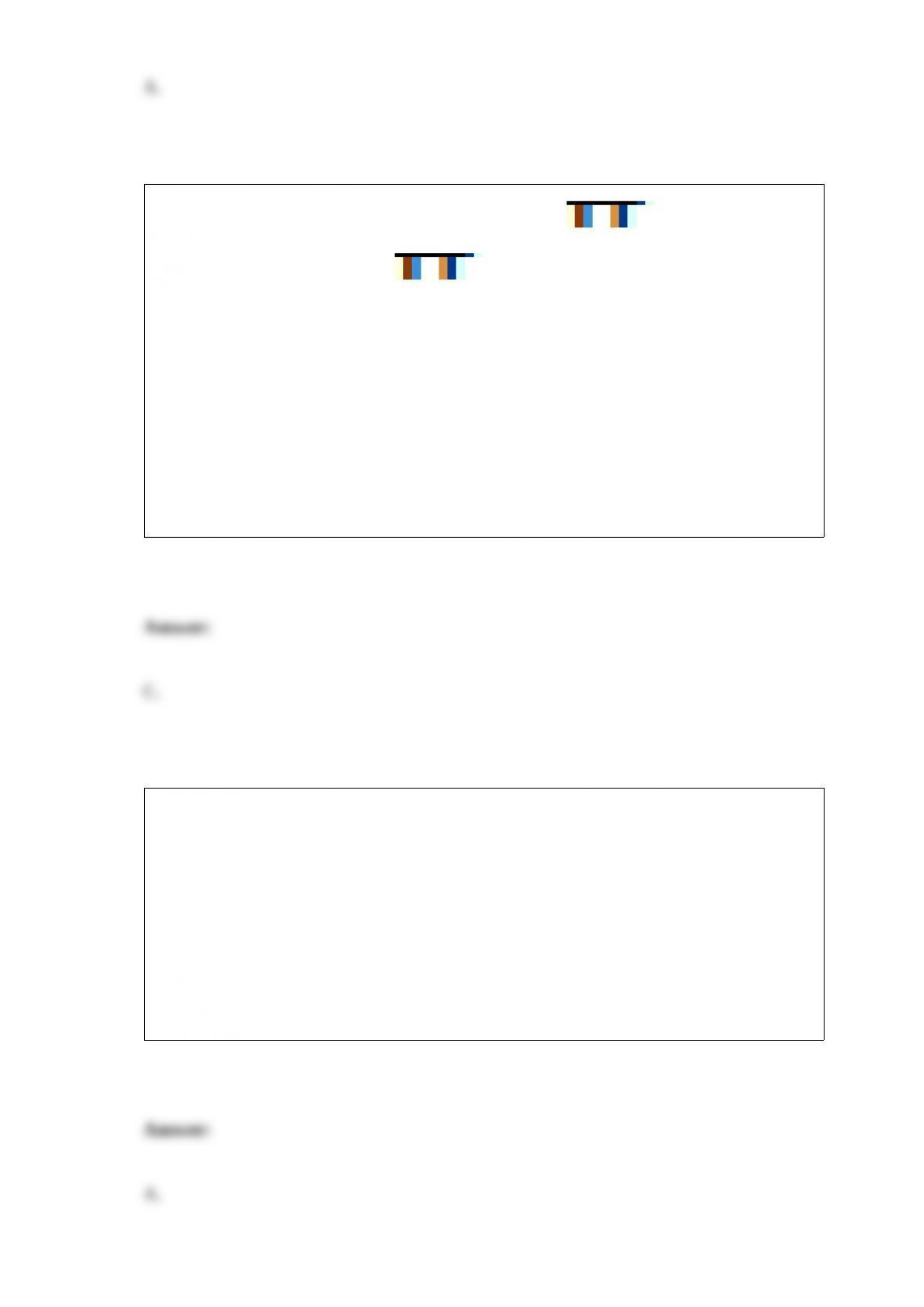
Suppose compensation is given by W = 500,000 + 200 + 17S, where W =
total compensation of the CEO, = company profits (in millions) = $300,
and S = sales (in millions) = $500. What percentage of the CEO’s total earnings is tied
to profits of the firm?
A. 1.5 percent
B. 7.9 percent
C. 10.6 percent
D. 43.4 percent
If the price of labor increases, in order to minimize the costs of producing a given level
of output, the firm manager should use:
A. less of labor and more of capital.
B. less of labor and less of capital.
C. more of labor and more of capital.
D. more of labor and less of capital.
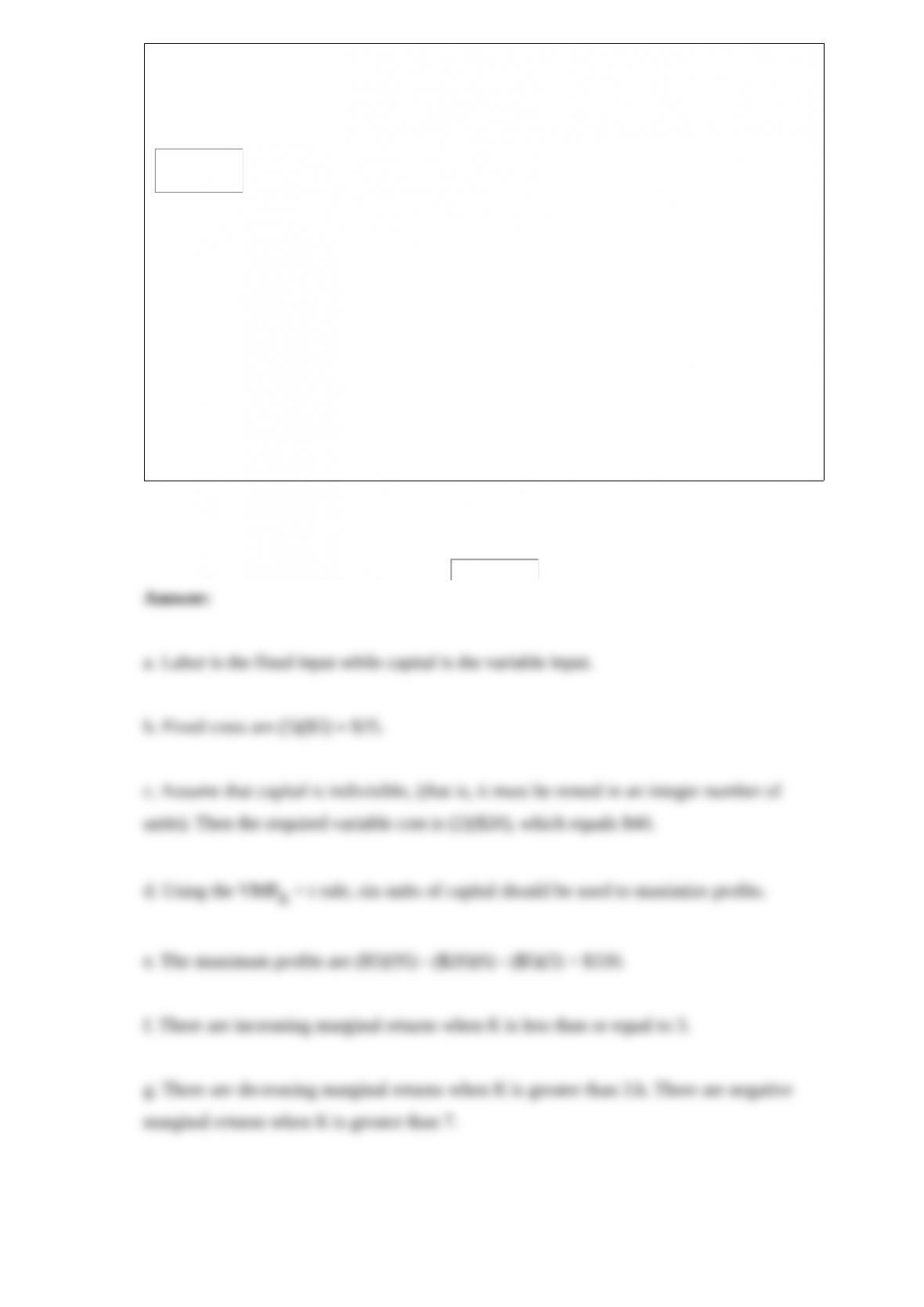
The following table summarizes the short-run production function for your firm. Your
product sells for $5 per unit, labor costs $5 per unit, and the rental price of capital is
$20 per unit. Complete the following table, and then answer the accompanying
questions.
a. Which inputs are fixed inputs? Which are the variable inputs?
b. How much are your fixed costs?
c. What is the variable cost of producing 20 units of output?
d. How many units of the variable input should be used to maximize profits?e. What are
your maximum profits?f. Over what range of variable input usage do increasing
marginal returns exist?g. Over what range of variable input usage do decreasing
marginal returns exist?h. Over what range of variable input usage do negative marginal
returns exist?

Which would you expect to make the highest profits, other things equal?
A. Bertrand oligopolist
B. Cournot oligopolist
C. Stackelberg leader
D. Stackelberg follower