
Many tout that the Internet has lowered consumers’ search costs. If this is true, ceteris
parabis, the consumer reservation price should:
A. be higher.
B. be lower.
C. remain the same.
D. There is insufficient information to determine the impact of lower search costs on
reservation prices.
The upper boundary of the budget set is the:
A. indifference curve.
B. origin.
C. budget line.
D. vertical intercept.
Suppose a new contracting environment that requires less specialized investments is
considered. This new contract will result in:
A. an increase in the marginal benefit and a longer optimal contract.
B. an increase in the marginal benefit and a shorter optimal contract.
C. a decrease in the marginal benefit and a longer optimal contract.
D. a decrease in the marginal benefit and a shorter optimal contract.
If you put $700 in a savings account at an interest rate of 3 percent, how much money
will you have in one year?
A. $370
B. $679.61
C. $703.00
D. $721
A single firm that charges the monopoly price in the market earns $600. If another firm
successfully enters the market, the incumbent’s profits fall to $350 and the entrant earns
$275. If the incumbent engages in limit pricing, its profits are $400. For what interest
rate, i, is limit pricing a profitable strategy for the incumbent?
A. i > 4
B. i < 0.25
C. 0.75 < i < 4
D. 0.25 < i < 0.75

Revenue sharing tries to induce worker effort by linking:
A. worker compensation to profits.
B. worker compensation to revenues.
C. worker output to profits.
D. worker output to revenues.
What is the horizontal intercept of the budget line, given that M = $1,000, PX = $50,
and PY = $40?
A. 2000.0
B. 20.0
C. 25.0
D. 11.11
Suppose the market demand for good X is given by QX
d = 20 – 2PX. If the equilibrium
price of X is $5 per unit, then the total value a consumer receives from consuming the

equilibrium quantity is
A. $100.
B. $75.
C. $50.
D. $25.
A monopoly produces widgets at a marginal cost of $8 per unit and zero fixed costs. It
faces an inverse demand function given by P = 38 – Q. The monopoly price is:
A. $30.
B. $23.
C. $15.
D. $8.
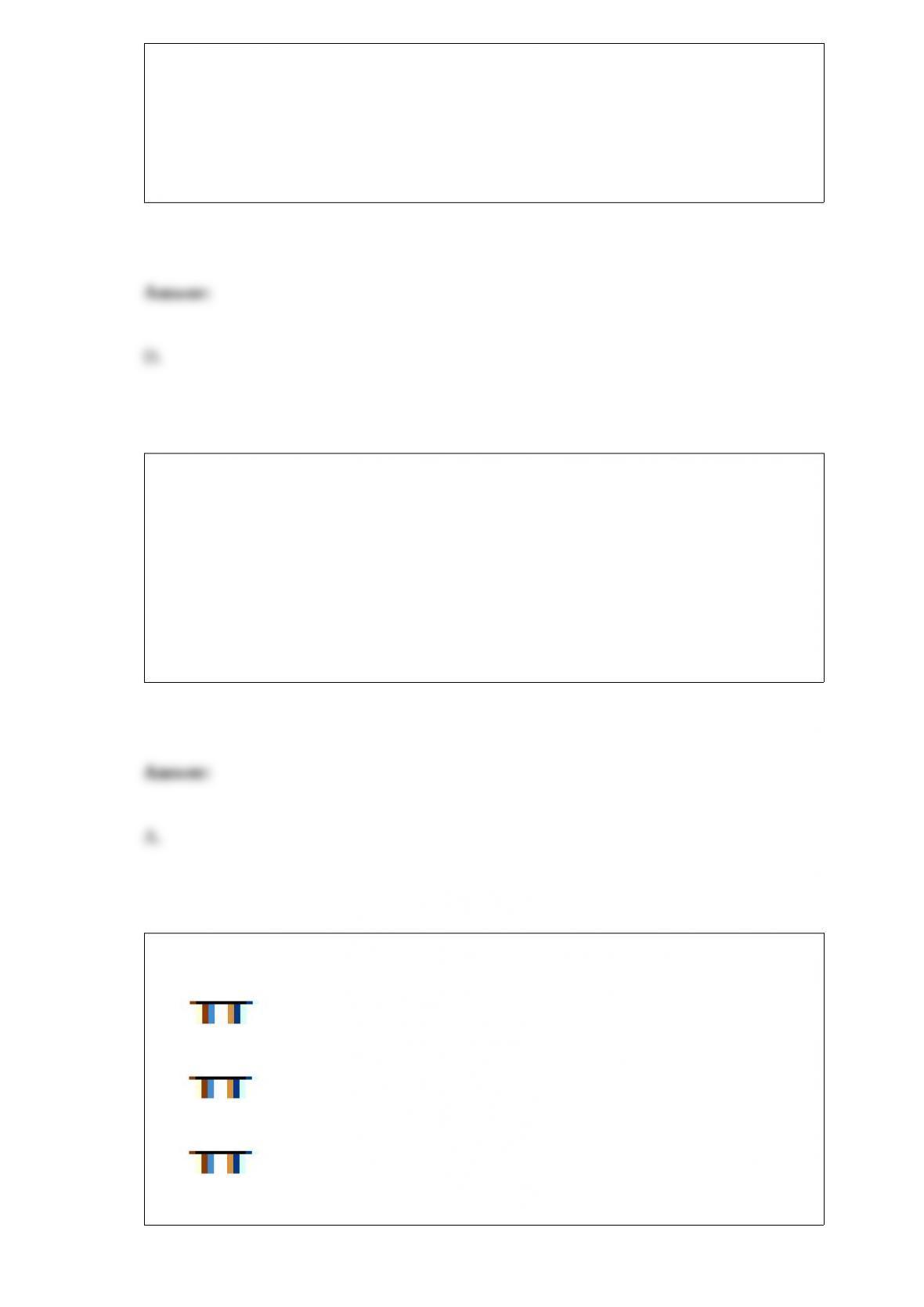
In the game shown below, firms 1 and 2 must independently decide whether to charge
high or low prices.
Which of the following are the Nash equilibrium payoffs (each period) if the game is
repeated 10 times?
A. (0, 0)
B. (5, -5)
C. (-5, 5)
D. (10, 10)
By instituting performance-based rewards to CEOs the profits of firms will:
A. rise.
B. fall.
C. remain constant.
D. None of the statements is correct.
Which of the following profit functions exhibits a Cobb-Douglas production function?
A. = P x K0.75L0.50 – 20L – 35K
B. = P x min(2L, 5K) – 20L – 35K
C. = P x (3K + 4L) – 20L – 35K

D. = P x (3K0.5 + 4L0.5) 1/0.2 – 20L – 35K