Archives: Quiz
ECON E 23486
Which of the following is an example of individual choice? A) The government announces plans to ban smoking in all Florida restaurants. B) Lauren spends her allowance on pillows for her bed. C) France decides to withhold funding to rebuild […]
Economics 65128
Firms will choose a tit-for-tat strategy if they: A) expect that price wars will ultimately provide benefits for the dominant firm. B) believe that the firms in the industry will be competing with each other for a long time. C) […]
ECON A 60526
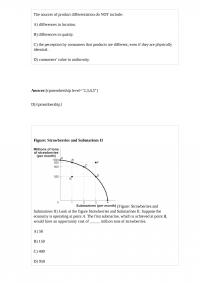
The sources of product differentiation do NOT include: A) differences in location. B) differences in quality. C) the perception by consumers that products are different, even if they are physically identical. D) consumers’ value in uniformity. Figure: Strawberries and Submarines […]
ECON E 60354
An analytical approach through which strategic choices can be assessed is called: A) cost”benefit analysis. B) econometric theory. C) game theory. D) monopolistic competition. The opportunity cost of an hour of leisure: A) is always assumed to be equal to […]
ECON A 58937
As you consume more turkey relative to mashed potatoes, the _____ of turkey eventually decreases. A) price B) usefulness C) marginal utility D) demand Answer: A Answer: A Figure: The Demand for Bricklayers (Figure: The Demand for Bricklayers) Look at […]
BUS 77399
The study of behavior in situations of interdependence is called: A) cost”benefit analysis. B) econometric theory. C) game theory. D) strategic theory. Wendy sells ice-making machines. She can sell six per week at a price of $2,000 per machine. If […]
MicroEconomic 16333
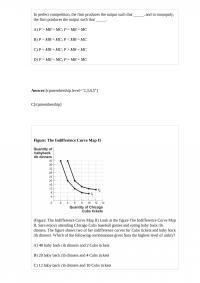
In perfect competition, the firm produces the output such that _____, and in monopoly, the firm produces the output such that _____. A) P > MR = MC; P = MR = MC B) P = MR = MC; P […]
Economics 17619
Gas prices recently increased by 25%. In response, purchases of gasoline decreased by 5%. According to this finding, the price elasticity of demand for gas is: A) 5. B) 2. C) 0.2. D) 0.5. Governments continue to impose price controls. […]
Economics 22408
Which of the following is NOT one of the four principles for understanding individual choice? A) Resources are scarce. B) Overall spending sometimes gets out of line with the economy’s productive capacity. C) “How much” is a decision at the […]
ECON E 61325
If a country has the comparative advantage in producing cloth, in the market for cloth the autarky price would be _____ the world price and the country would _____ cloth. A) less than; export B) greater than; export C) less […]
ECB 49345
Assume an economy moves from autarky to free international trade. In the export sector, consumer surplus _____, producer surplus _____, and the economy as a whole _____. A) rises; rises; gains B) rises; falls; gains C) falls; rises; gains D) […]
ECON 31365
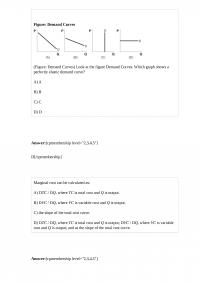
Figure: Demand Curves (Figure: Demand Curves) Look at the figure Demand Curves. Which graph shows a perfectly elastic demand curve? A) A B) B C) C D) D Marginal cost can be calculated as: A) DTC / DQ, where TC […]
ECB 11219
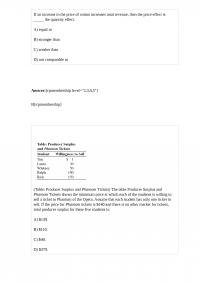
If an increase in the price of cotton increases total revenue, then the price effect is _____ the quantity effect. A) equal to B) stronger than C) weaker than D) not comparable to (Table: Producer Surplus and Phantom Tickets) The […]
ECON 73312
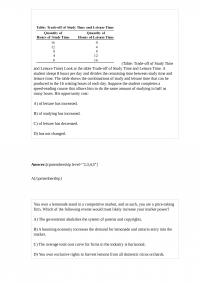
(Table: Trade-off of Study Time and Leisure Time) Look at the table Trade-off of Study Time and Leisure Time. A student sleeps 8 hours per day and divides the remaining time between study time and leisure time. The table shows […]
MicroEconomic 23469
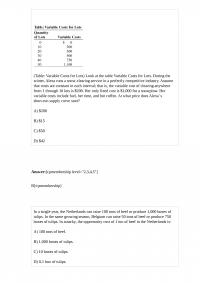
(Table: Variable Costs for Lots) Look at the table Variable Costs for Lots. During the winter, Alexa runs a snow-clearing service in a perfectly competitive industry. Assume that costs are constant in each interval; that is, the variable cost of […]
ECON A 42364
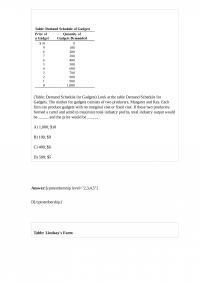
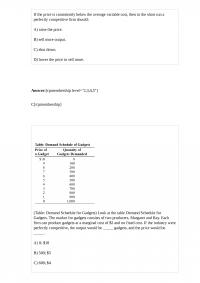
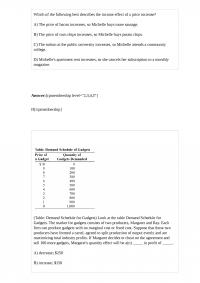
(Table: Demand Schedule for Gadgets) Look at the table Demand Schedule for Gadgets. The market for gadgets consists of two producers, Margaret and Ray. Each firm can produce gadgets with no marginal cost or fixed cost. If these two producers […]
ECON E 55527
The trade-off between work and leisure underlying the supply of labor involves the income effect and the _____ effect. A) substitution B) elasticity C) production D) wage Answer: A Which of the following is NOT a reason that markets usually […]
MicroEconomic 14248
If the government intervened in the market by lowering the price of a good below the equilibrium price, which of the following would NOT occur? A) Some consumers would receive an increase in consumer surplus. B) Producers would likely lose […]
ECON 77096
Suppose the government levies a $4 per month excise tax on cable TV. If the demand for cable TV is relatively (but not perfectly) inelastic and the supply curve is relatively (but not perfectly) elastic, then the price of cable […]
BUS 11004
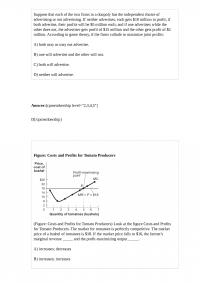
Suppose that each of the two firms in a duopoly has the independent choice of advertising or not advertising. If neither advertises, each gets $10 million in profit; if both advertise, their profits will be $5 million each; and if […]
ECON A 10205
If the price is consistently below the average variable cost, then in the short run a perfectly competitive firm should: A) raise the price. B) sell more output. C) shut down. D) lower the price to sell more. (Table: Demand […]
ECB 11889
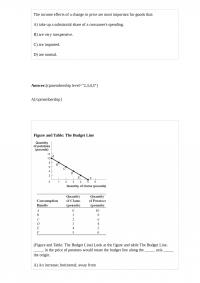
The income effects of a change in price are most important for goods that: A) take up a substantial share of a consumer’s spending. B) are very inexpensive. C) are imported. D) are normal. Figure and Table: The Budget Line […]
ECON E 19852
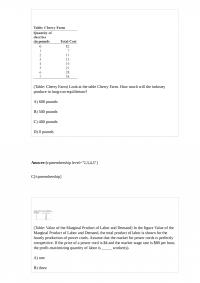
(Table: Cherry Farm) Look at the table Cherry Farm. How much will the industry produce in long-run equilibrium? A) 600 pounds B) 500 pounds C) 400 pounds D) 0 pounds (Table: Value of the Marginal Product of Labor and Demand) […]
BUS 85394
Which is NOT an example of a resource? A) land B) labor C) capital D) production The quantity demanded of labor will decrease if: A) the price of the product that the labor produces increases. B) the productivity of labor […]
ECB 92877 If a monopolist is
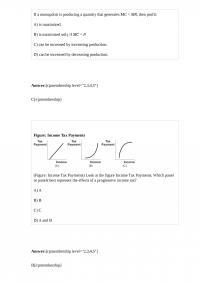
If a monopolist is producing a quantity that generates MC < MR, then profit: A) is maximized. B) is maximized only if MC = P. C) can be increased by increasing production. D) can be increased by decreasing production. Figure: […]
ECON 40153
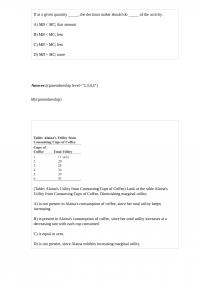
If at a given quantity _____, the decision maker should do _____ of the activity. A) MB < MC; that amount B) MB < MC; less C) MB > MC; less D) MB > MC; none (Table: Alaina’s Utility from […]
ECON E 55454
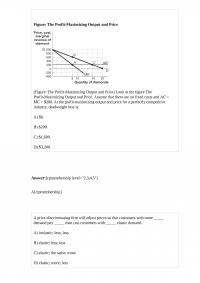
Figure: The Profit-Maximizing Output and Price (Figure: The Profit-Maximizing Output and Price) Look at the figure The Profit-Maximizing Output and Price. Assume that there are no fixed costs and AC = MC = $200. At the profit-maximizing output and price […]
BUS 31197
Suppose a person rolls a typical six-sided die. What is the probability that the die will come up with a 1 two times in a row? A) 1 in 6 B) 1 in 3 C) 1 in 36 D) 1 […]
ECON 76475
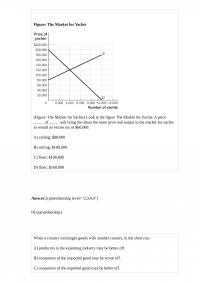
Figure: The Market for Yachts (Figure: The Market for Yachts) Look at the figure The Market for Yachts. A price _____ of _____ will bring the about the same price and output in the market for yachts as would an […]
ECON 39903
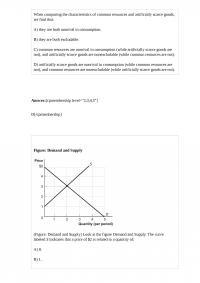
When comparing the characteristics of common resources and artificially scarce goods, we find that: A) they are both nonrival in consumption. B) they are both excludable. C) common resources are nonrival in consumption (while artificially scarce goods are not), and […]
ECB 63249
If a firm operating in monopolistic competition is producing a quantity that generates MC = MR, then the marginal decision rule tells us that profit: A) is maximized. B) can be increased by decreasing production. C) can be increased by […]
ECB 12124
Which of the following scenarios is likely to provide the LEAST amount of economic usefulness? A) NFL player Peyton Manning is shown throwing a football in a toothpaste commercial. B) An online advertisement is posted at Cars.com for a 2005 […]
MicroEconomic 43055
In making an “either”or” decision: A) choose the activity that results in the greater economic profit. B) choose the activity that results in the greater accounting profit. C) continue in an activity as long as the marginal cost is greater […]
Economics 47344
_____ tax is NOT used in the United States. A) Property B) Value-added C) Profits D) Sales If a perfectly competitive firm sells 10 units of output at $30 per unit, its marginal revenue is: A) $10. B) $30. C) […]
ECON E 17411
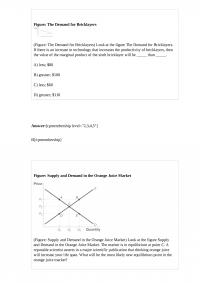
Figure: The Demand for Bricklayers (Figure: The Demand for Bricklayers) Look at the figure The Demand for Bricklayers. If there is an increase in technology that increases the productivity of bricklayers, then the value of the marginal product of the […]
ECON A 46194
The income elasticity of demand measures: A) how much the quantity demanded changes in response to a price change. B) how much a consumer can buy at given income levels. C) how much consumer purchasing power is affected when prices […]
ECON 60038
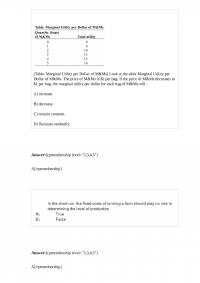
(Table: Marginal Utility per Dollar of M&Ms) Look at the table Marginal Utility per Dollar of M&Ms. The price of M&Ms is $2 per bag. If the price of M&Ms decreases to $1 per bag, the marginal utility per dollar […]
BUS 28991
The model suggesting that countries will specialize in producing the good that uses its relatively abundant factor of production most intensively is referred to as the _____ model. A) Heckscher”Ohlin B) absolute advantage C) sweatshop labor D) pauper labor fallacy […]
ECON 45706
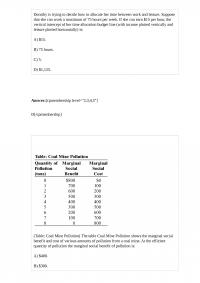
Dorothy is trying to decide how to allocate her time between work and leisure. Suppose that she can work a maximum of 75 hours per week. If she can earn $15 per hour, the vertical intercept of her time allocation […]
ECON E 81330
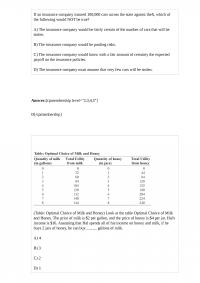
If an insurance company insured 100,000 cars across the state against theft, which of the following would NOT be true? A) The insurance company would be fairly certain of the number of cars that will be stolen. B) The insurance […]
ECON E 13555
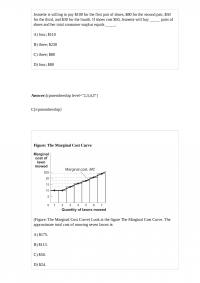
Jeanette is willing to pay $100 for the first pair of shoes, $80 for the second pair, $50 for the third, and $30 for the fourth. If shoes cost $50, Jeanette will buy _____ pairs of shoes and her total […]
ECB 71336
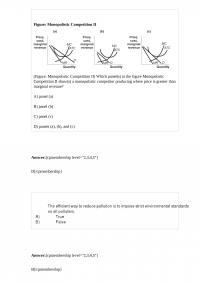
Figure: Monopolistic Competition II (Figure: Monopolistic Competition II) Which panel(s) in the figure Monopolistic Competition II show(s) a monopolistic competitor producing where price is greater than marginal revenue? A) panel (a) B) panel (b) C) panel (c) D) panels (a), […]
ECON A 72919
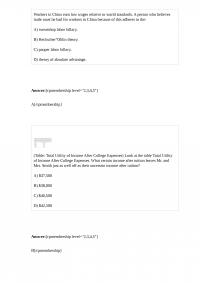
Workers in China earn low wages relative to world standards. A person who believes trade must be bad for workers in China because of this adheres to the: A) sweatshop labor fallacy. B) Heckscher”Ohlin theory. C) pauper labor fallacy. D) […]
ECON E 37328
Which of the following best describes the income effect of a price increase? A) The price of bacon increases, so Michelle buys more sausage. B) The price of corn chips increases, so Michelle buys potato chips. C) The tuition at […]
MicroEconomic 58706
The government might impose a price ceiling if _____ can make a strong moral or political argument for _____ prices. A) demanders; lower B) suppliers; lower C) demanders; higher D) suppliers; higher Total revenue will decrease if the price goes […]
ECB 23226
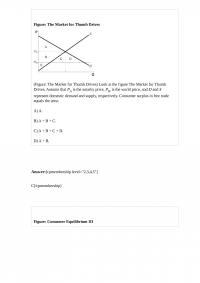
Figure: The Market for Thumb Drives (Figure: The Market for Thumb Drives) Look at the figure The Market for Thumb Drives. Assume that PA is the autarky price, PW is the world price, and D and S represent domestic demand […]
BUS 96610
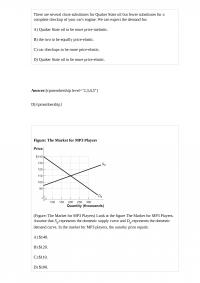
There are several close substitutes for Quaker State oil but fewer substitutes for a complete checkup of your car’s engine. We can expect the demand for: A) Quaker State oil to be more price-inelastic. B) the two to be equally […]
ECON 10514
Prices above equilibrium on agricultural products like milk exist to maximize the consumer surplus. Answer: A Answer: A Figure: Market I (Figure: Market I) Look at the figure Market I. A price floor at $15 would result in deadweight loss […]
MicroEconomic 83161
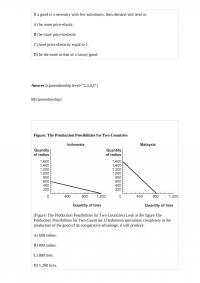
If a good is a necessity with few substitutes, then demand will tend to: A) be more price-elastic. B) be more price-inelastic. C) have price elasticity equal to 1. D) be the same as that of a luxury good. Figure: […]
ECB 10678
To maximize her grade in economics, Stacey should study until: A) her marginal cost of studying begins to increase. B) her marginal benefit of studying begins to decrease. C) her marginal benefit of studying equals her marginal cost of studying. […]