Archives: Quiz
ECON A 77664
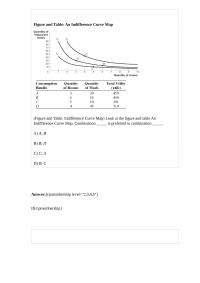
Figure and Table: An Indifference Curve Map (Figure and Table: Indifference Curve Map) Look at the figure and table An Indifference Curve Map. Combination _____ is preferred to combination _____. A) A; B B) B; D C) C; A D) […]
BUS 78234
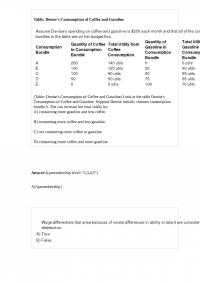
Table: Denise’s Consumption of Coffee and Gasoline (Table: Denise’s Consumption of Coffee and Gasoline) Look at the table Denise’s Consumption of Coffee and Gasoline. Suppose Denise initially chooses consumption bundle A. She can increase her total utility by: A) consuming […]
BUS 56328
As George ate pizza during one recent outing, he found that he enjoyed each additional slice less and less. This implies that his marginal benefit was: A) decreasing. B) increasing. C) constant. D) vertical. Decreasing and increasing returns to scale […]
MicroEconomic 66808
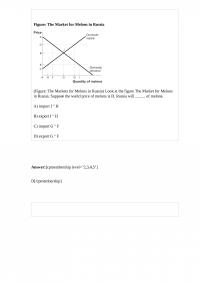
Figure: The Market for Melons in Russia (Figure: The Markets for Melons in Russia) Look at the figure The Market for Melons in Russia. Suppose the world price of melons is D. Russia will _____ of melons. A) import I […]
ECON 94334
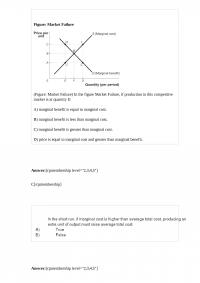
Figure: Market Failure (Figure: Market Failure) In the figure Market Failure, if production in this competitive market is at quantity E: A) marginal benefit is equal to marginal cost. B) marginal benefit is less than marginal cost. C) marginal benefit […]
MicroEconomic 77018
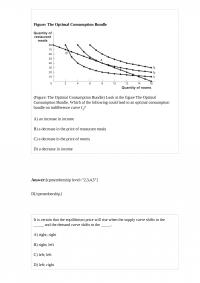
Figure: The Optimal Consumption Bundle (Figure: The Optimal Consumption Bundle) Look at the figure The Optimal Consumption Bundle. Which of the following could lead to an optimal consumption bundle on indifference curve I1? A) an increase in income B) a […]
ECON E 58289
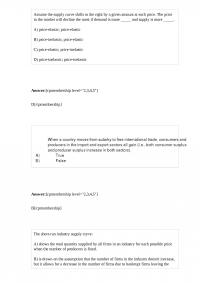
Assume the supply curve shifts to the right by a given amount at each price. The price in the market will decline the most if demand is more _____ and supply is more _____. A) price-elastic; price-elastic B) price-inelastic; price-elastic […]
ECB 26291
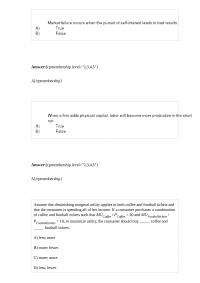
Assume that diminishing marginal utility applies to both coffee and football tickets and that the consumer is spending all of her income. If a consumer purchases a combination of coffee and football tickets such that MUCoffee / PCoffee = 20 […]
ECON A 91078
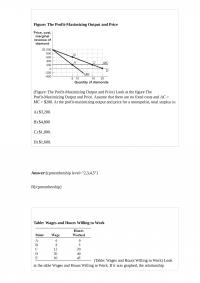
Figure: The Profit-Maximizing Output and Price (Figure: The Profit-Maximizing Output and Price) Look at the figure The Profit-Maximizing Output and Price. Assume that there are no fixed costs and AC = MC = $200. At the profit-maximizing output and price […]
BUS 97680
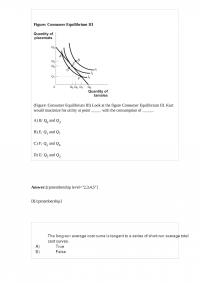
Figure: Consumer Equilibrium III (Figure: Consumer Equilibrium III) Look at the figure Consumer Equilibrium III. Kurt would maximize his utility at point _____ with the consumption of _____. A) B; Q6 and Q3 B) E; Q1 and Q7 C) F; […]
ECON 31063
Producers of artificially scarce goods face _____ that are similar to those of natural monopolists; they decline over the relevant range of output. A) external benefits B) external costs C) total fixed costs D) average total costs Answer: D Answer: […]
Economics 12900
If a perfectly competitive firm is producing a quantity where P > MC, then the firm can increase profit by: A) making no change in output or price because it is already maximizing profit. B) increasing the price. C) decreasing […]
ECB 98429
The 1890 law intended to prevent the establishment of more monopolies and to break up existing ones in the United States was the: A) Taft-Hartley Act. B) Sherman Antitrust Act. C) Affordable Care Act. D) Federal Trade Commission Act Taxes […]
MicroEconomic 94574
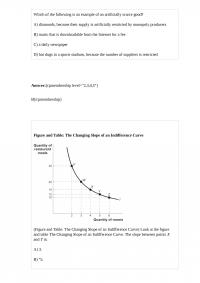
Which of the following is an example of an artificially scarce good? A) diamonds, because their supply is artificially restricted by monopoly producers B) music that is downloadable from the Internet for a fee C) a daily newspaper D) hot […]
Economics 13656
The scaling of the axes of a time-series graph: A) is not a critical element in presenting the intended information. B) may change the interpretation of the data. C) generally places the time period on the vertical axis. D) generally […]
ECON A 84182
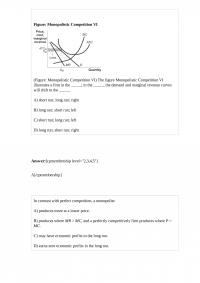
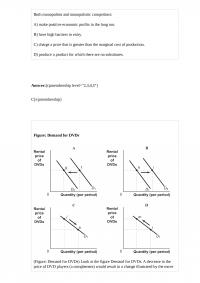
Figure: Monopolistic Competition VI (Figure: Monopolistic Competition VI) The figure Monopolistic Competition VI illustrates a firm in the _____; in the _____, the demand and marginal revenue curves will shift to the _____. A) short run; long run; right B) […]
MicroEconomic 63359
Both monopolists and monopolistic competitors: A) make positive economic profits in the long run. B) have high barriers to entry. C) charge a price that is greater than the marginal cost of production. D) produce a product for which there […]
ECON A 72070
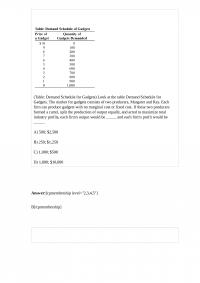
(Table: Demand Schedule for Gadgets) Look at the table Demand Schedule for Gadgets. The market for gadgets consists of two producers, Margaret and Ray. Each firm can produce gadgets with no marginal cost or fixed cost. If these two producers […]
MicroEconomic 81216
After learning about indifference curves, Sandy realizes that her marginal rate of substitution of grapes for cheese is 2. Since the price of cheese is $3 and the price of grapes is $1, Sandy: A) should buy more grapes and […]
BUS 39126
Monopolistic competition is similar to perfect competition because firms in both market structures: A) are price takers. B) produce goods that are perfect substitutes. C) find it beneficial to advertise. D) do not face any barriers to entry to the […]
ECB 38476
If the marginal benefit received from consuming a good is less than the marginal cost of production: A) society’s well-being can be improved if production increases. B) society’s well-being can be improved if production decreases. C) society’s well-being cannot be […]
MicroEconomic 17698
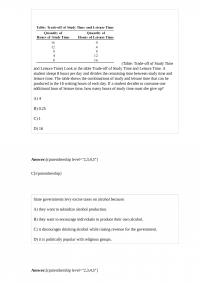
(Table: Trade-off of Study Time and Leisure Time) Look at the table Trade-off of Study Time and Leisure Time. A student sleeps 8 hours per day and divides the remaining time between study time and leisure time. The table shows […]
ECON E 22264
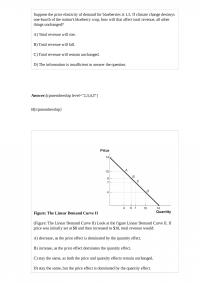
Suppose the price elasticity of demand for blueberries is 1.5. If climate change destroys one-fourth of the nation’s blueberry crop, how will that affect total revenue, all other things unchanged? A) Total revenue will rise. B) Total revenue will fall. […]
BUS 38050
You notice that when a new yoga class is offered at the student recreation center at a highly desirable time, some students from the other yoga classes go to the new class instead. This statement best represents this economic concept: […]
ECON 27429
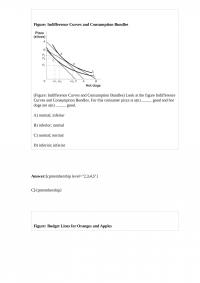
Figure: Indifference Curves and Consumption Bundles (Figure: Indifference Curves and Consumption Bundles) Look at the figure Indifference Curves and Consumption Bundles. For this consumer pizza is a(n) _____ good and hot dogs are a(n) _____ good. A) normal; inferior B) […]
MicroEconomic 76590
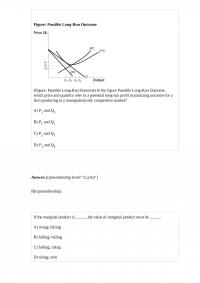
Figure: Possible Long-Run Outcome (Figure: Possible Long-Run Outcome) In the figure Possible Long-Run Outcome, which price and quantity refer to a potential long-run profit maximizing outcome for a firm producing in a monopolistically competitive market? A) P1 and Q3 B) […]
Economics 40677
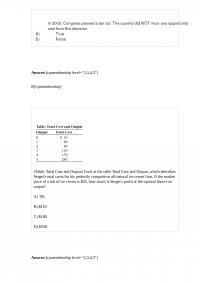
(Table: Total Cost and Output) Look at the table Total Cost and Output, which describes Sergei’s total costs for his perfectly competitive all-natural ice cream firm. If the market price of a tub of ice cream is $35, how much […]
ECON 10783
If quantity supplied responds substantially to a relatively small change in price, supply is: A) price-elastic. B) price-inelastic. C) negatively sloped. D) insensitive to changes in price. Along a given supply curve, an increase in the price of a good […]
ECON E 80971
The demand for meals at a local Applebee’s will shift to the left if: A) the Olive Garden offers a 10 percent discount coupon in the local newspaper. B) the price of a meal at Applebee’s rises. C) local incomes […]
MicroEconomic 99923
A small public park in a large town with many other parks often has very few visitors because of its size. There is no fee to enter the park, but few people visit it, since other parks have more amenities. […]
ECB 82962
The average total cost curve has a U shape because the ______ effect is dominant at low levels of output, and the _____ effect is dominant at high levels of output. A) diminishing returns; spreading B) spreading; diminishing returns C) […]
MicroEconomic 83220
To minimize deadweight loss, markets where demand is relatively _____ and supply is relatively _____ should be taxed. A) elastic; inelastic B) elastic; elastic C) inelastic; elastic D) inelastic; inelastic Figure: Shifts in Demand and Supply II (Figure: Shifts in […]
MicroEconomic 76606
Steven consumes staples and paper clips. He is maximizing his utility in consumption of both goods. The price of staples rises. After the change in price Steven should consume _____ staples and _____ paper clips. A) more; fewer B) more; […]
ECON A 64921
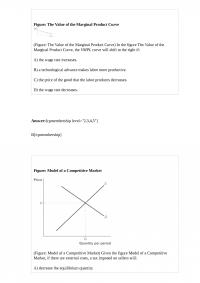
Figure: The Value of the Marginal Product Curve (Figure: The Value of the Marginal Product Curve) In the figure The Value of the Marginal Product Curve, the VMPL curve will shift to the right if: A) the wage rate increases. […]
ECON E 98436
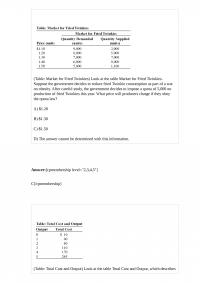
(Table: Market for Fried Twinkies) Look at the table Market for Fried Twinkies. Suppose the government decides to reduce fried Twinkie consumption as part of a war on obesity. After careful study, the government decides to impose a quota of […]
BUS 73922
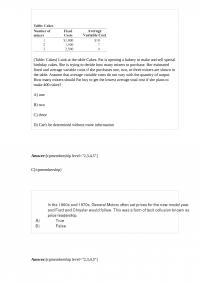
(Table: Cakes) Look at the table Cakes. Pat is opening a bakery to make and sell special birthday cakes. She is trying to decide how many mixers to purchase. Her estimated fixed and average variable costs if she purchases one, […]
ECON E 40253
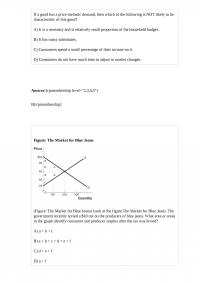
If a good has a price-inelastic demand, then which of the following is NOT likely to be characteristic of this good? A) It is a necessity and is relatively small proportion of the household budget. B) It has many substitutes. […]
ECB 53498
The price elasticity of a good will tend to be larger: A) the longer the relevant time. B) the fewer number of substitute goods available. C) if it is a staple. D) if it is relatively inexpensive. The price of […]
ECON 92172
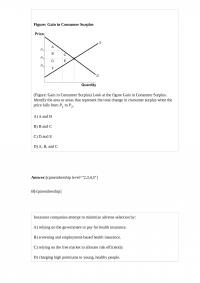
Figure: Gain in Consumer Surplus (Figure: Gain in Consumer Surplus) Look at the figure Gain in Consumer Surplus. Identify the area or areas that represent the total change in consumer surplus when the price falls from P1 to P2. A) […]
Economics 56560
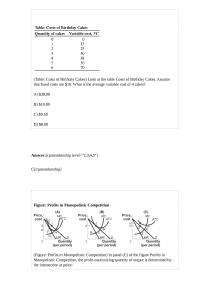
(Table: Costs of Birthday Cakes) Look at the table Costs of Birthday Cakes. Assume that fixed costs are $10. What is the average variable cost of 4 cakes? A) $38.00 B) $10.00 C) $9.50 D) $8.00 Figure: Profits in Monopolistic […]
ECON E 37805
Scenario: Monopolist The demand curve for a monopolist is P = 75 ” 0.5Q, and the monopolist has the following MC expressed as P = 2Q. Assume also that ATC at the profit-maximizing level of production is equal to $12.50. […]
BUS 44395
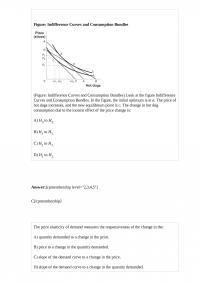
Figure: Indifference Curves and Consumption Bundles (Figure: Indifference Curves and Consumption Bundles) Look at the figure Indifference Curves and Consumption Bundles. In the figure, the initial optimum is at a. The price of hot dogs increases, and the new equilibrium […]
ECON A 68494
If the extra output that is produced by hiring one more unit of labor adds more to _____ than to _____, the firm will increase its profit by increasing the use of labor. A) total cost; total revenue B) total […]
ECB 89333
Answer: A Answer: B Answer: B Which of these is one of the four principles of individual choice? A) Resources are usually renewable. B) The real cost of something is impossible to measure. C) People take advantage of opportunities to […]
ECB 90669
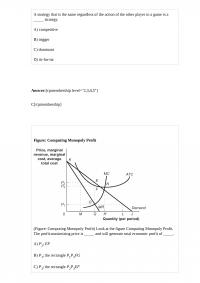
A strategy that is the same regardless of the action of the other player in a game is a _____ strategy. A) competitive B) trigger C) dominant D) tit-for-tat Figure: Computing Monopoly Profit (Figure: Computing Monopoly Profit) Look at the […]
ECON A 46803
Accountants use only _____ costs in their computations. A) opportunity B) implicit C) explicit D) variable Moral hazard: A) occurs when incentives are distorted because an individual knows more about his or her own actions than other people do. B) […]
ECON A 14289
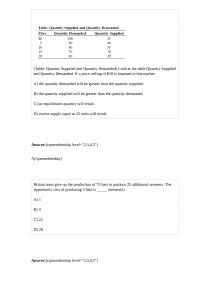
(Table: Quantity Supplied and Quantity Demanded) Look at the table Quantity Supplied and Quantity Demanded. If a price ceiling of $10 is imposed in this market: A) the quantity demanded will be greater than the quantity supplied. B) the quantity […]
Economics 86706
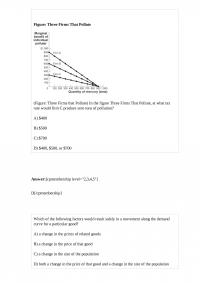
Figure: Three Firms That Pollute (Figure: Three Firms that Pollute) In the figure Three Firms That Pollute, at what tax rate would firm C produce zero tons of pollution? A) $400 B) $500 C) $700 D) $400, $500, or $700 […]
BUS 37646
(Scenario: Linear Production Possibility Frontier) Look at the scenario Linear Production Possibility Frontier. Largetown CANNOT produce _____ shirts and _____ pairs of socks. A) 20; 0 B) 40; 40 C) 0; 40 D) 10; 20 The United States must give […]
MicroEconomic 47407
Redistribution programs are means-tested. To qualify for such a program, a person must demonstrate that: A) his or her family is larger than the mean family size for the country as a whole. B) his or her average (or mean) […]