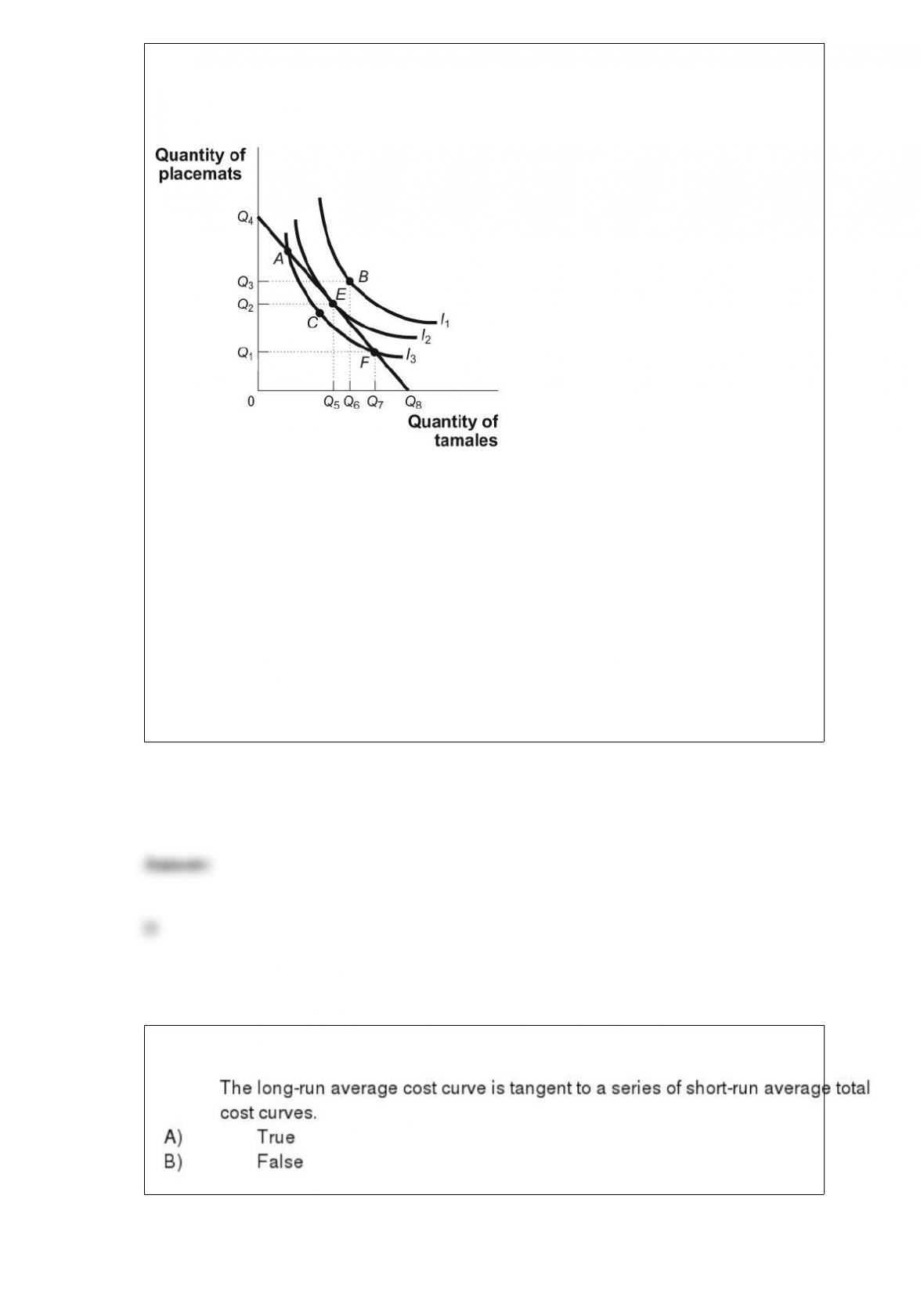
Figure: Consumer Equilibrium III
(Figure: Consumer Equilibrium III) Look at the figure Consumer Equilibrium III. Kurt
would maximize his utility at point _____ with the consumption of _____.
A) B; Q6 and Q3
B) E; Q1 and Q7
C) F; Q5 and Q4
D) E; Q5 and Q2

The funds that an insurance company may have to pay out are known as the:
A) fair premium.
B) capital at risk.
C) total premium.
D) deductible.
A lower wage:
A) has an income effect but not a substitution effect on the quantity of labor supplied.
B) means a higher income for any given level of labor supplied.
C) has an income effect that is always negative with respect to the quantity of labor
supplied.
D) has an income effect that is always positive with respect to the quantity of labor
supplied.

A monopolist responds to an increase in marginal cost by _____ price and _____
output.
A) increasing; decreasing
B) increasing; increasing
C) decreasing; increasing
D) decreasing; decreasing
The demand curve for a monopoly is:
A) above the marginal revenue curve.
B) below the marginal revenue curve.
C) horizontal because of economics of scale.
D) infinitely elastic.
Which of the following is an example of a positive statement?
A) The poverty rate should be 4%.

B) A high rate of economic growth should be a more important goal for the country
than a low rate of unemployment.
C) The federal government pays for 46% of U.S. health care costs.
D) Everyone in the country should be covered by national health insurance.
Scenario: The Decision to Hire Labor
Assume that both the product market and the labor market are perfectly competitive.
The price of this firm’s product is $5. The firm’s total product with respect to labor is
given in the table that follows.
(Scenario: The Decision to Hire Labor) Look at the scenario The Decision to Hire
Labor. If this profit-maximizing firm hires two workers, what is a possible equilibrium
wage rate in the labor market?
A) $30
B) $5
C) $13
D) $6

Free trade between countries:
A) should be based on absolute advantage.
B) will allow wealthy countries to exploit less developed nations.
C) will shift the domestic production possibility frontier to the right.
D) will allow for greater levels of consumption than without trade.
If you are willing to give up 5 units of good Y (on the vertical axis) for 5 units of good
X (on the horizontal axis) and your level of satisfaction is unchanged, the marginal rate
of substitution is:
A) 0.5.
B) 1.
C) 2.
D) 5.
Suppose there are diminishing returns to labor. If the _____ of labor hired by a firm
increases, holding everything else constant, the _____ labor will _____.
A) price; demand for; increase

B) quantity; marginal product of; fall
C) quantity; marginal product of; rise
D) quantity; value of the marginal product of; rise
For most goods, demand curves slope downward because:
A) marginal utility rises as quantity demanded increases.
B) the substitution effect constitutes almost the entire effect of a price change, and this
effect always causes quantity demanded and price to be inversely related.
C) the income effect constitutes almost the entire effect of a price change, and this
effect always causes quantity demanded and price to be inversely related.
D) the income and substitution effects work in opposite directions.

A firm produces at the output level at which its average total costs are minimized. At
this output level, its average total costs are equal to all of the following EXCEPT:
A) price.
B) MC.
C) MR.
D) AVC.
In the circular-flow diagram the flow of money going into each sector or market is
_____ the flow of money coming out of that market or sector.
A) equal to
B) greater than
C) less than
D) unrelated to

An economy is said to have a comparative advantage if it:
A) can produce more of all goods than another economy.
B) can produce less of all goods than another economy.
C) has the highest cost of producing a particular good.
D) has the lowest cost of producing a particular good.
Critics of Temporary Assistance for Needy Families argue that it creates perverse
incentives such as:
A) family breakup, since a family with both spouses present may not qualify for aid.
B) a reward for not seeking work.
C) the abandonment of children.
D) family breakup, a reward for not seeking work, and the abandonment of children.
When diseconomies of scale occur:
A) long-run average cost rises.

B) marginal cost declines.
C) average total cost declines.
D) average variable cost declines.
Javon is consuming his optimal utility-maximizing consumption bundle of lobster and
macaroni-and-cheese dinners when he loses his job and has less money to spend. Both
are normal goods. When he adjusts his consumption to reflect the new level of income,
the number of macaroni-and-cheese dinners he consumes:
A) rises.
B) falls.
C) stays the same.
D) changes, but it is impossible to determine in what way.

(Figure: Wine and Wheat) Look at the
figure Wine and Wheat. If this economy is producing 12 tons of wheat and 9,000 bottles
of wine, we know the economy:
A) is using its resources efficiently.
B) is using its resources inefficiently.
C) is producing at an unattainable point.
D) has unemployment.
In perfect competition:
A) a firm’s total revenue is found by multiplying the market price by the firm’s quantity
of output.
B) the firm’s total revenue curve is a downward-sloping line.
C) at any price, the more sold, the higher a firm’s marginal revenue.
D) the firm’s total revenue curve is nonlinear.
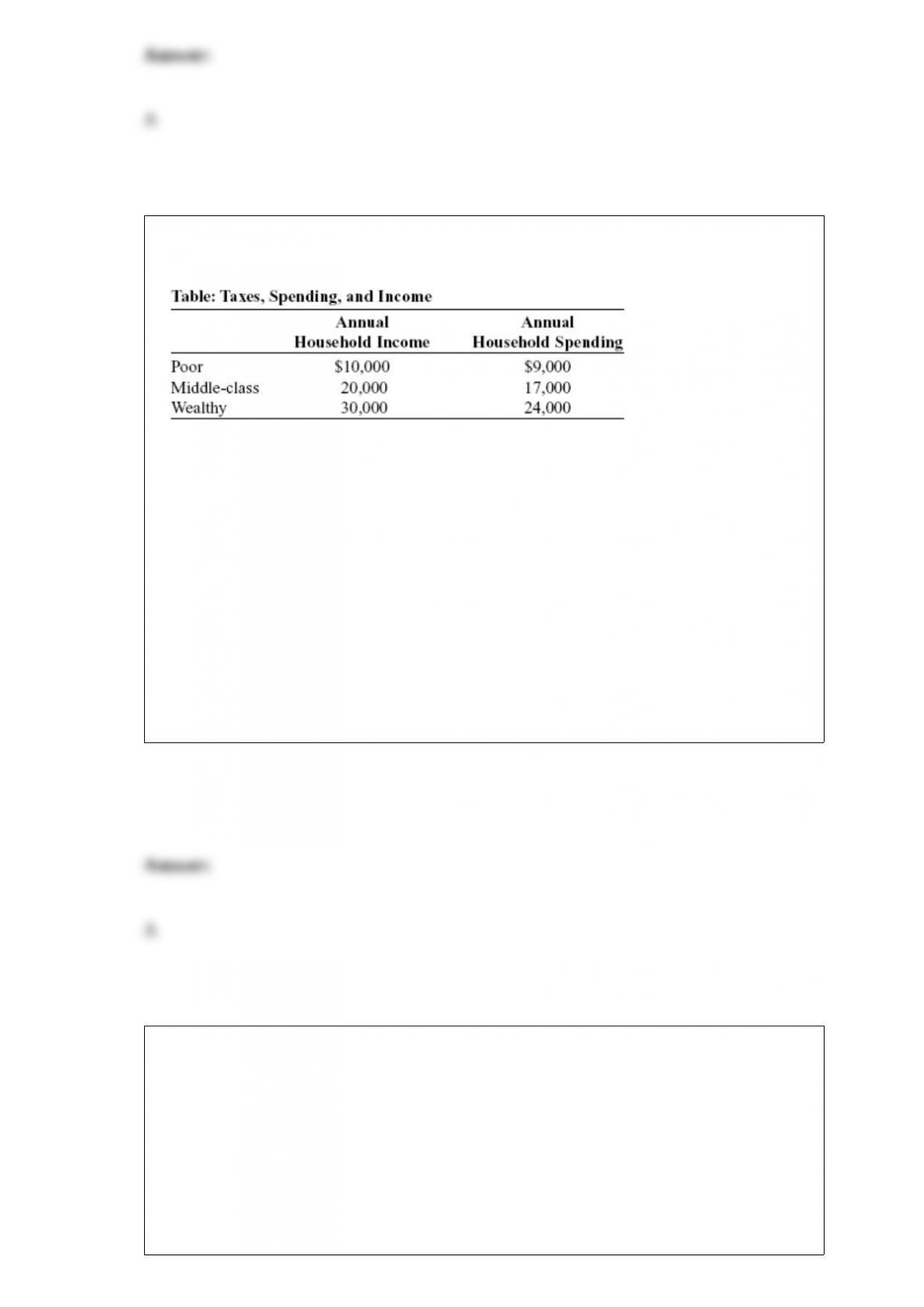
(Table: Taxes, Spending, and Income) Look at the table Taxes, Spending, and Income.
Suppose Governor Meridias decides to initiate a state tax of 5% on all sales. A poor
household will spend _____ of its annual income on the sales tax, while a wealthy
household will spend _____ of its annual income.
A) 4.5%; 4%
B) 5%; 5%
C) 5%; 3.5%
D) 3.5%; 4.5%
Marginal revenue for a monopolist is:
A) equal to price.
B) greater than price.
C) less than price.
D) the change in total revenue plus the change in output.

On any particular day, the probability that it will rain is 25% and that you will be sick is
10%. The probability that both happen on the same day is:
A) 0.25%.
B) 1%.
C) 2.5%.
D) 17.5%.
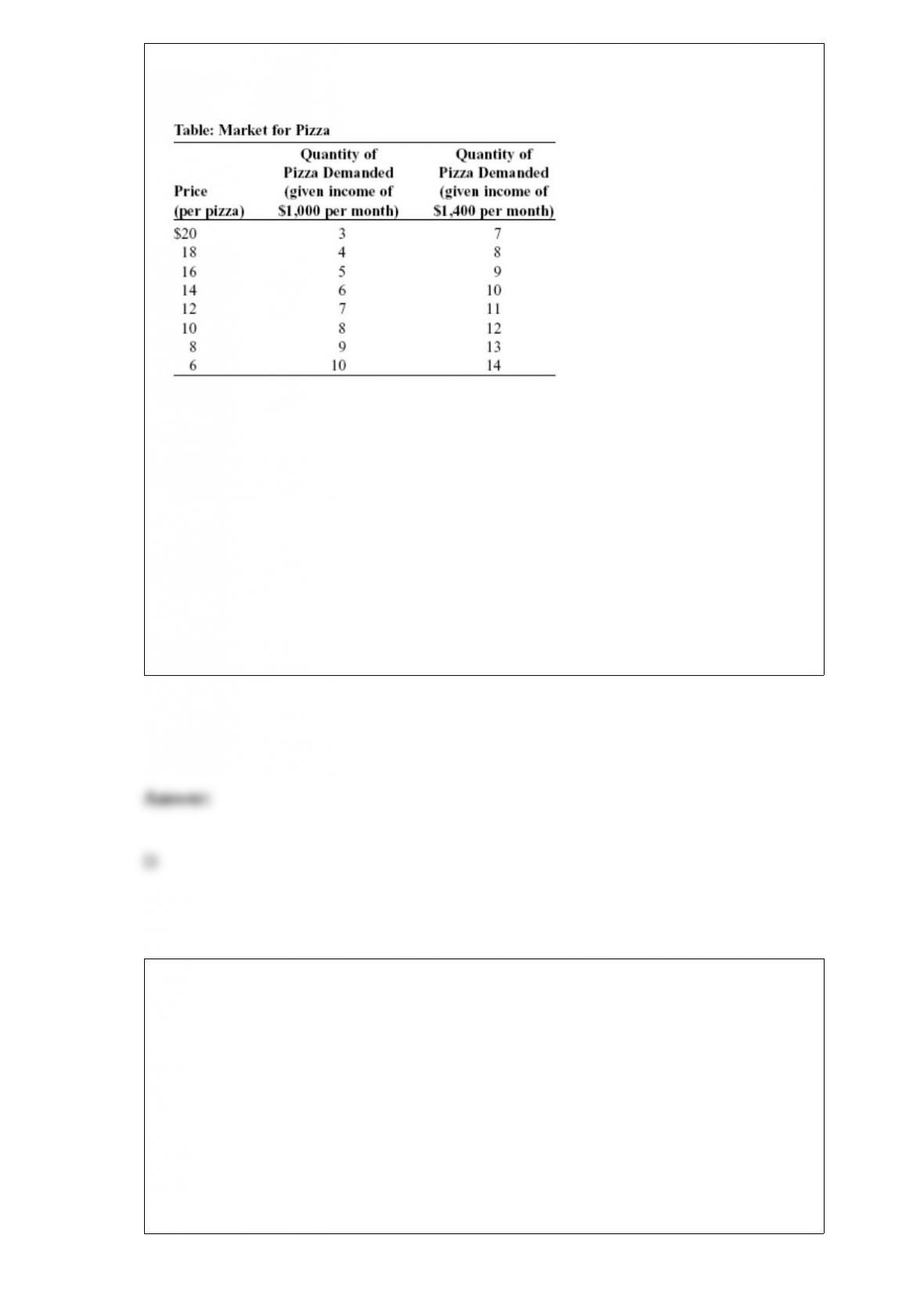
(Table: Market for Pizza) Look at the table Market for Pizza. When income changes
from $1,000 to $1,400 per month, the income elasticity of demand for pizza, by the
midpoint method, at a price of $14 per pizza is:
A) “1.
B) 1.
C) 1.25.
D) 1.5.
Suppose Bob has a part-time business washing cars. He has washed nine cars on a
given day; the marginal benefit of washing the tenth car is $20 and the marginal cost is
$12. Bob should:
A) wash the tenth car.
B) not wash the tenth car.
C) increase his marginal benefit.
D) There is not enough information to decide.

Computer software that you can download from the Internet for a price is an artificially
scarce good because it is _____ but _____ in consumption.
A) nonexcludable; rival
B) excludable; nonrival
C) nonexcludable; nonrival
D) excludable; rival
Above-equilibrium wages paid by some employers as an incentive for better
performance are called:
A) efficiency wages.
B) market power wages.
C) compensating differentials.
D) discrimination.

Scenario: Music Downloads and Streamed Movies
Phillip has an income of $300 per month, which he uses to purchase music downloads
(MD) and streamed movies (SM). Each music download costs $1 and each streamed
movie costs $5.
(Scenario: Music Downloads and Streamed Movies) Read the scenario Music
Downloads and Streamed Movies. Which of the following equations expresses Phillip’s
budget line?
A) 300 = 1MD + 5SM
B) SM = 300 ” 1X
C) 300 = 1 / MD + 5 / SM
D) SM = 300 + 5SM
Individuals differ in risk aversion because of:
A) adverse selection.
B) moral hazard.
C) differences in income or wealth.
D) differences in their insurance.

An efficient way to finance the provision of city services such as street cleaning would
be to charge all city residents a lump-sum tax. Such a tax would be:
A) progressive.
B) regressive.
C) proportional.
D) This question can’t be answered without knowing the amount of the tax.