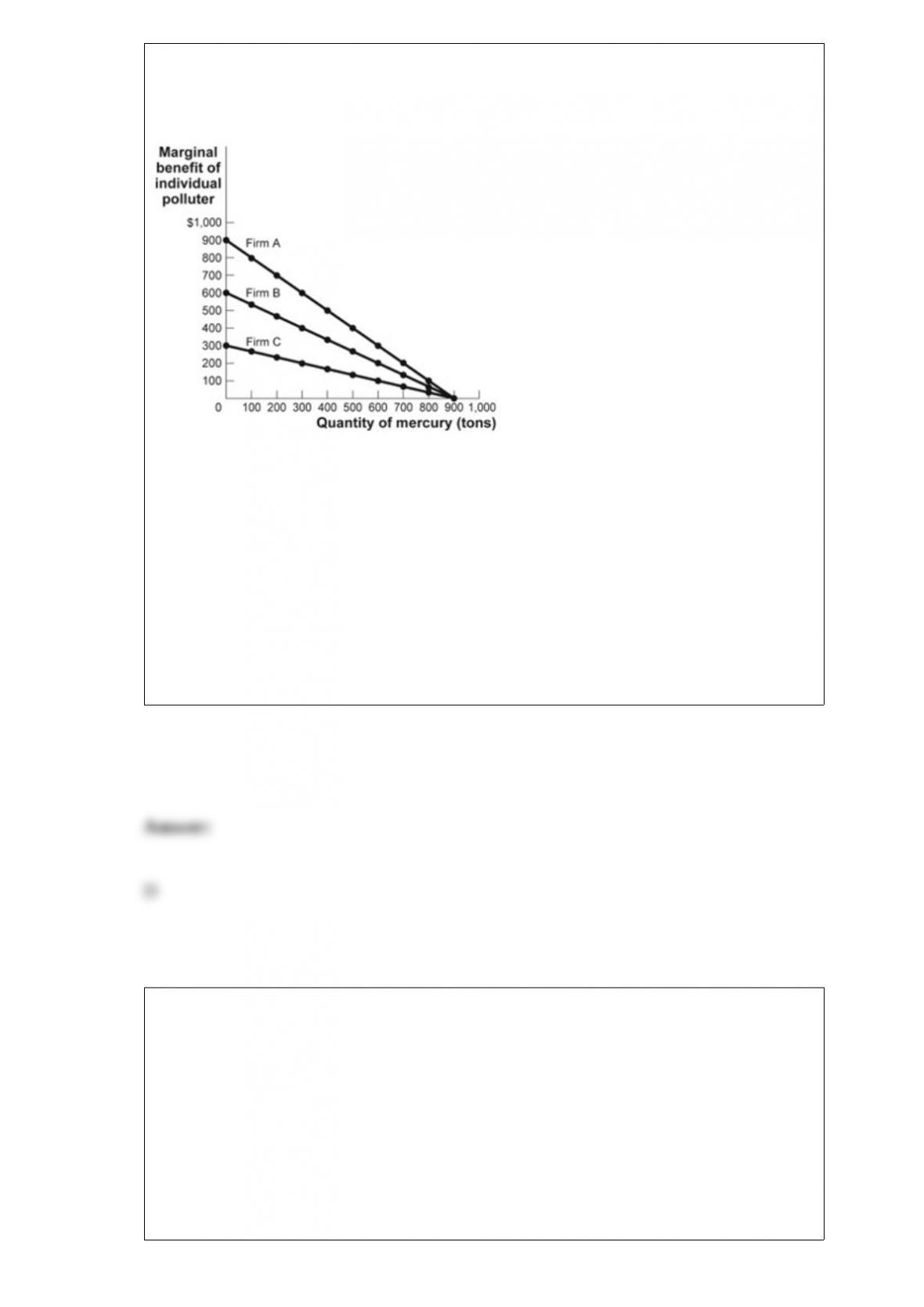
Figure: Three Firms That Pollute
(Figure: Three Firms that Pollute) In the figure Three Firms That Pollute, at what tax
rate would firm C produce zero tons of pollution?
A) $400
B) $500
C) $700
D) $400, $500, or $700
Which of the following factors would result solely in a movement along the demand
curve for a particular good?
A) a change in the prices of related goods
B) a change in the price of that good
C) a change in the size of the population
D) both a change in the price of that good and a change in the size of the population

In Kessy’s old kitchen, he could bake 10 cookies or mix 15 glasses of lemonade in one
day. Now Kessy has a larger oven and refrigerator. How does this affect his production
possibility frontier?
A) It shifts his production possibility frontier out.
B) It shifts his production possibility frontier in.
C) He will be less efficient.
D) He will not be able to produce as much as before.
Figure: Shifts in Demand and Supply
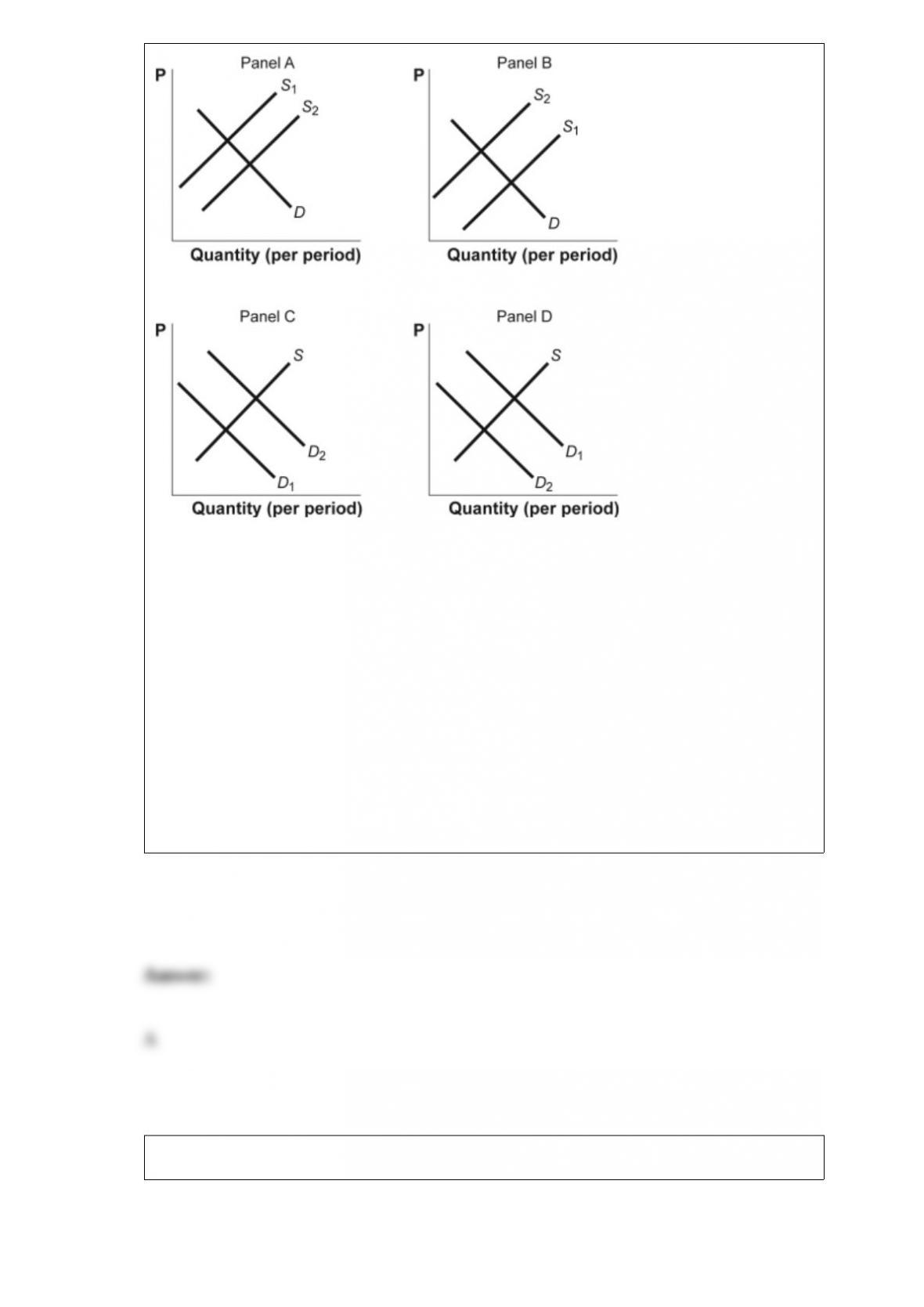
(Figure: Shifts in Demand and Supply) Look at the figure Shifts in Demand and Supply.
The graph shows how supply and demand might shift in response to specific events.
Suppose a new machine allows restaurants and fast-food outlets to produce french fries
at a lower cost. Which panel BEST describes how this will affect the market for french
fries?
A) panel A
B) panel B
C) panel C
D) panel D

The problem of scarcity is confronted by:
A) industrialized societies only.
B) preindustrial societies only.
C) societies governed by communist philosophies only.
D) all societies.
The price of popcorn is $0.50 per box and the price of peanuts is $0.25 per bag. You
have $5 to spend on both goods. The maximum number of boxes of popcorn that you
can purchase is:
A) 5.
B) 10.
C) 20.
D) 40.
A binding price ceiling will cause a persistent _____, and a binding price floor will
cause a persistent _____.
A) surplus; surplus
B) shortage; surplus
C) shortage; shortage
D) surplus; shortage
Which of the following is a positive statement?
A) The poverty rate is 14%.
B) A high rate of inflation is the most important economic goal for the country.
C) Everyone in the country should save money for retirement.
D) Basketball players should not be paid higher salaries than teachers.
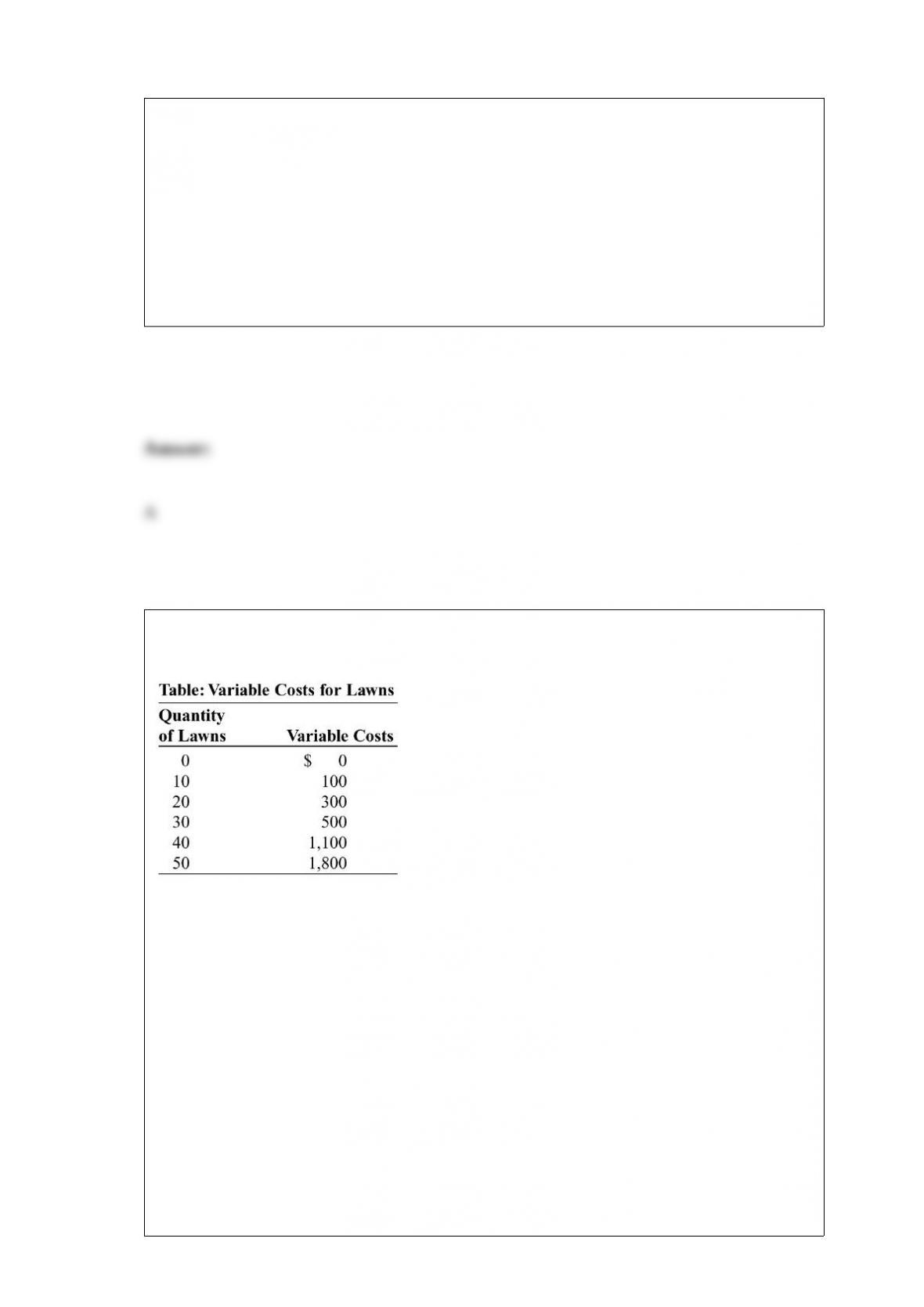
(Table: Variable Costs for Lawns) Look at the table Variable Costs for Lawns. During
the summer, Alex runs a lawn-mowing service, and lawn-mowing is a perfectly
competitive industry. Assume that costs are constant in each interval; that is, the
variable cost of mowing 1 through 10 lawns is $100. His only fixed cost is $1,000 for
the mower. His variable costs include fuel, his time, and mower parts. If the price for
mowing a lawn is $40, how much is Alex’s profit at the profit-maximizing output?
A) “$10
B) “$300
C) $300
D) “$1,000

The price elasticity of demand measures the:
A) responsiveness of the change in quantity demanded to a change in price.
B) change in price versus a change in quantity demanded.
C) responsiveness of the change in the slope of the demand curve to a change in price.
D) change in the slope of the demand curve versus a change in the quantity demanded.
If Japan must give up the production of 75 computers to produce 25 additional cellular
telephones, the opportunity cost of producing 4 cellular telephones is _____ computers.
A) 4
B) 12
C) 71
D) 79
When a tenant in a rent-controlled apartment sublets the apartment to another renter at a
rent higher than the price ceiling:
A) it is inefficient.
B) the transaction takes place on a black market.
C) there is an increase in quantity demanded.
D) there is a decrease in quantity demanded.
A private good is a good or service for which exclusion is _____ and which is _____ in
consumption.
A) possible; rival
B) possible; nonrival
C) not possible; rival
D) not possible; nonrival
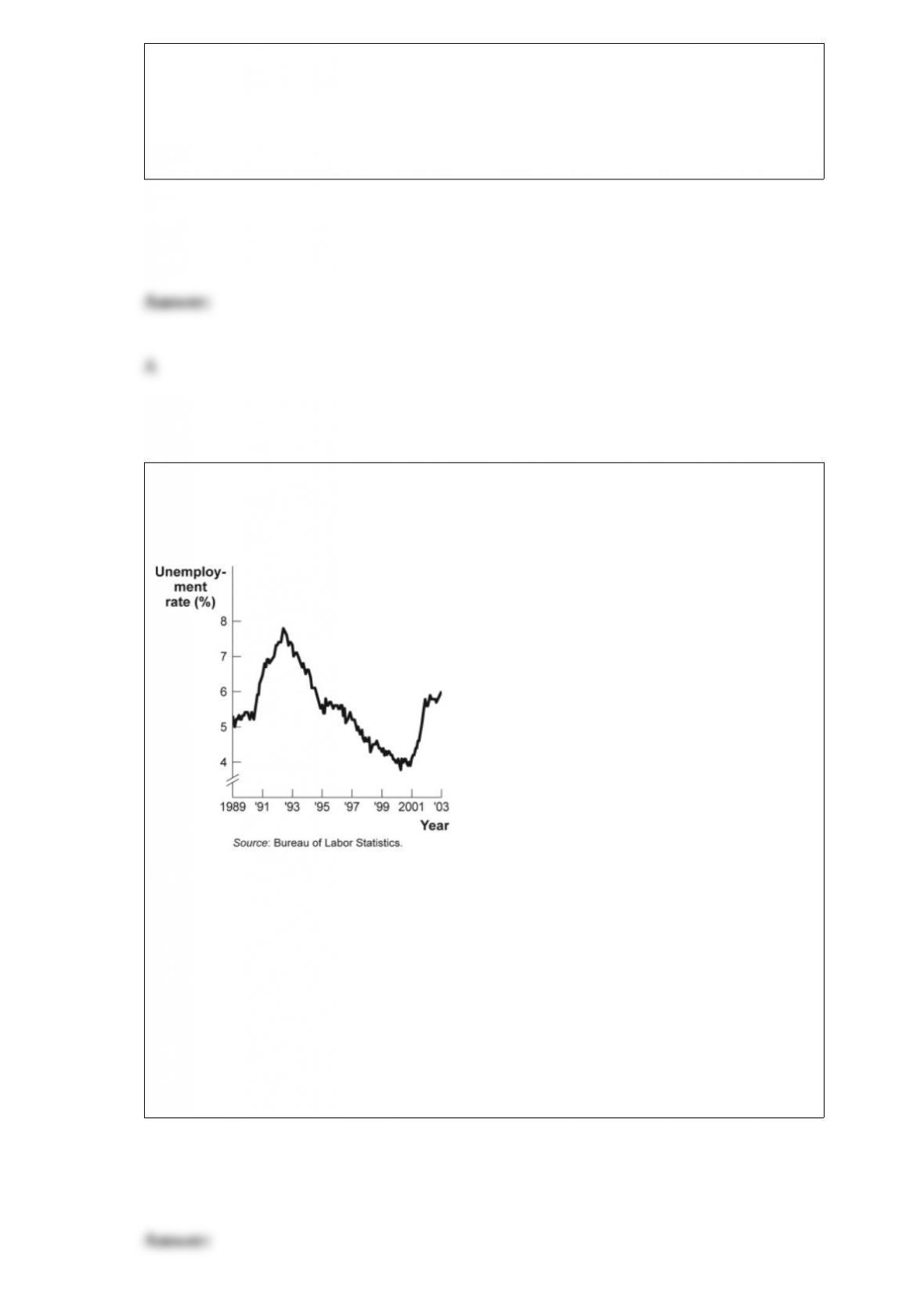
Figure: Unemployment Rate over Time
(Figure: Unemployment Rate over Time) Look
at the figure Unemployment Rate over Time. In the time-series graph, as we move from
1993 to 1995, we see that the unemployment rate has _____ from approximately _____
to approximately _____.
A) decreased; 5%; 4%
B) increased; 5.3%; 7.3%
C) decreased; 7%; 5.5%
D) increased; 4%; 6.3%

Which of the following methods of discouraging speeding is likely to be MOST
effective because people usually exploit opportunities to make themselves better off?
A) increasing the number of signs stating the speed limit
B) increasing the fine associated with speeding tickets
C) public service announcements reminding drivers of the dangers of speeding
D) All three methods are equally effective.
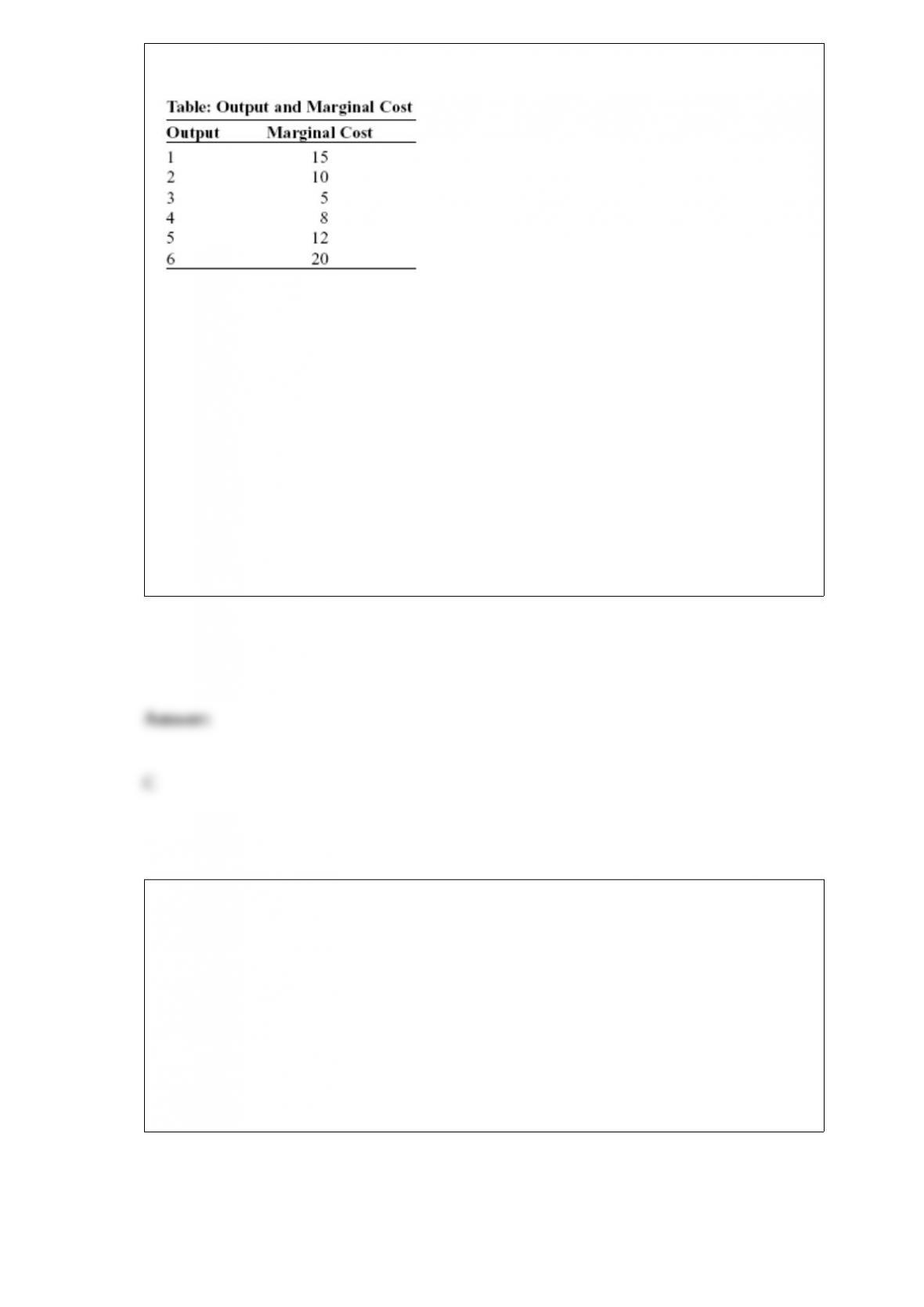
(Table: Output and Marginal Cost) Look at the table Output and Marginal Cost. After
graduation you achieve your dream of opening an art shop that specializes in selling
mud statues. How many statues should you produce to minimize your average variable
costs?
A) two
B) three
C) four
D) five
A tariff is most likely to _____ prices and _____ domestic consumption of the good or
service being protected.
A) decrease; increase
B) increase; decrease
C) have no effect on; not change
D) decrease; decrease

If goods A and Z are complements, an increase in the price of good Z will:
A) increase the demand for good A.
B) decrease the demand for good A.
C) decrease the demand for good Z.
D) decrease the demand for both good A and good Z.
Income tax rates are such that Mr. R. Hood earns $35,000 per year and pays $7,000 in
taxes, while Mr. G. Gisbourne earns $1 million per year and pays $200,000 in taxes.
This tax is:
A) progressive.
B) regressive.
C) proportional.
D) a lump-sum tax.
If the number of available tradable emissions permits is decreased, the equilibrium price
of the permits _____ and the equilibrium quantity of emissions _____.
A) decreases; decreases
B) increases; increases
C) increases; decreases
D) decreases; increases
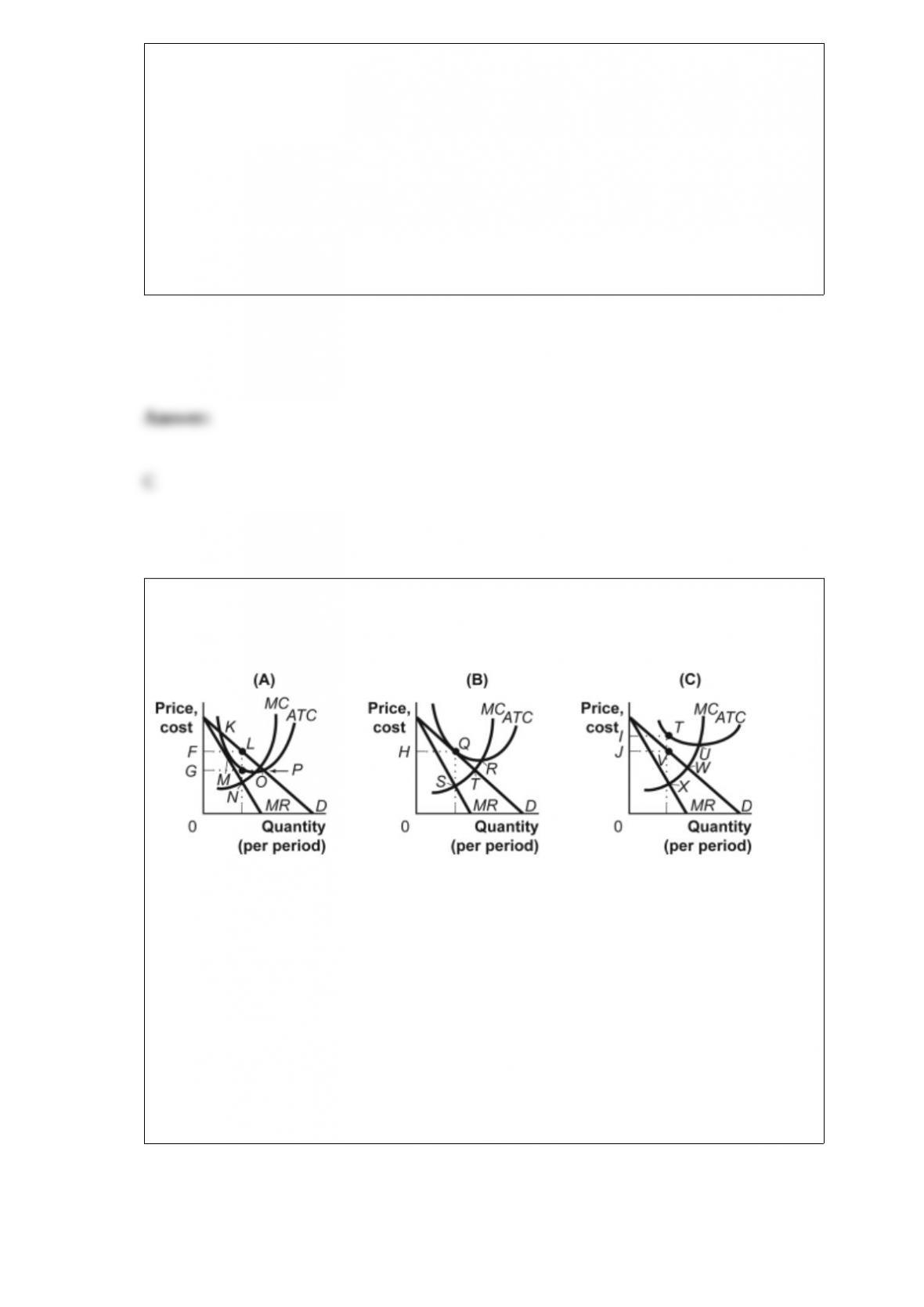
Figure: Firms in Monopolistic Competition
(Figure: Firms in Monopolistic Competition) Look at the figure Firms in Monopolistic
Competition. A positive economic profit will be earned if the profit-maximizing price is
_____ in panel _____.
A) F; (A)
B) G; (A)
C) H; (B)
D) I; (C)
If the government imposes a $5 excise tax on leather shoes and the price of leather
shoes increases by $2:
A) the government will receive less tax revenue than anticipated.
B) consumers are paying more of the tax than the producers.
C) producers are paying more of the tax than are the consumers.
D) the quantity of shoes sold will increase.
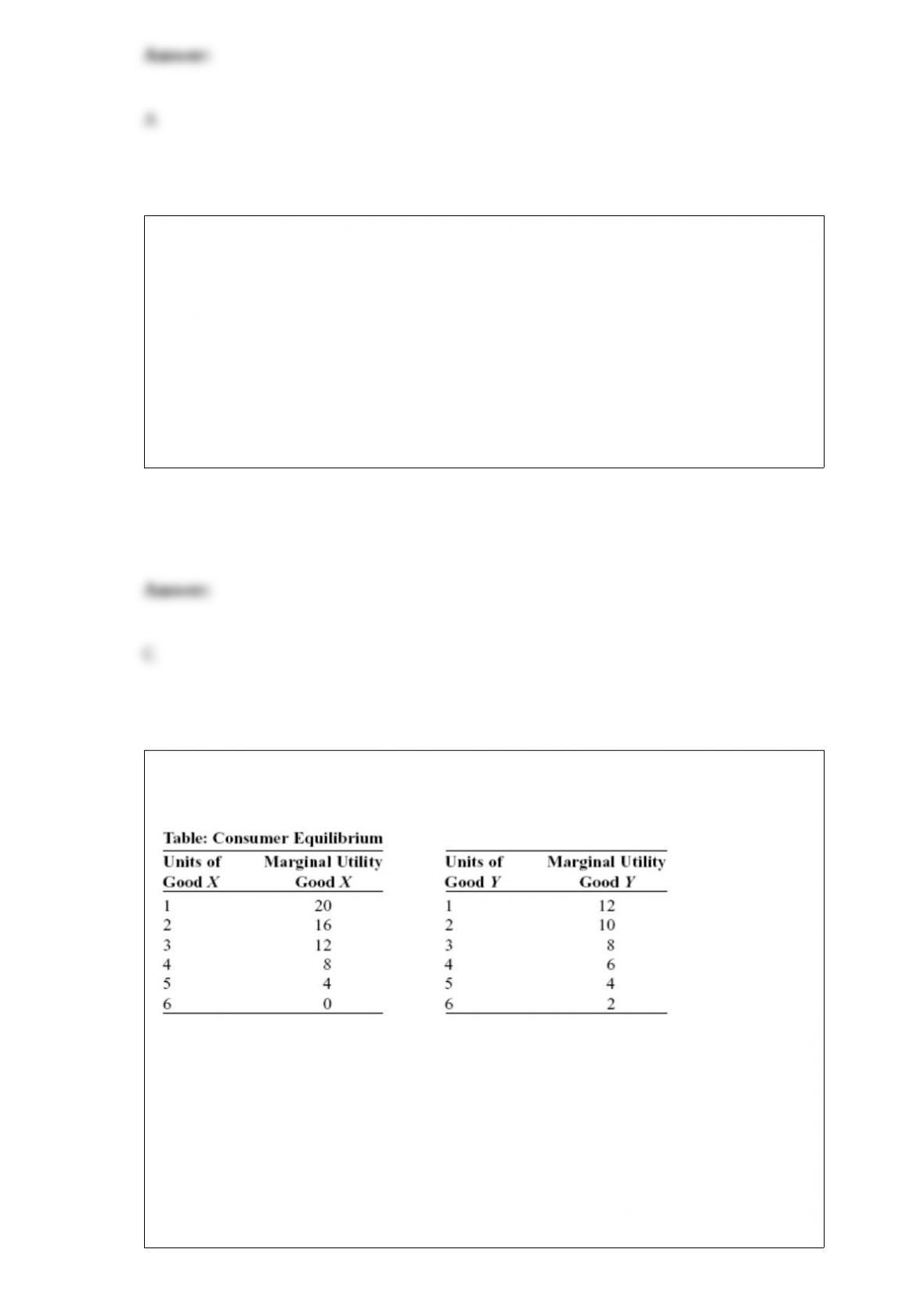
(Table: Consumer Equilibrium) Look at the table Consumer Equilibrium. Assume that
the price of good X is $5 per unit, the price of good Y is $1 per unit, and you have $10
to spend on both goods. To maximize utility, you would consume _____ unit(s) of X
and _____ unit(s) of Y.
A) no; 1
B) 1; 5

C) 4; 6
D) 5; 5
An increase in a consumer’s income will do all of the following EXCEPT:
A) shift the budget line away from the origin.
B) increase the horizontal intercept.
C) increase the vertical intercept.
D) change the slope of the budget line.
Consumers’ willingness to pay for a good is used to derive the _____ for that good.
A) producer surplus
B) cost of production
C) supply curve
D) demand curve

Suppose that the market for haircuts in a community is perfectly competitive and that
the market is initially in long-run equilibrium. Subsequently, an increase in population
increases the demand for haircuts. In the short run, the typical firm is likely to:
A) earn an economic profit.
B) incur an economic loss.
C) have no change in its economic profit.
D) have neither an economic profit nor an economic loss.
Zoe’s grandparents are excited about finally paying off their mortgage, because, as they
say, “Our cost of housing is now zero.” Zoe should explain to them the economic
principle of:
A) marginal analysis: if the additional cost of housing is zero, then their additional
benefit is also zero.
B) opportunity cost: by living in the house, they are giving up the opportunity to sell the
house, buy a smaller one, and pocket the difference.
C) efficiency: If their cost of housing is now zero, they should let Zoe move in without
charging her any rent. Zoe is better off, and her grandparents aren’t hurt.
D) equity: it is unfair that some people are still paying off their mortgage.
Which of the following statements is TRUE?
A) Very talented people may have a comparative advantage in everything they do.
B) Very untalented people have a comparative advantage in something they do.
C) Very talented people may have a low opportunity cost in most things they do.
D) Very untalented people may have a high opportunity cost in most things they do.
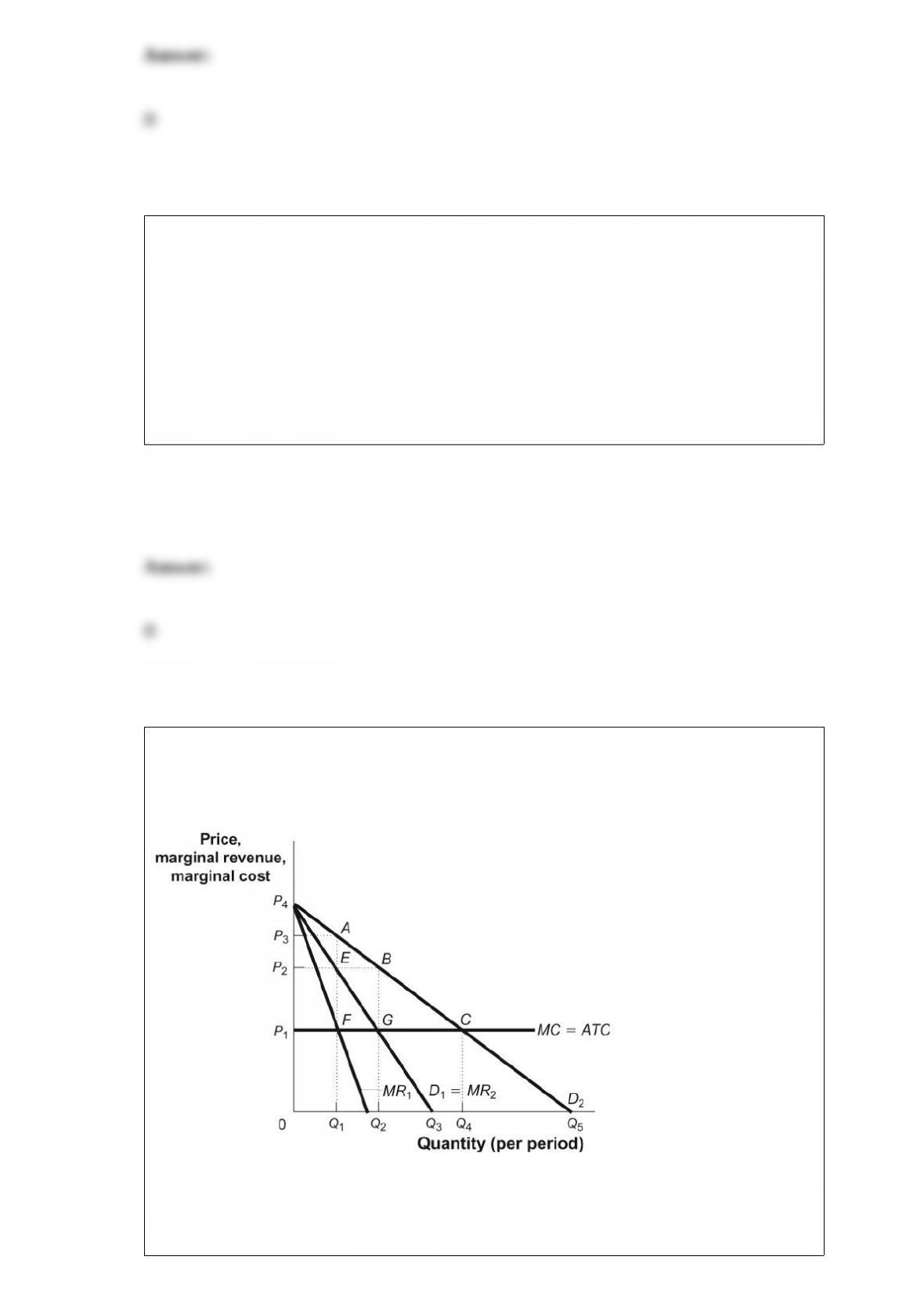
Figure: Monopoly Profits in Duopoly
(Figure: Monopoly Profits in Duopoly) Look at the figure Monopoly Profits in
Duopoly. Two firms could engage in _____ and reap monopoly profits.

A) game theory
B) the prisoners’ dilemma
C) collusive behavior
D) measuring the four-firm concentration ratio
Wage differences across jobs that reflect the fact that some jobs are less pleasant than
others are called:
A) efficiency wages.
B) market power.
C) compensating differentials.
D) discrimination.