Suppose that each of the two firms in a duopoly has the independent choice of
advertising or not advertising. If neither advertises, each gets $10 million in profit; if
both advertise, their profits will be $5 million each; and if one advertises while the
other does not, the advertiser gets profit of $15 million and the other gets profit of $2
million. According to game theory, if the firms collude to maximize joint profits:
A) both may or may not advertise.
B) one will advertise and the other will not.
C) both will advertise.
D) neither will advertise.
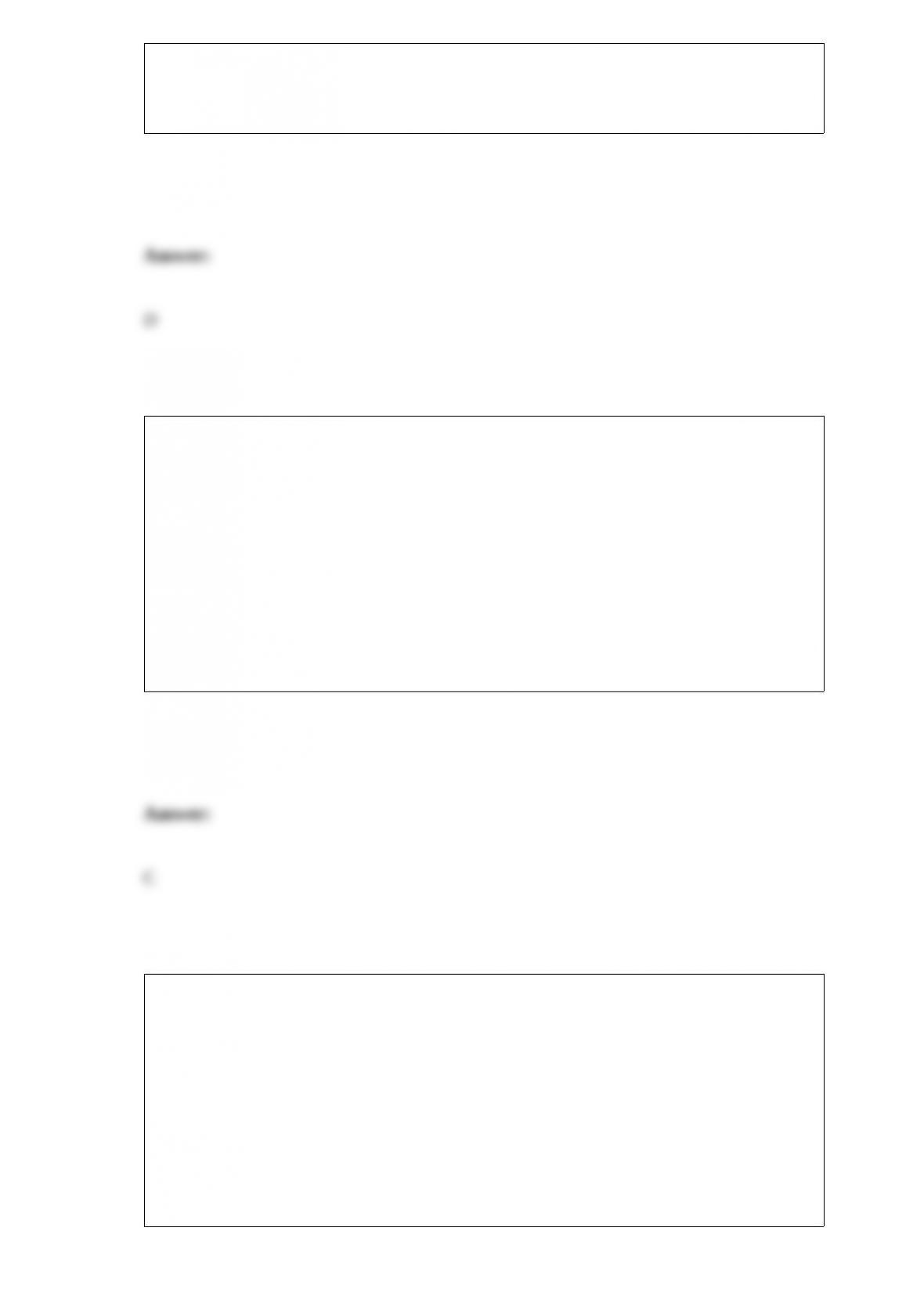
Figure: Costs and Profits for Tomato Producers
(Figure: Costs and Profits for Tomato Producers) Look at the figure Costs and Profits
for Tomato Producers. The market for tomatoes is perfectly competitive. The market
price of a bushel of tomatoes is $18. If the market price falls to $16, the farmer’s
marginal revenue _____ and the profit-maximizing output _____.
A) increases; decreases
B) increases; increases
C) decreases; increases
D) decreases; decreases
Suppose a perfectly competitive industry is suddenly transformed into a monopoly
industry. We can assume that monopoly output will be _____ than the competitive
output and that _____.
A) higher; deadweight loss will emerge
B) lower; consumer surplus will increase
C) lower; deadweight loss will emerge
D) higher; consumer surplus will decrease
Consider a production possibility frontier for Iraq. If in 2014 Iraq’s resources are not
being fully utilized, Iraq will be somewhere _____ of its production possibility frontier.
A) inside
B) outside
C) near the bottom
D) near the top
Suppose that the average cost of a doctor visit is $100. If the government imposes a
price ceiling of $50 on the cost of a doctor visit, there will be:
A) an excess supply of doctor visits.
B) an excess demand for doctor visits.
C) an increase in the equilibrium number of doctor visits.
D) no change in the number of doctor visits.
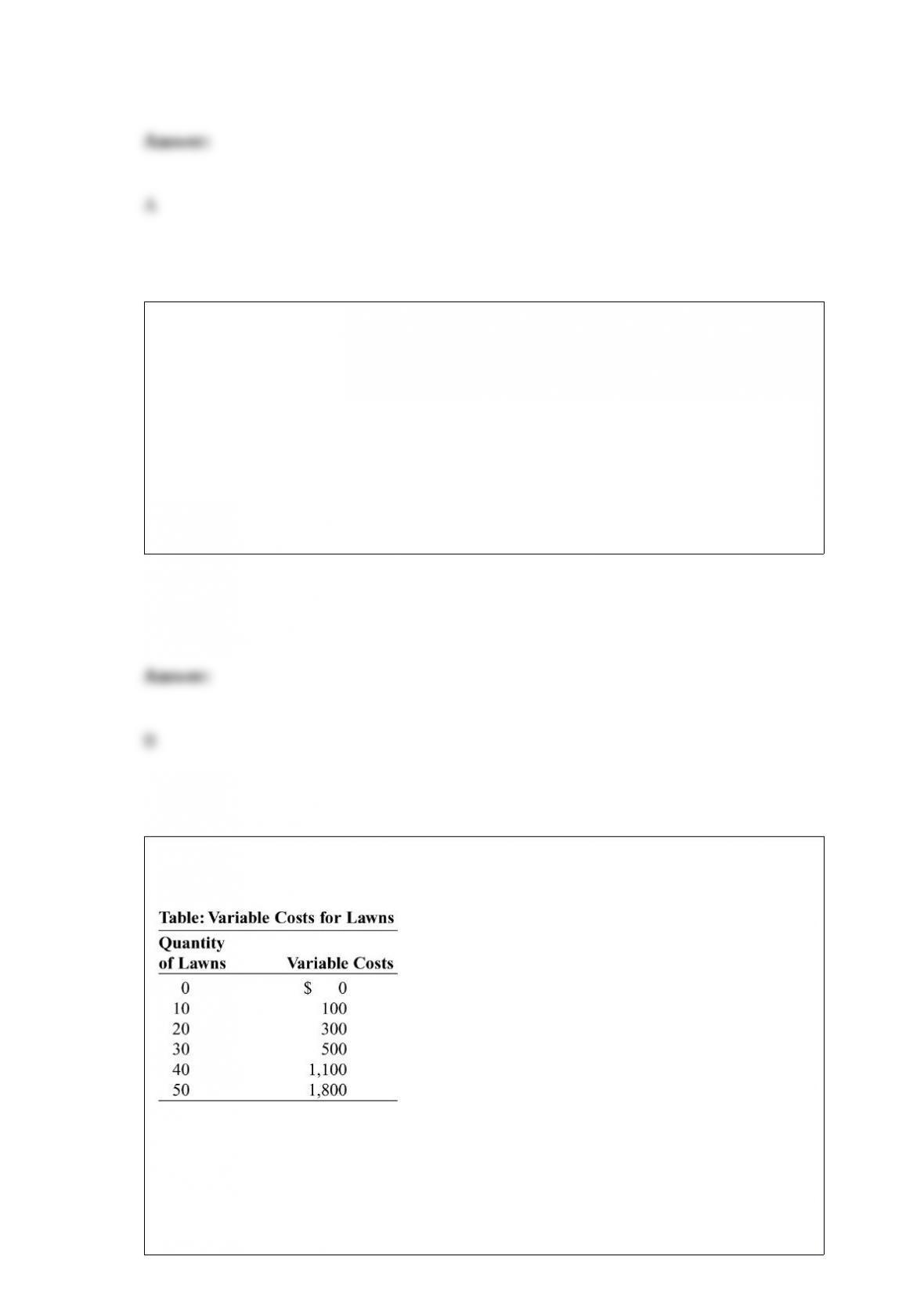
(Table: Variable Costs for Lawns) Look at the table Variable Costs for Lawns. During
the summer, Alex runs a lawn-mowing service in a perfectly competitive industry.
Assume that costs are constant in each interval; that is, the variable cost of mowing 1
through 10 lawns is $100. His only fixed cost is $1,000 for the mower. His variable
costs include fuel, his time, and mower parts. What is Alex’s break-even price?

A) $100.00
B) $10.00
C) $50.00
D) $27.50
A maximum price set below the equilibrium price is a:
A) demand price.
B) supply price.
C) price floor.
D) price ceiling.
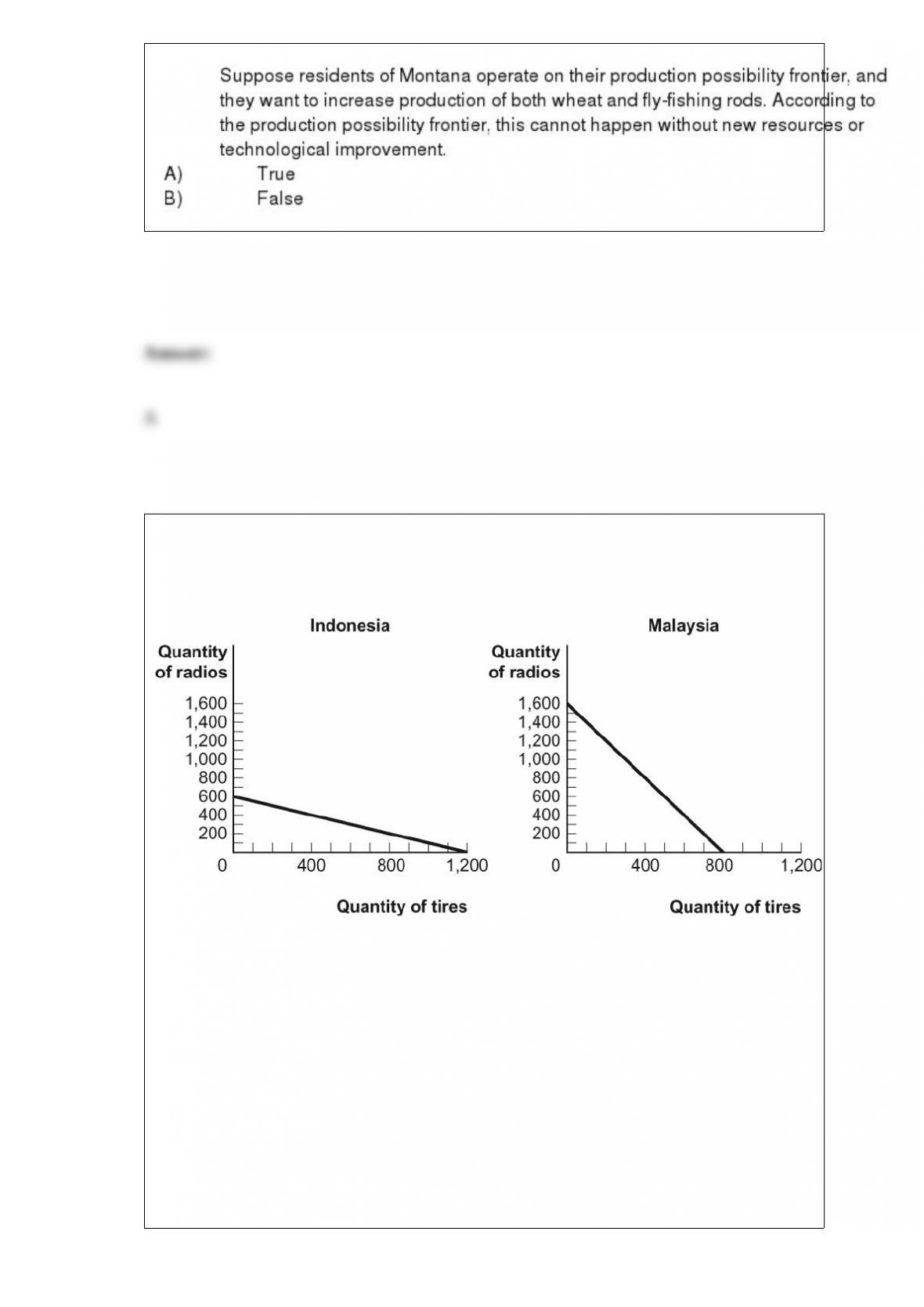
Figure: The Production Possibilities for Two Countries
(Figure: The Production Possibilities for Two Countries) Look at the figure The
Production Possibilities for Two Countries. If Indonesia and Malaysia trade 1 radio for
1.5 tires, the most that Indonesia can consume is _____ radios and _____ tires, while
the most that Malaysia can consume is _____ radios and _____ tires.
A) 300; 600; 800; 200
B) 1,200; 400; 800; 200
C) 400; 600; 1,200; 600
D) 600; 600; 600; 600
_____ tax does NOT distort incentives and is best at promoting economic efficiency.
A) A lump-sum
B) FICA
C) A property
D) An income
A decrease in demand with no change in supply will lead to _____ in equilibrium
quantity and _____ in equilibrium price.
A) an increase; an increase
B) an increase; a decrease
C) a decrease; an increase
D) a decrease; a decrease
An important assumption underlying the marginal productivity theory of income
distribution is that:
A) product markets are monopolistically competitive.
B) factor markets are perfectly competitive.
C) the relevant value of the marginal product is not the equilibrium value.
D) the firm does not own any land or physical capital.
A wage _____ raises the quantity of labor supplied through the _____ effect.
A) decrease; substitution
B) increase; substitution
C) increase; income
D) decrease; complement
Individuals gain from trade because:
A) of specialization in production.
B) they can sell at a lower price than they can buy at.
C) self-sufficiency is efficient.
D) of the principle of absolute advantage.
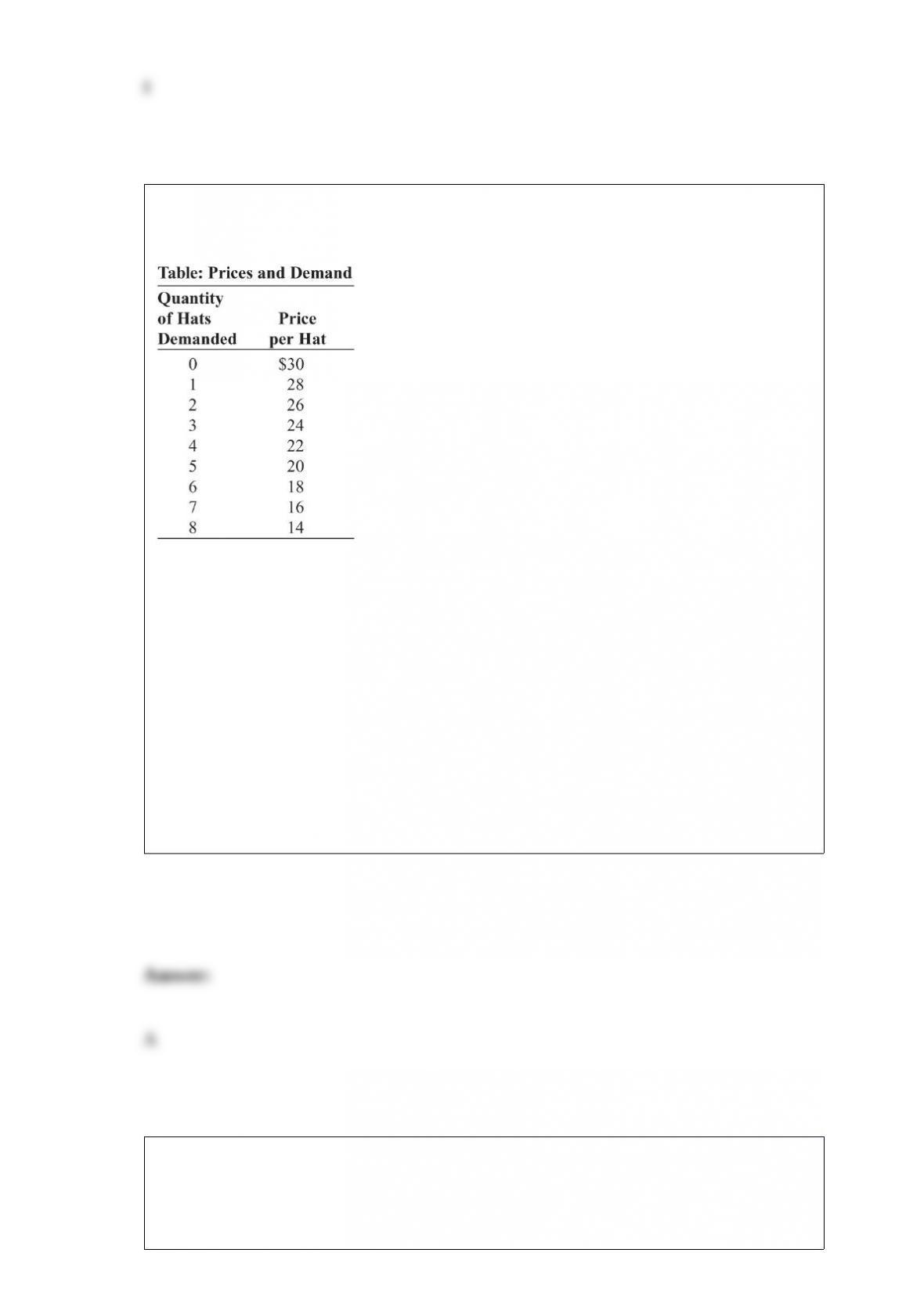
(Table: Prices and Demand) Look at the table Prices and Demand. The New Orleans
Saints have a monopoly on Saints logo hats. The marginal cost of producing a hat is
$18. If the Saints were a perfectly competitive firm in a perfectly competitive industry,
at their profit-maximizing price and output deadweight loss would be:
A) $0.
B) $12.
C) $18.
D) $24.
Which of the following can best be considered to be a resource used in the production
of computers?
A) money from investors
B) wages of computer engineers
C) computer engineers
D) taxes on the profits from the sale of the computers
Figure: Supply and Demand

(Figure: Supply and Demand) Look at the figure Supply and Demand. A binding price
ceiling is represented by:
A) the price P1.
B) the price P2.
C) the price P3.
D) point C.
Joseph chooses a combination of apples and oranges along his budget line. The
marginal rate of substitution of apples for oranges is 2, the price of an apple is $0.50,
and the price of an orange is $0.50. Joseph:
A) is maximizing total utility.
B) should consume more apples and fewer oranges to maximize total utility.
C) should consume fewer apples and more oranges to maximize total utility.
D) may or may not be maximizing total utility.
(Table: Total Product of Labor at Debbie’s Bakery) Look at the table Total Product of
Labor at Debbie’s Bakery. Debbie can sell cakes at $10 each. If Debbie must pay each
worker $40 per day, how many workers will she hire to maximize profit?
A) three
B) four
C) five
D) six
Grades are low in class and your professor makes available a 10-point extra credit
assignment. Most of the students turn in the assignment. This statement best represents
this economic concept:
A) The real cost of something is what you must give up to get it.
B) “How much” is a decision at the margin.
C) People usually exploit opportunities to make themselves better off.
D) There are gains from trade.
The practice of one company tacitly setting prices for the industry as a whole is:
A) tacit collusion.
B) product differentiation.
C) antitrust policy.
D) price leadership.
The market for apples is in equilibrium at a price of $0.50 per pound. If the government
imposes a price floor in the market at a price of $0.40 per pound:
A) quantity demanded will decrease.
B) quantity supplied will increase.
C) there will be a shortage of apples.
D) the price floor will not affect the market price or output.
How people choose among the alternatives available to them is:
A) not part of the study of economics.
B) impossible to describe.
C) the study of microeconomics.
D) not important in the study of microeconomics.
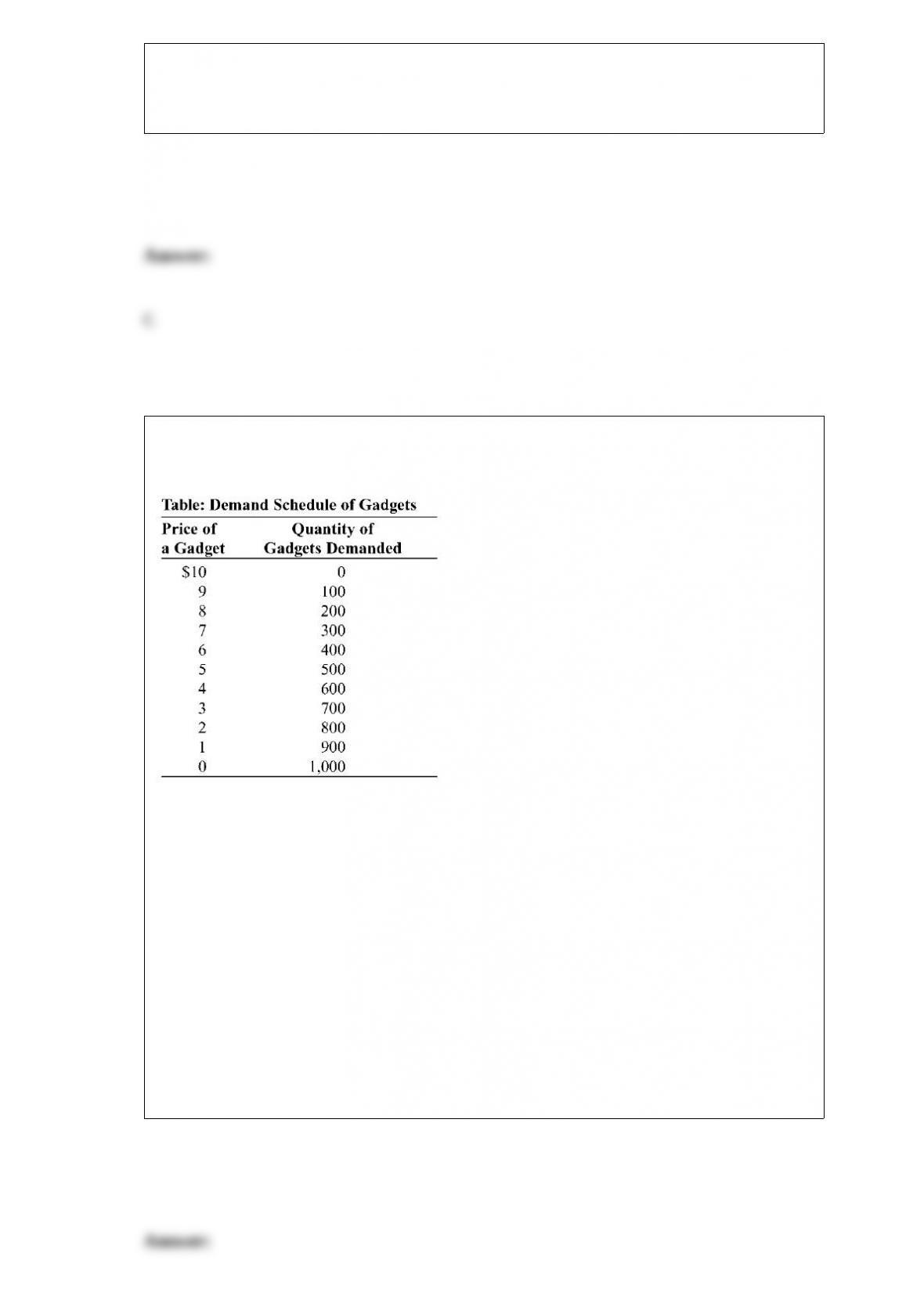
(Table: Demand Schedule for Gadgets) Look at the table Demand Schedule for
Gadgets. The market for gadgets consists of two producers, Margaret and Ray. Each
firm can produce gadgets with no marginal cost or fixed cost. If industry output is 350
gadgets produced by Margaret and 250 gadgets produced by Ray and if Ray decides to
increase output by 100, industry price will be:
A) $3.
B) $2.
C) $1.
D) $0.
The socially optimal quantity of pollution is:
A) zero.
B) the quantity whose marginal social cost is equal to zero.
C) the quantity whose marginal social benefit is equal to zero.
D) the quantity whose marginal social cost is equal to the marginal social benefit.
Suppose ABC Health is a private health insurance company that offers an identical
policy to all customers. Each customer pays a premium equal to the average consumer’s
annual medical expenses. This is a system that has the potential to fail because of the
_____ problem.
A) adverse selection
B) income inequality
C) single-payer
D) equity versus efficiency
The marginal product of labor is all of the following EXCEPT:
A) the change in output resulting from a one-unit change in labor.
B) the slope of the total product curve.
C) positive at some levels of input and possibly negative at others.
D) total product divided by total labor.
As defined in the text, the long run is a planning period:
A) in which a firm can adjust all resources.
B) that is at least five years long.
C) during which the firm must increase sales to stay in business.
D) in which variable resources become fixed.
The Conduire family owns three cars and is considering buying insurance to cover the
cost of repairs. They face two possible states: state 1, in which their cars need no repairs
and their income available for purchasing other goods and services is equal to $50,000;
and state 2, in which their cars need $10,000 worth of repairs and their income available
for purchasing other goods and services is reduced to $40,000. The probability of
occurrence is 0.5 for each state. They can buy insurance that will cover the full cost of
repairs for $5,000. If the Conduires are risk-averse and maximize their expected utility:
A) they will buy the insurance.
B) they will be indifferent between buying and not buying the insurance, since their
expected income for purchasing other goods and services is $45,000 regardless of what
they do.
C) they will not buy the insurance, since buying it does not increase their expected
income for purchasing other goods and services.
D) they will put $10,000 in savings to pay for any required repairs and not buy
insurance.
A well-known example of an international cartel is:
A) Japan.
B) OPEC.
C) Exxon.
D) General Motors.