Archives
ANT 37916
If fossil species A is consistently recovered from geological deposits beneath layers containing fossil species B, then A is considered older than B. This relative dating technique is based on the principle of: a. superposition. b. paleomagnetism. c. fluorine analysis. […]
ANT 44778
The discovery of Kenyanthropus platyopswas important mainly because: a. it had a small brain like an ape’s. b. it was discovered in Kenya. c. it showed diversity in the hominin fossil record 3.5 mya. d. it probably lived in woodlands. […]
ANT 45347
Chromosome number is reduced during: a. mitosis. b. recombination. c. translation. d. meiosis. Children living at high altitudes develop a larger chest cavity by adulthood than children living at lower altitudes. This is an example of: a. environmental adaptations that […]
ANT 50615
Infancy ends: a. at about 36 months. b. before deciduous dentition has completely erupted. c. with completion of brain growth. d. with weaning, which occurs at the same time across cultures. Chororapithecus is considered the: a. oldest fossil in Africa. […]
ANT 53194
Discuss the six key attributes that make humans unique relative to other species. Discuss the origins of racism. Include early scientists and their views on human variation. Answer: Answer: The six distinguishing features of humanity are bipedalism, nonhoning chewing, complex […]
ANT The Last Neandertals Date To Ybp
A layer of stratigraphy in one location overwhelmingly represents one species, while the same species is discovered in a similar stratigraphic layer fifty miles away. What method is used to provide an estimate of age for this layer and this […]
CGS SS 30544
The arboreal hypothesis proposes that defining primate characteristics were adaptations to life in the trees, such as: a. grasping hands and feet, developed vision, and greater intelligence. b. grasping hands, tails, and intelligence. c. developed vision, greater sense of smell, […]
CGS SS 36802
Based on the research of Philip Reno, early hominins show reduced sexual dimorphism, which is evidence for cooperation and likely for: a. monogamy. b. multifamily grouping. c. pair bonding. d. multimale grouping. The cladistic approach to primate classification is: a. […]
CGS SS 67213
Along with other distinct traits robust australopithecines had __________ adapted for grinding food. a. large premolars and molars b. large temporalis muscles and a sagittal crest c. large front teeth and small back teeth d. both a. and b. Male […]
CGS SS 69460
The Homo floresiensis specimen: a. had a small brain due to a pathology. b. lived about 20,000 yBP. c. is the result of genetic drift. d. fits Allen’s rule in body proportions. Human populations living in areas of endemic malaria […]
CGS SS 93930
In class your professor shows you an MRI scan of a primate brain. The professor points out the relatively large size of the olfactory bulb beneath the frontal lobe. This suggests to you that: a. this primate exhibits a derived […]
SOC 67412
Polyandrous residence patterns represent: a. a social grouping that includes multiple adult males and females. b. common observations in prosimians and Old World monkeys. c. a social grouping in which males cooperate in parenting activities. d. a social grouping that […]
SOC 99805
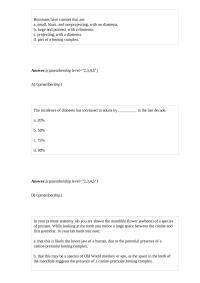
Hominins have canines that are: a. small, blunt, and nonprojecting, with no diastema. b. large and pointed, with a diastema. c. projecting, with a diastema. d. part of a honing complex. The incidence of diabetes has increased in adults by […]
SSCI 22957
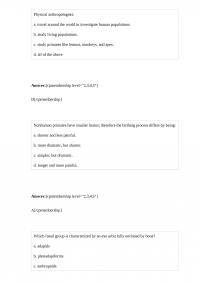
Physical anthropologists: a. travel around the world to investigate human populations. b. study living populations. c. study primates like lemurs, monkeys, and apes. d. all of the above Nonhuman primates have smaller brains; therefore the birthing process differs by being: […]
SSCI 29442
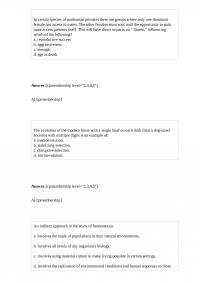
In certain species of nonhuman primates there are groups where only one dominant female has access to mates. The other females must wait until the opportunity to gain mate access presents itself. This will have direct impacts on ” fitness,” […]
SSCI 43904
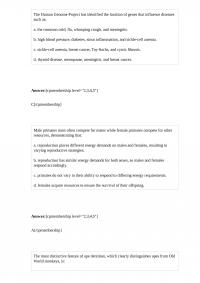
The Human Genome Project has identified the location of genes that influence diseases such as: a. the common cold, flu, whooping cough, and meningitis. b. high blood pressure, diabetes, sinus inflammation, and sickle-cell anemia. c. sickle-cell anemia, breast cancer, Tay-Sachs, […]
SSCI 77380
Bone comparisons from hunter-gatherers to later agriculturalists to modern peoples show: a. an increase in size. b. greater robusticity of the long arm bones only. c. a decline in size. d. a stasis in bone density. Hox genes: a. appear […]
SSCI 94055
Uniformitarianism is the theory that: a. the earth is very old, based on geologic evidence from stratigraphic layers in Scotland. b. the natural processes operating today are the same as the natural processes that operated in the past. c. the […]