Archives
978-0134129945 Chapter 1 Lecture Note Part 1
CHAPTER 1 INTRODUCTION TO GLOBAL MARKETING SUMMARY A. Marketing is an organizational function and a set of processes for creating, communicating, and delivering value to customers and for managing customer relationships in ways that benefit the organization and its stakeholders. […]
978-0134129945 Chapter 1 Lecture Note Part 2
Management Orientations (Learning Objective #5) The form and substance of a company’s response to global market opportunities will depend greatly on its management’s assumptions and beliefs – both conscious and unconscious – about the nature of the world. The world […]
978-0134129945 Chapter 1 Lecture Note Part 3
TEACHING TOOLS AND EXERCISES Additional Cases: “GENICON: A Surgical Strike into Emerging Markets” by Allen H. Kupetz; Adam P. Tindall; Gary Haberland. June 2010, HBS: 910M41-PDF-ENG. “Market Stretch” by Gavin Price and Margaret Sutherland. June 2009. HBS: 909M46-PDF- ENG. “Global […]
978-0134129945 Chapter 1 Solution Manual
DISCUSSION QUESTIONS 1-1. What are the basic goals of marketing? Are these goals relevant to global marketing? Marketing activities represent an organization’s efforts to satisfy customer wants and needs by offering products and services that create value. These goals are […]
978-0134129945 Chapter 10 Lecture Note Part 1
CHAPTER 10 BRAND AND PRODUCT DECISIONS IN GLOBAL MARKETING SUMMARY A. The product is the most important element of a company’s marketing program. Global marketers face the challenge of formulating coherent product and brand strategies on a worldwide basis. A […]
978-0134129945 Chapter 10 Lecture Note Part 2
EXTEND, ADAPT, CREATE: STRATEGIC ALTERNATIVES IN GLOBAL MARKETING (Learning Objective #5) To capitalize on opportunities outside the home country, company managers must devise and implement appropriate marketing programs. Depending on organizational objectives and market needs, a particular program may consist […]
978-0134129945 Chapter 10 Solution Manual
DISCUSSION QUESTIONS 10-1. What is the difference between a product and a brand? A product can be defined as a collection of tangible and intangible attributes. The former include physical features, design attributes, and packaging. The chrome on a Harley- […]
978-0134129945 Chapter 11 Lecture Note Part 1
CHAPTER 11 PRICING DECISIONS SUMMARY A. Pricing decisions are a critical element of the marketing mix that must reflect costs, competitive factors, and customer perceptions regarding value of the product. In a true global market, the law of one price […]
978-0134129945 Chapter 11 Lecture Note Part 2
GLOBAL PRICING: THREE POLICY ALTERNATIVES √ (Learning Objective #5) There are three alternative positions a company can take on worldwide pricing. Extension or Ethnocentric The first can be called an extension or ethnocentric pricing policy. An extension or ethnocentric pricing […]
978-0134129945 Chapter 11 Solution Manual
DISCUSSION QUESTIONS 11-1. What are the basic factors that affect price in any market? What considerations enter into the pricing decision? One factor is the price floor, which can be linked to product cost or some other consideration. For example, […]
978-0134129945 Chapter 12 Lecture Note Part 1
CHAPTER 12 GLOBAL MARKETING CHANNELS AND PHYSICAL DISTRIBUTION SUMMARY A. A channel of distribution is the network of agencies and institutions that links producers with users. Physical distribution is the movement of goods through channels. Business –to-consumer marketing uses consumer […]
978-0134129945 Chapter 12 Lecture Note Part 2
PHYSICAL DISTRIBUTION, SUPPLY CHAINS, and LOGISTICS MANAGEMENT √ (Learning Objective #4) In Chapter 1, marketing was described as one of the activities in a firm’s value chain. The distribution P of the marketing mix is a critical value chain activity. […]
978-0134129945 Chapter 12 Solution Manual
DISCUSSION QUESTIONS 12-1. In what ways can channel intermediaries create utility for buyers? The major categories of channel utility are: place utility (the availability of a product or service in a location that is convenient to a potential customer), 12-2. […]
978-0134129945 Chapter 13 Lecture Note Part 1
CHAPTER 13 GLOBAL MARKETING COMMUNICATIONS DECISION I: ADVERTISING AND PUBLIC RELATIONS SUMMARY A. Marketing communications—the promotion P of the marketing mix— includes advertising, public relations, sales promotion, and personal selling. When a company embraces integrated marketing communications (IMC), it recognizes […]
978-0134129945 Chapter 13 Lecture Note Part 2
Global Media Decisions √ (Learning Objective #4) The next issue facing advertisers is which medium or media to use when communicating with target audiences. Media availability can vary from country to country. Some companies use virtually the entire spectrum of […]
978-0134129945 Chapter 13 Solution Manual
DISCUSSION QUESTIONS 13-1. In what ways can global brands and global advertising campaigns benefit a company? The Chapter 11 opening quotation by the Colgate executive applies here; “You get a lot more benefit and you can do a lot more […]
978-0134129945 Chapter 14 Lecture Note Part 1
CHAPTER 14 GLOBAL MARKETING COMMUNICATIONS DECISIONS II: SALES PROMOTION, PERSONAL SELLING, SPECIAL FORMS OF MARKETING COMMUNICATION SUMMARY A. Sales promotion is any paid, short-term communication program that adds tangible value to a product or brand. Consumer sales promotions are targeted […]
978-0134129945 Chapter 14 Lecture Note Part 2
SPECIAL FORMS OF MARKETING COMMUNICATIONS: DIRECT MARKETING, SUPPORT MEDIA, EVENT SPONSORSHIP, AND PRODUCT PLACEMENT (Learning Objective #3) The Direct Marketing Association defines direct marketing as any communication with a consumer or business recipient that is designed to generate a response […]
978-0134129945 Chapter 14 Solution Manual
DISCUSSION QUESTIONS 14-1. Briefly review how the main tools of sales promotion (e.g., sampling and couponing) can be used in global markets. What issues and problems can arise in different country markets? Sampling is likely to result in actual trial […]
978-0134129945 Chapter 15 Lecture Note Part 1
CHAPTER 15 GLOBAL MARKETING AND THE DIGITAL REVOLUTION SUMMARY A. The digital revolution has created a global electronic marketplace. The revolution has gained momentum over the course of 75-plus years, during which time technological breakthroughs included the digital mainframe computer; […]
978-0134129945 Chapter 15 Lecture Note Part 2
NEW PRODUCTS AND SERVICES (Learning Objective #6) The digital revolution has spurred innovation in many different industries. Companies in all parts of the world are developing a new generation of products, services, and technologies. These include broadband networks, mobile commerce, […]
978-0134129945 Chapter 15 Solution Manual
DISCUSSION QUESTIONS 15-1. Briefly review the key innovations that culminated in the digital revolution. What is the basic technological process that made the revolution possible? The origins of the digital revolution can be traced back to the mid-twentieth century; between […]
978-0134129945 Chapter 16 Lecture Note Part 1
CHAPTER 16 STRATEGIC ELEMENTS OF COMPETITIVE ADVANTAGE SUMMARY A. In this chapter we focused on factors that help industries and countries achieve competitive advantage. According to Porter’s five forces model, industry competition is a function of the threat of new […]
978-0134129945 Chapter 16 Lecture Note Part 2
Demand Conditions The nature of home demand conditions for the firm’s products and services is important because it determines the rate and nature of improvement and innovation by the firms in the nation. Demand conditions are the factors that either […]
978-0134129945 Chapter 16 Solution Manual
DISCUSSION QUESTIONS 16-1. Outline Porter’s five forces model of industry competition. How are the various barriers to entry relevant to global marketing? The first force, the threat of new entrants, depends on the presence or absence of barriers to entry. […]
978-0134129945 Chapter 17 Lecture Note Part 1
CHAPTER 17 LEADERSHIP, ORGANIZATION, AND CORPORATE SOCIAL RESPONSIBILITY SUMMARY A. To respond to the opportunities and threats in the global marketing environment, organizational leaders must develop a global vision and strategy. Leaders must also be able to communicate that vision […]
978-0134129945 Chapter 17 Lecture Note Part 2
LEAN PRODUCTION: ORGANIZING THE JAPANESE WAY (Learning Objective #3) In the automobile industry, a comparison of early craft production processes, mass production, and modern “lean” production provides an interesting case study of the effectiveness of new organizational structures in the […]
978-0134129945 Chapter 17 Solution Manual
DISCUSSION QUESTIONS 17-1. Are top executives of global companies likely to be home-country nationals? In a truly global company, the person chosen to the top executive job should be the best person for that job, irrespective of nationality, however, this […]
978-0134129945 Chapter 2 Lecture Note Part 1
CHAPTER 2 THE GLOBAL ECONOMIC ENVIRONMENT SUMMARY A. The economic environment is a major determinant of global market potential and opportunity. In today’s global economy, capital movements are the driving force, production is uncoupled from employment, and capitalism has vanquished […]
978-0134129945 Chapter 2 Lecture Note Part 2
Marketing Opportunities in LDCs and Developing Countries Despite many problems in LDCs and developing countries, it is possible to nurture long-term market opportunities. Although Nike sells only a small portion of its output in China, it clearly has the future […]
978-0134129945 Chapter 2 Solution Manual
DISCUSSION QUESTIONS 2-1. The seven criteria for describing a nation’s economy introduced at the beginning of this chapter can be combined in a number of different ways. For example, the United States can be characterized as follows: Type of economy: […]
978-0134129945 Chapter 3 Lecture Note Part 1
CHAPTER 3 THE GLOBAL TRADE ENVIRONMENT SUMMARY A. This chapter examines the environment for world trade, focusing on the institutions and regional cooperation agreements that affect trade patterns. B. The multilateral World Trade Organization, created in 1995 as the successor […]
978-0134129945 Chapter 3 Lecture Note Part 2
ASIA-PACIFIC: The Association of Southeast Asian Nations (ASEAN) (Learning Objective #5) The Association of Southeast Asian Nations (ASEAN) was established in 1967 as an organization for economic, political, social, and cultural cooperation among its member countries. The original six members […]
978-0134129945 Chapter 3 Solution Manual
DISCUSSION QUESTIONS 3-1. Explain the role of the World Trade Organization. Why has the Doha Round of trade talks stalled? The World Trade Organization (WTO) is the successor to GATT. Based in Geneva, the WTO has a dispute-settlement body (DSB), […]
978-0134129945 Chapter 4 Lecture Note Part 1
CHAPTER 4 SOCIAL AND CULTURAL ENVIRONMENTS SUMMARY A. Culture, a society’s “programming of the mind,” has both a pervasive and changing influence on each national market environment. Global marketers must recognize the influence of culture and be prepared to either […]
978-0134129945 Chapter 4 Lecture Note Part 2
THE SELF-REFERENCE CRITERION √ (Learning Objective #4) A person’s perception of market needs is framed by his or her own cultural experience. A framework for reducing perceptual blockage and distortion was developed by James Lee. The unconscious reference to one’s […]
978-0134129945 Chapter 4 Solution Manual
DISCUSSION QUESTIONS 4-1. What are some of the elements that make up culture? How do these find expression in your native culture? This question can be especially interesting if there is multicultural representation among your students. Ask students from other […]
978-0134129945 Chapter 5 Lecture Note Part 1
CHAPTER 5 THE POLITICAL, LEGAL, AND REGULATORY ENVIRONMENTS SUMMARY A. The political environment of global marketing is the set of governmental institutions, political parties, and organizations that are the expression of the people in the nations of the world. In […]
978-0134129945 Chapter 5 Lecture Note Part 2
Innovation, Entrepreneurship, and the Global Startup Travis Kalanick and Uber Travis Kalanick is an entrepreneur. He developed an innovative product, created a brand, and started a company to market it. As is true with many entrepreneurs, Kalanick’s idea was based […]
978-0134129945 Chapter 5 Solution Manual
DISCUSSION QUESTIONS 5-1. Describe some of the sources of political risk. Specifically, what forms can political risk take? Political risk increases when a country experiences a currency crisis, when there is civil 5-2. Global marketers can avoid legal conflicts by […]
978-0134129945 Chapter 6 Lecture Note Part 1
CHAPTER 6 GLOBAL INFORMATION SYSTEMS AND MARKET RESEARCH SUMMARY A. Information is one of the most basic ingredients of a successful marketing strategy. A company’s management information system (MIS) and intranet provides decision makers with a continuous flow of information. […]
978-0134129945 Chapter 6 Lecture Note Part 2
Issues in Data Collection The research problem may be more narrowly focused on marketing issues, such as the need to adapt products and other mix elements to local tastes and to assess demand and profit potential. Existing markets are those […]
978-0134129945 Chapter 6 Solution Manual
DISCUSSION QUESTIONS 6-1. Explain how information technology puts powerful tools in the hands of global marketers. Electronic data interchange (EDI), electronic point of sale (EPOS), efficient consumer response, and data warehouses are some of the new tools and techniques available. […]
978-0134129945 Chapter 7 Lecture Note Part 1
CHAPTER 7 SEGMENTATION, TARGETING, AND POSITIONING SUMMARY A. The global environment must be analyzed before a company pursues expansion into new geographic markets. Through global market segmentation, a company can identify and group customers or countries according to common needs […]
978-0134129945 Chapter 7 Lecture Note Part 2
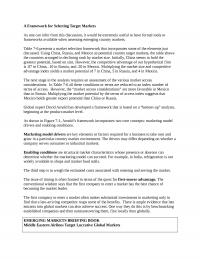
A Framework for Selecting Target Markets As one can infer from this discussion, it would be extremely useful to have formal tools or frameworks available when assessing emerging country markets. Table 7-6 presents a market selection framework that incorporates some […]
978-0134129945 Chapter 7 Solution Manual
DISCUSSION QUESTIONS 7-1. In a recent interview, a brand manager at Procter & Gamble noted, “Historically, we used to be focused on discovering the common hopes and dreams within a country, but now we’re seeing that the real commonalities are […]
978-0134129945 Chapter 8 Lecture Note Part 1
CHAPTER 8 IMPORTING, EXPORTING, AND SOURCING SUMMARY A. A company’s first business dealings outside the home country often take the form of exporting or importing. Companies should recognize the difference between export marketing and export selling. By attending trade shows […]
978-0134129945 Chapter 8 Lecture Note Part 2
KEY EXPORT PARTICIPANTS (Learning Objective #5) Export participants include: purchasing agents, export brokers, and export merchants, who have no assignment of responsibility. Others, including export management companies, manufacturers’ export representatives, export distributors, and freight forwarders, are assigned responsibilities by the […]
978-0134129945 Chapter 8 Solution Manual
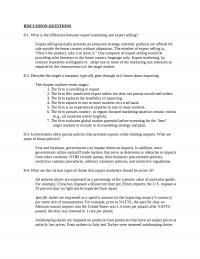
DISCUSSION QUESTIONS 8-1. What is the difference between export marketing and export selling? Export selling basically presents an extension strategy whereby products are offered for sale outside the home country without adaptation. The mindset of export selling is, 8-2. Describe […]
978-0134129945 Chapter 9 Lecture Note Part 1
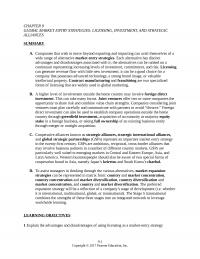
CHAPTER 9 GLOBAL MARKET ENTRY STRATEGIES: LICENSING, INVESTMENT, AND STRATEGIC ALLIANCES SUMMARY A. Companies that wish to move beyond exporting and importing can avail themselves of a wide range of alternative market entry strategies. Each alternative has distinct advantages and […]
978-0134129945 Chapter 9 Lecture Note Part 2
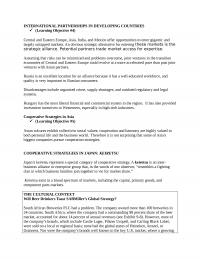
INTERNATIONAL PARTNERSHIPS IN DEVELOPING COUNTRIES (Learning Objective #4) Central and Eastern Europe, Asia, India, and Mexico offer opportunities to enter gigantic and largely untapped markets. An obvious strategic alternative for entering these markets is the strategic alliance. Potential partners trade […]
978-0134129945 Chapter 9 Solution Manual
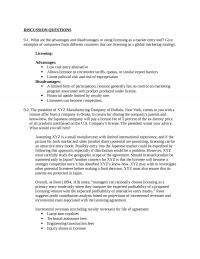
DISCUSSION QUESTIONS 9-1. What are the advantages and disadvantages or using licensing as a market entry tool? Give examples of companies from different countries that use licensing as a global marketing strategy. Licensing: Advantages: Disadvantages: A limited form of participation; […]
BUSMKT 12876
After Fidel Castro took power in Cuba in 1959, his government seized control of American property without paying compensation. Coca-Cola, DuPont, Texaco, and dozens of other American companies have filed claims against Cuba seeking financial settlements. Which of the following […]
BUSMKT 21755
Some company executives become so committed to a current, profitable technology that they fail to provide adequate levels of investment in new, apparently riskier technologies. Yong Nam, CEO of LG, recently stipulated that Chinese would be required throughout the company. […]
BUSMT 20590
The United States’ growing trade deficit reflects a number of factors which exclude: A) increased imports from China. B) a seemingly insatiable consumer demand for imported goods. C) the enormous cost of military operations in the Middle East. D) the […]
BUSMT 71185
The terminology used to describe the new forms of cooperation strategies varies widely and the phrases used include all of the following except: A) collaborative agreements. B) strategic alliances. C) global strategic partnerships. D) strategic international alliances. E) Greenfield operations. […]
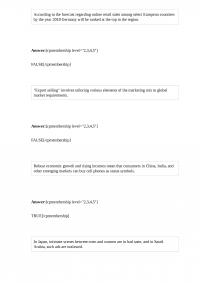
Marketing 22361
According to the forecast regarding online retail sales among select European countries by the year 2018 Germany will be ranked at the top in the region. “Export selling” involves tailoring various elements of the marketing mix to global market requirements. […]
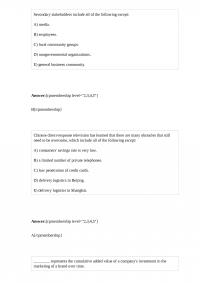
Marketing 37410
Secondary stakeholders include all of the following except: A) media. B) employees. C) local community groups. D) nongovernmental organizations. E) general business community. Chinese direct-response television has learned that there are many obstacles that still need to be overcome, which […]
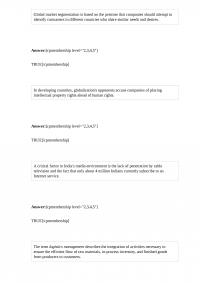
Marketing 37860
Global market segmentation is based on the premise that companies should attempt to identify consumers in different countries who share similar needs and desires. In developing countries, globalization’s opponents accuse companies of placing intellectual property rights ahead of human rights. […]
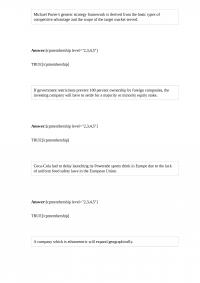
Marketing 77618
Michael Porter’s generic strategy framework is derived from the basic types of competitive advantage and the scope of the target market served. If government restrictions prevent 100 percent ownership by foreign companies, the investing company will have to settle for […]
Marketing 83015
Porsche relies on currency hedging rather than price increases to boost pretax profits on sales of its automobiles. What is the advantage of doing this, and how does hedging work? India has the youngest demographic profile among the world’s large […]
MET 29986
Every commercial transaction is based on a contract of sale, and the trade terms in that contract specify the exact point at which the ownership of merchandise is transferred from the seller to the buyer and which party in the […]
MET 44243
When Walmart came to Brazil in the mid-1990s, it discovered that local competitors did not have the technological infrastructure that allowed them to match its aggressive pricing policies. Licensing agreements offer limited market control since the licensee typically does not […]
MET AD 57704
Which of the following is not characteristic of direct marketing? A) A marketer relinquishes control of product when it is turned over to channel intermediaries. B) Advertising serves to generate an immediate inquiry or purchase. C) Repetition is used in […]
MET AD 73144
In 2013, the 10 most populous countries in the world accounted for just over ________ percent of the world income. A) 20 B) 30 C) 40 D) 50 E) 60 The sales of the Apple watch increased when customers were […]
MET AD 93370
The use of the color ________ dates back millennia as seen by artisans in ancient Egypt, China, and Mayan civilizations and is now associated with royalty and divinity. A) red B) green C) blue D) orange E) brown Which of […]
MGMT 29753
The term “polycentric” describes management’s belief or assumption that each country in which a company does business is the same as the home country business. Being socially responsible is the only the right thing to do; it can distinguish a […]
MGMT 35395
When British entrepreneur Richard Branson opened the first Virgin Megastore in Japan, he did so by establishing a joint venture with the Marui retailing chain. This represents an inappropriate market-entry approach for a global retailer. GATT (General Agreement on Tariffs […]
MGMT 50293
Ethnocentric pricing responds to the competitive and market conditions of national market. “Export price escalation” is the increase in the initial selling price of goods traded across borders. Answer: FALSE Aesthetic elements that are attractive, appealing, and in good taste […]
MGMT 60490
Former Disney chairman Michael Eisner and other company executives were blinded by ethnocentrism. Avoiding the Self-Reference Criterion (SRC) requires a person to suspend assumptions based on prior experience and success and be prepared to acquire new knowledge about human behavior […]
MK 19789
Cultural influences are also quite apparent in food preparation and consumption patterns and habits. Domino’s Pizza, the world’s largest pizza-delivery company, pulled out of Italy because: A) its tomato sauce was too bold and competed with Italian products. B) people […]
MK 21291
Which of the following correctly characterizes the retailing strategy of Benetton, IKEA, and Gap? A) few product categories, own-label focus B) few product categories, manufacturer brand focus C) many product categories, own-label focus D) many product categories, manufacturer brand focus […]
MK 34396
Brazil, China, and India are classified as upper-middle income countries, also known as industrialized or developing countries. An express warrantyis a written guarantee that assures the buyer that he or she is getting what he or she has paid for […]
MK 60845
The concentration of wealth in a handful of industrialized countries has significant implications for global marketers. After segmenting in terms of a single demographic variable”income” a company can reach the most affluent markets which does not include: A) half of […]
MK 71492
The DMBB (D’arcy Massius Benton & Bowles) agency created a psychographic profile of the Russian market. The categories include all of the following except: A) Kuptsy. B) Cossacks. C) Elites. D) Students. E) Business Executives. When a survey questionnaire in […]
MK 89904
Anheuser-Busch, the brewer of Budweiser beer, lost its independence after years of focusing primarily on the U.S. market. Sometimes it is preferable to market to a particular age group rather than a mind-set; in such an instance, psychographic studies can […]
MK 98336
Apple, Levi Strauss, Nike, Sony, well-known fashion design houses, and other companies with strong brands sometimes establish flagship retail stores as a means of obtaining marketing intelligence. The foreign exchange market consists literally of a buyer’s and a seller’s market […]
MKT 44776
The Swatch Group is the world’s second largest watchmaker. This shows that in the low-cost segment, brands compete on price and value. An ad valorem duty is expressed as a percentage of the value of goods. Answer: TRUE Dove, a […]
MKT 51879
Red Bull energy drink manufacturer, Dietrich Mateschitz, hired a market research firm to assess the market potential for the drink. In the tests, consumers reacted negatively to the taste, the logo, and the brand name. The company ignored the research […]
MKT 57441
Nokia’s reversal of fortune at the hands of Apple and Google underscores the fact that today’s executives must rethink the concept of the corporation if they wish to operationalize the concept of core competencies. Today, market capitalism is widely practiced […]
MT 51806
To motivate shopkeepers to stock more of P&G’s products, the company launched a: A) door-to-door program. B) retail store program. C) golden store program. D) hypermarket program. E) sole distributor program. Competitive advertising may impair the effectiveness of the message […]