Archives
978-0133460629 Chapter 01 Part 1
Foundations of Macroeconomics, 7e (Bade/Parkin) Chapter 1 Getting Started 1.1 Deinition and Questions 1) Scarcity exists because A) human wants exceed the resources available to satisfy them. B) some individuals have low income. C) the costs of production are high. […]
978-0133460629 Chapter 01 Part 10
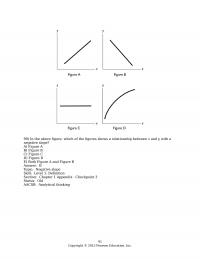
99) In the above igure, which of the igures shows a relationship between x and y with a negative slope? A) Figure A B) Figure B C) Figure C D) Figure D E) Both Figure A and Figure B Skill: […]
978-0133460629 Chapter 01 Part 11
116) Which of the following statements is the best example of the term ceteris paribus? A) An economist holds other factors constant when he examines the relationship between tax rates and tax revenues. B) More money should be spent on […]
978-0133460629 Chapter 01 Part 12
13) Wichita is building a convention center and inancing it with revenues raised from a city hotel tax. Local politicians assert that the convention center is essentially free for Wichita residents because out-of-town visitors are paying for it. Someone who […]
978-0133460629 Chapter 01 Part 13
5) Why does scarcity lead to the what, how, and for whom questions? Skill: Level 1: Deinition Section: Checkpoint 1.1 Status: Old AACSB: Written and oral communication 6) List and explain the three fundamental economic questions that must be answered […]
978-0133460629 Chapter 01 Part 14
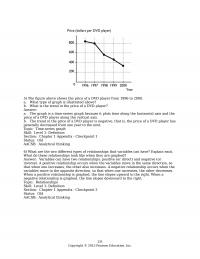
5) The igure above shows the price of a DVD player from 1996 to 2000. a. What type of graph is illustrated above? b. What is the trend in the price of a DVD player? Skill: Level 1: Deinition Section: […]
978-0133460629 Chapter 01 Part 15
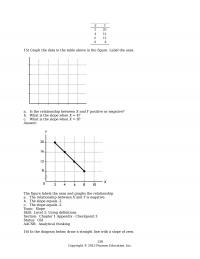
15) Graph the data in the table above in the igure. Label the axes. a. Is the relationship between X and Y positive or negative? b. What is the slope when X = 4? c. What is the slope when […]
978-0133460629 Chapter 01 Part 2
31) When Delta decides to quit lying to Lithuania, it directly answers the ________ question. A) what B) why C) for whom D) how E) when Skill: Level 2: Using deinitions Section: Checkpoint 1.1 Status: Old AACSB: Relective thinking 32) […]
978-0133460629 Chapter 01 Part 3
1.2 The Economic Way of Thinking 1) Rational choice A) is a choice that uses the available resources to best achieve the objective of the person making the choice. B) is always eicient. C) is what you must give up […]
978-0133460629 Chapter 01 Part 4
31) Instead of studying for an additional two hours for the economics inal, Leann decides to watch a movie. Leann is making A) a decision that does not involve an opportunity cost. B) a rational decision if her marginal cost […]
978-0133460629 Chapter 01 Part 5
61) Which of the following is an example of a normative economic statement? A) Universal access to quality health insurance is the most important domestic policy issue of our time. B) Extending the time in which laid-of workers are eligible […]
978-0133460629 Chapter 01 Part 6
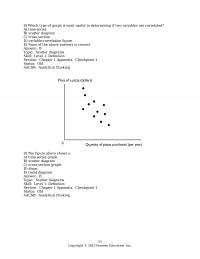
8) Which type of graph is most useful in determining if two variables are correlated? A) time-series B) scatter diagram C) cross-section D) variable-correlation igure E) None of the above answers is correct. Skill: Level 1: Deinition Section: Chapter 1 […]
978-0133460629 Chapter 01 Part 7
36) As a person increases his or her caloric intake, the person’s weight increases, ceteris paribus. The relationship between the person’s caloric intake and the person’s weight is an example of A) unrelated variables. B) a positive relationship. C) a […]
978-0133460629 Chapter 01 Part 8
57) In the diagram above, which igure(s) show(s) an inverse relationship between the variables? A) both B and C B) only B C) both A and C D) only D E) only C Skill: Level 2: Using deinitions Section: Chapter […]
978-0133460629 Chapter 01 Part 9
77) A slope is measured as the A) value of the variable measured on the y-axis divided by the value of the variable measured on the x-axis. B) value of the variable measured on the x-axis divided by the value […]
978-0133460629 Chapter 02 Part 1
Foundations of Macroeconomics, 7e (Bade/Parkin) Chapter 2 The U.S. and Global Economies 2.1 What, How, and For Whom? 1) Items that are purchased by individuals for their own enjoyment are called A) consumption goods and services. B) capital goods. C) […]
978-0133460629 Chapter 02 Part 2
31) Which factor of production does human capital enhance? i. land ii. labor iii. capital A) i only B) ii only C) iii only D) i and ii E) i, ii, and iii Skill: Level 2: Using deinitions Section: Checkpoint […]
978-0133460629 Chapter 02 Part 3
61) The richest 20 percent of individuals in the United States receive about ________ of the nation’s total income. A) 21 percent B) 51 percent C) 91 percent D) 99 percent E) 23 percent Skill: Level 1: Deinition Section: Checkpoint […]
978-0133460629 Chapter 02 Part 4
15) Which of the following correctly describes how the “global pie is baked”? A) Advanced economies account for about 50 percent of the value of the world’s production. B) The United States’ share of economic pie is increasing while China’s […]
978-0133460629 Chapter 02 Part 5
16) A money low in the circular low diagram is i. the government’s collection of taxes. ii. Chevrolet’s production of SUVs. iii. Nike’s payment of wages to its workers. A) i and iii B) i, ii and iii C) i […]
978-0133460629 Chapter 02 Part 6
46) If there is a national debt, we can conclude that the federal government has A) borrowed in the past. B) purchased more goods and services than were needed. C) spent money foolishly. D) loaned funds to U.S. taxpayers in […]
978-0133460629 Chapter 02 Part 7
5) Margo orders a MacBook Pro computer from The Apple Store online to use it in her graphic design business. How will this be relected in the igure above? A) as a low of a factor of production B) as […]
978-0133460629 Chapter 02 Part 8
3) The International Monetary Fund divides nations into three groups. What are the three groups and what are the characteristics of each group? Skill: Level 3: Using models Section: Checkpoint 2.2 Status: Old AACSB: Written and oral communication 4) Discuss […]
978-0133460629 Chapter 03 Part 1
Foundations of Macroeconomics, 7e (Bade/Parkin) Chapter 3 The Economic Problem 3.1 Production Possibilities 1) The United States produced approximately ________ worth of goods and services in 2011. A) $15 trillion B) $15 billion C) $150 trillion D) $150 billion E) […]
978-0133460629 Chapter 03 Part 10
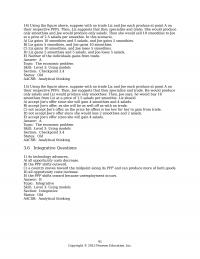
14) Using the igure above, suppose with no trade Liz and Joe each produce at point A on their respective PPFs. Then, Liz suggests that they specialize and trade. She would produce only smoothies and Joe would produce only salads. […]
978-0133460629 Chapter 03 Part 11
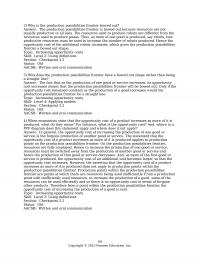
2) Why is the production possibilities frontier bowed out? Skill: Level 2: Using deinitions Section: Checkpoint 3.2 Status: Old AACSB: Written and oral communication 3) Why does the production possibilities frontier have a bowed out shape rather than being a […]
978-0133460629 Chapter 03 Part 12
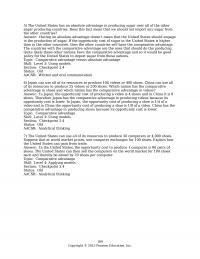
5) The United States has an absolute advantage in producing sugar over all of the other sugar producing countries. Does this fact mean that we should not import any sugar from the other countries? Skill: Level 3: Using models Section: […]
978-0133460629 Chapter 03 Part 2
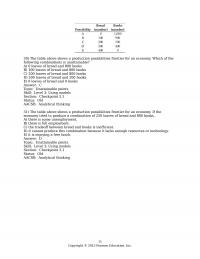
30) The table above shows a production possibilities frontier for an economy. Which of the following combinations is unattainable? A) 0 loaves of bread and 800 books B) 100 loaves of bread and 800 books C) 200 loaves of bread […]
978-0133460629 Chapter 03 Part 3
54) The production possibilities frontier is a graph showing the A) exact point of greatest eiciency for producing goods and services. B) tradeof between free lunches. C) maximum combinations of goods and services that can be produced. D) minimum combinations […]
978-0133460629 Chapter 03 Part 4
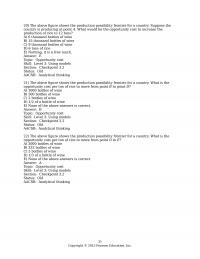
20) The above igure shows the production possibility frontier for a country. Suppose the country is producing at point A. What would be the opportunity cost to increase the production of rice to 12 tons? A) 6 thousand bottles of […]
978-0133460629 Chapter 03 Part 5
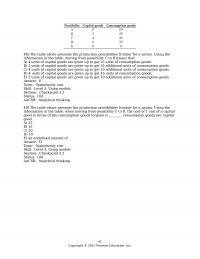
48) The table above presents the production possibilities frontier for a nation. Using the information in the table, moving from possibility C to B means that A) 4 units of capital goods are given up to get 55 units of […]
978-0133460629 Chapter 03 Part 6
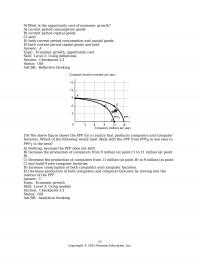
9) What is the opportunity cost of economic growth? A) current period consumption goods B) current period capital goods C) land D) both current period consumption and capital goods E) both current period capital goods and land Skill: Level 2: […]
978-0133460629 Chapter 03 Part 7
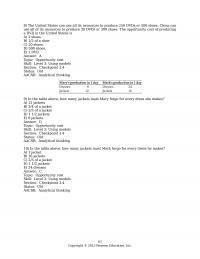
8) The United States can use all its resources to produce 250 DVDs or 500 shoes. China can use all of its resources to produce 30 DVDs or 300 shoes. The opportunity cost of producing a DVD in the United […]
978-0133460629 Chapter 03 Part 8
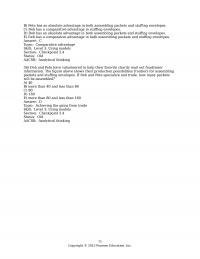
B) Pete has an absolute advantage in both assembling packets and stuing envelopes. C) Deb has a comparative advantage in stuing envelopes. D) Deb has an absolute advantage in both assembling packets and stuing envelopes. E) Deb has a comparative […]
978-0133460629 Chapter 03 Part 9
61) “Comparative advantage” is deined as a situation in which one person can produce A) more of all goods than another person. B) more of a good than another person. C) a good for a lower dollar cost than another […]
978-0133460629 Chapter 04 Part 1
Foundations of Macroeconomics, 7e (Bade/Parkin) Chapter 4 Demand and Supply 4.1 Demand 1) A market is deined as A) a physical place where people buy only goods. B) a physical place where people buy both goods and services. C) a […]
978-0133460629 Chapter 04 Part 10
66) The above igure shows the market for pizza. The market is in equilibrium when the cheese used to produce pizza falls in price. What point represents the most likely new price and quantity? A) A B) B C) C […]
978-0133460629 Chapter 04 Part 11
95) When the demand for a good decreases, its equilibrium price ________ and equilibrium quantity ________. A) falls; decreases B) falls; increases C) rises; decreases D) rises; increases E) falls; does not change Skill: Level 3: Using models Section: Checkpoint […]
978-0133460629 Chapter 04 Part 12
12) The above igures show the market for HD televisions. If the price of the LCD screens used to produce these televisions falls, which igure shows the efect of this change in price? A) Figure A B) Figure B C) […]
978-0133460629 Chapter 04 Part 13
Answer: A shortage occurs when the price is below the equilibrium price. When the price is less than the equilibrium price, the quantity demanded is greater than the quantity supplied. Topic: Shortage Skill: Level 2: Using deinitions Section: Checkpoint 4.3 […]
978-0133460629 Chapter 04 Part 2
31) To ind the market demand curve for in-line skates, we must A) add the quantities demanded at every price and every income by every buyer of in-line skates. B) add the quantities demanded at prices that all buyers can […]
978-0133460629 Chapter 04 Part 3
61) A huge 50 percent of sale on golf clubs is advertised for next week. What happens this week in the market for golf clubs? A) The supply of golf clubs increases. B) The supply of golf clubs decreases. C) […]
978-0133460629 Chapter 04 Part 4
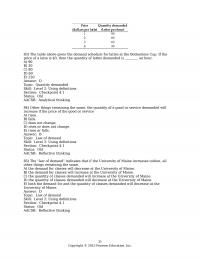
83) The table above gives the demand schedule for lattes at the Bottomless Cup. If the price of a latte is $3, then the quantity of lattes demanded is ________ an hour. A) 90 B) 30 C) 80 D) 60 […]
978-0133460629 Chapter 04 Part 5
14) Which of the following shifts the supply curve of rutabagas rightward? (A rutabaga is a potato-like vegetable.) A) an increase in the price of a rutabaga B) an exceptionally cold summer that killed much of the rutabaga crop C) […]
978-0133460629 Chapter 04 Part 6
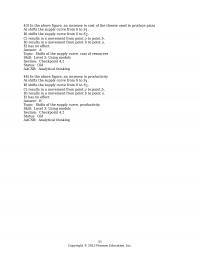
43) In the above igure, an increase in cost of the cheese used to produce pizza A) shifts the supply curve from S to S1. B) shifts the supply curve from S to S2. C) results in a movement from […]
978-0133460629 Chapter 04 Part 7
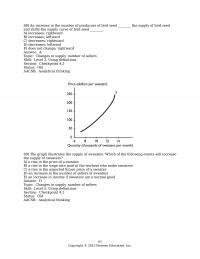
68) An increase in the number of producers of bird seed ________ the supply of bird seed and shifts the supply curve of bird seed ________. A) increases; rightward B) increases; leftward C) decreases; rightward D) decreases; leftward E) does […]
978-0133460629 Chapter 04 Part 8
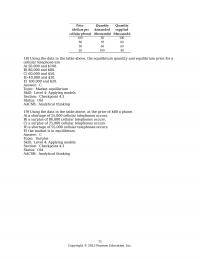
18) Using the data in the table above, the equilibrium quantity and equilibrium price for a cellular telephone are A) 50,000 and $100. B) 80,000 and $80. C) 60,000 and $50. D) 40,000 and $20. E) 100,000 and $20. Skill: […]
978-0133460629 Chapter 04 Part 9
45) The initial equilibrium price in the market for Web pages is $200 per page and 1000 Web pages are created in a month. Many new Web design irms now enter the market. As a result, A) the supply of […]
978-0133460629 Chapter 05 Part 1
Foundations of Macroeconomics, 7e (Bade/Parkin) Chapter 5 GDP: A Measure of Total Production and Income 5.1 GDP, Income, and Expenditure 1) A measure of a country‘s production is its A) gross daily production. B) general daily product. C) general domestic […]
978-0133460629 Chapter 05 Part 2
31) Expenditures on U.S. produced steaks, shoes, and doctor visits are most likely classiied as A) consumption expenditure. B) investment. C) government expenditure on goods and services. D) net exports of goods and services. E) net imports of goods and […]
978-0133460629 Chapter 05 Part 3
61) In a circular low diagram, i. the value of production = income. ii. the value of production = expenditure. iii. expenditure = income. A) i, ii and iii are true statements. B) Only iii is a true statement. C) […]
978-0133460629 Chapter 05 Part 4
17) When Jamie purchases a classic 1968 Plymouth Cuda convertible from Shane, GDP A) does not change, because the car was not produced this year. B) increases, because the car is a durable good and increases consumption. C) increases, because […]
978-0133460629 Chapter 05 Part 5
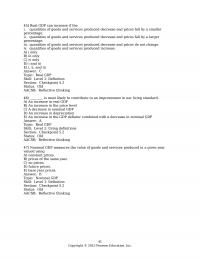
45) Real GDP can increase if the i. quantities of goods and services produced decrease and prices fall by a smaller percentage. ii. quantities of goods and services produced decrease and prices fall by a larger percentage. iii. quantities of […]
978-0133460629 Chapter 05 Part 6
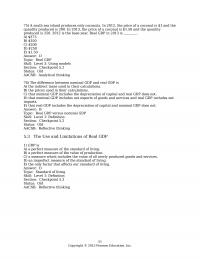
75) A south sea island produces only coconuts. In 2012, the price of a coconut is $1 and the quantity produced is 200. In 2013, the price of a coconut is $1.50 and the quantity produced is 250. 2012 is […]
978-0133460629 Chapter 05 Part 7
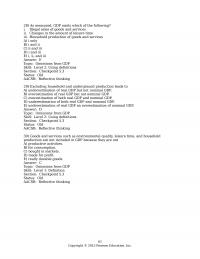
28) As measured, GDP omits which of the following? i. Illegal sales of goods and services ii. Changes in the amount of leisure time iii. Household production of goods and services A) i only B) i and ii C) ii […]
978-0133460629 Chapter 05 Part 8
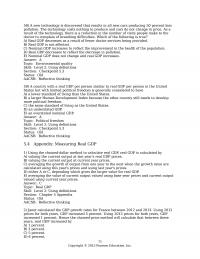
58) A new technology is discovered that results in all new cars producing 50 percent less pollution. The technology costs nothing to produce and cars do not change in price. As a result of the technology, there is a reduction […]
978-0133460629 Chapter 05 Part 9
4) Are sales and purchases of used goods counted as part of GDP? Why or why not? Skill: Level 2: Using deinitions Section: Checkpoint 5.2 Status: Old AACSB: Written and oral communication 5) If you sell your textbook to your […]
978-0133460629 Chapter 06 Part 1
Foundations of Macroeconomics, 7e (Bade/Parkin) Chapter 6 Jobs and Unemployment 6.1 Labor Market Indicators 1) The Bureau of Labor Statistics (BLS) compiles information about employment by A) performing a census of every household in the nation. B) performing a quarterly […]
978-0133460629 Chapter 06 Part 10
6.5 Essay: Labor Market Indicators 1) How does the Current Population Survey determine if a person should be counted in the labor force? Skill: Level 1: Deinition Section: Checkpoint 6.1 Status: Old AACSB: Written and oral communication 2) What is […]
978-0133460629 Chapter 06 Part 2
30) The working-age population of people over the age of 16 can be divided into two groups, people A) in the labor force and people looking for work. B) in the labor force and people with a job. C) looking […]
978-0133460629 Chapter 06 Part 3
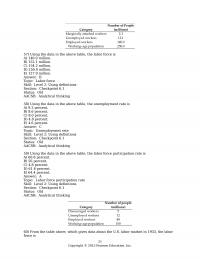
57) Using the data in the above table, the labor force is A) 140.0 million. B) 152.1 million. C) 154.2 million. D) 250.0 million. E) 127.9 million. Skill: Level 2: Using deinitions Section: Checkpoint 6.1 Status: Old AACSB: Analytical thinking […]
978-0133460629 Chapter 06 Part 4
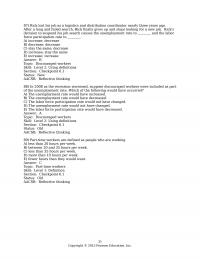
87) Rick lost his job as a logistics and distribution coordinator nearly three years ago. After a long and failed search, Rick inally gives up and stops looking for a new job. Rick’s decision to suspend his job search causes […]
978-0133460629 Chapter 06 Part 5
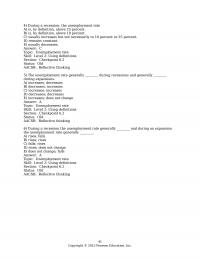
4) During a recession, the unemployment rate A) is, by deinition, above 25 percent. B) is, by deinition, above 10 percent. C) usually increases but not necessarily to 10 percent or 25 percent. D) remains constant. E) usually decreases. Skill: […]
978-0133460629 Chapter 06 Part 6
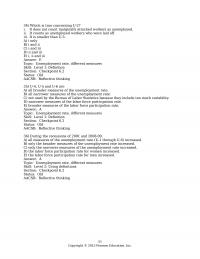
34) Which is true concerning U-2? i. It does not count marginally attached workers as unemployed. ii. It counts as unemployed workers who were laid of. iii. It is smaller than U-3. A) i only B) i and ii C) […]
978-0133460629 Chapter 06 Part 7
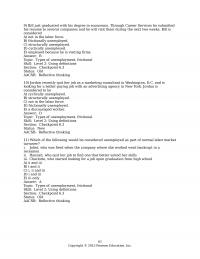
9) Bill just graduated with his degree in economics. Through Career Services he submitted his resume to several companies and he will visit them during the next two weeks. Bill is considered A) not in the labor force. B) frictionally […]
978-0133460629 Chapter 06 Part 8
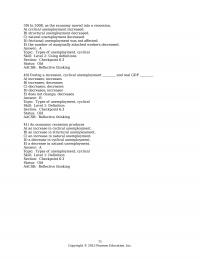
39) In 2008, as the economy moved into a recession, A) cyclical unemployment increased. B) structural unemployment decreased. C) natural unemployment decreased. D) frictional unemployment was not afected. E) the number of marginally attached workers decreased. Skill: Level 2: Using […]
978-0133460629 Chapter 06 Part 9
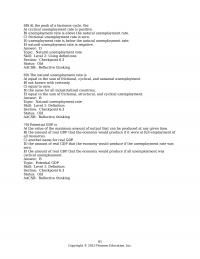
68) At the peak of a business cycle, the A) cyclical unemployment rate is positive. B) unemployment rate is above the natural unemployment rate. C) frictional unemployment rate is zero. D) unemployment rate is below the natural unemployment rate. E) […]
978-0133460629 Chapter 07 Part 1
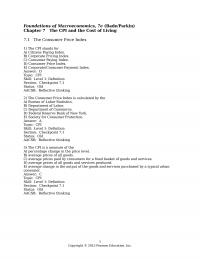
Foundations of Macroeconomics, 7e (Bade/Parkin) Chapter 7 The CPI and the Cost of Living 7.1 The Consumer Price Index 1) The CPI stands for A) Citizens Paying Index. B) Corporate Pricing Index. C) Consumer Paying Index. D) Consumer Price Index. […]
978-0133460629 Chapter 07 Part 10
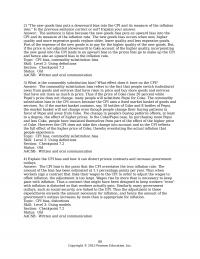
2) “The new goods bias puts a downward bias into the CPI and its measure of the inlation rate.” Is the previous sentence correct or not? Explain your answer. Skill: Level 2: Using deinitions Section: Checkpoint 7.2 Status: Old AACSB: […]
978-0133460629 Chapter 07 Part 2
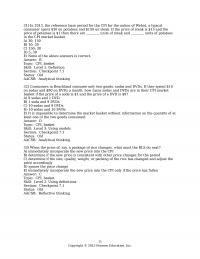
31) In 2013, the reference base period for the CPI for the nation of Webot, a typical consumer spent $30 on potatoes and $150 on steak. If the price of steak is $15 and the price of potatoes is $1 […]
978-0133460629 Chapter 07 Part 3
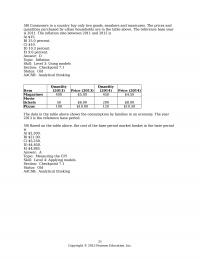
58) Consumers in a country buy only two goods, sneakers and manicures. The prices and quantities purchased by urban households are in the table above. The reference base year is 2011. The inlation rate between 2011 and 2012 is A) […]
978-0133460629 Chapter 07 Part 4
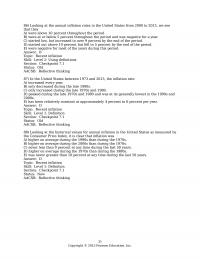
86) Looking at the annual inlation rates in the United States from 2000 to 2013, we see that they A) were above 10 percent throughout the period. B) were at or below 5 percent throughout the period and was negative […]
978-0133460629 Chapter 07 Part 5
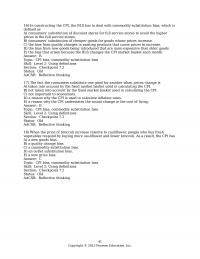
16) In constructing the CPI, the BLS has to deal with commodity substitution bias, which is deined as A) consumers’ substitution of discount stores for full service stores to avoid the higher prices in the full service stores. B) consumers’ […]
978-0133460629 Chapter 07 Part 6
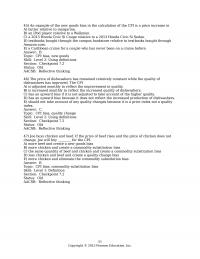
45) An example of the new goods bias in the calculation of the CPI is a price increase in A) butter relative to margarine. B) an iPod player relative to a Walkman. C) a 2013 Honda Civic Si Coupe relative […]
978-0133460629 Chapter 07 Part 7
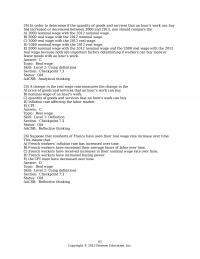
24) In order to determine if the quantity of goods and services that an hour’s work can buy has increased or decreased between 2000 and 2012, one should compare the A) 2000 nominal wage with the 2012 nominal wage. B) […]
978-0133460629 Chapter 07 Part 8
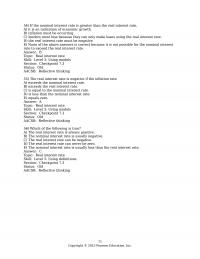
54) If the nominal interest rate is greater than the real interest rate, A) it is an indication of economic growth. B) inlation must be occurring. C) lenders must lose because they can only make loans using the real interest […]
978-0133460629 Chapter 07 Part 9
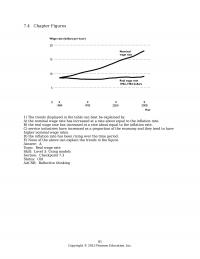
7.4 Chapter Figures 1) The trends displayed in the table can best be explained by A) the nominal wage rate has increased at a rate about equal to the inlation rate. B) the real wage rate has increased at a […]
978-0133460629 Chapter 08 Part 1
Foundations of Macroeconomics, 7e (Bade/Parkin) Chapter 8 Potential GDP and the Natural Unemployment Rate 8.1 Potential GDP 1) The Classical macroeconomic model proposes that A) government intervention is required to help the economy reach its potential. B) real GDP equals […]
978-0133460629 Chapter 08 Part 2
31) To determine GDP from the production function, we need to know A) the quantity of labor employed. B) the quantity of labor available for work. C) the unemployment rate. D) the quantity of labor supplied by irms. E) the […]
978-0133460629 Chapter 08 Part 3
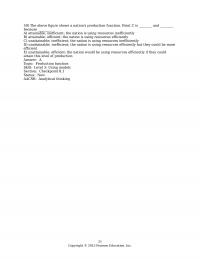
59) The above igure shows a nation‘s production function. Point C is ________ and ________ because ________. A) attainable; ineicient; the nation is using resources ineiciently B) attainable; eicient; the nation is using resources eiciently C) unattainable; ineicient; the nation […]
978-0133460629 Chapter 08 Part 4
84) For a household, the opportunity cost of not working is the A) nominal wage rate. B) real wage rate. C) cost of living. D) price level. E) demand for labor. Skill: Level 1: Deinition Section: Checkpoint 8.1 Status: Old […]
978-0133460629 Chapter 08 Part 5
112) The supply of labor curve has a ________ slope because as the real wage rate rises, ________. A) negative; irms hire fewer workers B) positive; the opportunity cost of leisure rises C) positive; the opportunity cost of leisure falls […]
978-0133460629 Chapter 08 Part 6
27) An eiciency wage is designed to ________ work efort and to ________ labor turnover. A) decrease; lower B) decrease; raise C) increase; raise D) increase; lower E) not change; decrease Skill: Level 1: Deinition Section: Checkpoint 8.2 Status: Old […]
978-0133460629 Chapter 08 Part 7
53) The two fundamental causes of unemployment at full employment are A) seasonal jobs and technological change. B) foreign competition and inancial bankruptcies. C) job search and job rationing. D) decreases in labor productivity and more generous retirement beneits. E) […]
978-0133460629 Chapter 08 Part 8
6) The smaller the extent of job rationing, the A) lower potential GDP. B) lower the unemployment rate. C) lower the labor force participation rate. D) higher the labor supply. E) higher the real wage rate. Skill: Level 3: Using […]
978-0133460629 Chapter 09 Part 1
Foundations of Macroeconomics, 7e (Bade/Parkin) Chapter 9 Economic Growth 9.1 The Basics of Economic Growth 1) Economic growth is deined as A) a decrease in the rate of inlation. B) an increase in employment. C) a sustained expansion of production […]
978-0133460629 Chapter 09 Part 2
31) During 2008, Swaziland had a real GDP growth rate of 1.8 percent and a real GDP growth rate per person of -1.3 percent. These rates indicate that in Swaziland A) there was an error when calculating the growth rates […]
978-0133460629 Chapter 09 Part 3
61) Economic growth is a sustained expansion of production possibilities measured as the increase in ________ over a given period. A) real GDP B) real GDP per person C) the standard of living D) capital per person E) population Skill: […]
978-0133460629 Chapter 09 Part 4
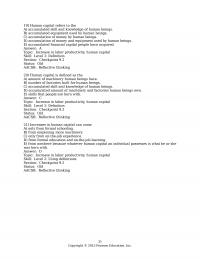
19) Human capital refers to the A) accumulated skill and knowledge of human beings. B) accumulated equipment used by human beings. C) accumulation of money by human beings. D) accumulation of money and equipment used by human beings. E) accumulated […]
978-0133460629 Chapter 09 Part 5
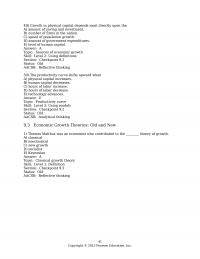
49) Growth in physical capital depends most directly upon the A) amount of saving and investment. B) number of irms in the nation. C) speed of population growth. D) amount of government expenditures. E) level of human capital. Skill: Level […]
978-0133460629 Chapter 09 Part 6
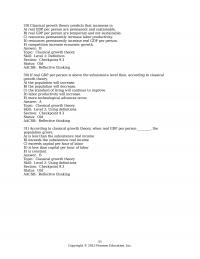
29) Classical growth theory predicts that increases in A) real GDP per person are permanent and sustainable. B) real GDP per person are temporary and not sustainable. C) resources permanently increase labor productivity. D) resources permanently increase real GDP per […]
978-0133460629 Chapter 09 Part 7
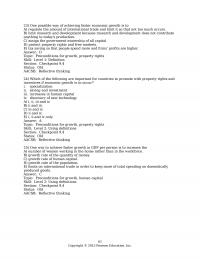
23) One possible way of achieving faster economic growth is to A) regulate the amount of international trade and limit it so that not too much occurs. B) limit research and development because research and development does not contribute anything […]
978-0133460629 Chapter 09 Part 8
2) The idea of continuous economic growth as a “perpetual motion machine” best relects the prediction of which growth theory? A) the classical growth theory B) the traditional growth theory C) the Keynesian growth theory D) the new growth theory […]
978-0133460629 Chapter 09 Part 9
8) What are the sources of human capital? Skill: Level 1: Deinition Section: Checkpoint 9.2 Status: Old AACSB: Written and oral communication 9) Explain the productivity curve and how the components interact. Answer: The productivity curve is a relationship that […]
978-0133460629 Chapter 10 Part 1
Foundations of Macroeconomics, 7e (Bade/Parkin) Chapter 10 Finance, Saving, and Investment 10.1 Financial Institutions and Markets 1) Economists use the word “capital” to mean A) the tools, instruments, and other produced goods used to produce goods and services. B) the […]
978-0133460629 Chapter 10 Part 10
13) At the beginning of the year, United Delivery had trucks valued at $1.3 million. During the year, United Delivery purchased new trucks valued at $500,000. If the value of the trucks at the end of the year was $1.5 […]
978-0133460629 Chapter 10 Part 2
31) During 2013, a country‘s total purchases of newly produced capital goods are $1,000 billion, the country issues $750 billion of stock certiicates, and there is $200 billion of depreciation. Net investment in this country equals A) $800 billion. B) […]
978-0133460629 Chapter 10 Part 3
61) Intel’s capital at the end of the year equals Intel’s capital at the beginning of the year A) minus its stock dividends. B) plus net investment. C) minus depreciation. D) plus gross investment. E) plus depreciation. Skill: Level 2: […]
978-0133460629 Chapter 10 Part 4
25) The demand for loanable funds curve slopes downward because the A) higher the real interest rate, the lower the cost of investment. B) expected rate of proit is related positively to the real interest rate. C) price of bonds […]
978-0133460629 Chapter 10 Part 5
54) If the disposable income decreases, then A) the supply of loanable funds increases. B) the supply of loanable funds decreases. C) the quantity of loanable funds demanded increases. D) the quantity of loanable funds supplied decreases. E) the demand […]
978-0133460629 Chapter 10 Part 6
83) In the loanable funds market, if the real interest rate is higher than the equilibrium real interest rate, A) there is a shortage of loanable funds. B) there is a surplus of loanable funds. C) there is a surplus […]
978-0133460629 Chapter 10 Part 7
9) If there is no Ricardo-Barro efect, a government budget surplus ________ the total supply of loanable funds and ________ the real interest rate. A) increases; raises B) increases; lowers C) decreases; raises D) decreases; lowers E) does not change; […]
978-0133460629 Chapter 10 Part 8
34) Suppose the government’s budget deicit increases by $500 billion. If there is no Ricardo-Barro efect, what occurs? A) The demand for loanable funds curve shifts rightward, the real interest rate rises, and the quantity of loanable funds increases. B) […]
978-0133460629 Chapter 10 Part 9
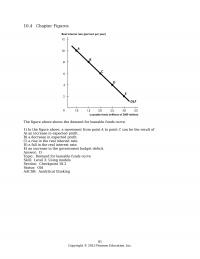
10.4 Chapter Figures The igure above shows the demand for loanable funds curve. 1) In the igure above, a movement from point A to point C can be the result of A) an increase in expected proit. B) a decrease […]
978-0133460629 Chapter 11 Part 1
Foundations of Macroeconomics, 7e (Bade/Parkin) Chapter 11 The Monetary System 11.1 What Is Money? 1) Which statement about money is most correct? A) Money is a new invention and only includes dollar bills and coins. B) Money is a new […]
978-0133460629 Chapter 11 Part 10
85) The Fed buys $25,000 of government securities. The desired reserve ratio is 20 percent and the currency drain ratio is zero. What will be the change in the quantity of money? A) $5,000 B) $20,000 C) $25,000 D) $125,000 […]
978-0133460629 Chapter 11 Part 11
115) The Citizens First Bank sells $100,000 of government securities to the Fed. This sale immediately A) decreases the quantity of money. B) decreases the bank’s checkable deposits. C) increases the bank’s reserves. D) decreases the bank’s assets. E) increases […]
978-0133460629 Chapter 11 Part 12
8) The Second National Bank of Townville has $400,000 in checking deposits, $125,000 in savings deposits, $500,000 in loans, $20,000 in its reserve account at the Fed, and $5,000 of currency in its vault. What is the amount of its […]
978-0133460629 Chapter 11 Part 13
Topic: Open market operation Skill: Level 3: Using models Section: Checkpoint 11.4 Status: Old AACSB: Analytical thinking 9) If the Fed sells $100 million of U.S. government securities, what happens to the quantity of money? Skill: Level 2: Using deinitions […]
978-0133460629 Chapter 11 Part 2
31) When money is used to compare the relative price of a burrito and a taco, money is being used as a A) medium of exchange. B) store of value. C) measurement of inlation. D) unit of account. E) token […]
978-0133460629 Chapter 11 Part 3
61) Which of the following are included in the M1 deinition of money? A) currency and checkable deposits B) currency and savings deposits C) traveler’s checks and money market mutual funds D) currency and small time deposits E) traveler’s checks […]
978-0133460629 Chapter 11 Part 4
11.2 The Banking System 1) A commercial bank is deined as A) any institution that accepts deposits. B) a irm that is chartered to accept deposits and make loans. C) the institution that sets regulations for commercial activities. D) a […]
978-0133460629 Chapter 11 Part 5
11.3 The Federal Reserve System 1) A public authority that provides banking services to commercial banks and regulates inancial institutions and markets is called a A) commercial bank. B) thrift institution. C) central bank. D) money market fund. E) mint. […]
978-0133460629 Chapter 11 Part 6
31) The required reserve ratio is 10 percent and Charlie deposits $3,000 in her checking account. The bank must A) increase reserves by $3,000. B) increase reserves by $300. C) decrease reserves by $3,000. D) decrease reserves by $300. E) […]
978-0133460629 Chapter 11 Part 7
61) The minimum percent of deposits that banks must hold and cannot loan is determined by the A) interest rate. B) discount rate. C) required reserve ratio. D) federal funds rate. E) ratio of M2 to M1. Skill: Level 2: […]
978-0133460629 Chapter 11 Part 8
25) Suppose the desired reserve ratio is 10 percent. If the Commerce Bank has total deposits of $20,000, total assets of $10,000, and actual reserves of $8000, the amount of excess reserves is A) $2,000. B) $6,000. C) $800. D) […]
978-0133460629 Chapter 11 Part 9
55) If the Fed sells government securities to a member of the nonbank public, then the resulting efect on the quantity of money is A) much larger than if the securities were sold to a bank. B) much smaller than […]
978-0133460629 Chapter 12 Part 1
Foundations of Macroeconomics, 7e (Bade/Parkin) Chapter 12 Money, Interest, and Inlation 12.1 Money and the Interest Rate 1) The quantity of money demanded is the A) average daily volume of bank account withdrawals. B) amount that people and businesses choose […]
978-0133460629 Chapter 12 Part 10
12.7 Essay: Money, the Price Level, and Inlation 1) A government policymaker suggests “Double the money supply and U.S. citizens’ real incomes will double.” In the long run, is this policy advice correct? Skill: Level 3: Using models Section: Checkpoint […]
978-0133460629 Chapter 12 Part 2
31) Which of the following increases the quantity of money demanded? A) a rise in the nominal interest rate B) a rise in the inlation rate C) a rise in the real interest rate D) a fall in the nominal […]
978-0133460629 Chapter 12 Part 3
61) During an economic expansion when real GDP increases, the A) demand for money increases. B) demand for money decreases. C) supply of money decreases. D) nominal interest rate is constant. E) real interest rate is constant. Skill: Level 2: […]
978-0133460629 Chapter 12 Part 4
90) When the nominal interest rate is ________ the equilibrium interest rate, the quantity of money demanded is less than the quantity of money supplied; when the nominal interest rate is ________ the equilibrium interest rate, the quantity of money […]
978-0133460629 Chapter 12 Part 5
12.2 Money, the Price Level, and Inlation 1) In the long-run, money market equilibrium determines A) the value of money. B) the nominal interest rate C) the real interest rate. D) real GDP. E) velocity. Skill: Level 1: Deinition Section: […]
978-0133460629 Chapter 12 Part 6
30) According to the equation of exchange, if the quantity of money is $20 billion, velocity 3, and real GDP is $6 billion, then the price level is A) 10. B) 40. C) 1.6. D) 1.1. E) 2. Skill: Level […]
978-0133460629 Chapter 12 Part 7
60) In the long run, an increase in the quantity of money ________ the value of money and ________ the price level. A) raises; raises B) does not change; raises C) raises; lowers D) lowers; raises E) lowers; lowers Skill: […]
978-0133460629 Chapter 12 Part 8
24) It is estimated that if the inlation rate is lowered from 3 percent a year to 0 percent a year, the growth rate of real GDP will rise by ________ percentage points a year. A) 0.06 to 0.09 B) […]
978-0133460629 Chapter 12 Part 9
7) What efect does an increase in the price level have on the demand for money and the demand for money curve? Skill: Level 1: Deinition Section: Checkpoint 12.1 Status: Old AACSB: Relective thinking 8) What efect does an increase […]
978-0133460629 Chapter 13 Part 1
Foundations of Macroeconomics, 7e (Bade/Parkin) Chapter 13 Aggregate Supply and Aggregate Demand 13.1 Aggregate Supply 1) Over the business cycle, factors such as the quantity of capital, human capital and technology A) grow but do not luctuate as much as […]
978-0133460629 Chapter 13 Part 10
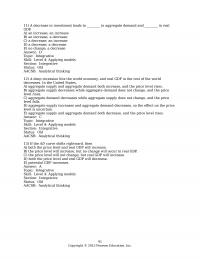
11) A decrease in investment leads to ________ in aggregate demand and ________ in real GDP. A) an increase; an increase B) an increase; a decrease C) a decrease; an increase D) a decrease; a decrease E) no change; a […]
978-0133460629 Chapter 13 Part 11
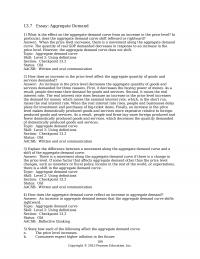
13.7 Essay: Aggregate Demand 1) What is the efect on the aggregate demand curve from an increase in the price level? In particular, does the aggregate demand curve shift leftward or rightward? Skill: Level 2: Using deinitions Section: Checkpoint 13.2 […]
978-0133460629 Chapter 13 Part 2
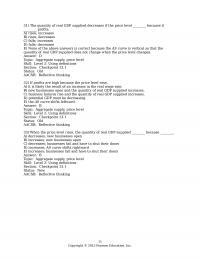
31) The quantity of real GDP supplied decreases if the price level ________ because it ________ proits. A) rises; increases B) rises; decreases C) falls; increases D) falls; decreases E) None of the above answers is correct because the AS […]
978-0133460629 Chapter 13 Part 3
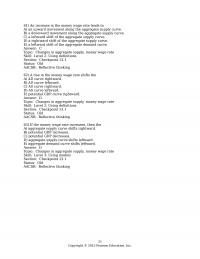
61) An increase in the money wage rate leads to A) an upward movement along the aggregate supply curve. B) a downward movement along the aggregate supply curve. C) a leftward shift of the aggregate supply curve. D) a rightward […]
978-0133460629 Chapter 13 Part 4
5) Which of the following produces a movement along the aggregate demand curve and does not shift the aggregate demand curve? A) a change in foreign incomes B) a change in the price level C) a change in monetary policy […]
978-0133460629 Chapter 13 Part 5
35) Aggregate demand ________ and shifts the AD curve ________ when ________. A) increases; rightward; government expenditure increases B) increases; rightward; taxes increase C) increases; rightward; future expected proit decreases D) decreases; leftward; foreign income increases E) increases; leftward; government […]
978-0133460629 Chapter 13 Part 6
63) When the price level rises, the real interest rate ________ and the quantity of real GDP demanded ________. A) rises; increases B) rises; decreases C) falls; increases D) falls; decreases E) does not change; does not change Skill: Level […]
978-0133460629 Chapter 13 Part 7
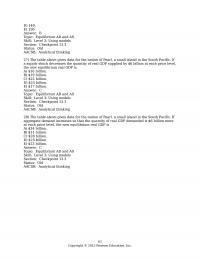
D) 140. E) 150. Answer: B Topic: Equilibrium AD and AS Skill: Level 3: Using models Section: Checkpoint 13.3 Status: Old AACSB: Analytical thinking 27) The table above gives data for the nation of Pearl, a small island in the […]
978-0133460629 Chapter 13 Part 8
54) To prevent demand-pull inlation, A) irms must refuse to increase the money wage rate. B) irms must refuse to increase the real wage rate. C) the Fed must not let the quantity of money persistently rise. D) the natural […]
978-0133460629 Chapter 13 Part 9
84) Staglation is a combination of ________ real GDP and a ________ price level. A) increasing; rising B) increasing; falling C) decreasing; rising D) decreasing; falling E) no change in; rising Skill: Level 1: Deinition Section: Checkpoint 13.3 Status: Old […]
978-0133460629 Chapter 14 Part 1
Foundations of Macroeconomics, 7e (Bade/Parkin) Chapter 14 Aggregate Expenditure Multiplier 14.1 Expenditure Plans and Real GDP 1) Which of the following variables is ixed in the aggregate expenditure model? A) price level B) consumption C) output D) investment E) real […]
978-0133460629 Chapter 14 Part 10
4) Investment decreases by $300 billion, government expenditure is unchanged, and exports increase by $500 billion. As a result, autonomous expenditure ________, the total expenditure ________, and equilibrium real GDP ________. A) decreases by $300 billion; decreases; decreases by more […]
978-0133460629 Chapter 14 Part 11
13) How do irms respond to unplanned inventory changes? What is the efect on their production and GDP? Skill: Level 3: Using models Section: Checkpoint 14.2 Status: Old AACSB: Written and oral communication 14) A country reports that it has […]
978-0133460629 Chapter 14 Part 12
Skill: Level 2: Using deinitions Section: Checkpoint 14.3 Status: Old AACSB: Relective thinking 6) Discuss how the marginal propensity to consume, imports, and marginal tax rates inluence the expenditure multiplier. Skill: Level 2: Using deinitions Section: Checkpoint 14.3 Status: Old […]
978-0133460629 Chapter 14 Part 2
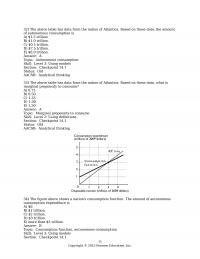
32) The above table has data from the nation of Atlantica. Based on these data, the amount of autonomous consumption is A) $1.5 trillion. B) $1.0 trillion. C) $0.5 trillion. D) $7.5 trillion. E) $6.0 trillion. Skill: Level 3: Using […]
978-0133460629 Chapter 14 Part 3
58) When the real interest rate rises, there is A) an upward movement along the consumption function. B) a downward movement along the consumption function. C) an upward shift of the consumption function. D) a downward shift of the consumption […]
978-0133460629 Chapter 14 Part 4
12) Which of the following is NOT included in aggregate expenditure? A) consumption expenditure B) investment C) government expenditure D) taxes E) net exports Skill: Level 1: Deinition Section: Checkpoint 14.2 Status: Old AACSB: Relective thinking 13) The aggregate expenditure […]
978-0133460629 Chapter 14 Part 5
41) If aggregate planned expenditures are less than real GDP, then A) inventories increase above their planned levels and businesses decrease their production. B) inventories decrease below their planned levels and businesses increase their production. C) there is no equilibrium […]
978-0133460629 Chapter 14 Part 6
69) The above table gives data for the nation of South Hampton. There are no imports into or exports from South Hampton. The equilibrium level of real GDP is A) $500 billion. B) $600 billion. C) $700 billion. D) $800 […]
978-0133460629 Chapter 14 Part 7
8) When investment increases, the multiplier points out that A) consumption decreases by a greater amount. B) real GDP increases by a greater amount. C) consumption increases by the same amount. D) real GDP decreases by a greater amount. E) […]
978-0133460629 Chapter 14 Part 8
Topic: Multiplier Skill: Level 2: Using deinitions Section: Checkpoint 14.3 Status: Old AACSB: Analytical thinking 38) Which of the following reduces the magnitude of the expenditure multiplier? A) higher marginal tax rates B) decrease in imports C) decrease in saving […]
978-0133460629 Chapter 14 Part 9
14.4 The AD Curve and Equilibrium Expenditure 1) When the price level ________, equilibrium expenditure ________ and the quantity of real GDP demanded ________. A) falls; increases; increases B) rises; increases; decreases C) falls; increases; decreases D) rises; decreases; increases […]
978-0133460629 Chapter 15 Part 1
Foundations of Macroeconomics, 7e (Bade/Parkin) Chapter 15 The Short-Run Policy Tradeof 15.1 The Short-Run Phillips Curve 1) If the economy is at full employment, then the unemployment rate A) is greater than the natural unemployment rate. B) is equal to […]
978-0133460629 Chapter 15 Part 2
30) According to ________, when real GDP is ________ percentage points greater than potential GDP, the unemployment rate is one percentage point ________ the natural unemployment rate. A) Keynes’ Law; two; below B) Okun’s Law; two; below C) Phillip’s Law; […]
978-0133460629 Chapter 15 Part 3
60) If real GDP exceeds potential GDP, then employment is ________ full employment, and the unemployment rate is ________ the natural unemployment rate. A) below; above B) equal to; below C) above; below D) above; above E) equal to; equal […]
978-0133460629 Chapter 15 Part 4
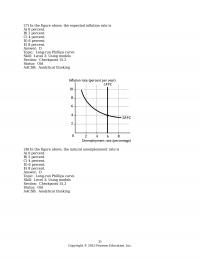
27) In the igure above, the expected inlation rate is A) 0 percent. B) 2 percent. C) 4 percent. D) 6 percent. E) 8 percent. Skill: Level 3: Using models Section: Checkpoint 15.2 Status: Old AACSB: Analytical thinking 28) In […]
978-0133460629 Chapter 15 Part 5
55) When the natural unemployment rate ________, the short-run Phillips curve shifts ________ and the long-run Phillips curve shifts ________. A) increases; leftward; leftward B) decreases; rightward; rightward C) decreases; leftward; rightward D) increases; rightward; rightward E) increases; rightward; leftward […]
978-0133460629 Chapter 15 Part 6
14) If the Fed tries to lower the unemployment rate so it is lower than the natural unemployment rate, in the short run before the expected inlation rate changes, the SRPC ________ and the LRPC ________. A) does not change; […]
978-0133460629 Chapter 15 Part 7
2) “The short-run Phillips curve shows the tradeof between real GDP and inlation.” Is the previous statement correct or incorrect? Briely explain you answer. Skill: Level 1: Deinition Section: Checkpoint 15.1 Status: Old AACSB: Relective thinking 3) “The short-run Phillips […]
978-0133460629 Chapter 15 Part 8
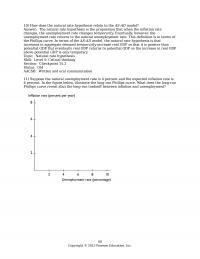
10) How does the natural rate hypothesis relate to the AS-AD model? Skill: Level 5: Critical thinking Section: Checkpoint 15.2 Status: Old AACSB: Written and oral communication 11) Suppose the natural unemployment rate is 4 percent and the expected inlation […]
978-0133460629 Chapter 16 Part 1
Foundations of Macroeconomics, 7e (Bade/Parkin) Chapter 16 Fiscal Policy 16.1 The Federal Budget 1) The federal budget is deined as A) a monthly statement of expenditure laws passed by the U.S. government. B) a monthly statement of whether the U.S. […]
978-0133460629 Chapter 16 Part 2
28) If tax revenues are $230 billion and the government’s outlays are $235 billion, then the budget A) deicit is $5 billion and government debt will remain the same. B) surplus is $5 billion and government debt will increase by […]
978-0133460629 Chapter 16 Part 3
21) Automatic stabilizers decrease the impact of a recession on the level of economic activity because they A) reduce the interest rate and so allow irms to increase their level of investment. B) increase taxes so the budget is always […]
978-0133460629 Chapter 16 Part 4
51) The balanced budget multiplier is based on the point that the ________ multiplier is larger than the ________ multiplier so that an equal increase in government expenditure and taxes ________ aggregate demand. A) tax; expenditure; does not change B) […]
978-0133460629 Chapter 16 Part 5
2) An increase in government expenditure can ________ potential GDP and an increase in taxes can ________ potential GDP. A) increase; increase B) increase; never change C) decrease; decrease D) never change; never change E) increase; decrease Skill: Level 1: […]
978-0133460629 Chapter 16 Part 6
32) If iscal stimulus creates a large budget ________, then in the long run economic growth ________. A) surplus; increases B) surplus; decreases C) deicit; increases D) deicit; decreases E) None of the above answers is correct. Skill: Level 2: […]
978-0133460629 Chapter 16 Part 7
9) A decrease in taxes should be applied in a situation with A) a recessionary gap. B) a inlationary gap. C) low unemployment. D) high demand for goods and services. E) no tax multiplier. Skill: Level 4: Applying models Section: […]
978-0133460629 Chapter 16 Part 8
6) Explain how tax revenue can be both an automatic iscal policy and a discretionary iscal policy. Skill: Level 3: Using models Section: Checkpoint 16.2 Status: Old AACSB: Written and oral communication 7) “Discretionary iscal policy is a iscal action […]
978-0133460629 Chapter 17 Part 1
Foundations of Macroeconomics, 7e (Bade/Parkin) Chapter 17 Monetary Policy 17.1 How the Fed Conducts Monetary Policy 1) The main goals of monetary policy include all of the following EXCEPT A) keeping the long term nominal interest rate equal to the […]
978-0133460629 Chapter 17 Part 2
30) To change the federal funds rate, the Fed A) tells banks how much to charge. B) coordinates with banks on establishing the new rate. C) increases or removes money from the stock market. D) uses open market operations to […]
978-0133460629 Chapter 17 Part 3
19) The Fed ________ inluence the real interest rate in the short run and ________ inluence the real interest rate in the long run. A) can; can B) can; cannot C) cannot; can D) cannot; cannot E) might be able […]
978-0133460629 Chapter 17 Part 4
49) When the exchange rate falls, imports ________ and exports ________. A) increase; increase B) increase; decrease C) decrease; increase D) decrease; decrease E) decrease; do not change Skill: Level 3: Using models Section: Checkpoint 17.2 Status: Old AACSB: Relective […]
978-0133460629 Chapter 17 Part 5
77) When the Fed fears inlation, the Fed ________ government securities, so that the federal funds rate ________ and the quantity of money ________. A) sells; falls; decreases B) sells; rises; decreases C) sells; falls; increases D) buys; falls; increases […]
978-0133460629 Chapter 17 Part 6
13) Which of the following are TRUE regarding Milton Friedman’s k-percent money targeting rule? i. Currently this policy is used by many policy makers. ii. This rule sets the growth rate of the quantity of money independently of the economy‘s […]
978-0133460629 Chapter 17 Part 7
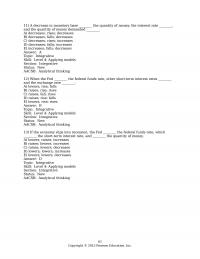
11) A decrease in monetary base ________ the quantity of money, the interest rate ________, and the quantity of money demanded ________. A) decreases; rises; decreases B) decreases; falls; decreases C) decreases; rises; increases D) decreases; falls; increases E) increases; […]
978-0133460629 Chapter 18 Part 1
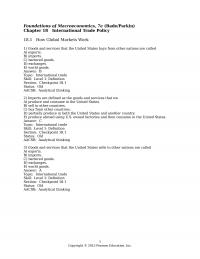
Foundations of Macroeconomics, 7e (Bade/Parkin) Chapter 18 International Trade Policy 18.1 How Global Markets Work 1) Goods and services that the United States buys from other nations are called A) exports. B) imports. C) bartered goods. D) exchanges. E) world […]
978-0133460629 Chapter 18 Part 2
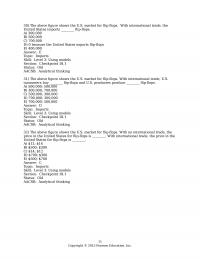
30) The above igure shows the U.S. market for lip-lops. With international trade, the United States imports ________ lip-lops. A) 300,000 B) 500,000 C) 700,000 D) 0 because the United States exports lip-lops E) 400,000 Skill: Level 3: Using models […]
978-0133460629 Chapter 18 Part 3
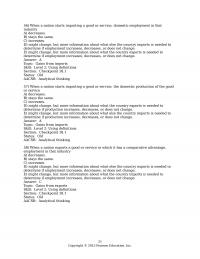
56) When a nation starts importing a good or service, domestic employment in that industry A) decreases. B) stays the same. C) increases. D) might change, but more information about what else the country imports is needed to determine if […]
978-0133460629 Chapter 18 Part 4
18) If the United States imposes a tarif on foreign chocolate, how are U.S. buyers of chocolate afected? A) The price they pay for chocolate rises. B) Their demand for chocolate increases because the U.S. production chocolate increases. C) The […]
978-0133460629 Chapter 18 Part 5
Answer: A Topic: Quota Skill: Level 1: Deinition Section: Checkpoint 18.2 Status: Old AACSB: Analytical thinking 48) When governments specify the maximum amount of a good that may be imported in a given period of time, they are establishing a […]
978-0133460629 Chapter 18 Part 6
8) What is the dumping argument for protection from international trade? A) Domestic irms must be protected until they gain a comparative advantage. B) Any irm necessary in wartime must be protected. C) Foreign producers selling below cost to drive […]
978-0133460629 Chapter 18 Part 7
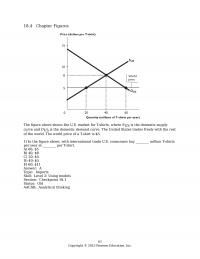
18.4 Chapter Figures The igure above shows the U.S. market for T-shirts, where SUS is the domestic supply curve and DUS is the domestic demand curve. The United States trades freely with the rest of the world. The world price […]
978-0133460629 Chapter 18 Part 8
14) The price that U.S. consumers pay for goods imported from Mexico has fallen and the quantity of U.S. imports from Mexico has ________. Because of these changes, the winners are U.S. ________ of goods imported from Mexico and the […]
978-0133460629 Chapter 18 Part 9
decreases. Topic: Efects of tarifs Skill: Level 2: Using deinitions Section: Checkpoint 18.2 Status: Old AACSB: Analytical thinking 4) The United States imposes a tarif on foreign limes. How does the tarif afect the U.S. price of a lime and […]
978-0133460629 Chapter 19 Part 1
Foundations of Macroeconomics, 7e (Bade/Parkin) Chapter 19 International Finance 19.1 Financing International Trade 1) The record of international receipts and payments is called the A) balance of payments. B) current account. C) oicial settlements account. D) capital and inancial account. […]
978-0133460629 Chapter 19 Part 10
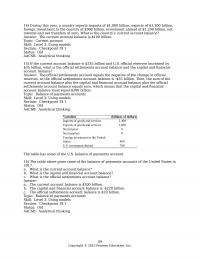
14) During this year, a country reports imports of $1,000 billion, exports of $1,100 billion, foreign investment in the country of $900 billion, investment abroad of $1,200 billion, net interest and net transfers of zero. What is the country’s current […]
978-0133460629 Chapter 19 Part 2
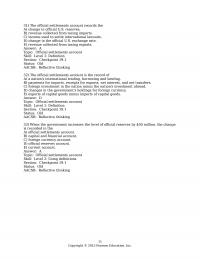
31) The oicial settlements account records the A) change in oicial U.S. reserves. B) revenue collected from taxing imports. C) income used to settle international lawsuits. D) change in the oicial U.S. exchange rate. E) revenue collected from taxing exports. […]
978-0133460629 Chapter 19 Part 3
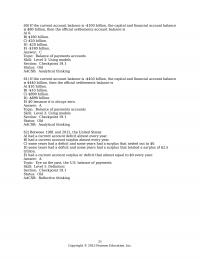
60) If the current account balance is -$100 billion, the capital and inancial account balance is $80 billion, then the oicial settlements account balance is A) 0. B) $180 billion. C) $20 billion. D) -$20 billion. E) -$180 billion. Skill: […]
978-0133460629 Chapter 19 Part 4
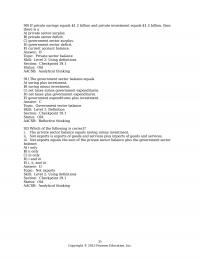
90) If private savings equals $1.2 billion and private investment equals $1.5 billion, then there is a A) private sector surplus. B) private sector deicit. C) government sector surplus. D) government sector deicit. E) current account balance. Skill: Level 2: […]
978-0133460629 Chapter 19 Part 5
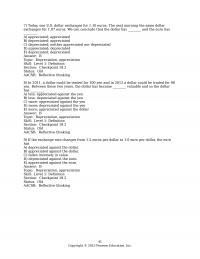
7) Today, one U.S. dollar exchanges for 1.10 euros. The next morning the same dollar exchanges for 1.07 euros. We can conclude that the dollar has ________ and the euro has ________. A) appreciated; appreciated B) depreciated; appreciated C) depreciated; […]
978-0133460629 Chapter 19 Part 6
37) The U.S. interest rate has ________ on the supply of dollars and has ________ on the demand for dollars. A) no efect; no efect B) no efect; an efect C) an efect; no efect D) an efect; an efect […]
978-0133460629 Chapter 19 Part 7
67) If the U.S. interest rate diferential falls, then the exchange rate A) deinitely rises. B) deinitely falls. C) does not change. D) falls only if it was the U.S. interest rate that changed. E) rises only if it was […]
978-0133460629 Chapter 19 Part 8
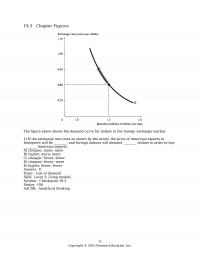
19.3 Chapter Figures The igure above shows the demand curve for dollars in the foreign exchange market. 1) If the exchange rate rises as shown by the arrow, the price of American exports to foreigners will be ________, and foreign […]
978-0133460629 Chapter 19 Part 9
4) If the exchange rate depreciates, then the A) quantity of dollars demanded decreases. B) quantity of dollars demanded increases. C) demand for dollars decreases. D) demand for dollars increases. E) supply of dollars decreases. Skill: Level 3: Using models […]