95) When the demand for a good decreases, its equilibrium price ________ and equilibrium
quantity ________.
A) falls; decreases
B) falls; increases
C) rises; decreases
D) rises; increases
E) falls; does not change
Skill: Level 3: Using models
Section: Checkpoint 4.3
Status: Old
AACSB: Analytical thinking
96) A technological improvement lowers the cost of producing corn. As a result, the price of
a pound of corn ________ and the quantity of corn ________.
A) rises; increases
B) rises; decreases
C) falls; increases
D) falls; decreases
E) falls; does not change
Skill: Level 3: Using models
Section: Checkpoint 4.3
Status: Old
AACSB: Analytical thinking
97) The technology associated with manufacturing computers has advanced enormously.
This change has led to the price of a computer ________ and the quantity ________.
A) rising; increasing
B) rising; decreasing
C) falling; increasing
D) falling; decreasing
E) falling; not changing
Skill: Level 3: Using models
Section: Checkpoint 4.3
Status: Old
AACSB: Analytical thinking
101
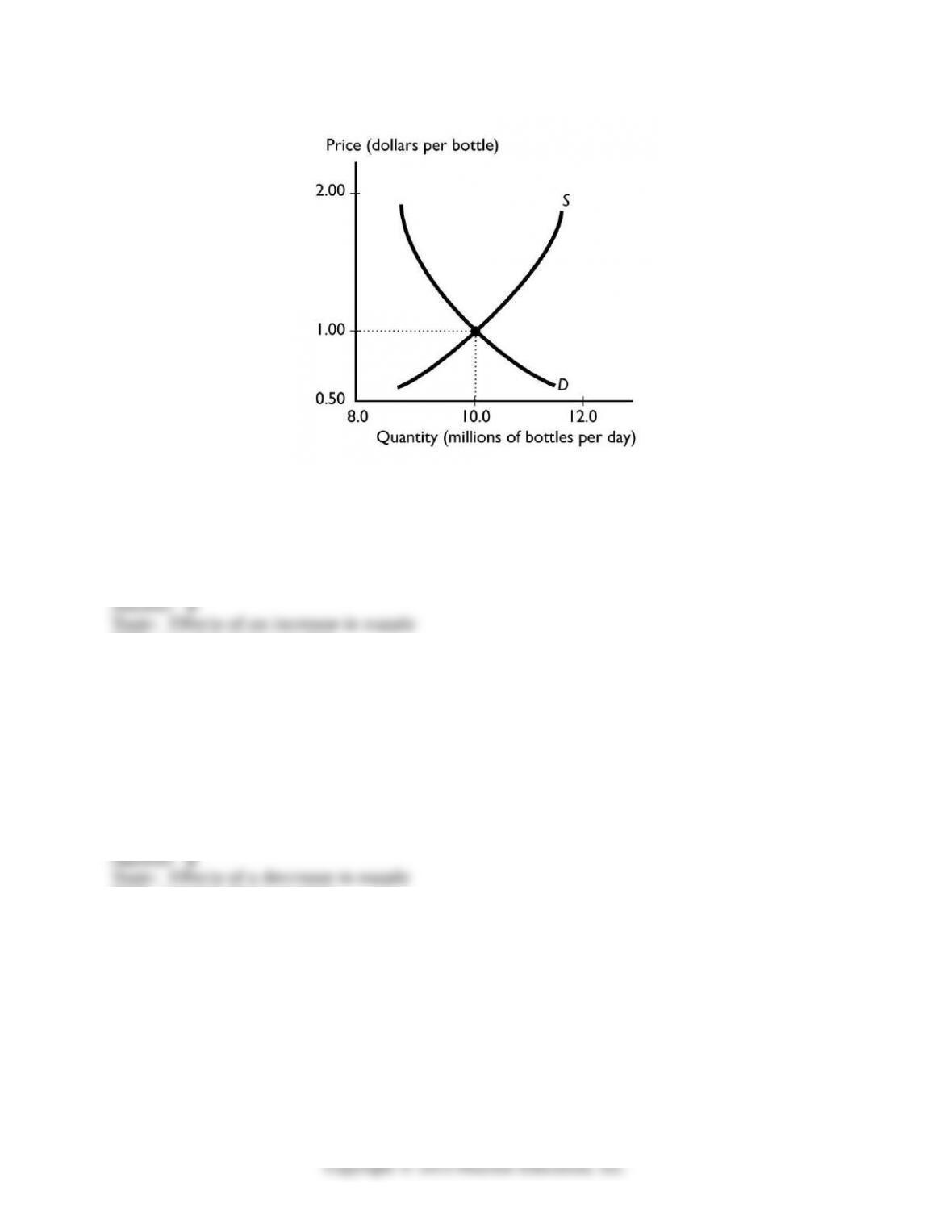
98) The graph illustrates the market for bottled water. If the producers of bottled water
switch to using improved technology, then the
A) supply of bottled water decreases.
B) quantity demanded of bottled water increases.
C) quantity demanded of bottled water does not change.
D) price of bottled water rises.
E) supply curve shifts leftward.
Skill: Level 3: Using models
Section: Checkpoint 4.3
Status: Old
AACSB: Analytical thinking
99) Suppose that the price of lettuce used to produce tacos increases. This change means
that the equilibrium price of a taco ________ and the equilibrium quantity ________.
A) rises; increases
B) rises; decreases
C) falls; increases
D) falls; decreases
E) does not change; decreases
Skill: Level 3: Using models
Section: Checkpoint 4.3
Status: Old
AACSB: Analytical thinking
102
100) Suppose a medical study reveals new beneits to consuming beef and at the same time
a bumper corn crop reduces the cost of feeding steers. The equilibrium quantity of beef will
A) decrease.
B) perhaps increase, decrease, or stay the same, but more information is needed to
determine which it does.
C) stay the same.
D) increase.
E) deinitely either stay the same or decrease.
Skill: Level 3: Using models
Section: Checkpoint 4.3
Status: Old
AACSB: Analytical thinking
101) Candy makers accurately anticipate the increase in demand for candy for Halloween
so that the supply of candy and demand for candy increase the same amount. As a result,
the price of candy ________ and the quantity of candy ________.
A) rises; does not change
B) falls; increases
C) does not change; increases
D) does not change; does not change
E) rises; increases
Skill: Level 3: Using models
Section: Checkpoint 4.3
Status: Old
AACSB: Analytical thinking
103
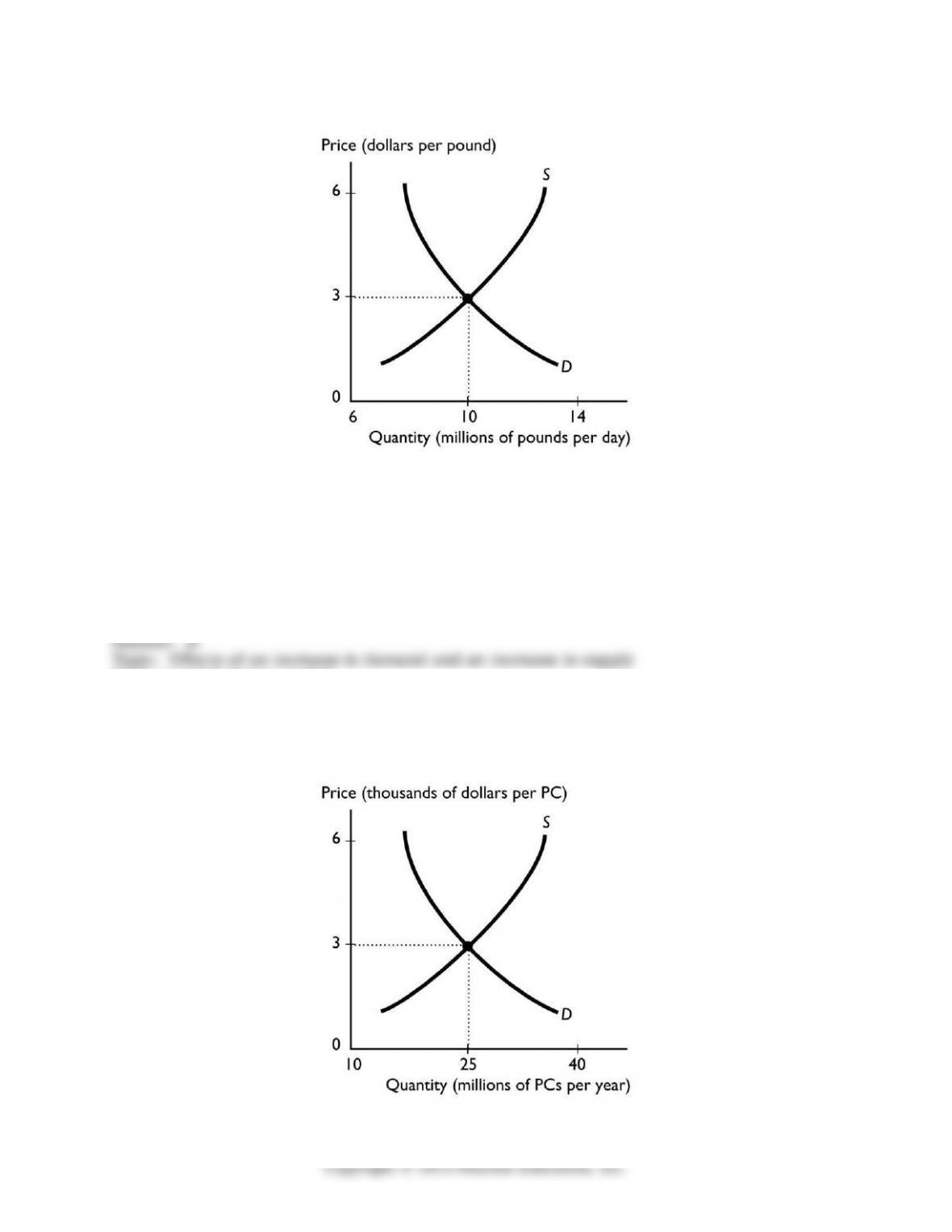
102) The graph illustrates the market for British pounds, the currency of the United
Kingdom. As the number of buyers of pounds increases and the number of sellers of pounds
increases, the equilibrium price of a pound
A) will rise.
B) will fall
C) will remain the same.
D) might rise, fall, or remain the same depending on whether the efect on buyers is larger
than, less than, or the same as the efect on sellers.
E) None of the above answers is correct.
Skill: Level 3: Using models
Section: Checkpoint 4.3
Status: Old
AACSB: Analytical thinking
103) The graph illustrates the market for computers. If the number of buyers of computers
104
increases and technology advances, you predict that the
A) equilibrium quantity of computers will increase.
B) equilibrium quantity of computers will decrease.
C) equilibrium price of a computer will rise.
D) equilibrium price of a computer will fall.
E) equilibrium quantity of computers might increase, decrease, or not change.
Skill: Level 3: Using models
Section: Checkpoint 4.3
Status: Old
AACSB: Analytical thinking
104) Which of the following deinitely results in a product’s equilibrium price rising?
A) an increase in both demand and supply
B) a decrease in both demand and supply
C) an increase in demand combined with a decrease in supply
D) a decrease in demand combined with an increase in supply
E) an increase in the supply combined with no change in the demand
Skill: Level 3: Using models
Section: Checkpoint 4.3
Status: Old
AACSB: Analytical thinking
105
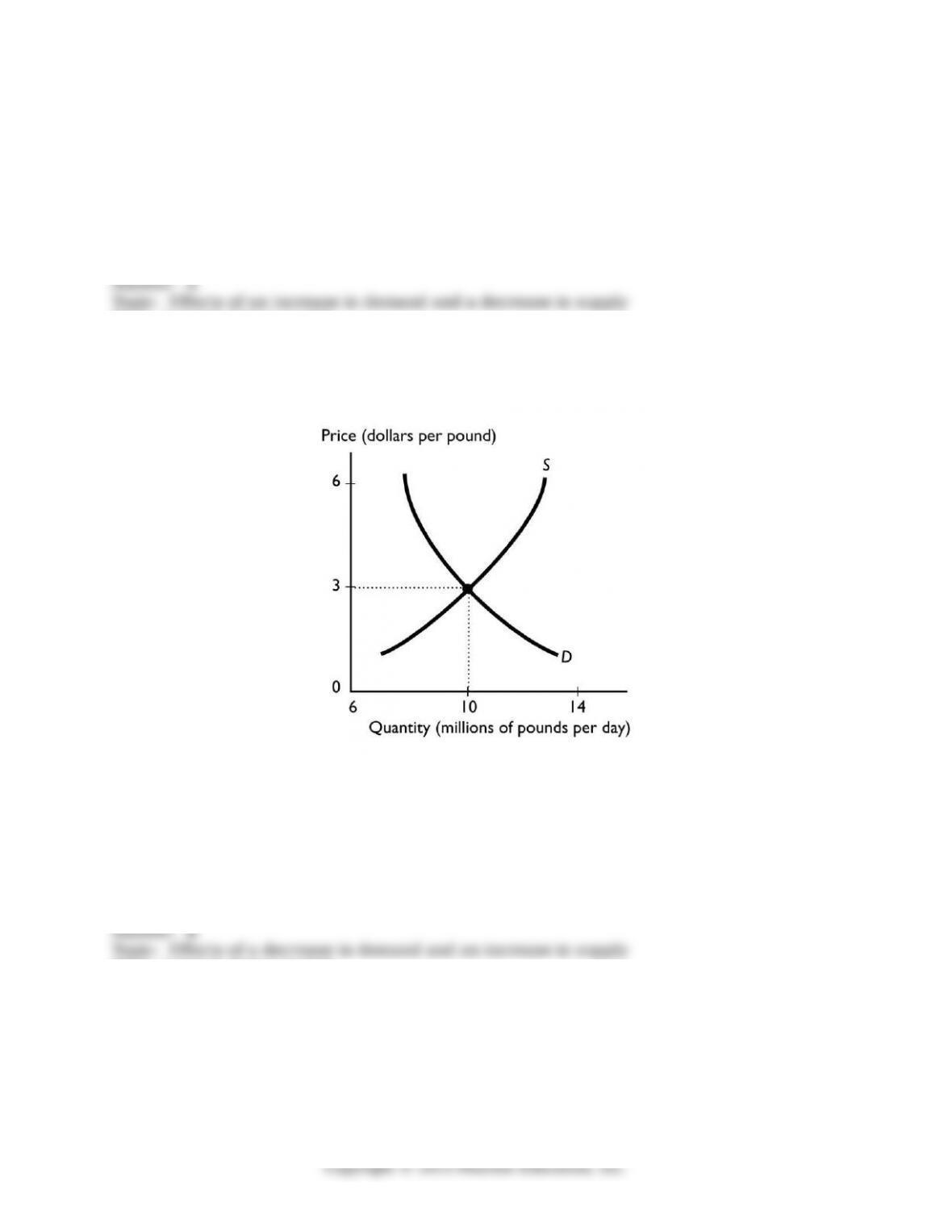
105) During 2008 the supply of gasoline decreased while at the same time the demand for
gasoline increased. If the magnitude of the increase in demand was greater than the
magnitude of the decrease in supply, then the equilibrium price of gasoline ________ and the
equilibrium quantity ________.
A) increased; increased
B) increased; decreased
C) increased; did not change
D) decreased; did not change
E) did not change; increased
Skill: Level 3: Using models
Section: Checkpoint 4.3
Status: Old
AACSB: Analytical thinking
106) The graph illustrates the market for British pounds, the currency of the United
Kingdom. As the number of buyers of pounds decreases and the number of sellers of
pounds increases, the equilibrium price of a pound
A) will rise.
B) will fall
C) will remain the same.
D) might rise, fall, or remain the same but more information is needed.
E) will rise if the magnitude of the efect on the buyers is larger than the magnitude of the
efect on the sellers.
Skill: Level 3: Using models
Section: Checkpoint 4.3
Status: Old
AACSB: Analytical thinking
4.4 Integrative Questions
1) Consider the market for bread. If the price of wheat rises, then the
A) demand curve for bread shifts leftward.
106

B) supply curve of bread shifts leftward.
C) price of bread falls.
D) equilibrium quantity of bread increases.
E) demand curve for bread shifts rightward.
Skill: Level 3: Using models
Section: Integrative
Status: Old
AACSB: Relective thinking
2) Consider the market for turkeys. In the United States, because of Thanksgiving in the
month of November,
A) there is a downward movement along the demand curve for turkeys.
B) there is an upward movement along the supply curve for turkeys.
C) the supply curve of turkeys shifts leftward.
D) the demand curve for turkeys shifts leftward.
E) neither the demand curve nor the supply curve shift; instead there is a movement along
both curves.
Skill: Level 3: Using models
Section: Integrative
Status: Old
AACSB: Relective thinking
3) Consider the market for feather pillows. If there is an increase in the price of feather
dusters, a substitute in production for feather pillows, then
A) the price of feather pillows decreases.
B) the demand curve for feather pillows shifts leftward.
C) the supply curve for feather pillows shifts leftward.
D) there is a downward movement along the demand curve for feather pillows.
E) the demand curve for feather pillows shifts rightward.
Skill: Level 3: Using models
Section: Integrative
Status: Old
AACSB: Relective thinking
107

4) Consider the market for peanut butter. If there is an increase in the price of peanuts,
A) there is an upward movement along the supply curve for peanut butter.
B) the supply curve for peanuts shifts rightward.
C) there is a decrease in the supply of peanuts.
D) there is a decrease in the supply of peanut butter.
E) there is a decrease in the demand for peanut butter.
Skill: Level 3: Using models
Section: Integrative
Status: Old
AACSB: Relective thinking
5) Peanut butter and jelly are complements for many consumers. Consider the market for
peanut butter. If there is an increase in the price of jelly,
A) there is a movement along the supply curve of peanut butter.
B) the price of peanut butter rises.
C) the quantity of peanut butter increases.
D) there is a shift in the supply curve for jelly.
E) the demand curve for peanut butter does not shift; instead there is a movement along it.
Skill: Level 3: Using models
Section: Integrative
Status: Old
AACSB: Relective thinking
6) Consider the market for wheat. If there is an improvement in harvesting technology,
A) the supply curve for wheat shifts rightward.
B) the demand curve for wheat shifts rightward.
C) there is a movement up along the demand curve.
D) the equilibrium price rises.
E) the demand curve for wheat shifts leftward.
Skill: Level 3: Using models
Section: Integrative
Status: Old
AACSB: Relective thinking
108
7) Consider the market for camera ilm. If more people start using digital cameras, which
do not require ilm,
A) the supply curve of ilm shifts rightward.
B) the demand curve for ilm shifts leftward.
C) there is a movement up along the demand curve for ilm.
D) there is a movement down along the demand curve for ilm.
E) neither the demand curve nor the supply curve for ilm shifts; instead there is a
movement along both.
Skill: Level 3: Using models
Section: Integrative
Status: Old
AACSB: Relective thinking
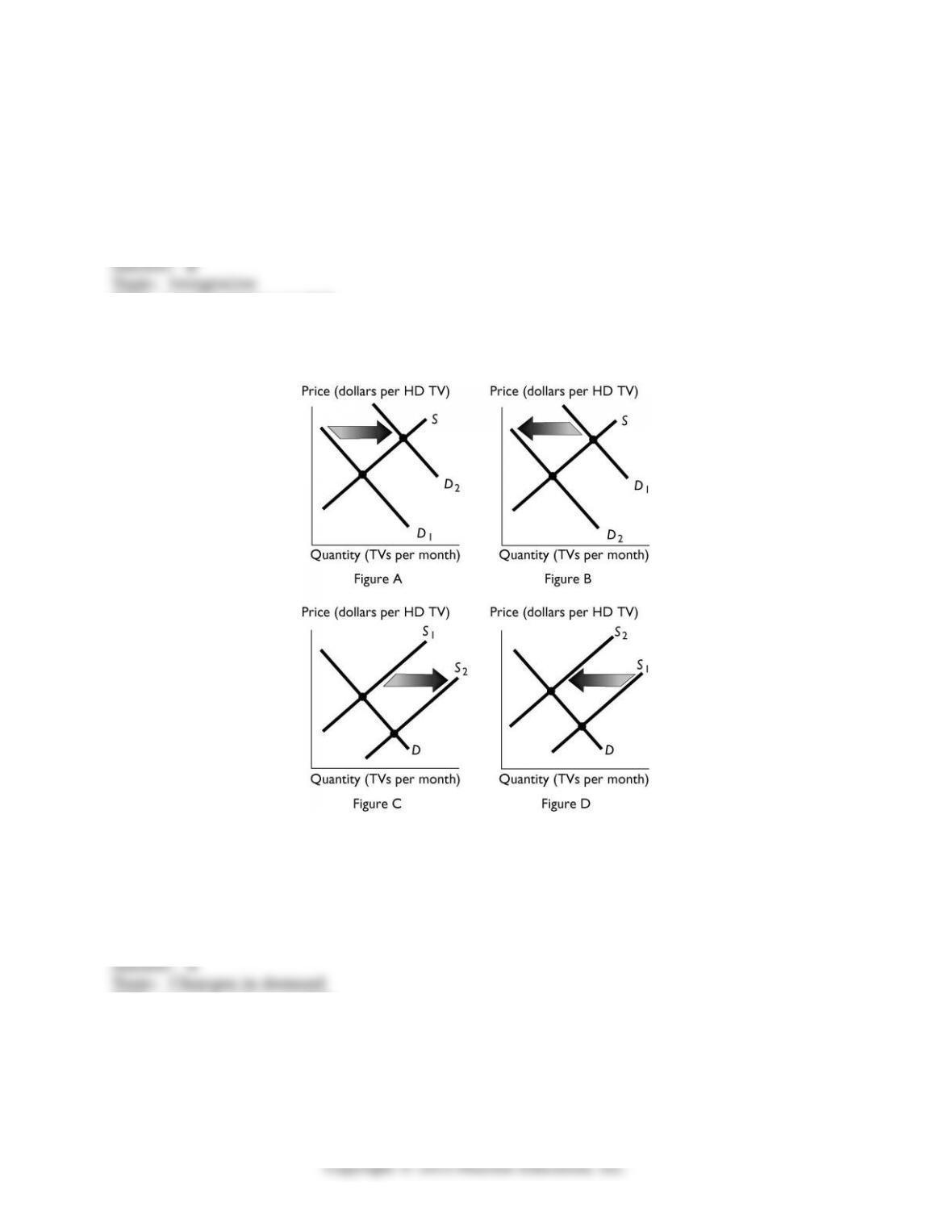
8) The above igures show the market for HD televisions. If people’s incomes increase and
HD televisions are a normal good, which igure shows the efect of this change?
A) Figure A
B) Figure B
C) Figure C
D) Figure D
E) None of the igures represent this change.
Skill: Level 3: Using models
Section: Integrative
Status: Old
AACSB: Analytical thinking
9) The above igures show the market for HD televisions. Blu-ray players can be used to
play HD movies. If the price of Blu-ray players falls, then which igure shows the efect of
this change in the market for HD televisions?
109
A) Figure A
B) Figure B
C) Figure C
D) Figure D
E) None of the igures represent this change.
Skill: Level 3: Using models
Section: Integrative
Status: Old
AACSB: Analytical thinking
10) The above igures show the market for HD televisions. If research is published showing
that watching HD television shows causes eye damage, then which igure shows the efect
of this change?
A) Figure A
B) Figure B
C) Figure C
D) Figure D
E) None of the igures represent this change.
Skill: Level 3: Using models
Section: Integrative
Status: Old
AACSB: Analytical thinking
11) The above igures show the market for HD televisions. If cable television providers
lower the price of providing HD cable service, which igure shows the efect of this change?
A) Figure A
B) Figure B
C) Figure C
D) Figure D
E) None of the igures represent this change.
Skill: Level 3: Using models
Section: Integrative
Status: Old
AACSB: Analytical thinking
110