68) An increase in the number of producers of bird seed ________ the supply of bird seed
and shifts the supply curve of bird seed ________.
A) increases; rightward
B) increases; leftward
C) decreases; rightward
D) decreases; leftward
E) does not change; rightward
Skill: Level 2: Using deinitions
Section: Checkpoint 4.2
Status: Old
AACSB: Analytical thinking
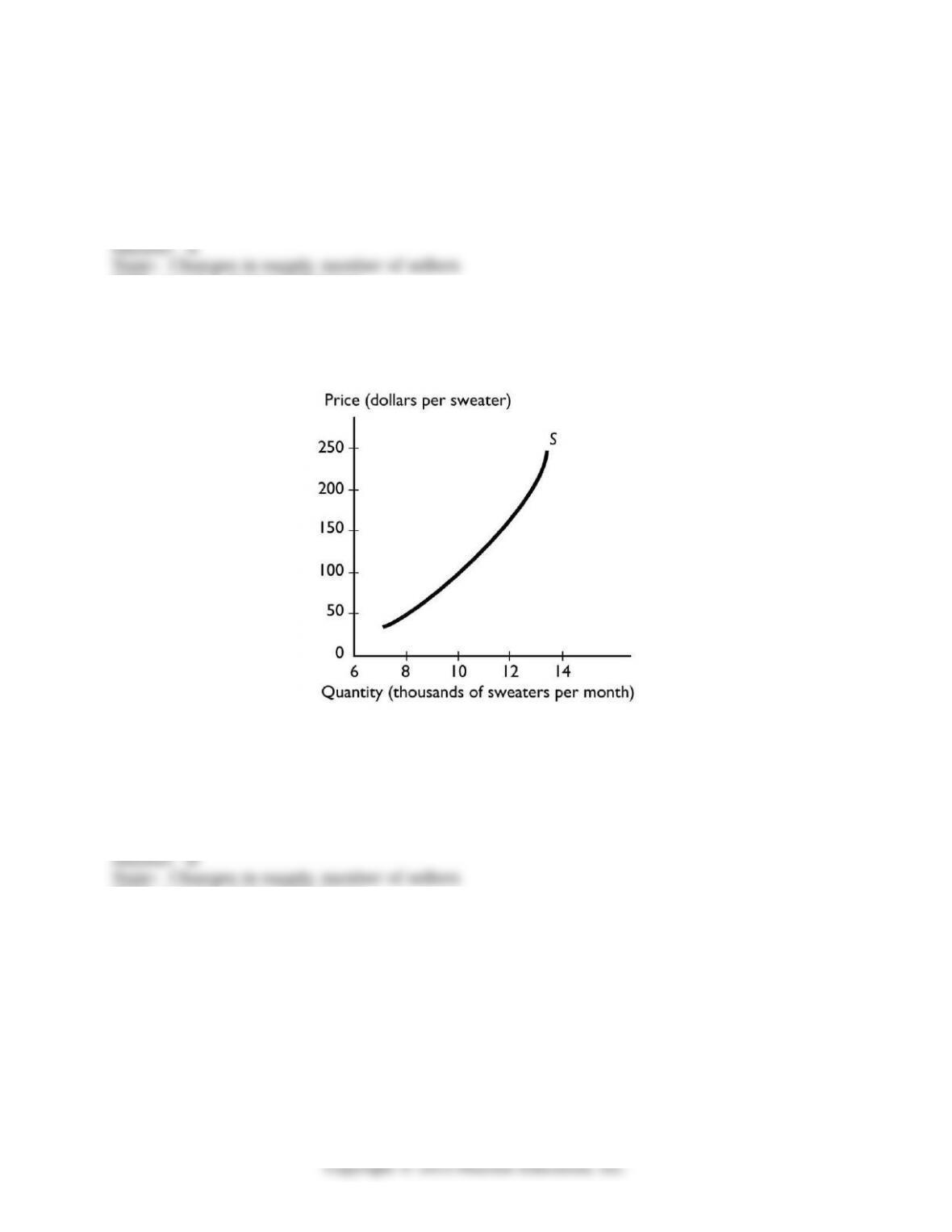
69) The graph illustrates the supply of sweaters. Which of the following events will increase
the supply of sweaters?
A) a rise in the price of a sweater
B) a rise in the wage rate paid to the workers who make sweaters
C) a rise in the expected future price of a sweater
D) an increase in the number of sellers of sweaters
E) an increase in income if sweaters are a normal good
Skill: Level 2: Using deinitions
Section: Checkpoint 4.2
Status: Old
AACSB: Analytical thinking
61
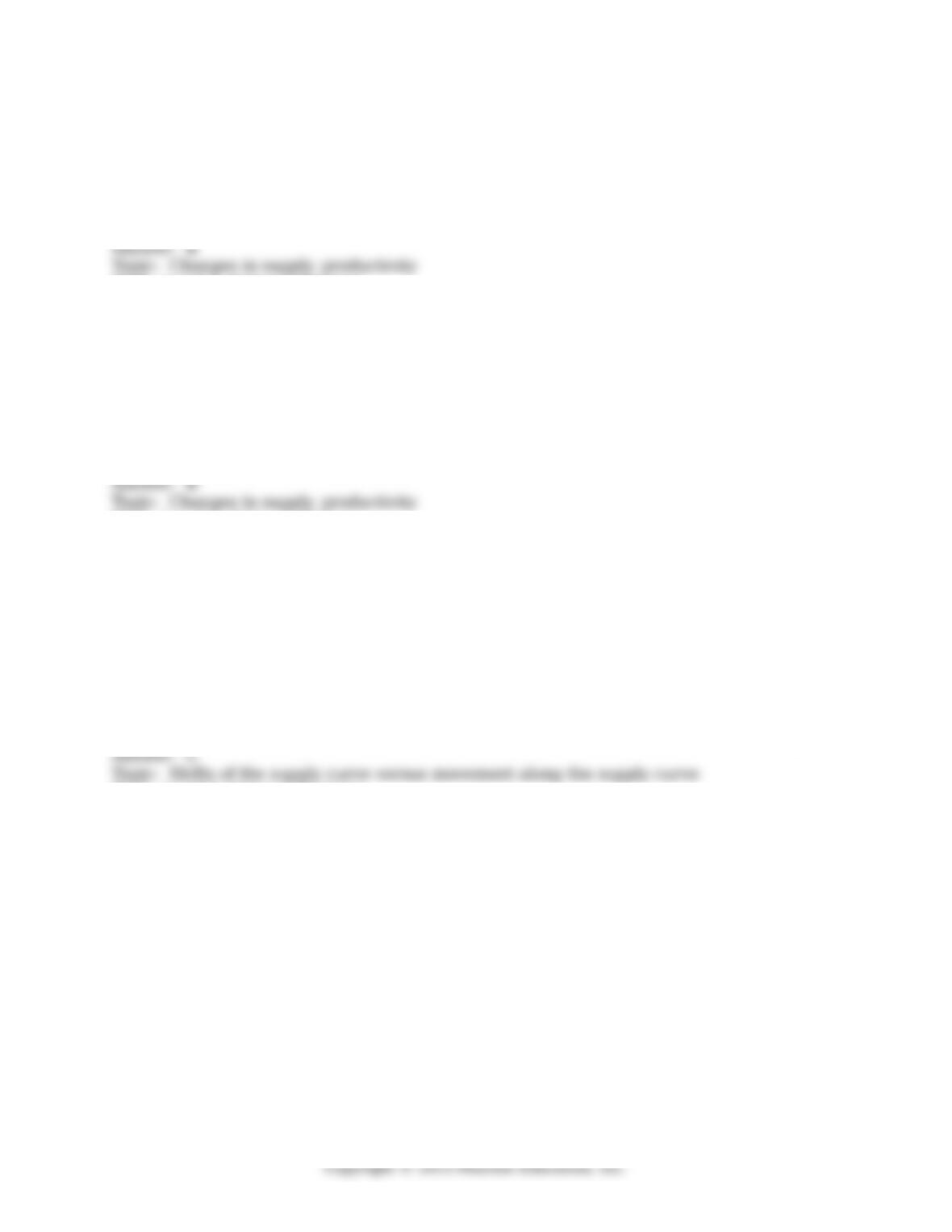
70) The graph illustrates the supply of sweaters. As the technology used to produce
sweaters improves, the
A) supply of sweaters decreases, and the demand for sweaters does not change.
B) supply of sweaters increases, and the demand for sweaters does not change.
C) quantity of sweaters supplied increases.
D) quantity of sweaters supplied decreases.
E) supply of sweaters increases, and the demand for sweaters increases.
Skill: Level 2: Using deinitions
Section: Checkpoint 4.2
Status: Old
AACSB: Analytical thinking
71) An increase in the productivity of producing jeans results in
A) the quantity of jeans supplied increasing.
B) the supply of jeans increasing.
C) buyers demanding more jeans because they are now more eiciently produced.
D) buyers demanding fewer jeans because their price will fall, which signals lower quality.
E) some change, but the impact on the supply of jeans is impossible to predict.
Skill: Level 2: Using deinitions
Section: Checkpoint 4.2
Status: Old
AACSB: Relective thinking
72) A change in the price of a good ________ its supply curve and ________ a movement along
its supply curve.
A) shifts; causes
B) shifts; does not cause
C) does not shift; causes
D) does not shift; does not cause
E) None of the above because the change in the price might cause either a shift in the
supply curve or a movement along the supply curve depending on the size of the change.
Skill: Level 2: Using deinitions
Section: Checkpoint 4.2
Status: Old
AACSB: Relective thinking
62
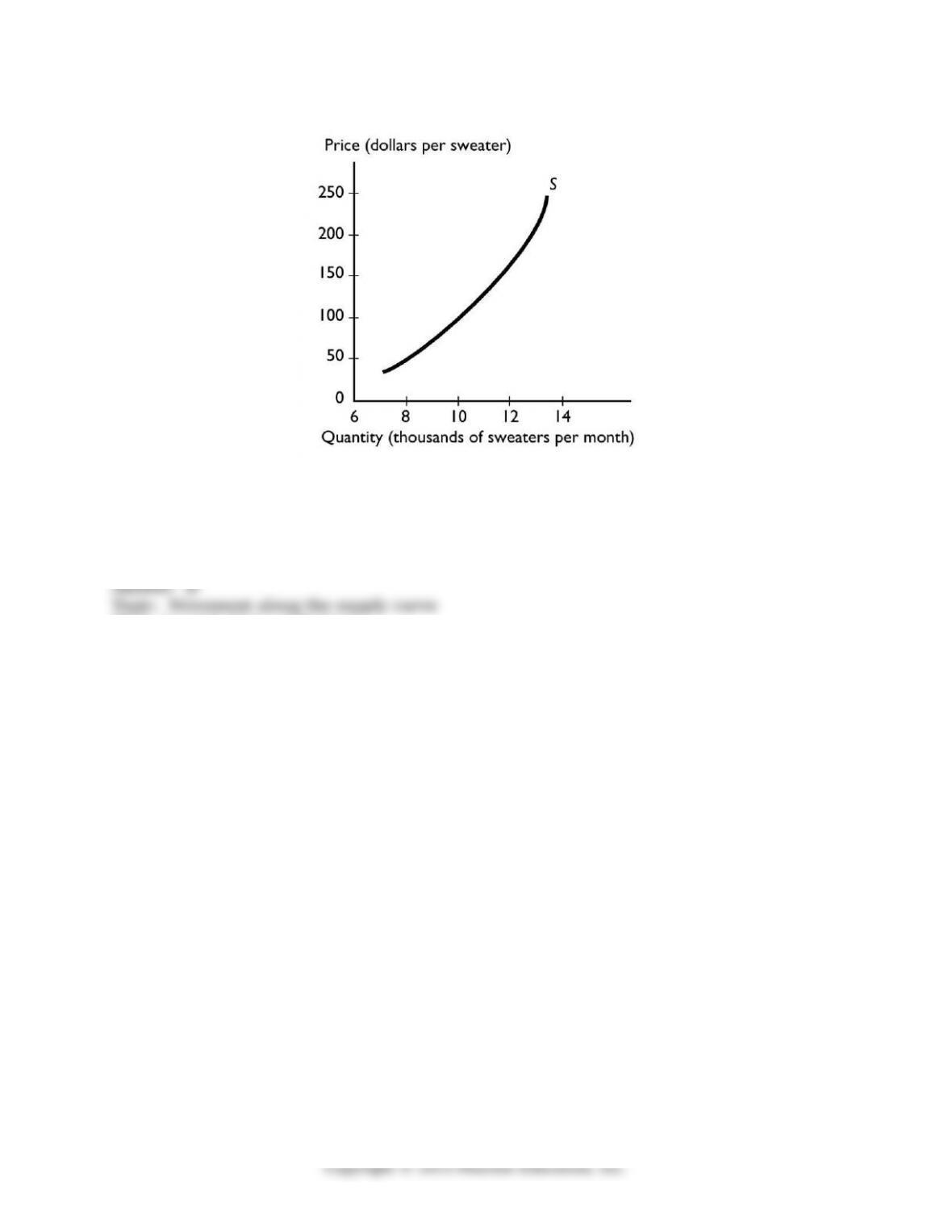
73) The graph illustrates the supply of sweaters. A fall in the price of sweaters brings
A) a movement along the supply curve.
B) a decrease in the quantity supplied of sweaters.
C) a shift of the supply curve.
D) Both answers A and B are correct.
E) Both answers B and C are correct.
Skill: Level 2: Using deinitions
Section: Checkpoint 4.2
Status: Old
AACSB: Analytical thinking
63
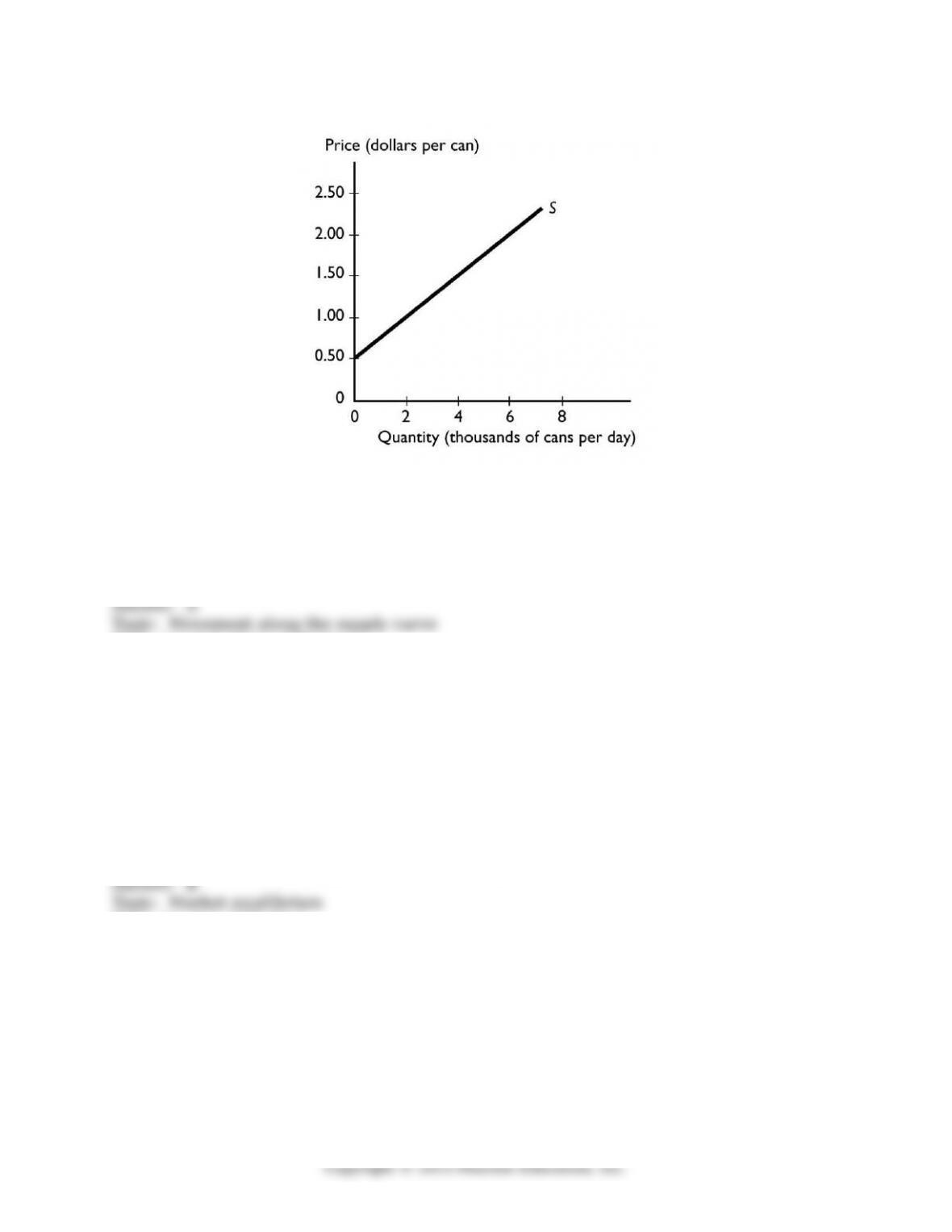
74) The graph illustrates the supply of soda. If the price of soda rises from $0.50 a can to
$1.50 a can, the quantity of soda supplied
A) increases from 0 cans to 4,000 cans a day.
B) decreases from 4,000 cans to 0 cans a day.
C) remains unchanged because the supply increases not the quantity supplied.
D) increases from 0 to 6,000 cans a day.
E) remains unchanged because the supply decreases not the quantity supplied.
Skill: Level 2: Using deinitions
Section: Checkpoint 4.2
Status: Old
AACSB: Analytical thinking
4.3 Market Equilibrium
1) Market equilibrium occurs when
A) all markets become equal.
B) the quantity demanded equals the quantity supplied.
C) opposing forces pull demand and supply apart.
D) demand and supply move in opposite direction.
E) demand and supply change so that they are equal at all possible prices.
Skill: Level 1: Deinition
Section: Checkpoint 4.3
Status: Old
AACSB: Relective thinking
64
2) Market equilibrium occurs when
A) the quantity demanded equals the quantity supplied.
B) the market is changing rapidly.
C) other things remain the same.
D) buyers get the lowest possible price.
E) everyone who wants the good gets the quantity he or she wants.
Skill: Level 1: Deinition
Section: Checkpoint 4.3
Status: Old
AACSB: Relective thinking
3) Market equilibrium
i. can never occur because there are always people who want a good but cannot aford it.
ii. occurs at the intersection of the supply and demand curves.
iii. is the point where the price equals the quantity.
A) ii only
B) iii only
C) ii and iii
D) i only
E) i and ii
Skill: Level 2: Using deinitions
Section: Checkpoint 4.3
Status: Old
AACSB: Relective thinking
4) A surplus of cardboard boxes means that
A) at the current price of a cardboard box, the quantity demanded exceeds the quantity
supplied.
B) at the current price of a cardboard box, the quantity demanded is less than the quantity
supplied.
C) the current price of a cardboard box is less than the equilibrium price.
D) at the current price of a cardboard box, the quantity demanded equals the quantity
supplied and the price will fall to restore the equilibrium.
E) More information is needed to determine if the price of cardboard boxes is higher than,
lower than, or equal to the equilibrium price.
Skill: Level 1: Deinition
Section: Checkpoint 4.3
Status: Old
AACSB: Relective thinking
65
5) When there is a surplus of snowboards, the
A) demand for snowboards is greater than the supply of snowboards.
B) supply of snowboards is greater than the demand for snowboards.
C) quantity of snowboards demanded is greater than the quantity of snowboards supplied.
D) quantity of snowboards supplied is greater than the quantity of snowboards demanded.
E) price rises to restore the equilibrium.
Skill: Level 1: Deinition
Section: Checkpoint 4.3
Status: Old
AACSB: Relective thinking
6) If there is a surplus of tacos, then the
A) quantity of tacos demanded equals the quantity of tacos supplied.
B) quantity of tacos demanded is greater than the quantity of tacos supplied.
C) quantity of tacos demanded is less than the quantity of tacos supplied.
D) market is at equilibrium.
E) supply curve of tacos will shift leftward to eliminate the surplus.
Skill: Level 2: Using deinitions
Section: Checkpoint 4.3
Status: Old
AACSB: Relective thinking
7) When a surplus of rice occurs,
A) the price of rice rises.
B) the price of rice falls.
C) there is a balance between the forces of supply and demand.
D) the quantity demanded is greater than quantity supplied at the current price.
E) the demand curve shifts rightward and the supply curve shifts leftward to eliminate the
surplus.
Skill: Level 2: Using deinitions
Section: Checkpoint 4.3
Status: Old
AACSB: Relective thinking
66
8) Suppose the equilibrium price of oranges is $2.00 per pound. If the actual price is above
the equilibrium price a
A) shortage exists, and the price falls to restore equilibrium.
B) shortage exists, and the price rises to restore equilibrium.
C) surplus exists, and the price falls to restore equilibrium.
D) surplus exists, and the price rises to restore equilibrium.
E) surplus exists, but nothing happens until either the demand or the supply changes.
Skill: Level 3: Using models
Section: Checkpoint 4.3
Status: Old
AACSB: Relective thinking
9) Suppose the current price of a pound of steak is $12 per pound and the equilibrium price
is $9 per pound. In this case, there is a
A) shortage, so the price falls and quantity demanded increases.
B) surplus, so the price falls and quantity demanded increases.
C) shortage, so the price rises and quantity demanded decreases.
D) surplus, so the price rises and quantity demanded increases.
E) surplus, so the price falls and quantity supplied increases.
Skill: Level 3: Using models
Section: Checkpoint 4.3
Status: Old
AACSB: Relective thinking
10) As a falling price eliminates a surplus in the jersey market,
A) the demand curve for jerseys shifts leftward, and the supply curve of jerseys shifts
rightward.
B) consumers increase the quantity of jerseys they demand.
C) producers increase the quantity of jerseys they supply.
D) producers decrease the quantity of jerseys they supply, and buyers decrease the
quantity of jerseys they demand.
E) the demand curve for jerseys shifts rightward, and the supply curve of jerseys shifts
leftward.
Skill: Level 5: Critical thinking
Section: Checkpoint 4.3
Status: Old
AACSB: Relective thinking
67
11) If the price is below the equilibrium price,
A) there is a surplus.
B) there is a shortage.
C) the supply curve will shift rightward.
D) the supply curve will shift leftward.
E) the demand curve will shift leftward.
Skill: Level 3: Using models
Section: Checkpoint 4.3
Status: Old
AACSB: Relective thinking
12) When there is a shortage of parking spaces at your college, the
A) demand for parking spaces is greater than the supply.
B) supply of parking spaces is greater than the demand.
C) quantity of parking spaces supplied is greater than the quantity of parking spaces
demanded.
D) quantity of parking spaces demanded is greater than the quantity of parking spaces
supplied.
E) Both answers A and D are correct.
Skill: Level 1: Deinition
Section: Checkpoint 4.3
Status: Old
AACSB: Relective thinking
13) If the price of carrots is below the equilibrium price, the
A) quantity demanded of carrots exceeds the quantity supplied, and a surplus exists.
B) quantity supplied of carrots exceeds the quantity demanded, and a surplus exists.
C) quantity demanded of carrots exceeds the quantity supplied, and a shortage exists.
D) quantity supplied of carrots exceeds the quantity demanded, and a shortage exists.
E) quantity supplied of carrots equals the quantity demanded.
Skill: Level 3: Using models
Section: Checkpoint 4.3
Status: Old
AACSB: Relective thinking
68
14) Suppose the current price of a pound of steak is $6 per pound and the equilibrium price
is $9 per pound. What takes place?
A) There is a shortage, so the price falls and quantity demanded increases.
B) There is a surplus, so the price falls and quantity demanded increases.
C) There is a shortage, so the price rises and quantity demanded decreases.
D) There is a shortage, so the price rises and quantity demanded increases.
E) There is a shortage, so the price falls and quantity demanded decreases.
Skill: Level 3: Using models
Section: Checkpoint 4.3
Status: Old
AACSB: Relective thinking
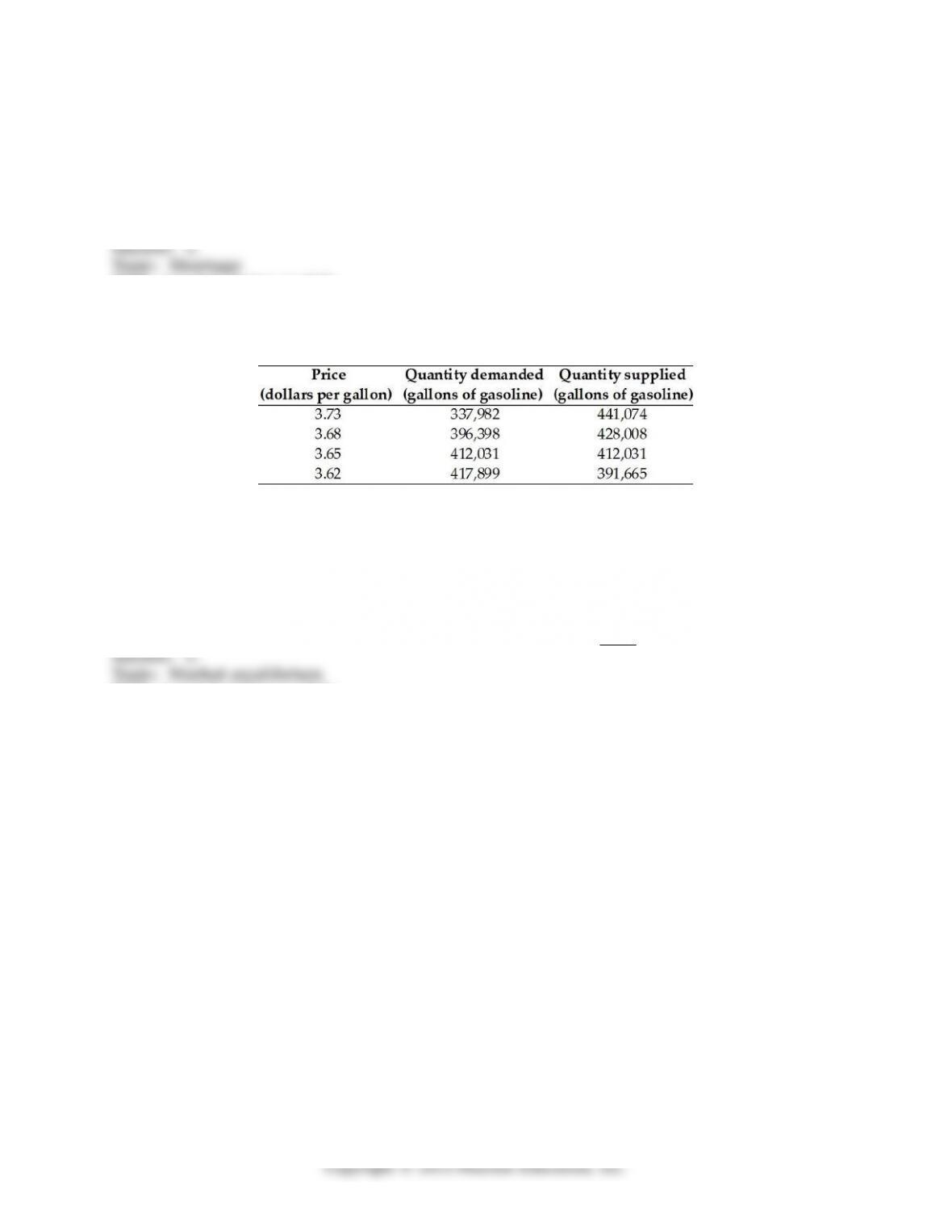
15) The table above shows the situation in the gasoline market in Tulsa, Oklahoma. If the
price of a gallon of gasoline is $3.65, then
A) there is a surplus of gasoline in Tulsa.
B) there is a shortage of gasoline in Tulsa.
C) the gasoline market in Tulsa is in equilibrium.
D) without more information we cannot determine if there is a surplus, a shortage, or an
equilibrium in the gasoline market in Tulsa.
E) there is neither a surplus nor a shortage but the market is NOT in equilibrium.
Skill: Level 3: Using models
Section: Checkpoint 4.3
Status: Old
AACSB: Analytical thinking
69
16) The table above shows the situation in the gasoline market in Tulsa, Oklahoma. If the
price of a gallon of gasoline is $3.73, then
A) there is a surplus of gasoline in Tulsa.
B) there is a shortage of gasoline in Tulsa.
C) the gasoline market in Tulsa is in equilibrium.
D) without more information we cannot determine if there is a surplus, a shortage, or an
equilibrium in the gasoline market in Tulsa.
E) there is neither a surplus nor a shortage, but the market is NOT in equilibrium.
Skill: Level 3: Using models
Section: Checkpoint 4.3
Status: Old
AACSB: Analytical thinking
17) The table above shows the situation in the gasoline market in Tulsa, Oklahoma. If the
price of a gallon of gasoline is $3.62, then
A) there is a surplus of gasoline in Tulsa.
B) there is a shortage of gasoline in Tulsa.
C) the gasoline market in Tulsa is in equilibrium.
D) without more information we cannot determine if there is a surplus, a shortage, or an
equilibrium in the gasoline market in Tulsa.
E) there is neither a surplus nor a shortage, but the market is NOT in equilibrium.
Skill: Level 3: Using models
Section: Checkpoint 4.3
Status: Old
AACSB: Analytical thinking
70