27) An eiciency wage is designed to ________ work efort and to ________ labor turnover.
A) decrease; lower
B) decrease; raise
C) increase; raise
D) increase; lower
E) not change; decrease
Skill: Level 1: Deinition
Section: Checkpoint 8.2
Status: Old
AACSB: Relective thinking
28) An eiciency wage is ________ because the result is ________.
A) set above the equilibrium real wage; reduced turnover and less work efort
B) set above the equilibrium real wage; increased turnover and more work efort
C) set below the equilibrium real wage; reduced turnover and more work efort
D) set above the equilibrium real wage; reduced turnover and more work efort
E) not often used; not much diferent from minimum wage use
Skill: Level 1: Deinition
Section: Checkpoint 8.2
Status: New
AACSB: Relective thinking
29) An eiciency wage ________ because ________.
A) decreases job rationing; the real wage rate is lowered below the equilibrium
B) increases job rationing; the real wage rate is lowered below the equilibrium
C) decreases job rationing; the real wage rate is raised above the equilibrium
D) increases job rationing; the real wage rate is raised above the equilibrium
E) is used often; it is inexpensive and efective
Skill: Level 1: Deinition
Section: Checkpoint 8.2
Status: New
AACSB: Relective thinking
51
30) Eiciency wages are
A) the legal minimum wage a irm can pay a worker.
B) a possible cause of job rationing because they drive wages below their equilibrium level.
C) a possible cause of job rationing because they drive wages above their equilibrium level.
D) a possible cause of job rationing because they force wages to equal their equilibrium
level.
E) another name for the equilibrium wage.
Skill: Level 2: Using deinitions
Section: Checkpoint 8.2
Status: Old
AACSB: Relective thinking
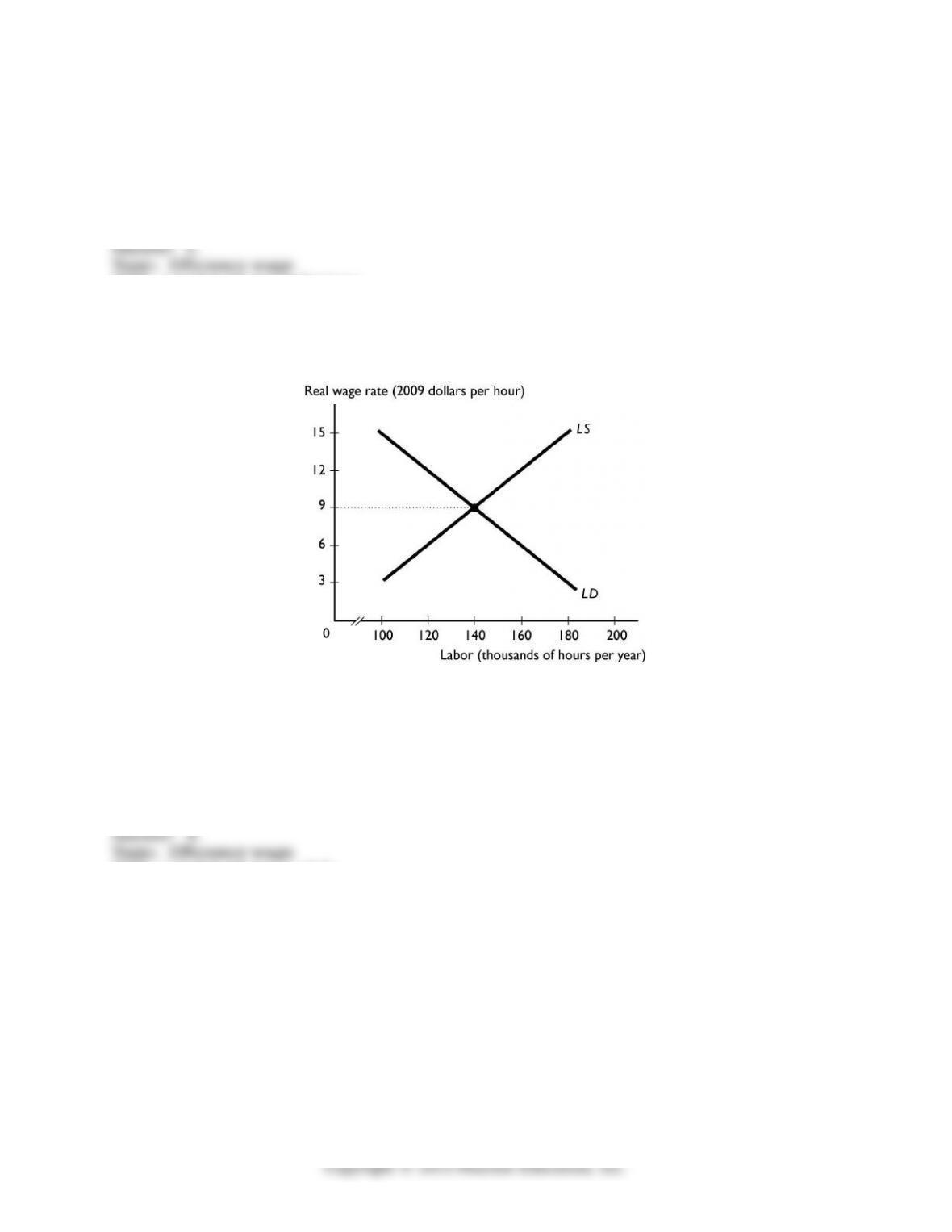
31) The igure above shows the market for fast food restaurant employees in a college town
in a small nation to the East. The local Taco Bell pays its workers $12 an hour. This wage
rate is
A) an eiciency wage aimed at reducing employee turnover.
B) designed reduce the unemployment rate.
C) an efort to increase the demand for labor.
D) the actual equilibrium wage rate.
E) illegal because the equilibrium wage rate is $6 an hour.
Skill: Level 3: Using models
Section: Checkpoint 8.2
Status: Old
AACSB: Analytical thinking
52
32) The igure above shows the labor market in a small town. If the government imposes a
wage of $10 that irms must at least pay,
A) the government has imposed a minimum wage and market forces are not allowed to
work.
B) the government has imposed an eiciency wage.
C) job search will decrease.
D) job rationing will decrease.
E) inlation will occur as wages rise.
Skill: Level 3: Using models
Section: Checkpoint 8.2
Status: Old
AACSB: Analytical thinking
33) The igure above shows the labor market in a small town. If the government imposes
________ that irms must at least pay, the efect will be ________ because ________.
A) a minimum wage of $10; an increase in unemployment; a surplus of labor is created
B) a minimum wage of $10; a decrease in unemployment; a shortage of labor is created
C) an eiciency wage of $10; a decrease in unemployment; a surplus of labor is created
D) an eiciency wage of $10; an increase in unemployment; a shortage of labor is created
E) a minimum wage of $10; no change in unemployment; it will not afect how irms
demand labor
Skill: Level 3: Using models
Section: Checkpoint 8.2
Status: New
AACSB: Analytical thinking
34) To increase workers’ incomes, the City of New York’s government set a wage below
which it is illegal for employers to pay employees. This wage is referred to as the
A) minimum wage.
B) eiciency wage.
C) government wage.
D) union wage.
E) city wage.
Skill: Level 1: Deinition
Section: Checkpoint 8.2
Status: Old
AACSB: Relective thinking
53
35) A minimum wage rate that is set ________ the equilibrium real wage rate creates a
________ of labor.
A) above; surplus
B) above; shortage
C) below; surplus
D) below; shortage
E) equal to; shortage
Skill: Level 1: Deinition
Section: Checkpoint 8.2
Status: Old
AACSB: Relective thinking
36) If the minimum wage rate is set above the equilibrium wage rate, then
A) unemployment deinitely increases.
B) unemployment deinitely decreases.
C) unemployment deinitely does not change.
D) unemployment either decreases or does not change.
E) None of the above answers is correct because the minimum wage decreases search but
its efect on unemployment is ambiguous.
Skill: Level 1: Deinition
Section: Checkpoint 8.2
Status: Old
AACSB: Relective thinking
37) The minimum wage is a
A) possible cause of job search because it lowers wages below their equilibrium.
B) possible cause of job rationing because it lowers wages below their equilibrium.
C) government established highest wage that is legal to pay.
D) possible cause of job rationing because it raises wages above their equilibrium.
E) factor that decreases unemployment because fewer people search for work if the
minimum wage is increased.
Skill: Level 2: Using deinitions
Section: Checkpoint 8.2
Status: Old
AACSB: Relective thinking
54
38) A minimum wage set above the equilibrium wage rate
A) increases the natural unemployment rate.
B) increases the demand for labor.
C) increases the number of workers employed.
D) decreases job rationing.
E) decreases the natural unemployment rate because fewer workers will become
unemployed.
Skill: Level 2: Using deinitions
Section: Checkpoint 8.2
Status: Old
AACSB: Relective thinking
39) Which of the following will increase the natural unemployment rate?
i. a minimum wage set above the equilibrium wage rate
ii. eiciency wages
iii. union-negotiated wages
A) i only
B) i and ii
C) i and iii only
D) ii and iii only
E) i, ii and iii
Skill: Level 2: Using deinitions
Section: Checkpoint 8.2
Status: Old
AACSB: Relective thinking
40) If the minimum wage is set
A) below the equilibrium wage rate, it will create unemployment.
B) above the equilibrium wage rate, it will create unemployment.
C) equal to the equilibrium wage rate, it will create a shortage of labor.
D) below the equilibrium wage rate, it will create a shortage of labor.
E) equal to the equilibrium wage rate, it will create a surplus of labor.
Skill: Level 3: Using models
Section: Checkpoint 8.2
Status: Old
AACSB: Relective thinking
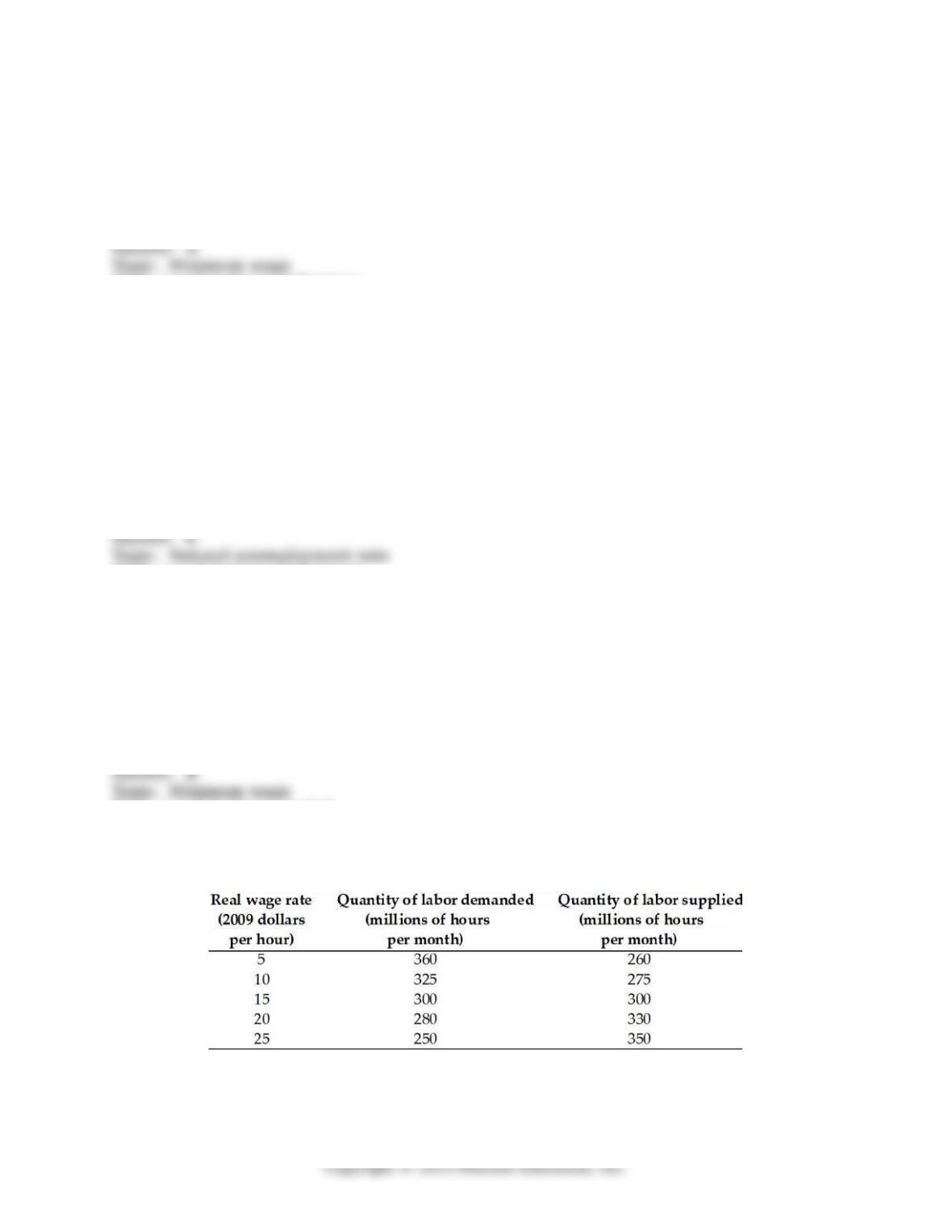
41) According to the above table, if the minimum wage is set at $20 per hour, then
A) there is an excess demand for labor.
B) the quantity of labor supplied exceeds the quantity of labor demanded by 50 million
hours per month.
55
C) the quantity of labor demanded will increase until it is equal to the quantity of labor
supplied.
D) the labor demand curve will shift until $20 is the new equilibrium real wage rate.
E) the labor supply curve will shift until $20 is the new equilibrium real wage rate.
Skill: Level 3: Using models
Section: Checkpoint 8.2
Status: Old
AACSB: Analytical thinking
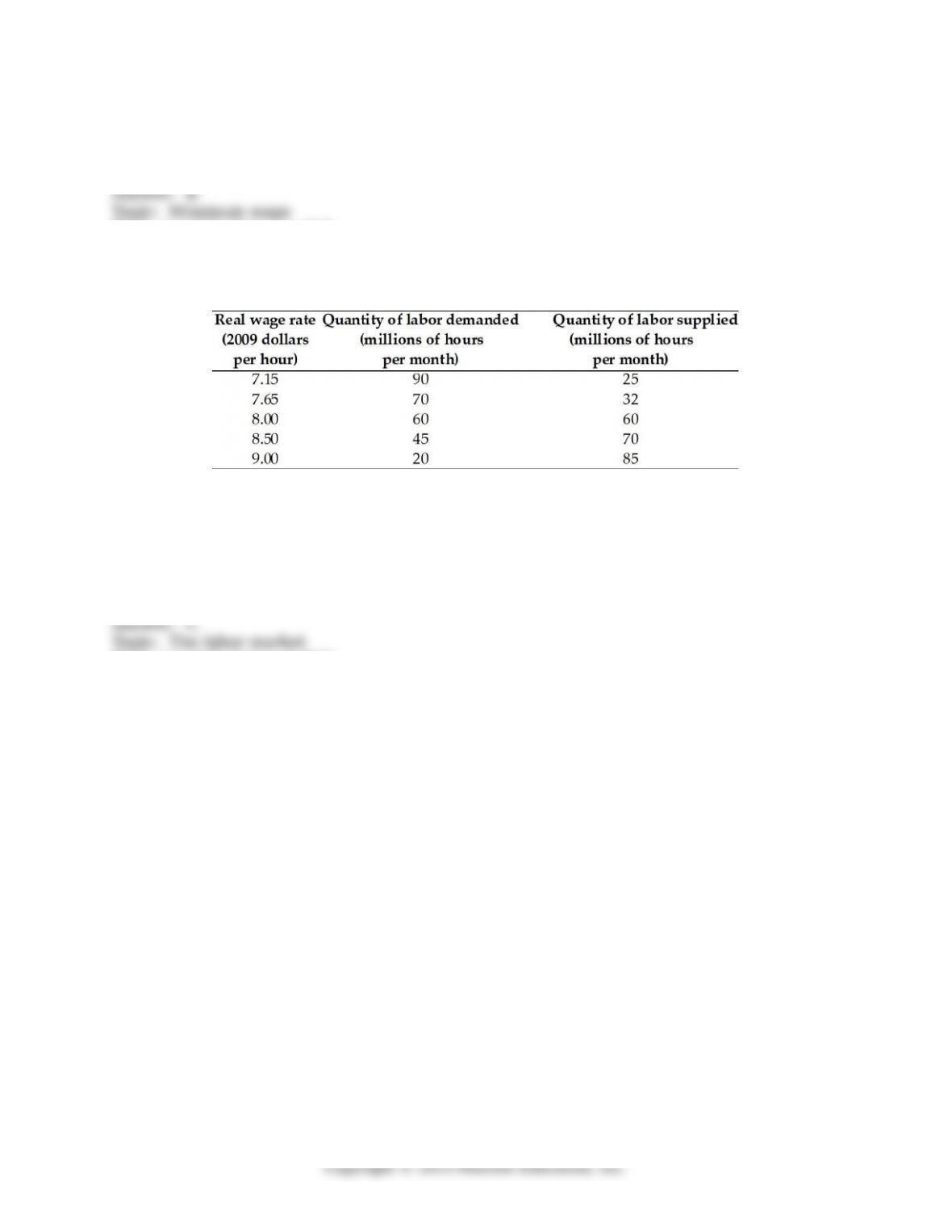
42) The table above gives the labor market for a small foreign economy. Equilibrium in the
labor market occurs at a real wage rate of
A) $7.15 per hour.
B) $7.65 per hour.
C) $8.00 per hour.
D) $8.50 per hour.
E) $9.00 per hour.
Skill: Level 3: Using models
Section: Checkpoint 8.2
Status: Old
AACSB: Analytical thinking
56
43) The table above gives the labor market for a small foreign economy. A minimum wage
law that sets the minimum wage at $8.50 per hour produces
A) equilibrium in the labor market.
B) a labor surplus of 25 million hours.
C) a labor shortage of 25 million hours.
D) a labor surplus of $0.50 per hour.
E) a labor surplus of 65 million hours.
Skill: Level 3: Using models
Section: Checkpoint 8.2
Status: Old
AACSB: Analytical thinking
44) The table above gives the labor market for a small foreign economy. A(n) ________ would
create ________.
A) minimum wage of $5.00; an increase in job rationing.
B) union-negotiated wage of $7.50; unemployment and job rationing.
C) eiciency wage of $8.00; unemployment and job rationing.
D) eiciency wage of $9.00; an increase in job rationing.
E) minimum wage of $9.00; a decrease in job search.
Skill: Level 4: Applying models
Section: Checkpoint 8.2
Status: Old
AACSB: Analytical thinking
57
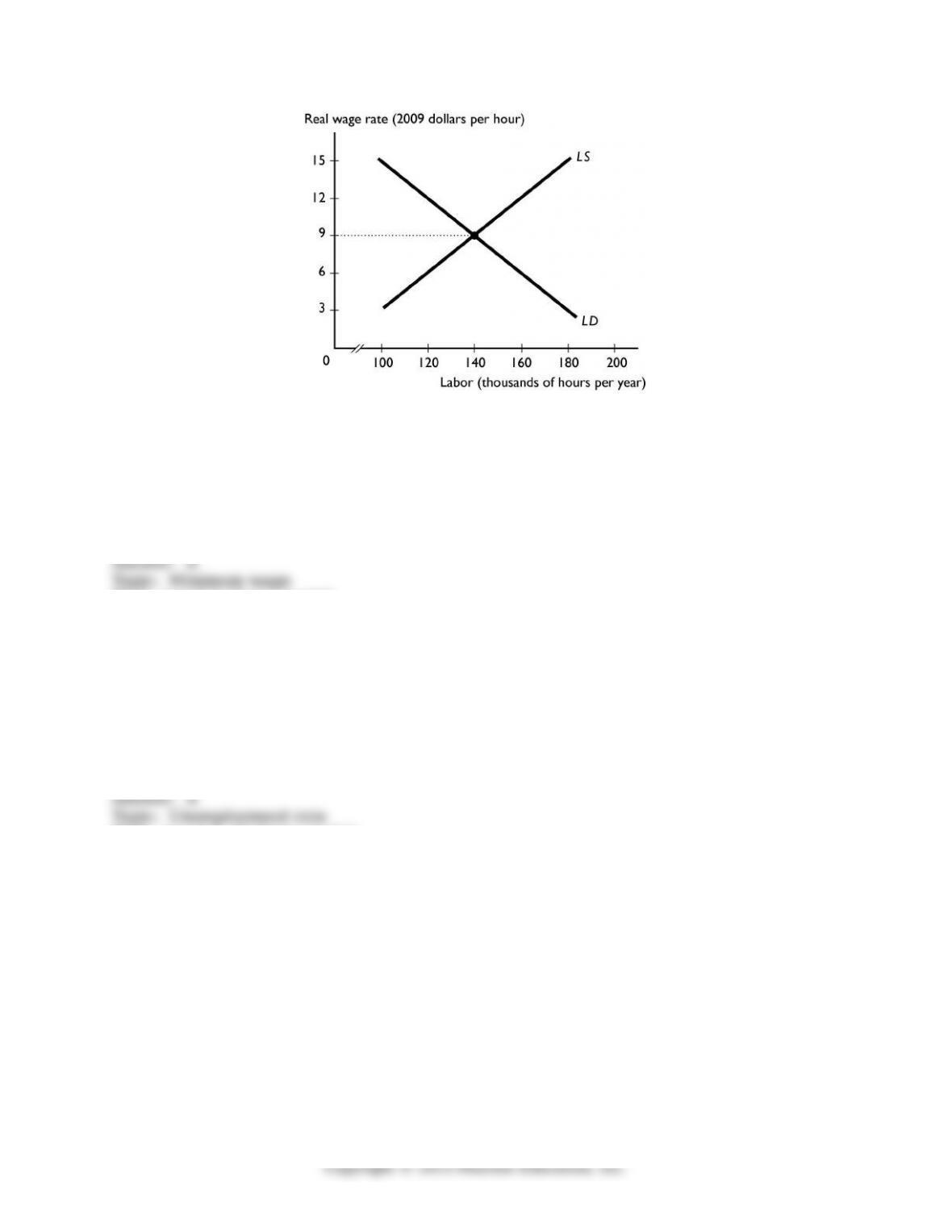
45) In the above igure, a minimum wage will not change the unemployment rate if it is set
at
A) $6.00.
B) $9.00.
C) $12.00.
D) Both B and C are correct because any wage rate that exceeds $9 per hour has no efect
on the unemployment rate.
E) None of the above because the minimum wage always afects the unemployment rate.
Skill: Level 3: Using models
Section: Checkpoint 8.2
Status: Old
AACSB: Analytical thinking
46) In the above igure, a(n) ________ would be set ________.
A) eiciency wage; above $9.00 and would increase the natural rate of unemployment
B) efective minimum wage; above $6.00.
C) union wage; above $9.00 but would not afect the natural rate of unemployment.
D) eiciency wage; above $6.00.
E) eiciency wage; below $9.00
Skill: Level 4: Applying models
Section: Checkpoint 8.2
Status: Old
AACSB: Analytical thinking
58
47) It is estimated that, on the average and without taking account of skill diferentials,
union wages are
A) less than nonunion wages.
B) equal to nonunion wages.
C) 30 percent higher than nonunion wages.
D) 100 percent higher than nonunion wages.
E) 66 percent higher than nonunion wages.
Skill: Level 2: Using deinitions
Section: Checkpoint 8.2
Status: Revised
AACSB: Relective thinking
48) It is estimated that, on the average and taking account of skill diferentials, union
wages are
A) less than nonunion wages.
B) equal to nonunion wages.
C) 10-25 percent higher than nonunion wages.
D) 100 percent higher than nonunion wages.
E) 66 percent higher than nonunion wages.
Skill: Level 2: Using deinitions
Section: Checkpoint 8.2
Status: New
AACSB: Relective thinking
49) It is estimated that, on the average and ________, union wages are ________ because
________.
A) without taking account of skill diferentials; 15-20 percent higher than nonunion wages;
employers are biased against nonunion workers
B) taking account of skill diferentials; 30 percent higher than nonunion wages; in some
industries union workers perform jobs that require greater skill than nonunion workers and
employers show bias against nonunion workers
C) without taking account of skill diferentials; 30 percent higher than nonunion wages; in
some industries union workers perform jobs that require greater skill than nonunion
workers
D) taking account of skill diferentials; 30 percent higher than nonunion wages; union
workers are better qualiied than nonunion workers
E) without taking account of skill diferentials; equal to nonunion wages; diferentiating
based on union membership is discrimination and illegal
Skill: Level 2: Using deinitions
Section: Checkpoint 8.2
Status: New
AACSB: Relective thinking
59
50) The presence of union wages leads to
A) a fall in the real wage rate as fewer people are hired.
B) a fall in the real wage rate as more people are hired.
C) less job search as more workers are hired.
D) job rationing because the real wage exceeds the equilibrium real wage.
E) lower unemployment because workers do not want to lose the high union wage they are
being paid.
Skill: Level 2: Using deinitions
Section: Checkpoint 8.2
Status: Old
AACSB: Relective thinking
51) The Fair Labor Standards Act originally set the minimum wage at
A) $1.25 in 1983.
B) $1.25 in 1938.
C) $0.25 in 1938.
D) $0.25 in 1983.
E) $3.00 in 1960.
Skill: Level 2: Using deinitions
Section: Checkpoint 8.2
Status: Old
AACSB: Relective thinking
52) The real minimum wage rate
A) has generally increased since 1967.
B) has generally decreased during the 1970s and 1980s and has luctuated around a $6.50
per hour average since the mid-1980s.
C) was at its highest level in 1995.
D) fell after 1967 until it reached a minimum around 1985 and has generally risen since
then.
E) has stayed in the range between $6 and $5 (measured in 2009 dollars per hour) since
1967.
Skill: Level 2: Using deinitions
Section: Checkpoint 8.2
Status: Revised
AACSB: Relective thinking
60