31) During 2008, Swaziland had a real GDP growth rate of 1.8 percent and a real GDP
growth rate per person of -1.3 percent. These rates indicate that in Swaziland
A) there was an error when calculating the growth rates because the growth rate of real
GDP per person cannot be negative.
B) the population growth rate was negative.
C) the population grew at a faster rate than real GDP.
D) poverty levels are declining.
E) real GDP grew more rapidly than did the population.
Skill: Level 5: Critical thinking
Section: Checkpoint 9.1
Status: Old
AACSB: Analytical thinking
32) In India last year, the growth rate of real GDP was 3.5 percent and the population grew
from 1,000 million people to 1,100 million. Real GDP per person
A) increased by 13.5 percent.
B) decreased by 6.5 percent.
C) increased by 6.5 percent.
D) decreased by 13.5 percent.
E) increased by 3.5 percent.
Skill: Level 3: Using models
Section: Checkpoint 9.1
Status: Old
AACSB: Analytical thinking
33) Belgium’s real GDP per person is $33,000 and Austria’s is $34,700. The population
growth rate in Belgium is 0.13 percent and the growth rate of real GDP is 3.0 percent. The
population growth rate in Austria is 0.08 percent and the growth rate of real GDP is 3.3
percent. If these growth rates continue, how many years will it take for Belgium’s real GDP
per person to equal Austria’s real GDP per person?
A) Belgium’s standard of living will never equal Austria’s.
B) just over 23 years
C) just over 24 years
D) just over 21 years
E) over 230 years
Skill: Level 3: Using models
Section: Checkpoint 9.1
Status: Old
AACSB: Analytical thinking
11
34) If Country A’s real GDP is growing at 6 percent per year and Country B’s real GDP is
growing at 6 percent per year, then the standard of living is
A) growing more rapidly in Country A.
B) higher in Country B.
C) changing at the same rate in Country A and Country B.
D) growing more slowly in Country A.
E) changing at the same rate in Country A and Country B only if the rate of population
growth is the same in both countries.
Skill: Level 2: Using deinitions
Section: Checkpoint 9.1
Status: Old
AACSB: Relective thinking
35) If Country A’s real GDP per person is growing at 6 percent and Country B’s real GDP
per person is growing at 3 percent, then
A) the standard of living is higher in Country A.
B) the standard of living is higher in Country B.
C) the standard of living is growing more rapidly in Country A.
D) We cannot say whose standard of living is growing more rapidly without knowing the
population growth rate.
E) We cannot say whose standard of living is growing more rapidly without knowing the
growth rate of real GDP.
Skill: Level 2: Using deinitions
Section: Checkpoint 9.1
Status: Old
AACSB: Relective thinking
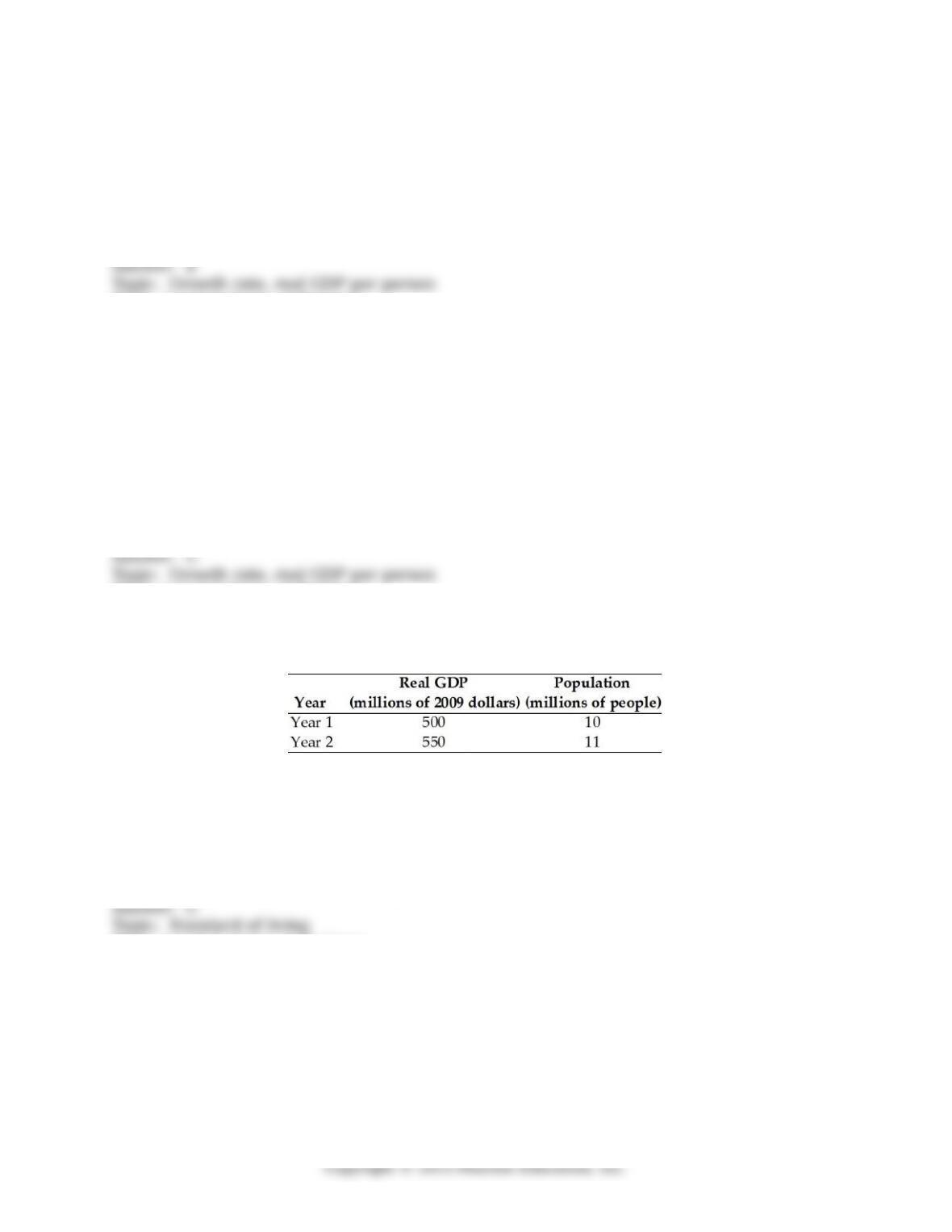
36) According to the data in the table above,
A) the standard of living improved between year 1 and year 2.
B) the standard of living worsened between year 1 and year 2.
C) as measured by real GDP per person, the standard of living remained the same between
year 1 and year 2.
D) real GDP grew more rapidly than population between year 1 and year 2.
E) real GDP grew more slowly than population between year 1 and year 2.
Skill: Level 2: Using deinitions
Section: Checkpoint 9.1
Status: Old
AACSB: Analytical thinking
37) According to the data in the table above, real GDP grew at a rate of ________ between
year 1
and year 2.
A) 10 percent
B) 1 percent
C) 50 percent
12
D) 5 percent
E) 55 percent
Skill: Level 2: Using deinitions
Section: Checkpoint 9.1
Status: Old
AACSB: Analytical thinking
38) According to the data in the table above, real GDP per person grew at a rate of ________
between year 1 and year 2.
A) 10 percent
B) 0 percent
C) 1 percent
D) 5 percent
E) 50 percent
Skill: Level 3: Using models
Section: Checkpoint 9.1
Status: Old
AACSB: Analytical thinking
39) The Rule of ________ can be used to calculate the number of years that it takes for the
level of a variable to ________.
A) 20; double
B) 70; triple
C) 70; double
D) 20; triple
E) thumb; double
Skill: Level 1: Deinition
Section: Checkpoint 9.1
Status: Old
AACSB: Relective thinking
13

40) The Rule of 70 states that the level of a variable will double in
A) 70 years.
B) the number of years equal to the variable’s annual rate of growth divided by 70.
C) the number of years equal to 70 divided by the variable’s annual growth rate.
D) the number of years equal to the variable’s annual growth rate minus 70.
E) the number of years equal to 70 multiplied by the variable’s annual growth rate
expressed as a decimal.
Skill: Level 2: Using deinitions
Section: Checkpoint 9.1
Status: Old
AACSB: Relective thinking
41) The Rule of 70, as applied to real GDP growth, can be used to ind the
A) real GDP growth rate necessary to double growth.
B) number of years it takes for the level of real GDP to double.
C) growth rate of real GDP.
D) number of years it takes for the growth rate of real GDP to double.
E) population growth rate necessary to double the GDP growth rate.
Skill: Level 1: Deinition
Section: Checkpoint 9.1
Status: Old
AACSB: Relective thinking
42) The Rule of 70 can be used to calculate the
A) economic growth rate per month.
B) population growth rate per year.
C) number of years it would take for the level of any variable to double.
D) 70 percent level of the economic growth rate.
E) economic growth rate per year.
Skill: Level 1: Deinition
Section: Checkpoint 9.1
Status: Old
AACSB: Relective thinking
14

43) Approximately how long will it take Ethiopia to double its real GDP per person of $100
if its growth rate of real GDP per person is 0.9 percent?
A) 63 years
B) 77.7 years
C) 70 years
D) 109 years
E) 100 years
Skill: Level 3: Using models
Section: Checkpoint 9.1
Status: Old
AACSB: Analytical thinking
44) If Country A’s real GDP grows at a rate of 14 percent per year, about how many years
will it take for Country A’s real GDP to double?
A) 10
B) 7
C) 5
D) 30
E) 14
Skill: Level 3: Using models
Section: Checkpoint 9.1
Status: Old
AACSB: Analytical thinking
45) According to the Rule of 70, if a country grows at 2.0 percent per year instead of 1.5
percent per year, how many fewer years will it take to double its level of real GDP?
A) It will take 11.6 years fewer.
B) It will take 35 years fewer.
C) It will take 58.3 years fewer.
D) It will take 20 years fewer.
E) It will take 17.9 years fewer.
Skill: Level 3: Using models
Section: Checkpoint 9.1
Status: Old
AACSB: Analytical thinking
15

46) The annual growth rate of an economy is 10 percent. The economy’s GDP will double in
about ________ years.
A) 7
B) 10
C) 12
D) 14
E) 20
Skill: Level 3: Using models
Section: Checkpoint 9.1
Status: Old
AACSB: Analytical thinking
47) Using the rule of 70, a sustained 3 percent per year real GDP growth rate will
A) last for 70 years.
B) double the current level of real GDP in about 23 years.
C) double the current level of real GDP in about 210 years.
D) double the current level of real GDP in about 70 years.
E) double the current level of real GDP in about 40 years.
Skill: Level 3: Using models
Section: Checkpoint 9.1
Status: Old
AACSB: Analytical thinking
48) A nation’s annual growth rate of real GDP per person is 2 percent. Its standard of living
will
A) double in 35 years.
B) not change because its population is growing.
C) fall because of its population growth.
D) double in 10 years.
E) double in 50 years.
Skill: Level 3: Using models
Section: Checkpoint 9.1
Status: Old
AACSB: Analytical thinking
16

49) If a country experiences a real GDP growth rate of 6 percent, real GDP will double in
A) 10 years.
B) 11.67 years.
C) 14 years.
D) 17.5 years.
E) 16.67 years.
Skill: Level 2: Using deinitions
Section: Checkpoint 9.1
Status: Old
AACSB: Analytical thinking
50) This year, real GDP per person in Country A is eight times real GDP per person in
Country B. If Country B’s real GDP per person grows at a rate of 5 percent, about how
many years will it take for Country B to reach the level of real GDP per person in Country A
in this year?
A) 14 years
B) 28 years
C) 56 years
D) 42 years
E) It will never reach Country A’s level of GDP per person.
Skill: Level 4: Applying models
Section: Checkpoint 9.1
Status: Old
AACSB: Analytical thinking
51) This year Iceland has a real GDP per person that is approximately 8 times greater than
that of Cape Verde. Cape Verde’s growth rate of real GDP per person was 5.2 percent. If
Cape Verde maintains this current growth rate, approximately how many years will it take
for Cape Verde’s real GDP per person to reach the same level that Iceland has this year?
A) 13.5 years
B) 20 years
C) 27 years
D) 40 years
E) 54 years
Skill: Level 4: Applying models
Section: Checkpoint 9.1
Status: Old
AACSB: Analytical thinking
17

52) If it took 20 years for real GDP to double, what was the growth rate of real GDP?
A) 4.5 percent
B) 3.0 percent
C) 3.5 percent
D) 4 percent
E) 5 percent
Skill: Level 4: Applying models
Section: Checkpoint 9.1
Status: Old
AACSB: Analytical thinking
53) In this year, Country A has a real GDP per person that is 4 times greater than that of
Country B. Country B’s growth rate of real GDP per person is 3.5 percent per year. How
many years will it take for Country B’s real GDP per person to reach the same level that
Country A had in this year?
A) 10 years
B) 20 years
C) 40 years
D) 60 years
E) 56 years
Skill: Level 2: Using deinitions
Section: Checkpoint 9.1
Status: Old
AACSB: Analytical thinking
54) Suppose Mexico’s real GDP per person in 2008 is $6,000 and the U.S. real GDP per
person is $24,000. Mexico has annual growth in real GDP per person of 5 percent.
Approximately how many years will it take Mexico to equal $24,000 of real GDP per
person?
A) 14 years
B) 18 years
C) 28 years
D) 36 years
E) 40 years
Skill: Level 4: Applying models
Section: Checkpoint 9.1
Status: Old
AACSB: Analytical thinking
18
55) Over the past 110 years, real GDP per person in the United States has grown at an
average rate of about ________ per year.
A) 1 percent
B) 2 percent
C) 5 percent
D) 10 percent
E) 7.5 percent
Skill: Level 1: Deinition
Section: Checkpoint 9.1
Status: Revised
AACSB: Relective thinking
56) For the world, what period of time experienced the fastest growth rate of real GDP per
person?
A) around 500 B.C.
B) around 400 A.D.
C) between 1000 A.D. and 1500 A.D.
D) after about 1850 A.D.
E) between 1500 A.D. and 1850 A.D.
Skill: Level 1: Deinition
Section: Checkpoint 9.1
Status: Old
AACSB: Relective thinking
57) Real GDP per person averaged $150 a year (in 2009 dollars) from 1,000,000 BC until
1620. During this time there was a period when it rose to ________ around ________ because
________.
A) $210; 1620; the Pilgrim Fathers began to arrive in the Americas
B) $210; 1492; Columbus sailed to the Americas
C) $140; 400 BC; the Roman Empire collapsed
D) $190; 500 BC; of the gains from human capital while Aristotle and Plato were teaching
in Athens
E) a 1-million year high; the 1340s; the Black Death gripped Europe
Skill: Level 1: Deinition
Section: Checkpoint 9.1
Status: New
AACSB: Relective thinking
19
58) Real GDP per person averaged $150 a year (in 2009 dollars) from 1,000,000 BC until
1620. Then in ________ real GDP began to increase without limit and by 1850 had risen to
twice its 1650 level because ________.
A) 1650; the Pilgrims arrived in the Americas
B) 1750; Columbus arrived in the Americas
C) 1650; of the Industrial Revolution
D) 1750; of the Industrial Revolution
E) 1776; United States was founded
Skill: Level 1: Deinition
Section: Checkpoint 9.1
Status: New
AACSB: Relective thinking
59) Since the beginning of the 20th century the decade with the slowest real GDP per
person growth rate other than the 1930s is ________ because of the ________.
A) 2000-2010; the war on terror
B) 1990-2000; fear of Y2K
C) 1930-1940; Great Depression
D) 2000-2010; 2008/2009 deep recession
E) 2010-2020; Keynesian economic policies being used more frequently than in the 1930s
Skill: Level 1: Deinition
Section: Checkpoint 9.1
Status: New
AACSB: Relective thinking
60) The economic growth rate is measured as the
A) annual percentage change of real GDP.
B) annual percentage change of employment.
C) amount of real GDP.
D) annual percentage change of the population.
E) amount of population.
Skill: Level 1: Deinition
Section: Checkpoint 9.1
Status: Old
AACSB: Relective thinking
20