Archives: Solution Manual
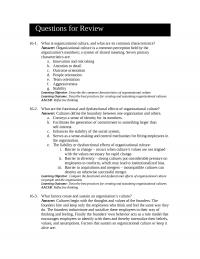
978-0134103983 Chapter 16 Solution Manual
Questions for Review 16-1. What is organizational culture, and what are its common characteristics? Answer: Organizational culture is a common perception held by the characteristics are: a. Innovation and risk taking b. Attention to detail c. Outcome orientation d. People […]
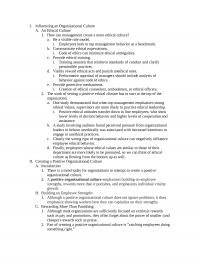
978-0134103983 Chapter 16 Lecture Note Part 3
I. Influencing an Organizational Culture A. An Ethical Culture 1. How can management create a more ethical culture? a. Be a visible role model. i. Employees look to top management behavior as a benchmark. b. Communicate ethical expectations. i. Code […]
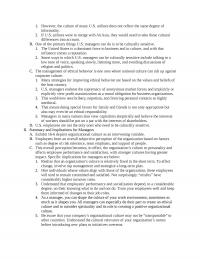
978-0134103983 Chapter 16 Lecture Note Part 2
1. However, the culture of many U.S. airlines does not reflect the same degree of informality. 2. If U.S. airlines were to merge with AirAsia, they would need to take these cultural differences into account. B. One of the primary […]
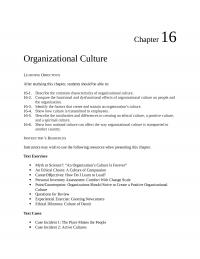
978-0134103983 Chapter 16 Lecture Note Part 1
Chapter 16 Organizational Culture LEARNING OBJECTIVES After studying this chapter, students should be able to: 16-1. Describe the common characteristics of organizational culture. 16-2. Compare the functional and dysfunctional effects of organizational culture on people and the organization. 16-3. Identify […]
978-0134103983 Chapter 15 Solution Manual
Questions for Review 15-1. What are seven key elements to define an organization’s structure? Answer: The seven key elements that define an organization’s structure are: Work specialization Departmentalization Learning Objective: Identify seven elements of an organization’s structure Learning Outcome: Discuss […]
978-0134103983 Chapter 15 Lecture Note Part 4
1. Downsize your organization to realize major cost savings, and focus the company around core competencies—but only if necessary, because downsizing can have a significant negative impact on employee affect. 2. Consider the scarcity, dynamism, and complexity of the environment, […]
978-0134103983 Chapter 15 Lecture Note Part 3
1. Exhibit 15-6 shows a virtual organization in which management outsources all of the primary functions of the business. a. The dotted lines in this exhibit represent those relationships typically maintained under contracts. b. In essence, managers in virtual structures […]
978-0134103983 Chapter 15 Lecture Note Part 2
A. Technology 1. Technology refers to how an organization transfers its inputs into outputs. a. Every organization has at least one technology for converting financial, human, and physical resources into products or services. b. The Chinese consumer electronics company Haier […]
978-0134103983 Chapter 15 Lecture Note Part 1
Chapter 15 Foundations of Organization Structure LEARNING OBJECTIVES After studying this chapter, students should be able to: 15-1.Identify seven elements of an organization’s structure. 15-2.Identify the characteristics of the functional structure, the divisional structure, and the matrix structure. 15-3.Identify the […]
978-0134103983 Chapter 14 Solution Manual
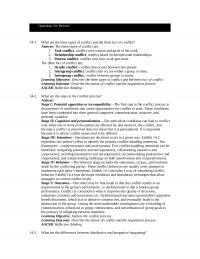
Questions for Review 14-1. What are the three types of conflict and the three loci of conflict? Answer: The three types of conflict are: 1. Task conflict: conflict over content and goals of the work. The three loci of conflict […]
978-0134103983 Chapter 14 Lecture Note Part 3
i. It appears that negotiators in a position of power or equal status who show anger negotiate better outcomes because their anger induces concessions from their opponents. b. Another factor is how genuine your anger is—“faked” anger, or anger produced […]
978-0134103983 Chapter 14 Lecture Note Part 2
a. They are seen as more likely to keep their promises and present information accurately, so others are more willing to accept their promises as part of a bargain. 2. Finally, individuals who have higher reputations are better liked and […]
978-0134103983 Chapter 14 Lecture Note Part 1
Chapter 14 Conflict and Negotiation LEARNING OBJECTIVES) After studying this chapter, students should be able to: 14-1. Describe the three types of conflict and the three loci of conflict. 14-2. Outline the conflict process. 14-3. Contrast distributive and integrative bargaining. […]
978-0134103983 Chapter 13 Solution Manual
Questions for Review 13-1. How is leadership different from power? Answer: Power refers to a capacity that A has to influence the behavior of B, so that B acts in accordance with A’s wishes. Power may exist but not be […]
978-0134103983 Chapter 13 Lecture Note Part 3
A. How Do People Respond to Organizational Politics? 1. For most people—who have modest political skills or are unwilling to play the politics game—outcomes tend to be predominantly negative. a. Exhibit 13-4 summarizes the extensive research on the relationship between […]
978-0134103983 Chapter 13 Lecture Note Part 2
A. To decide not to play is deciding not to be effective. B. Better to be explicit about it with a political map than to proceed as if power and politics didn’t matter. II. Summary and Implications for Managers A. […]
978-0134103983 Chapter 13 Lecture Note Part 1
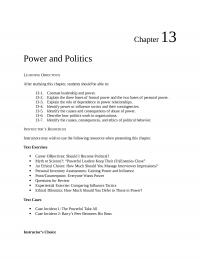
Chapter 13 Power and Politics LEARNING OBJECTIVES After studying this chapter, students should be able to: 13-1. Contrast leadership and power. 13-2. Explain the three bases of formal power and the two bases of personal power. 13-3. Explain the role […]
978-0134103983 Chapter 12 Lecture Note Part 3
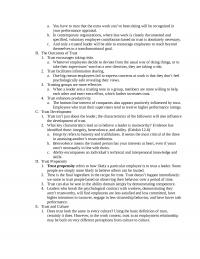
a. You have to trust that the extra work you’ve been doing will be recognized in your performance appraisal. b. In contemporary organizations, where less work is closely documented and specified, voluntary employee contribution based on trust is absolutely necessary. […]
978-0134103983 Chapter 12 Lecture Note Part 1
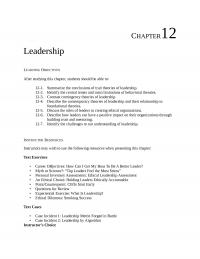
CHAPTER12 Leadership LEARNING OBJECTIVES After studying this chapter, students should be able to: 12-1. Summarize the conclusions of trait theories of leadership. 12-2. Identify the central tenets and main limitations of behavioral theories. 12-3. Contrast contingency theories of leadership. 12-4. […]
978-0134103983 Chapter 11 Solution Manual
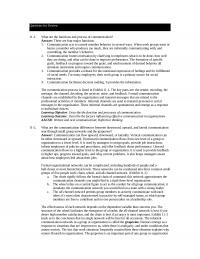
Questions for Review 11-1. What are the functions and process of communication? Answer: There are four major functions. 1. Communication acts to control member behavior in several ways. When work groups tease or 2. Communication fosters motivation by clarifying to […]
978-0134103983 Chapter 11 Lecture Note Part 3
a. individuals telling considerably more. b. Compounded across a large organization, this is an enormous amount of deception happening every single day! 2. Evidence also shows that people are more comfortable lying over the phone than face-to-face and more comfortable […]
978-0134103983 Chapter 11 Lecture Note Part 2
A. Distortions, ambiguities, and incongruities between verbal and nonverbal messages all increase uncertainty and reduce satisfaction. Careful attention to the methods and modes for each communication better ensures that the message is properly interpreted by the receiver. Specific implications for […]
978-0134103983 Chapter 11 Lecture Note Part 1
Chapter 11 Communication LEARNING OBJECTIVES After studying this chapter, students should be able to: 11-1. Describe the functions and process of communication. 11-2. Contrast downward, upward, and lateral communication through small-group networks and the grapevine. 11-3. Contrast oral, written, and […]
978-0134103983 Chapter 10 Solution Manual
Questions for Review 10-1. How do you explain the growing popularity of teams in organizations? Answer: Although teams are not always effective they have become popular. Some of the reasons include: a. Teams are a great way to use employee […]
978-0134103983 Chapter 10 Lecture Note Part 3
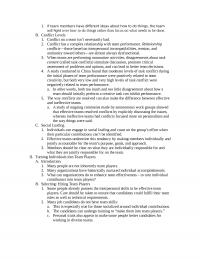
1. If team members have different ideas about how to do things, the team will fight over how to do things rather than focus on what needs to be done. B. Conflict Levels 1. Conflict on a team isn’t necessarily […]
978-0134103983 Chapter 10 Lecture Note Part 2
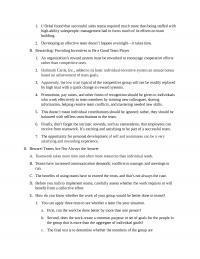
1. L’Oréal found that successful sales teams required much more than being staffed with high-ability salespeople: management had to focus much of its efforts on team building. 2. Developing an effective team doesn’t happen overnight—it takes time. B. Rewarding: Providing […]
978-0134103983 Chapter 10 Lecture Note Part 1
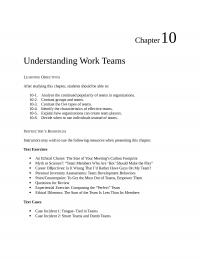
Chapter 10 Understanding Work Teams LEARNING OBJECTIVES After studying this chapter, students should be able to: 10-1. Analyze the continued popularity of teams in organizations. 10-2. Contrast groups and teams. 10-3. Contrast the five types of teams. 10-4. Identify the […]
978-0134103983 Chapter 9 Solution Manual Part 2
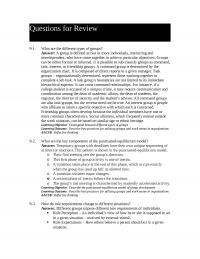
Questions for Review 9-1. What are the different types of groups? Answer: A group is defined as two or more individuals, interacting and interdependent, who have come together to achieve particular objectives. Groups can be either formal or informal. It […]
978-0134103983 Chapter 9 Solution Manual Part 1
Teaching Notes When students have finished, select a group to share the results of their discussion. Ask other groups how their results compare or contrast to that group’s. This exercise is applicable to face-to-face classes or synchronous online classes such […]
978-0134103983 Chapter 9 Lecture Note Part 3
a. Research on faultlines has shown that splits such as these are generally detrimental to group functioning and performance. b. Overall, although research on faultlines suggests that diversity in groups is a potential double-edged sword, recent work indicates they can […]
978-0134103983 Chapter 9 Lecture Note Part 2
a. Groups that are more focused on performance than learning are especially likely to fall victim to groupthink and to suppress the opinions of those who do not agree with the majority. b. Does groupthink attack all groups? No. It […]
978-0134103983 Chapter 9 Lecture Note Part 1
CHAPTER 9 Foundations of Group Behavior LEARNING OBJECTIVES After studying this chapter, students should be able to: 9-1. Distinguish between the different types of groups. 9-2. Describe the punctuated-equilibrium model of group development. 9-3. Show how role requirements change in […]
978-0134103983 Chapter 8 Solution Manual
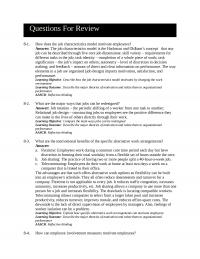
Questions For Review 8-1. How does the job characteristics model motivate employees? Answer: The job characteristics model is the Hackman and Oldham’s concept that any job can be described through five core job dimensions: skill variety – requirements for Learning […]
978-0134103983 Chapter 8 Lecture Note Part 3
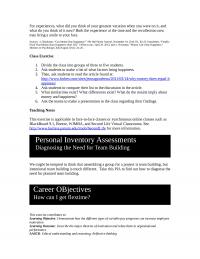
For experiences, what did you think of your greatest vacation when you were on it, and what do you think of it now? Both the experience at the time and the recollection now may bring a smile to your face. […]
978-0134103983 Chapter 8 Lecture Note Part 2
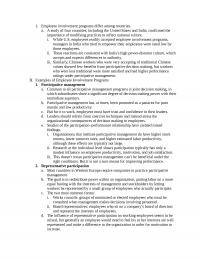
1. Employee involvement programs differ among countries. a. A study of four countries, including the United States and India, confirmed the importance of modifying practices to reflect national culture. i. While U.S. employees readily accepted employee involvement programs, managers in […]
978-0134103983 Chapter 8 Lecture Note Part 1
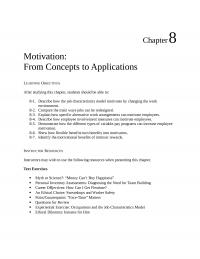
Chapter 8 Motivation: From Concepts to Applications LEARNING OBJECTIVES After studying this chapter, students should be able to: 8-1. Describe how the job characteristics model motivates by changing the work environment. 8-2. Compare the main ways jobs can be redesigned. […]
978-0134103983 Chapter 7 Solution Manual
Questions for Review 7-1. What are the three key elements of motivation? Answer: Motivation is the processes that account for an individual’s intensity, direction, and persistence of effort toward attaining a goal – specifically, an Learning Objective: Describe the three […]
978-0134103983 Chapter 7 Lecture Note Part 3
i. If outcomes are favorable and individuals get what they want, they care less about the process, so procedural justice doesn’t matter as much when distributions are perceived to be fair. b. Informational Justice. Research has shown that employees care […]
978-0134103983 Chapter 7 Lecture Note Part 2
I. Integrating Contemporary Motivation Theories A. Exhibit 7-9 integrates much of what we know about motivation. Its basic foundation is the expectancy model. B. Expectancy theory predicts that an employee will exert a high level of effort if he/she perceives […]
978-0134103983 Chapter 7 Lecture Note Part 1
Chapter 7 Motivation Concepts LEARNING OBJECTIVES After studying this chapter, students should be able to: 7-1. Describe the three key elements of motivation. 7-2. Compare the early theories of motivation. 7-3. Contrast the elements of self-determination theory and goal-setting theory. […]
978-0134103983 Chapter 6 Solution Manual
Questions for Review 6-1. What are the factors that influence our perception? Answer: Perception is a process by which individuals organize and interpret their sensory impressions in order to give meaning to their environment. What one perceives Learning Objective: Explain […]
978-0134103983 Chapter 6 Lecture Note Part 3
a. An emphasis on rights in decision making means respecting and protecting the basic rights of individuals, such as the right to privacy, free speech, and due process. b. Focus on justice—requires individuals to impose and enforce rules fairly and […]
978-0134103983 Chapter 6 Lecture Note Part 2
a. Idea generation: once we have collected the relevant information, it is time to translate that knowledge into ideas. i. Idea generation: the process of creative behavior in which we develop possible solutions to a problem from relevant information and […]
978-0134103983 Chapter 6 Lecture Note Part 1
CHAPTER 6 Perception and Individual Decision Making LEARNING OBJECTIVES After studying this chapter, your students should be able to: 6-1. Explain the factors that influence perception. 6-2. Describe attribution theory. 6-3. Explain the link between perception and decision making. 6-4. […]
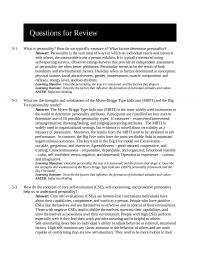
978-0134103983 Chapter 5 Solution Manual
Questions for Review 5-1. What is personality? How do we typically measure it? What factors determine personality? Answer: Personality is the sum total of ways in which an individual reacts and interacts with others, the measurable traits a person exhibits. […]
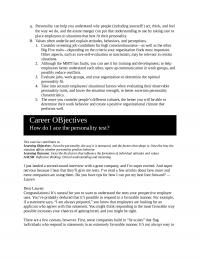
978-0134103983 Chapter 5 Lecture Note Part 3
A. Personality can help you understand why people (including yourself!) act, think, and feel the way we do, and the astute manger can put that understanding to use by taking care to place employees in situations that best fit their […]
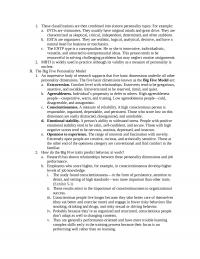
978-0134103983 Chapter 5 Lecture Note Part 2
1. These classifications are then combined into sixteen personality types. For example: a. INTJs are visionaries. They usually have original minds and great drive. They are characterized as skeptical, critical, independent, determined, and often stubborn. b. ESTJs are organizers. They […]
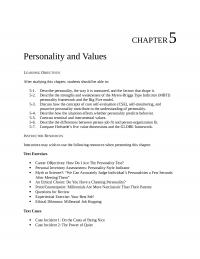
978-0134103983 Chapter 5 Lecture Note Part 1
CHAPTER 5 Personality and Values LEARNING OBJECTIVES After studying this chapter, students should be able to: 5-1. Describe personality, the way it is measured, and the factors that shape it. 5-2. Describe the strengths and weaknesses of the Myers-Briggs Type […]
978-0134103983 Chapter 4 Solution Manual
Questions for Review 4-1. How are emotions different from moods? Answer: Emotions are intense feelings directed at someone or something. Moods are feelings that tend to be less intense than emotions and often lack a contextual stimulus. Learning Objective: Differentiate […]
978-0134103983 Chapter 4 Lecture Note Part 3
Myth or Science? “Smile, and the Work World Smiles with You” This exercise contributes to: Learning Objective: Differentiate between emotions and moods Learning Outcome: Discuss the importance of individual moods and emotions in the workplace AACSB: Written and oral communications; […]