Archives: Solution Manual
978-0134129945 Chapter 13 Lecture Note Part 1
CHAPTER 13 GLOBAL MARKETING COMMUNICATIONS DECISION I: ADVERTISING AND PUBLIC RELATIONS SUMMARY A. Marketing communications—the promotion P of the marketing mix— includes advertising, public relations, sales promotion, and personal selling. When a company embraces integrated marketing communications (IMC), it recognizes […]
978-0134129945 Chapter 12 Solution Manual
DISCUSSION QUESTIONS 12-1. In what ways can channel intermediaries create utility for buyers? The major categories of channel utility are: place utility (the availability of a product or service in a location that is convenient to a potential customer), 12-2. […]
978-0134129945 Chapter 12 Lecture Note Part 2
PHYSICAL DISTRIBUTION, SUPPLY CHAINS, and LOGISTICS MANAGEMENT √ (Learning Objective #4) In Chapter 1, marketing was described as one of the activities in a firm’s value chain. The distribution P of the marketing mix is a critical value chain activity. […]
978-0134129945 Chapter 12 Lecture Note Part 1
CHAPTER 12 GLOBAL MARKETING CHANNELS AND PHYSICAL DISTRIBUTION SUMMARY A. A channel of distribution is the network of agencies and institutions that links producers with users. Physical distribution is the movement of goods through channels. Business –to-consumer marketing uses consumer […]
978-0134129945 Chapter 11 Solution Manual
DISCUSSION QUESTIONS 11-1. What are the basic factors that affect price in any market? What considerations enter into the pricing decision? One factor is the price floor, which can be linked to product cost or some other consideration. For example, […]
978-0134129945 Chapter 11 Lecture Note Part 2
GLOBAL PRICING: THREE POLICY ALTERNATIVES √ (Learning Objective #5) There are three alternative positions a company can take on worldwide pricing. Extension or Ethnocentric The first can be called an extension or ethnocentric pricing policy. An extension or ethnocentric pricing […]
978-0134129945 Chapter 11 Lecture Note Part 1
CHAPTER 11 PRICING DECISIONS SUMMARY A. Pricing decisions are a critical element of the marketing mix that must reflect costs, competitive factors, and customer perceptions regarding value of the product. In a true global market, the law of one price […]
978-0134129945 Chapter 10 Solution Manual
DISCUSSION QUESTIONS 10-1. What is the difference between a product and a brand? A product can be defined as a collection of tangible and intangible attributes. The former include physical features, design attributes, and packaging. The chrome on a Harley- […]
978-0134129945 Chapter 10 Lecture Note Part 2
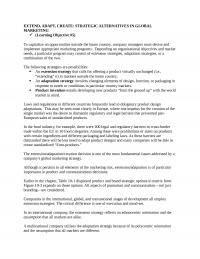
EXTEND, ADAPT, CREATE: STRATEGIC ALTERNATIVES IN GLOBAL MARKETING (Learning Objective #5) To capitalize on opportunities outside the home country, company managers must devise and implement appropriate marketing programs. Depending on organizational objectives and market needs, a particular program may consist […]
978-0134129945 Chapter 10 Lecture Note Part 1
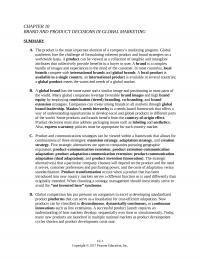
CHAPTER 10 BRAND AND PRODUCT DECISIONS IN GLOBAL MARKETING SUMMARY A. The product is the most important element of a company’s marketing program. Global marketers face the challenge of formulating coherent product and brand strategies on a worldwide basis. A […]
978-0134129945 Chapter 9 Solution Manual
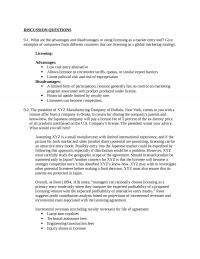
DISCUSSION QUESTIONS 9-1. What are the advantages and disadvantages or using licensing as a market entry tool? Give examples of companies from different countries that use licensing as a global marketing strategy. Licensing: Advantages: Disadvantages: A limited form of participation; […]
978-0134129945 Chapter 9 Lecture Note Part 2
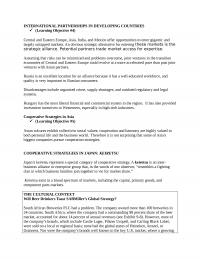
INTERNATIONAL PARTNERSHIPS IN DEVELOPING COUNTRIES (Learning Objective #4) Central and Eastern Europe, Asia, India, and Mexico offer opportunities to enter gigantic and largely untapped markets. An obvious strategic alternative for entering these markets is the strategic alliance. Potential partners trade […]
978-0134129945 Chapter 9 Lecture Note Part 1
CHAPTER 9 GLOBAL MARKET ENTRY STRATEGIES: LICENSING, INVESTMENT, AND STRATEGIC ALLIANCES SUMMARY A. Companies that wish to move beyond exporting and importing can avail themselves of a wide range of alternative market entry strategies. Each alternative has distinct advantages and […]
978-0134129945 Chapter 8 Solution Manual
DISCUSSION QUESTIONS 8-1. What is the difference between export marketing and export selling? Export selling basically presents an extension strategy whereby products are offered for sale outside the home country without adaptation. The mindset of export selling is, 8-2. Describe […]
978-0134129945 Chapter 8 Lecture Note Part 2
KEY EXPORT PARTICIPANTS (Learning Objective #5) Export participants include: purchasing agents, export brokers, and export merchants, who have no assignment of responsibility. Others, including export management companies, manufacturers’ export representatives, export distributors, and freight forwarders, are assigned responsibilities by the […]
978-0134129945 Chapter 8 Lecture Note Part 1
CHAPTER 8 IMPORTING, EXPORTING, AND SOURCING SUMMARY A. A company’s first business dealings outside the home country often take the form of exporting or importing. Companies should recognize the difference between export marketing and export selling. By attending trade shows […]
978-0134129945 Chapter 7 Solution Manual
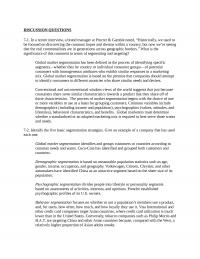
DISCUSSION QUESTIONS 7-1. In a recent interview, a brand manager at Procter & Gamble noted, “Historically, we used to be focused on discovering the common hopes and dreams within a country, but now we’re seeing that the real commonalities are […]
978-0134129945 Chapter 7 Lecture Note Part 2
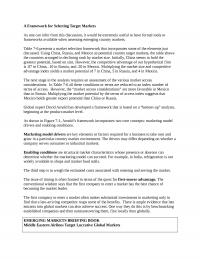
A Framework for Selecting Target Markets As one can infer from this discussion, it would be extremely useful to have formal tools or frameworks available when assessing emerging country markets. Table 7-6 presents a market selection framework that incorporates some […]
978-0134129945 Chapter 7 Lecture Note Part 1
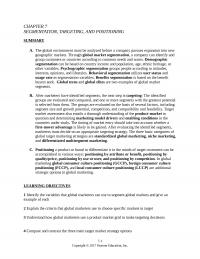
CHAPTER 7 SEGMENTATION, TARGETING, AND POSITIONING SUMMARY A. The global environment must be analyzed before a company pursues expansion into new geographic markets. Through global market segmentation, a company can identify and group customers or countries according to common needs […]
978-0134129945 Chapter 6 Solution Manual
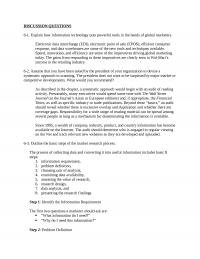
DISCUSSION QUESTIONS 6-1. Explain how information technology puts powerful tools in the hands of global marketers. Electronic data interchange (EDI), electronic point of sale (EPOS), efficient consumer response, and data warehouses are some of the new tools and techniques available. […]
978-0134129945 Chapter 6 Lecture Note Part 2
Issues in Data Collection The research problem may be more narrowly focused on marketing issues, such as the need to adapt products and other mix elements to local tastes and to assess demand and profit potential. Existing markets are those […]
978-0134129945 Chapter 6 Lecture Note Part 1
CHAPTER 6 GLOBAL INFORMATION SYSTEMS AND MARKET RESEARCH SUMMARY A. Information is one of the most basic ingredients of a successful marketing strategy. A company’s management information system (MIS) and intranet provides decision makers with a continuous flow of information. […]
978-0134129945 Chapter 5 Solution Manual
DISCUSSION QUESTIONS 5-1. Describe some of the sources of political risk. Specifically, what forms can political risk take? Political risk increases when a country experiences a currency crisis, when there is civil 5-2. Global marketers can avoid legal conflicts by […]
978-0134129945 Chapter 5 Lecture Note Part 2
Innovation, Entrepreneurship, and the Global Startup Travis Kalanick and Uber Travis Kalanick is an entrepreneur. He developed an innovative product, created a brand, and started a company to market it. As is true with many entrepreneurs, Kalanick’s idea was based […]
978-0134129945 Chapter 5 Lecture Note Part 1
CHAPTER 5 THE POLITICAL, LEGAL, AND REGULATORY ENVIRONMENTS SUMMARY A. The political environment of global marketing is the set of governmental institutions, political parties, and organizations that are the expression of the people in the nations of the world. In […]
978-0134129945 Chapter 4 Solution Manual
DISCUSSION QUESTIONS 4-1. What are some of the elements that make up culture? How do these find expression in your native culture? This question can be especially interesting if there is multicultural representation among your students. Ask students from other […]
978-0134129945 Chapter 4 Lecture Note Part 2
THE SELF-REFERENCE CRITERION √ (Learning Objective #4) A person’s perception of market needs is framed by his or her own cultural experience. A framework for reducing perceptual blockage and distortion was developed by James Lee. The unconscious reference to one’s […]
978-0134129945 Chapter 4 Lecture Note Part 1
CHAPTER 4 SOCIAL AND CULTURAL ENVIRONMENTS SUMMARY A. Culture, a society’s “programming of the mind,” has both a pervasive and changing influence on each national market environment. Global marketers must recognize the influence of culture and be prepared to either […]
978-0134129945 Chapter 3 Solution Manual
DISCUSSION QUESTIONS 3-1. Explain the role of the World Trade Organization. Why has the Doha Round of trade talks stalled? The World Trade Organization (WTO) is the successor to GATT. Based in Geneva, the WTO has a dispute-settlement body (DSB), […]
978-0134129945 Chapter 3 Lecture Note Part 2
ASIA-PACIFIC: The Association of Southeast Asian Nations (ASEAN) (Learning Objective #5) The Association of Southeast Asian Nations (ASEAN) was established in 1967 as an organization for economic, political, social, and cultural cooperation among its member countries. The original six members […]
978-0134129945 Chapter 3 Lecture Note Part 1
CHAPTER 3 THE GLOBAL TRADE ENVIRONMENT SUMMARY A. This chapter examines the environment for world trade, focusing on the institutions and regional cooperation agreements that affect trade patterns. B. The multilateral World Trade Organization, created in 1995 as the successor […]
978-0134129945 Chapter 2 Solution Manual
DISCUSSION QUESTIONS 2-1. The seven criteria for describing a nation’s economy introduced at the beginning of this chapter can be combined in a number of different ways. For example, the United States can be characterized as follows: Type of economy: […]
978-0134129945 Chapter 2 Lecture Note Part 2
Marketing Opportunities in LDCs and Developing Countries Despite many problems in LDCs and developing countries, it is possible to nurture long-term market opportunities. Although Nike sells only a small portion of its output in China, it clearly has the future […]
978-0134129945 Chapter 2 Lecture Note Part 1
CHAPTER 2 THE GLOBAL ECONOMIC ENVIRONMENT SUMMARY A. The economic environment is a major determinant of global market potential and opportunity. In today’s global economy, capital movements are the driving force, production is uncoupled from employment, and capitalism has vanquished […]
978-0134129945 Chapter 1 Solution Manual
DISCUSSION QUESTIONS 1-1. What are the basic goals of marketing? Are these goals relevant to global marketing? Marketing activities represent an organization’s efforts to satisfy customer wants and needs by offering products and services that create value. These goals are […]
978-0134129945 Chapter 1 Lecture Note Part 3
TEACHING TOOLS AND EXERCISES Additional Cases: “GENICON: A Surgical Strike into Emerging Markets” by Allen H. Kupetz; Adam P. Tindall; Gary Haberland. June 2010, HBS: 910M41-PDF-ENG. “Market Stretch” by Gavin Price and Margaret Sutherland. June 2009. HBS: 909M46-PDF- ENG. “Global […]
978-0134129945 Chapter 1 Lecture Note Part 2
Management Orientations (Learning Objective #5) The form and substance of a company’s response to global market opportunities will depend greatly on its management’s assumptions and beliefs – both conscious and unconscious – about the nature of the world. The world […]
978-0134129945 Chapter 1 Lecture Note Part 1
CHAPTER 1 INTRODUCTION TO GLOBAL MARKETING SUMMARY A. Marketing is an organizational function and a set of processes for creating, communicating, and delivering value to customers and for managing customer relationships in ways that benefit the organization and its stakeholders. […]
978-0134103983 Chapter 20 Lecture Note
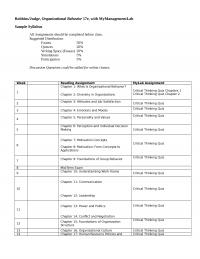
Robbins/Judge, Organizational Behavior 17e, with MyManagementLab Sample Syllabus All Assignments should be completed before class. Suggested Distribution: Exams 50% Quizzes 20% Writing Space (Essays) 20% Simulations 5% Participation 5% Discussion Questions could be added for online classes. Week Reading Assignment […]
978-0134103983 Chapter 19 Lecture Note
Introduction Welcome to the Instructor’s Manual for the seventeenth edition of Organizational Behavior! Long considered the standard for all organizational behavior textbooks, this edition continues its tradition of making current, relevant research come alive for students. While maintaining its hallmark […]
978-0134103983 Chapter 18 Solution Manual
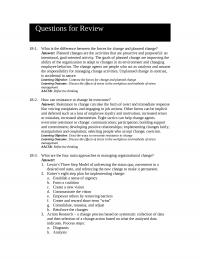
Questions for Review 18-1. What is the difference between the forces for change and planned change? Answer: Planned changes are the activities that are proactive and purposeful: an intentional, goal-oriented activity. The goals of planned change are improving the Learning […]
978-0134103983 Chapter 18 Lecture Note Part 4
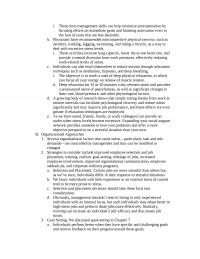
i. These time-management skills can help minimize procrastination by focusing efforts on immediate goals and boosting motivation even in the face of tasks that are less desirable. b. Physicians have recommended noncompetitive physical exercise, such as aerobics, walking, jogging, swimming, […]
978-0134103983 Chapter 18 Lecture Note Part 3
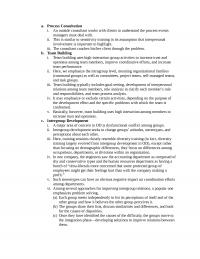
a. Process Consultation i. An outside consultant works with clients to understand the process events managers must deal with. ii. This is similar to sensitivity training in its assumption that interpersonal involvement is important to highlight. iii. The consultant coaches […]
978-0134103983 Chapter 18 Lecture Note Part 2
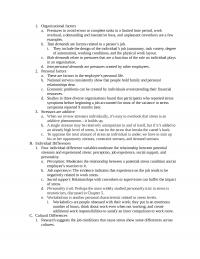
1. Organizational factors a. Pressures to avoid errors or complete tasks in a limited time period, work overload, a demanding and insensitive boss, and unpleasant coworkers are a few examples. b. Task demands are factors related to a person’s job. […]
978-0134103983 Chapter 18 Lecture Note Part 1
Chapter 18 Organizational Change and Stress Management LEARNING OBJECTIVES After studying this chapter, students should be able to: 18-1. Contrast the forces for change and planned change. 18-2. Describe ways to overcome resistance to change. 18-3. Compare the four main […]
978-0134103983 Chapter 17 Solution Manual
Questions for Review 17-1. What is the value of various recruitment methods? Answer: Strategic recruiting has become a cornerstone for many companies. Some of the most effective recruiting techniques include internal referrals, Learning Objective: Describe the value of recruitment methods […]
978-0134103983 Chapter 17 Lecture Note Part 4
1. culture, reflect the values of the organization, demonstrate economic feasibility, and be sustainable in the long term. a. Such benefits will likely improve employees’ psychological well-being and therefore increase organizational performance. B. Drafting and Enforcing Employment Policies 1. Employment […]
978-0134103983 Chapter 17 Lecture Note Part 3
a. They can conduct medical exams after making a contingent offer, to determine whether an applicant is physically or mentally able to do the job. II. Training and Development Programs A. Introduction 1. Skills deteriorate and can become obsolete. 2. […]
978-0134103983 Chapter 17 Lecture Note Part 2
(a) schools. ii. The individual ranking approach rank-orders employees from best to worst. (a) This approach assumes that the difference between the first and second employee is the same as that between the twenty-first and twenty-second. (b) This approach allows […]
978-0134103983 Chapter 17 Lecture Note Part 1
Chapter 17 Human Resource Policies and Practices LEARNING OBJECTIVES After studying this chapter, students should be able to: 17-1. Describe the value of recruitment methods. 17-2. Specify initial selection methods. 17-3. Identify the most useful substantive selection methods. 17-4. Compare […]